Monday, January 21, 2013

Physics Is Fun?

I've posted something on this topic before, and I'll continue to do it. I always like to highlight classes and/or teachers that go beyond what they have been asked to do and try to make a physics lesson more interesting and more engaging to the students. This is one such example.

Montgomery's physics class is certainly not what one would think of as a traditional classroom.

Yes, there are lectures. Yes, there is homework. But there's also a lot more that this group of seniors gets to experience.

"The fun thing about older kids, they're still kids," she said. "They just want to play."

I also like the observation that she had on her students.


The hands-on activities help students relate to what they are studying. But even that doesn't always make it easy.

"They still struggle. When you go to paper and pencil, it helps that they have that interest. But they have to apply the math," she said. "Physics is hard."

In the past, almost no one took physics at the high school level. Until the State of Ohio stepped in and gave it a boost.

"They made it so you have to have physics to get an honors diploma. Our numbers practically doubled after that," she said. "They might not be excited to take it, but they find something about it that is interesting to them."

Being that the class is generally made up of some of the brightest students in the senior class, Montgomery said the students don't always deal well with struggling to understand the difficult subject matter.

"They still think that because they're good at everything else, they expect to get every question right the first time," she said. "I still have to go back and look at questions more than once sometimes."
As we all had to do if we're in education.

Zz.

Sunday, January 20, 2013

So I Am Your Intro Physics Instructor

{I wrote an essay on what I would say to my student if I were his/her academic advisor. Since this is the beginning of the semester for many schools (or the beginning of the school year in parts of the world), I thought it would be appropriate for me to "publish" another "speech". This time, I'm directing it to a class of  intro physics students.}


Dear Students,

Welcome to the intro physics course. For many of you, this is your first college level physics course that you are taking. Hopefully, it will lay the foundation for the rest of your undergraduate education and becomes something that you will find useful.

I would like to let you know of some of my expectations from you, and would like to let you know of what you can expect from me. I know that many of you are taking this course because you have to, not because you want to. I am also aware that the majority of you are not physics majors. However, I hope to impress upon you why you would want to do well in this class. Besides the fact that it will affect your overall GPA, I want to make you aware that there are a lot of things you can learn and acquire from this class that will be very useful to you not only in your academic pursuit, but also in other parts of your life later on.

The most important point I want to make is this: while the material that we will be covering is important for you to understand to do well in this class, what is equally important is the ability in analyzing a problem that you are faced with, and figuring out how to systematically solve it. I want you to pay attention not only to the content of the course, but also to how I approach a problem and how I go about solving it. I will try to teach you the physics and also the problem-solving technique. I will try, as best as I can, describe to you what I'm thinking when I look at a problem, and how I analyze it to know what to start with and how to proceed.

Keep in mind that while this is something that I can attempt to teach you, it really is a skill that you can only acquire after repeated practice. It is very much like learning how to ride a bike. I can tell you what to do, but you'll never gain the skill to ride a bike until you have practiced several times, and taken a tumble here and there. The homework that you will have to do is meant to be your vehicle to practice on to acquire such skill.

At some point, you may question why we are studying certain things, or why we are trying to tackle a certain type of problem. One example that I can bring up is the projectile motion that you will see and have to solve till you're sick of it. You may find it strange that we are asking you to solve various configurations of the projectile motion problem. Are we trying to train you to be an artillery person? No.

You see, I could teach you that F=ma and then walk away. There. We've covered a huge section of our semester already. Now, go use that to build me a house. Chances are, you can't. What you've received is only a superficial knowledge. You may know the relationship between F, m, and a, but you don't understand how it is used or how it can be applied. Knowing how to do that will give you knowledge beyond the superficial level. So we try to apply F=ma in a number of examples. Unfortunately, the examples that we can use that are simple enough are limited. We can't exactly apply all the real-life conditions to an example because it will them make the problem too complex, and you will be thoroughly confused. You will be distracted by the complexity and lose the focus on how F=ma is applied. So we have to deal with simplified examples on how we use F=ma, and this is where examples of projectile motion, motion of objects sliding on inclined planes, etc.. come in. We are not trying to turn in you experts in artillery or building a slide. You should not be focusing on the nature of the example. You should be focusing on the aim of these examples, i.e. how F=ma is applied.

Now, because I want you to understand both the material and the technique, you should not hesitate to ask me questions if you do not understand anything. This is especially true if you do not understand why, in solving a problem, I would do such-and-such, or how I know to start with such-and-such if it is not obvious to you. It is important that you make sure you understand things every step of the way, because we will be building on you learn early in the semester and apply it to more complex situations later on. If you start with a shaky foundation, you will not be able to master the material that you will be faced with later in the semester. So please, ask me questions in class, or come to my office hours. I have been paid to serve you and impart knowledge and skills. Make use of this opportunity.

My last advice to you here is that the process of learning is a very private, internal activity. While you have your texts, your notes, your instructor, etc. to help you, in the end, it is YOU who have to make the effort to acquire such knowledge and skills. It must sink in for you. At some point, you have to figure things out for yourself. It means that you need to understand things on your own, and be able to do your own thinking. You have to figure our how you understand things and what you need to do to get something.

And this is where this physics course can be of a tremendous value to you, not just for your future academic pursuit, but in your later life. To put it bluntly, you will consciously learn how to think and how to analyze a problem. You will learn to what degree you can say that A causes B, and how can you figure out what affects what. This ability transcends a physics class and will be extremely useful to you as you become a responsible citizen.

I hope you have a productive and enjoyable time in this class. Now let's get to work.

Zz.

Thursday, January 17, 2013

"Quantum Information And Randomness"

If you haven't come across this yet, don't miss it. This is a very good review of what is essentially the most comment topic in Quantum Mechanics - randomness that is inherent in the standard interpretation of QM. The co-author of this article is Anton Zeilinger, so you are getting some of considerable authority on the subject. The review on the Bell-type experiments are excellent - pay attention to why this doesn't violate SR.

Zz.

Wednesday, January 16, 2013

"How many dominoes does one need to topple a domino as tall as the Domtoren?"

Supposedly, that was a question in a 2012 Dutch Science Quiz.

Anyone who has followed this blog for any considerable period of time would know that I love reading and studying about mundane phenomena and physics, and this one qualifies as one. PhysicsWorld is reporting a study appearing on ArXiv recently to answer that very question.

The Domtoren is a 112-m-tall cathedral tower in Utrecht and the idea is to begin with a standard-sized domino, which topples a larger domino. This then topples an even larger domino and so on until a Domtoren-sized domino can be felled. The process is called "domino multiplication" because a tiny tap on the first domino can, in principle, topple a huge monolith. Now, Van Leeuwen has calculated the upper limit on how much larger each successive domino can be. In principle, his calculations suggest that the maximum ratio of successive domino heights can be about 30% larger than the widely accepted value of 1.5. 

Of course, he had to make some simplification to his model:


But in the real world not all that energy is channelled into bringing down the next domino in line. First off, the dominoes bounce a little as they strike one another. Next, they have a tendency to slip along the surface they are stood on as they are nudged, lessening the chance of a fall or causing them to fall back towards the striking domino. And finally, once in contact, they drag against one another as they fall.

In his model, Van Leeuwen simplifies the situation by assuming that the collisions are completely inelastic, that the friction between the dominoes and the surface they stand on is infinite, and that the dominoes, once touching, experience zero friction and simply slide over one another. 

And of course, there's a video demo, but it isn't related to this particular preprint:


Fun!

Zz.

Tuesday, January 15, 2013

Misconception of the Heisenberg Uncertainty Principle - The Video

Back in 2006, I wrote an entry on the misconception of the Heisenberg Uncertainty Principle. I used light going through a single slit to illustrate what the HUP really is.

Now, I've found a video illustrating JUST THAT!


I hope that with the video, what I was trying to explain is even clearer than before.

Zz.

Monday, January 14, 2013

The "Brian Cox Effect" In The UK

I've heard about this from last year where the enrollment in physics degrees in the UK has seen a significant surge, but this one kinda reinforce it.

Manchester University is the first in the country to require students to gain two elite A* grades – alongside an A – at A-level to get onto its physics degrees.

It represents the highest entry threshold for any physics course in Britain, including those run by Oxford, Cambridge, Durham and Imperial College London. It is among only a handful of degrees in any subject nationally to demand two A*s.

Manchester has always been a popular choice for physics but the university admitted that a recent rise in applications had been partially driven by the attraction of Prof Cox, one of the department’s academics and presenter of television series such as Stargazing Live and Wonders of the Universe.
The news report went on to also include the LHC/search for the Higgs as also being partly responsible for the sudden popularity of physics.

I hope this is all good. Like I have said before, physics is too difficult to do for the wrong reasons. I hope that the LHC and Brian Cox are providing inspiration and new pathways that many students just simply didn't think of before, rather than just being enamored by the "celebrity" and "sexy news of the day".

Zz.

Saturday, January 12, 2013

Physics And Sports

I've had many posts on here on how physics is applied to sports. This video presents a lecture on the relationship between physics (classical mechanics) and sports/games. It appears that this was given just before last year's London Olympics.


Zz.

Friday, January 11, 2013

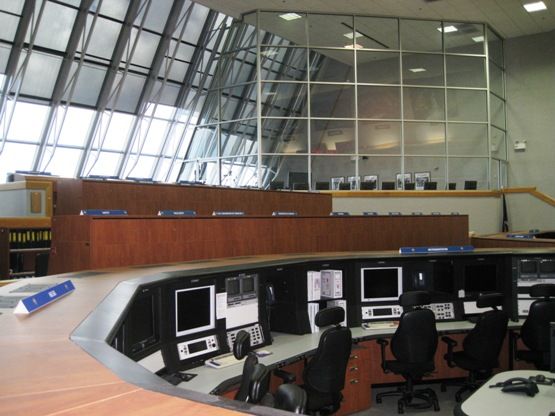
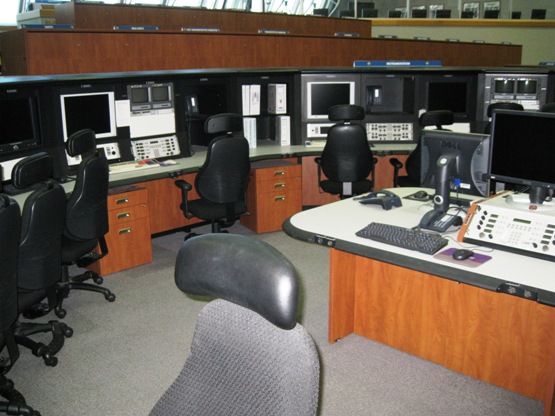
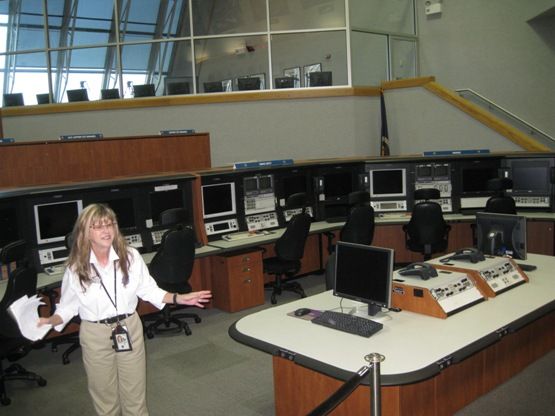
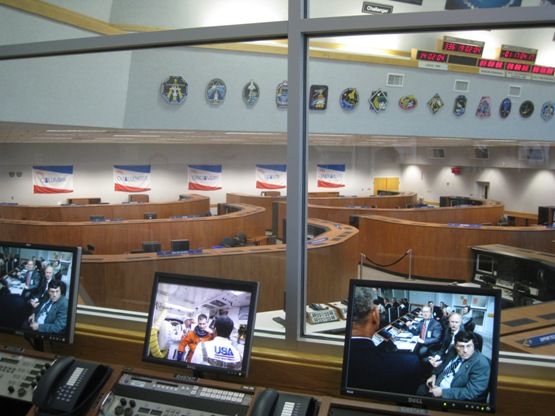
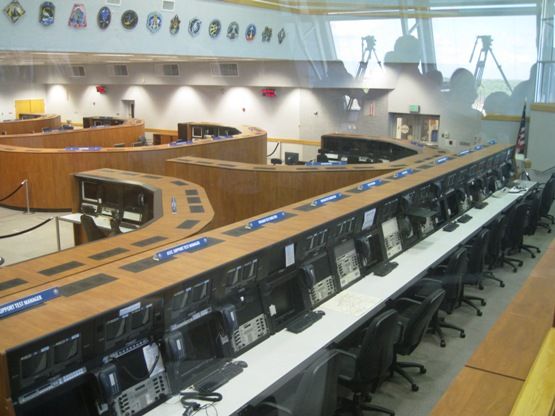
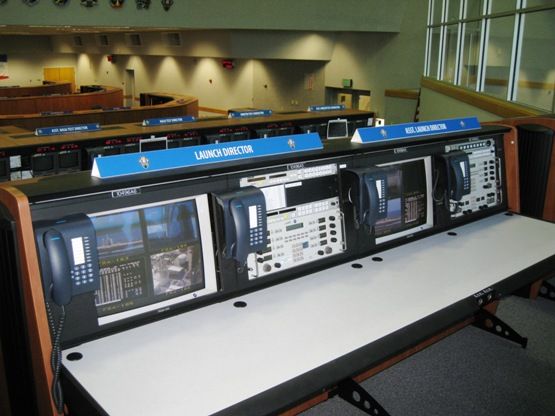
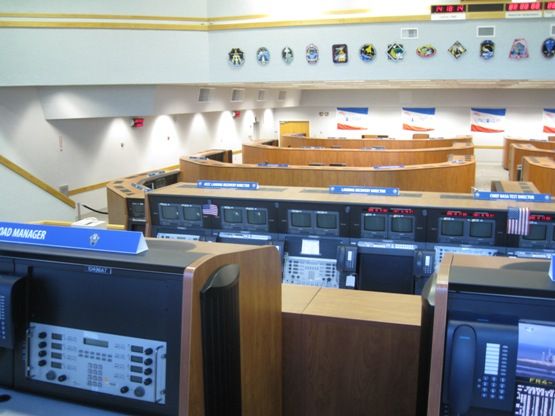
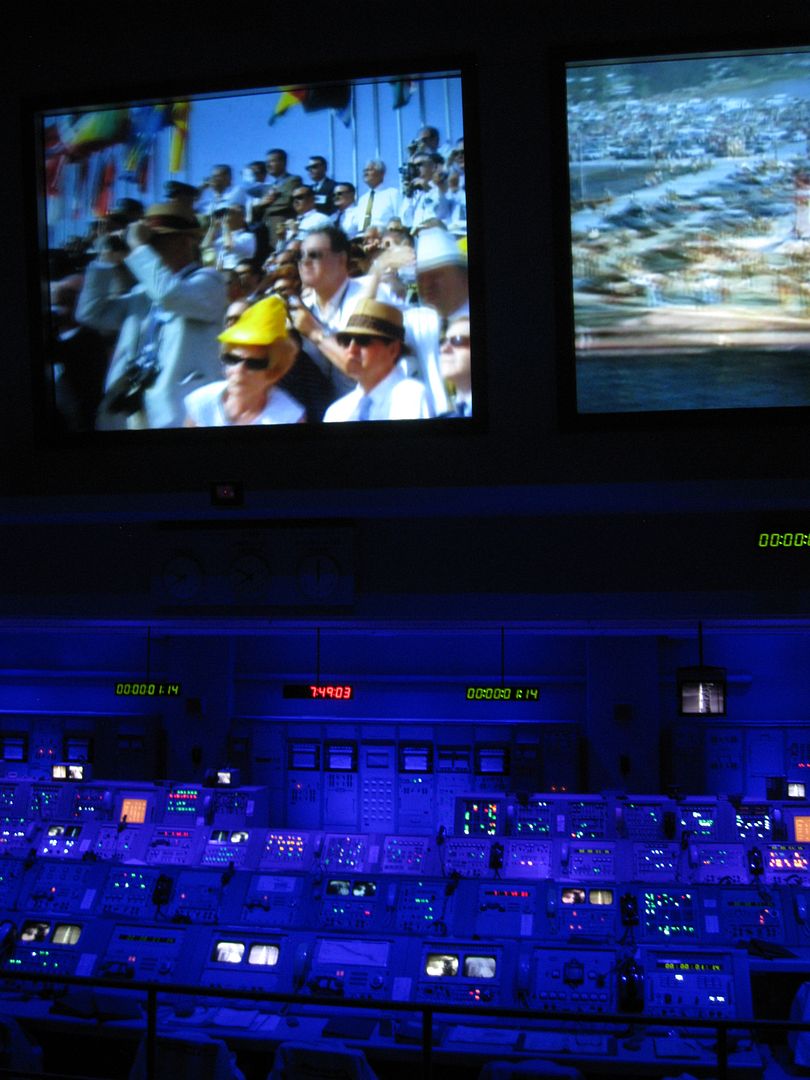
Video of the Launch Control Center

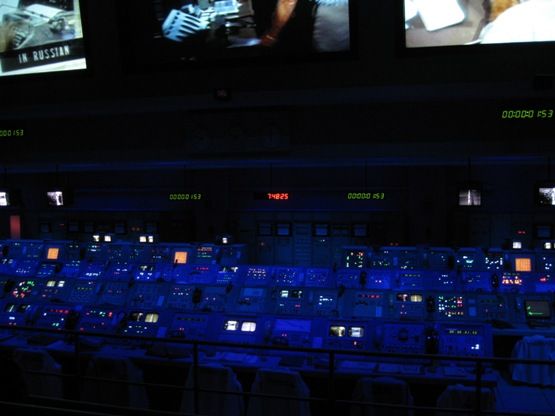
A while back I posted photos of my visit to the Kennedy Space Center in Florida. I mentioned in that trip report of the rare visit to the Launch Control Center (or Firing Room), which is normally not opened to most people, much less, the public.

I've put raw video footage of that visit to the LCC on YouTube in case anyone wants to take a look at it. I've done no editing of any kind to it (thus the "raw" description). You'll get to hear a little bit from the tour guide in the background in some shots, but other than that, there's no narration.


Zz.

Linking A Particle's Mass To Time

This is rather surprising and unique.

A paper to be published in Science claims to have made a clock that measures time by linking it to a mass.

Abstract: Historically, time measurements have been based on oscillation frequencies in systems of particles, from the motion of celestial bodies to atomic transitions. Relativity and quantum mechanics show that even a single particle of mass m determines a Compton frequency ω0 = mc2/ ħ, where c is the speed of light and ħ is the reduced Planck constant. A clock referenced to ω0 would enable high-precision mass measurements and a fundamental definition of the second. We demonstrate such a clock using an optical frequency comb to self-reference a Ramsey-Bordé atom interferometer and synchronize an oscillator at a subharmonic of ω0. This directly demonstrates the connection between time and mass. It allows measurement of microscopic masses with 4 × 10⁻⁹ accuracy in the proposed revision to SI units. Together with the Avogadro project, it yields calibrated kilograms. 

That's definitely an astounding accomplishment if this is verified. They actually could somehow get at the frequency associated with a particular mass.

A news report on this work can be found here, which reveals a bit more of the issue surrounding this measurement.

The idea for the clock stemmed from the quantum principle that particles also behave as waves, and vice versa. In particular, Müller and his colleagues wanted to determine how frequently the wave form of a single atom oscillates, a quantity that in quantum mechanics is inherently linked to the atom’s mass. Then the researchers could use those oscillations like swings of a pendulum to create a clock.

The snag in Müller’s plan was that it’s impossible to directly measure the oscillation frequency of waves of matter. The frequency of these waves is about 1025 hertz, 10 orders of magnitude higher than that of visible light waves. So Müller and his colleagues came up with an apparatus that creates two sets of waves — one based on a cesium atom at rest and another on the atom in motion. The researchers measured the frequency difference between the waves and then used that number, a manageable 100,000 hertz or so, to calculate the much larger oscillation frequency of cesium at rest.
Let's see this will work out.

Zz.

Wednesday, January 09, 2013

Physics - The Second Most Demanding Major?

We have had reports before on studies or surveys that convey the idea that physics is a difficult subject. Some would even say it is the most difficult subject.

This blog post on Physics Central reports on a survey of students of various majors. One of the survey question is on how much time the students spent per week studying the subject. Physics majors came in 2nd, just behind engineering, in the number of hours per week studying the material.

According to a survey of hundreds of thousands of college students in the U.S. and Canada, 36 percent of physics seniors spend 21+ hours preparing for class every week. Only one other group out-studied the physics majors: engineering students. 42 percent of engineering seniors devoted 21 or more hours to studying every week.
There are more to the survey than just this, so you can read the rest either in that blog, or from the actual survey itself.  And you can draw your own conclusions from them.

Zz.

Monday, January 07, 2013

LHCb Result Published

Hey, remember when I highlighted the recent result from LHCb where it could not find any hint of anything beyond what the Standard Model predicted? The paper on the result has now been published in PRL and you can get free access to it from the link in this review.

Zz.

Wednesday, January 02, 2013

How Not To Teach Physics?

This is an interesting article written by former U. of Ottawa professor Denis Rancourt (you may want to read a bit of his history with his former university). Certainly, article that appeared on this Dissident Voice webpage consistently challenge the establishments and the established notion. I have zero issues with that. However, I question the validity of many conclusions, especially when it is only backed by anecdotal evidence. And just because someone questioned the conventional way of doing stuff does not make him/her immune from being equally questioned for the conclusion he/she is drawing.

Rancourt wrote on how ineffective the standard method of teaching physics is at imparting physics knowledge to students. Certainly, there have been plenty of studies to indicate that such dull methods of teaching is not every effective. He then described how he did it is own way and how, in his opinion (and the opinion of his TA), it showed an improvement.

I told the students to close their books and not read them, unless they thought they might find something of interest in there that they wanted to know. I told them they could look anywhere they wanted and ask anyone questions to find what they wanted.

I told them that first we needed to figure out what was worth knowing, and what it means to know.
I got blank stares. They worried about how they would be graded in such a system. They wondered what I really meant and what did I want them to do. But they gave me a chance and, luckily, I didn’t know what I was doing, so it was quite authentic.

So I said: “Let’s see. There must be every day things that we want to know, that we can understand…? Things we are curious about?”

They couldn’t find any. Some of them said they had a lot of work to do in their other classes so they did not want me to be too demanding. Many shared that view. But as the conversation continued and as it became clear that, well, it was a conversation; they relaxed. But they still could not think of anything they wanted to know, beyond the latest homework in the other courses. Sad really.

So I said: “Why is the sky blue?” “No really, how does that work?”

Well many of them had heard something about that in high school so we started a class-wide discussion about how and why the sky is blue. And for every answer that did not quite work, we were able to find a flaw in the answer, or a dead-end, where the word answer was not really explaining anything beyond “something something”.

I told them that it maybe had something to do with why the evening sky can be red and also asked why clouds are white, when they are not red.

So this led us to what is light…? Now you can spend a lot of focused time asking yourself what light is if you want to know why the sky is blue. So I discovered… I helped them see, through questions, what it was to truly know or understand something versus just repeat the words… that they could search and explore and critique themselves. So they did.
 .
.
.

And we had a final examination. And, honestly, it was like no final examination I had ever seen before. It was the opposite of depressing and fun to grade. It was full of intelligence and independent thought and evidence of significant research. I had a sense that the students had understood things, could explain them, and owned their knowledge.

I went back to the previous year’s examinations and saw a huge difference. I lent the two piles of examinations to the TA and she concurred that, yes, there was a significant qualitative improvement that could not be denied.

Now know that I was not comparing “bad” teaching to “anything would be better than that”. I was considered one of the best traditional method teachers, by the usual standards. So I was comparing certified bad teaching to something much better.
Now, there's a number of issues here that were not tackled:

1. Many physicists today were taught using the "conventional" methods. I was one of them. While one can argue that these may not have been the best technique, one cannot argue that WE, as a group, didn't learn any physics from them. In fact, I will vehemently argue that my E&M instructor was one of the best teacher that I've ever had and left his permanent imprint on me on how I learn things in physics. He taught things in a conventional means, but he was damn good at it. So then, is the problem here the philosophy of teaching, or the EXECUTION of that philosophy, i.e. how such conventional teaching is presented? Was Rancourt's ineffectiveness  in making the student learned early on a problem of the philosophy of teaching, or was it because he simply was not a good teacher executing that philosophy or methodology? I'm not saying he isn't, but this is something we don't know.

2. How effective is his new "technique"? Sure, anecdotally, he could claim that the exam results were better. But this is not how we arrive at things in science. Educational research requires quite a number of sampling, testing, and controlled groups for comparison. One simply can't claim one has discovered something better simply via such anecdotal evidence.

3. Note that other countries, especially Asian countries such as Korea, Singapore, and China, have continually produced masses of students that have tested higher in math and science. As far as I can tell, their teaching and learning techniques are still heavily "conventional" and not approaching anywhere near what Rancourt is doing. So why are these kids able to learn and understand physics?

I fully understand the desire to do things differently. After all, I've written extensively on how I would revamp the undergraduate intro physics labs to fulfill various goals. However, until that is properly tested, I would not make any kinds of claim of its effectiveness, because I'll just be doing what I've criticized a lot of people have done - relying solely on anecdotal evidence before proper, scientific and more-verified evidence are available. And people who dissent should not be quick to dissent by lowering their standards of what can be accepted to be valid.

Zz.

Saturday, December 29, 2012

To 10 Reasons We Know The Earth Is Round

As if this needs further convincing, here are those top 10 reasons:


Zz.

Wednesday, December 19, 2012

Fabiola Gionotti

It is rare that someone from science is one of the finalists for Time Magazine's Person of the Year. It is even rarer that it is a physicist AND a woman. That is what Fabiola Gionotti has accomplished for her effort at the LHC leading up to the apparent discovery of the Higgs.

The announcement caused the kind of global sensation you don’t always see in response to a scientific discovery, and three names earned an equally unusual level of fame — Gianotti, who headed one of the experiments that confirmed the Higgs; her colleague Joe Incandela, who led the other; and Rolf Heuer, the research director of CERN. It was Gianotti who perhaps received the most attention, principally for her leadership role and her manifest gifts but occasionally for a reason as predictable as it is misguided: her gender. Physics is a male-dominated field, and the assumption is that a woman has to overcome hurdles and face down biases that men don’t.

Read her story at Time's website before it disappears.

Zz.

Tuesday, December 18, 2012

Berkeley Lab Open House 2012

In case you weren't there, here's a short video of this year's open house at Berkeley Lab.


I've said it before and I'll say it again. If you have a chance to visit one of these National Labs, you should do it. You'll see your taxpayers money at work in producing something that either drive knowledge, or drive our economy.

Zz.

Saturday, December 15, 2012

CERN Becomes A UN Observer

No, I don't mean an UNobserver. I mean a United Nations Observer.

CERN becomes the first physical science entity to be granted the status of an observer at the United Nations.

The lab joins environmental groups and public health agencies as the first physical sciences research organization in the ranks of UN observers. Observer status grants the right to speak at meetings, participate in procedural votes, and sign and sponsor resolutions, but not to vote on resolutions.
I will be curious to know if it can affect anything in the UN with such a status. Time will tell.

Zz.

Physics World's Top 10 2012 Breakthrough

Physics World has listed what it considers to be this year's Top 10 breakthroughs. Not surprisingly, the apparent discovery of the Higgs at the LHC took top honors.

I'm glad to say that many of the breakthroughs listed were also covered in this blog! :)

Zz.

Thursday, December 13, 2012

Is There Poop On The Moon?

I swear, those people at Minute Physics must have heard that I visited the Kennedy Space Center last week! How else do you explain this uncanny timing of them producing this video? :)


Zz.

Crystal Growth Under Zero Gravity

This is a rather interesting report on the growth of He4 crystal with and without gravity. They even have a video of the growth, which obviously occurs in a very short time.


Here's the synopsis accompanying the video:

There are several limitations to growing crystals on Earth, which is why a group of researchers from Japan have taken to the skies to grow them under zero gravity.

They have successfully grown helium crystals 10 times larger than can be achieved on Earth with ordinary materials and it took just a matter of seconds -- ordinary, classic crystals can take up to a thousand years to reach their final shape.

This was achieved using high pressures, extremely low temperatures (-270oC) and by splashing the crystals with a superfluid.

From 13 December, the paper can be downloaded from http://iopscience.iop.org/1367-2630/14/12/123023/article

Zz.

Wednesday, December 12, 2012

NASA T-Shirt

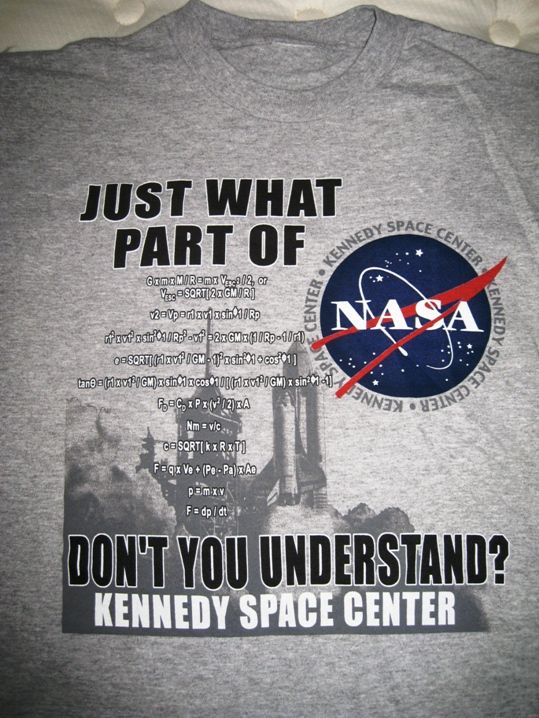
Yesterday, I posted my trip report to NASA's Kennedy Space Center. Of course, as a tourist, I had to buy something. While there were a few things I would like to get, this one t-shirt caught my eye, and it will probably confirmed to everyone what I nerd I am. Still, at least it is not one of those t-shirts that had Maxwell Equations on it that I have seen way too many times.

This is the front of the shirt.
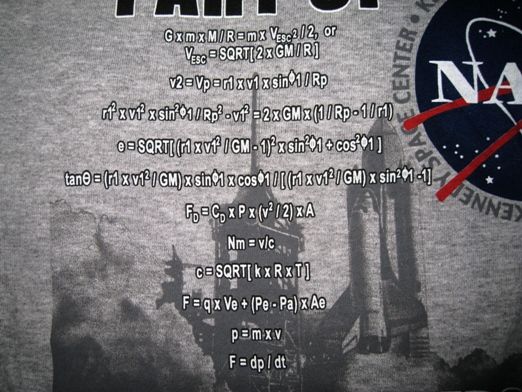
Here's a closer look at the equations if it isn't clear from that picture:

It's too bad that they had to put all those "x" to indicate a product, which isn't what we normally do when writing such equations, and it also creates a bit of a mess.

Still, I found the t-shirt a bit amusing and had to buy it. I haven't worn it yet (it is winter up here in Chicagoland). The question is, can you identify what each of these equations mean or are supposed to represent?

The back of the shirt has a print of the answer, but I'll hold off in showing that till you had your fun! :)

Zz.

Tuesday, December 11, 2012

Kennedy Space Center

If you've followed this blog recently, you'll noticed that I missed a stretch of about 10 days with no posting. I was on vacation.

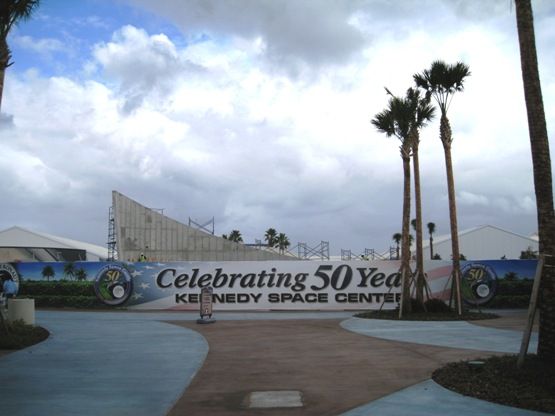
Still, my vacation had a "physics" component to it. As one of my stops, I visited the Kennedy Space Center in Cape Canaveral, Florida. I've never been to this place before, even though I've always wanted to go there especially during the Shuttle era. However, I never made it there till now, which I later found out, has its advantages. I will explain why that is so when we get to that point.

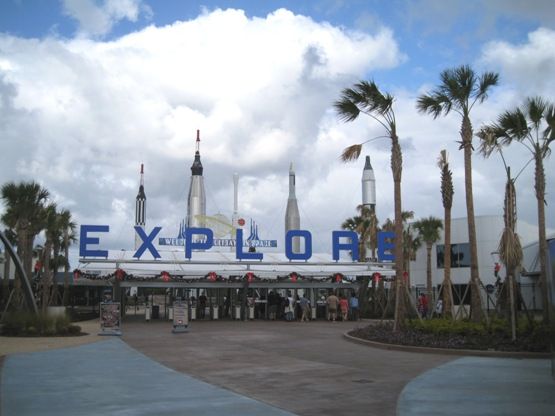
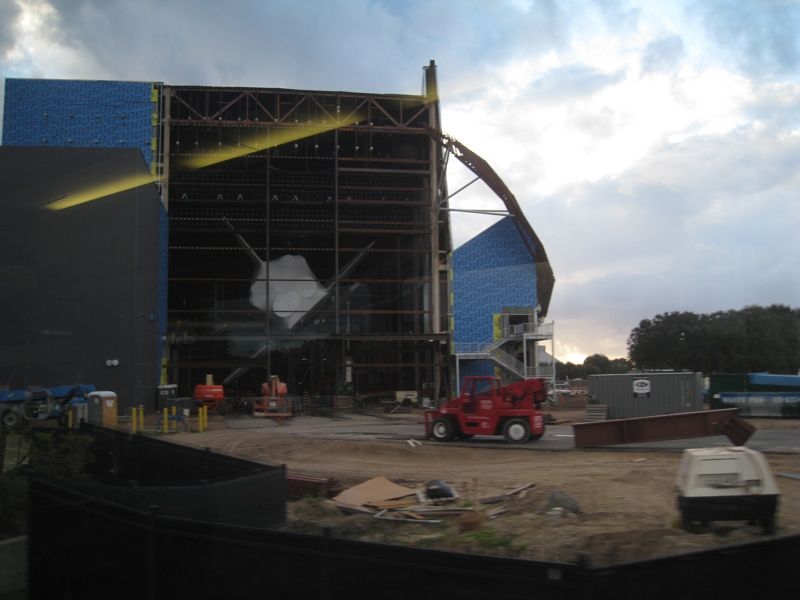
So this is the entrance to the visitor center. As you can see, there are constructions on new facilities that they are building to expand and enhance the visitor center.


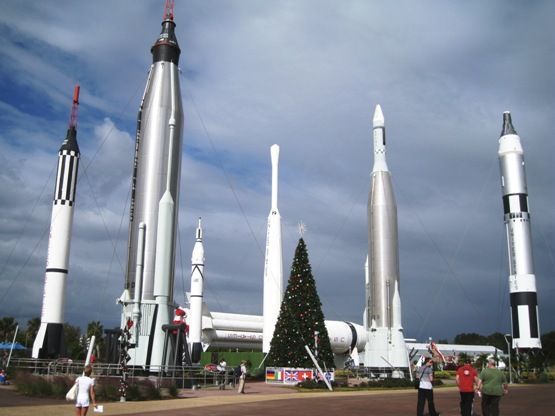
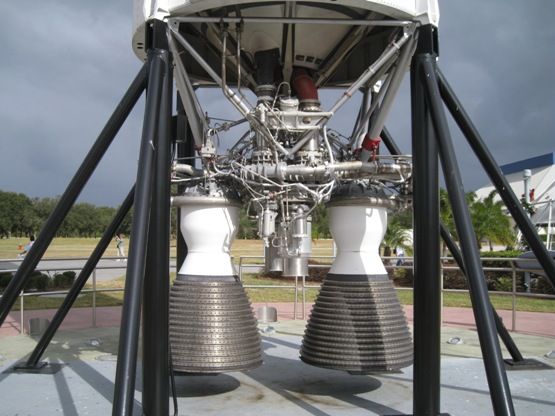
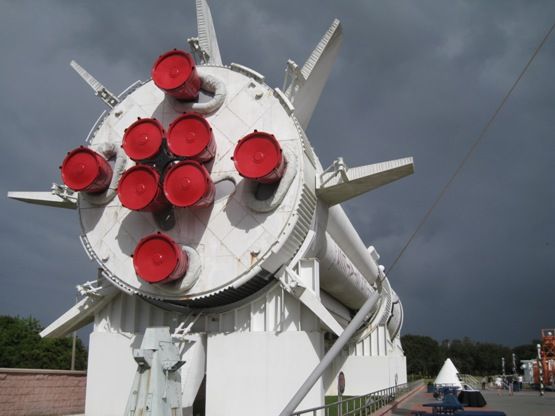
We made it to what I jokingly called the rocket graveyard. These cover the history of rocket propulsion that led to NASA sending satellites and manned space craft into space.


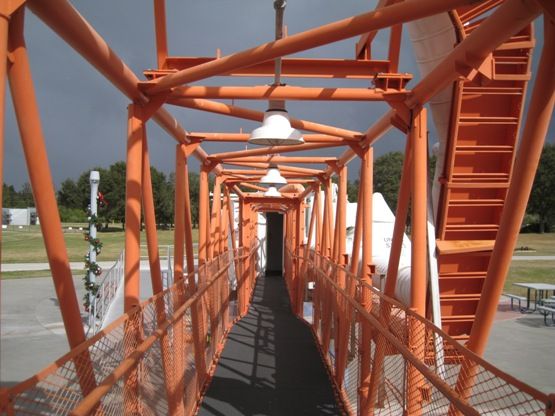
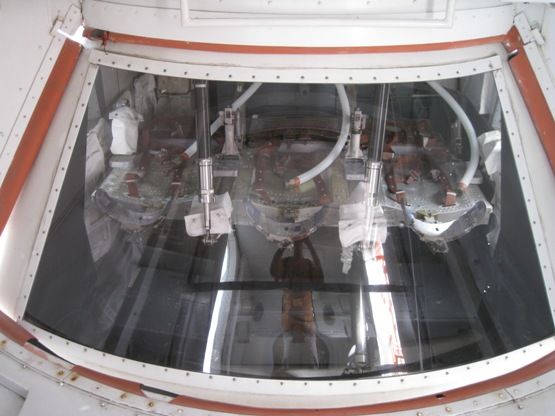
They had the bridge that used to connect the launch structure to the space module. So this is what the Apollo astronauts saw when they are walking into the capsule right before launch.


Here's what one of the capsules looks like. Man, was it tight!


I spent a bit of time looking around more of the visit center, but then took a tour that I signed up months ago. This is not your ordinary tour that they have running almost all day at the Space Center. This was a tour of the Launch Control Center. It appears that they started giving this tour about 2 months ago, and supposedly, they have not received any indication right now if it will go on after the New Year. This tour is only done once a day, and limited to less than 25 persons per tour. We were also not permitted to bring anything that we could not carry all the time, i.e. we were not allowed to put things down on the floor and walk away. This was beside the fact that we will be having 2 security escorts while in the building.

Now this is where coming here after the Shuttles had been retired was a plus. It turns out that they had never given the public access to the Launch Control Center (or what they refer to as the Firing Room) till now. In fact, most people working at the Kennedy Space Center have never been allowed to be in such a room. The reason why they are doing it now is because there are no more Shuttle launches. However, the room is still "operational", and it will be modified for NASA next program. That was the reason for all the restrictions and security.

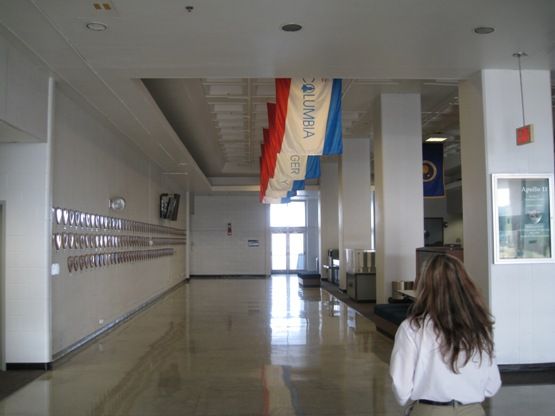
Well, enough of that. Here are pictures that I took of the LCC. We arrived at the building and this was the lobby.

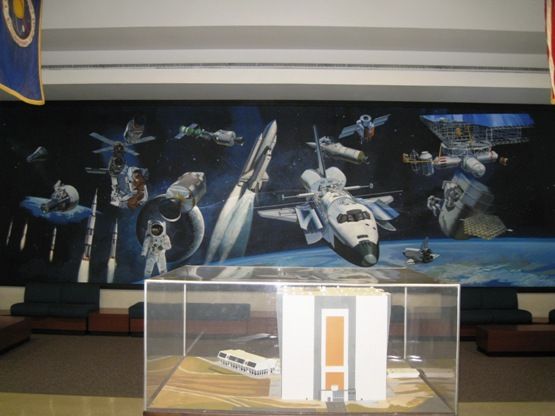
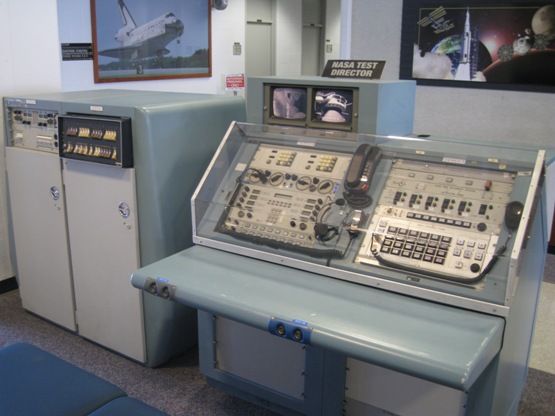
They have a few things on display in the lobby, including a very old console that, I think, was used during the Apollo program.


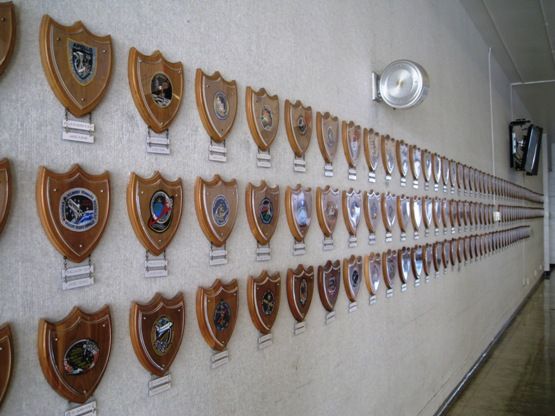
But what drew my eyes more was this wall of plaques of all the space launches that were done out of this building.

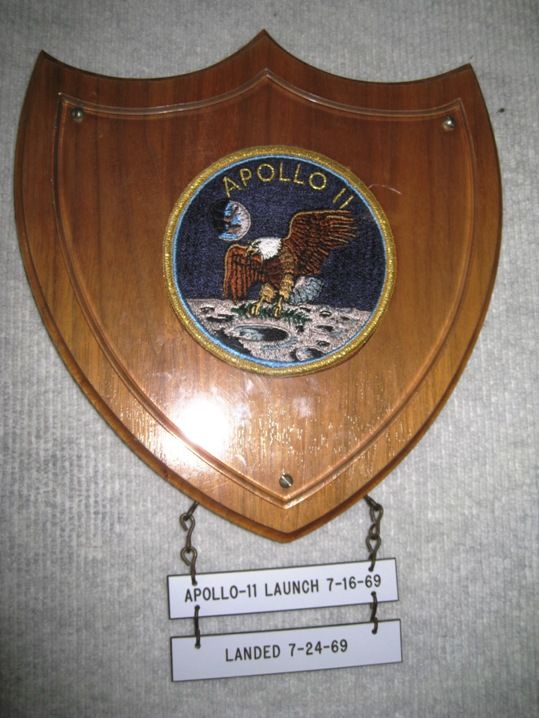
This includes the Apollo 11 mission,

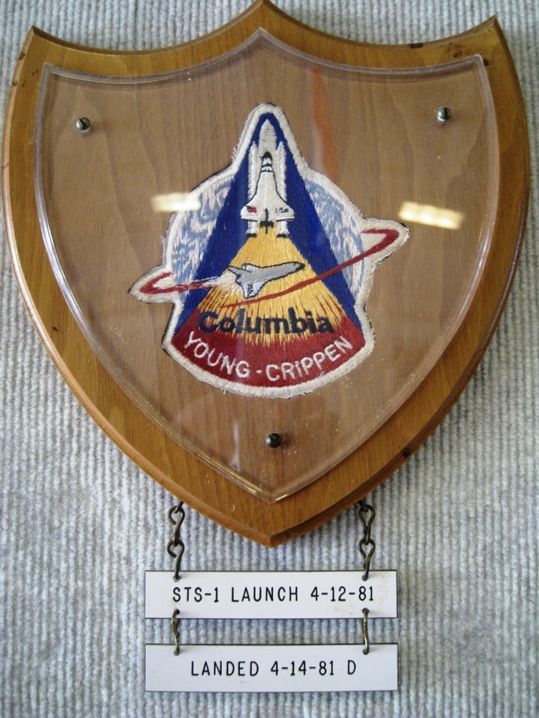
and the first mission of the Space Shuttle


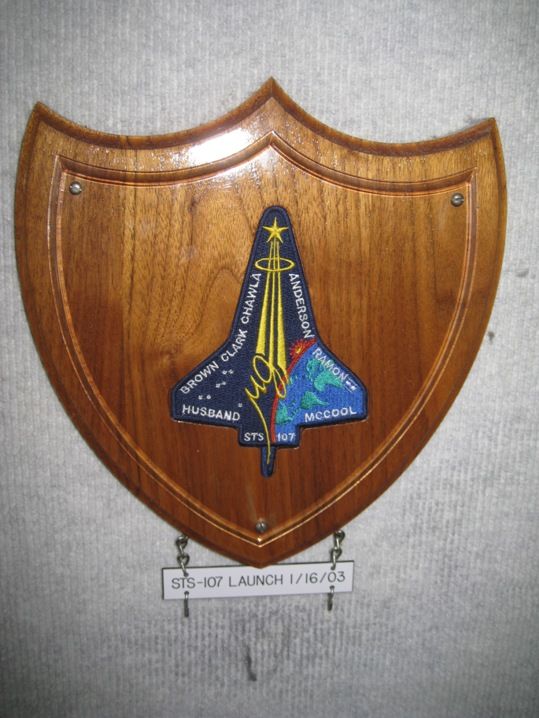
Each of the plaque had a launch date and the date it landed. However, two of the shuttle mission didn't have a "Landed" date, and those of course corresponded to the two tragic shuttle accidents.


If you look closely at where the "Landed" tag should have been, you'll notice that the wall showed a bit more wear than usual. It turns out that NASA employees rub their fingers at these locations when they walked pass them as a sign that these astronauts are always in their thoughts.

We were then taken into an elevator up to the LCC. I don't quite remember seeing the firing room on TV (I'm more familiar with the Command Center in Houston). But it was still an impressive room, and we got to see it from various locations.

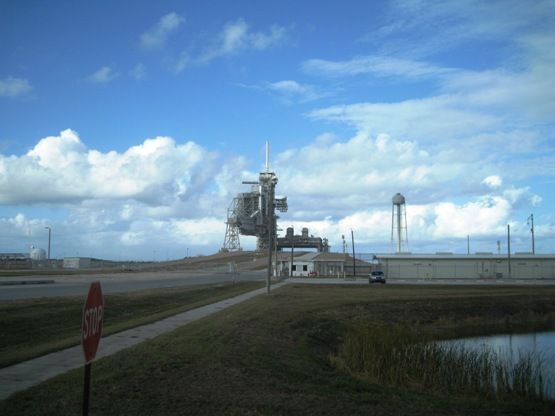
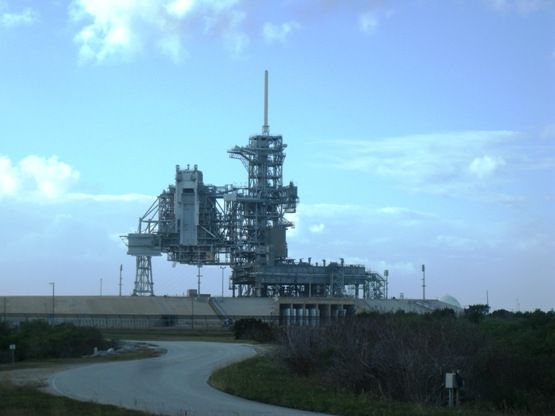
This was the view out of the window from the LCC. You can see the shuttle launch pad in the distance, and also the 2-lane gravel path that the crawler took from the shuttle assembly building to the launch pad.

After a long visit to the LCC building, we then got back on our bus and got a tour of the grounds. First off is the shuttle launch pad. I can only imagine what it would look like if the shuttle is all set and primed to go. Of course, I've seen it on TV, but I'm sure it would have been significantly more impressive in person. I would love to know more about their cryogenic systems to produce all those liquid hydrogen and oxygen.

We were then driven around a new launch pad that they are building for the Orion program (did they get full funding for this? I must have missed it). Our tour guide was continually gushing over this to emphasize that NASA is not dead, and that the space program is back in operation and "we are back in business".

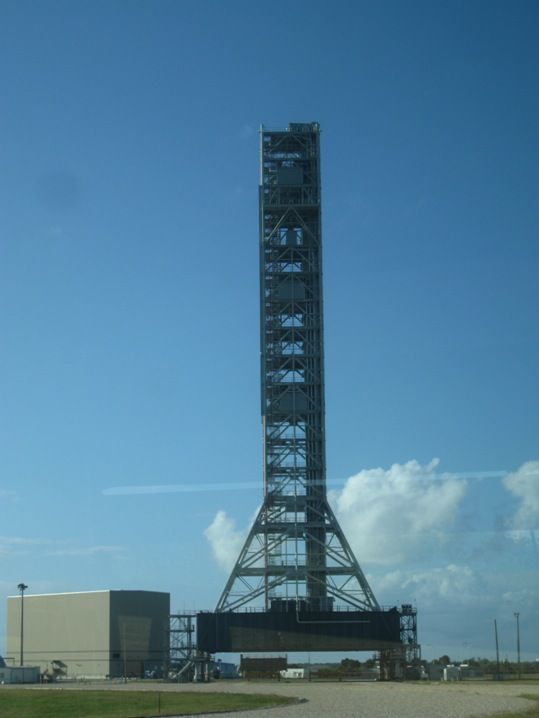
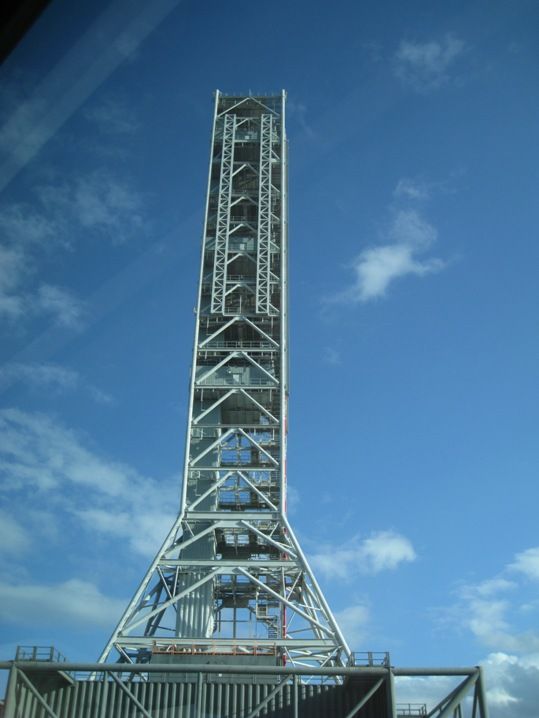
We also drove by the crawler, which is now sitting outdoors. If you don't know this, the crawler was the vehicle that brought the upright Space Shuttle (i.e. the orbiter, the external rocket, and the solid rocket boosters) from the assembly building to the launch pad. It literally crawled at about 1 mile per hour. While this may not have been that different than watching grass grows, I wouldn't have minded to see that either!

Our last stop was the Apollo experience. We were dropped off at a building and entered a room that simulated the firing of an Apollo rocket. The equipment in the room was authentic, and the audio and simulate was incredible because one could hear the windows rattled during take off.


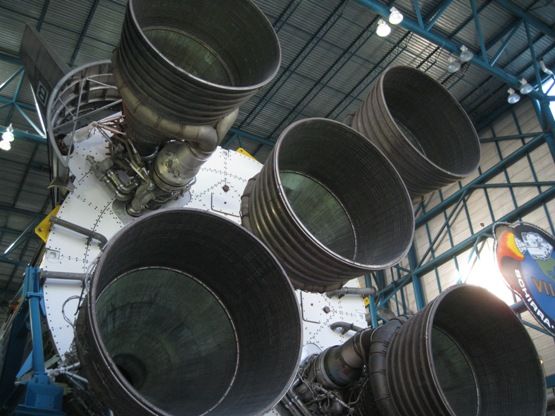
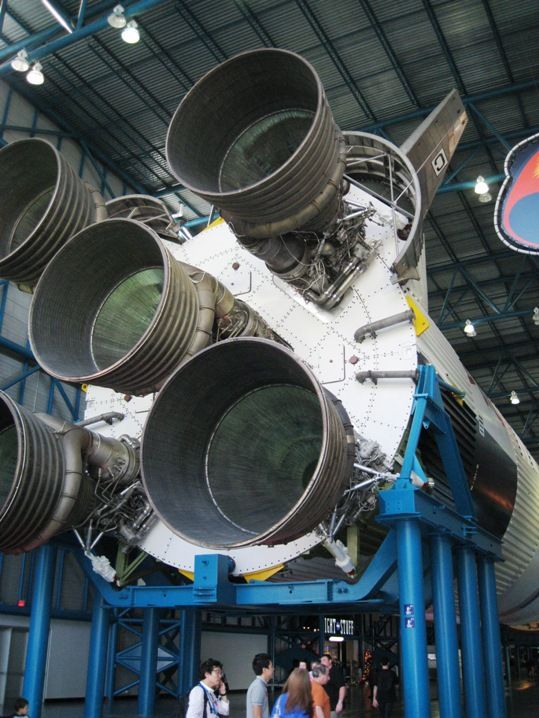
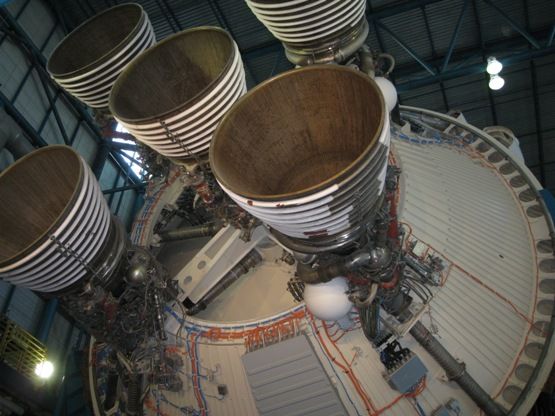
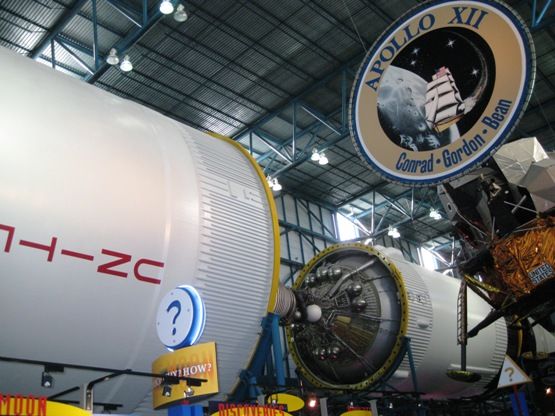
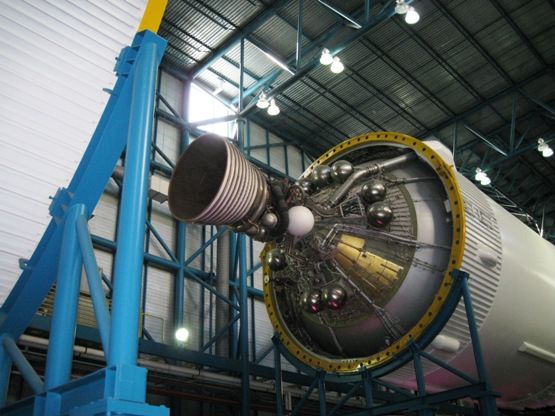
After that bone-jarring presentation, we were led into a huge building that housed the Apollo/Saturn V rocket. This was quite impressive. The Saturn V booster rocket alone is HUGE. Look at the 2nd picture that has human scale for you to compare.

We walked along the length of the rocket and saw various stages that separated at different times during launch.


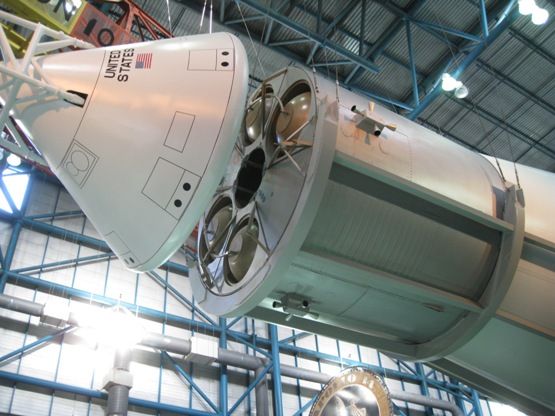
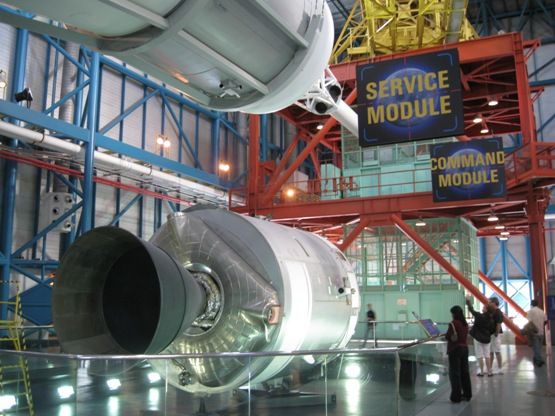
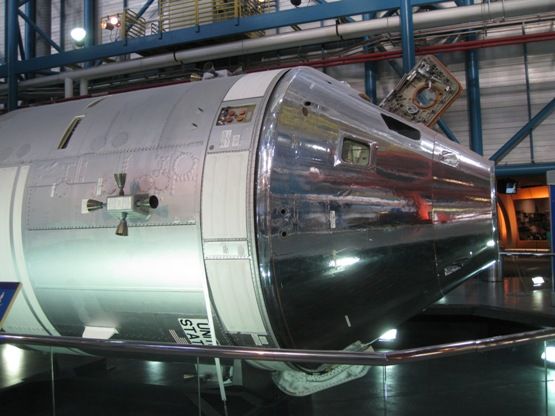
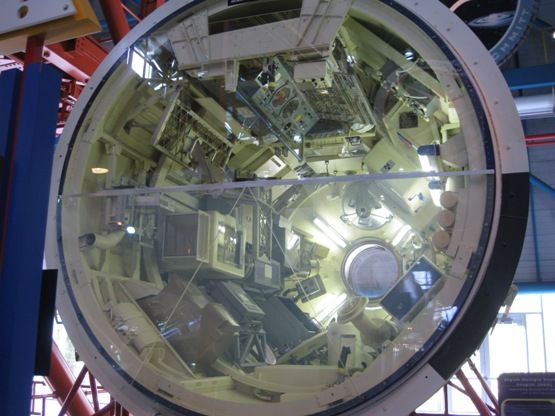
A closer look at the Service Module and the Capsule.


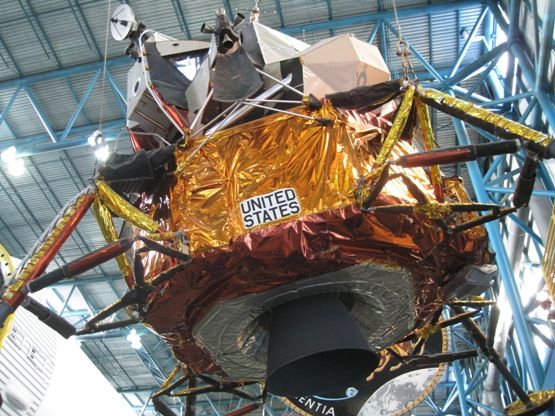
This is the lunar lander, which was the only part of the vehicle that landed on the moon, and which a big part of it gets left behind.

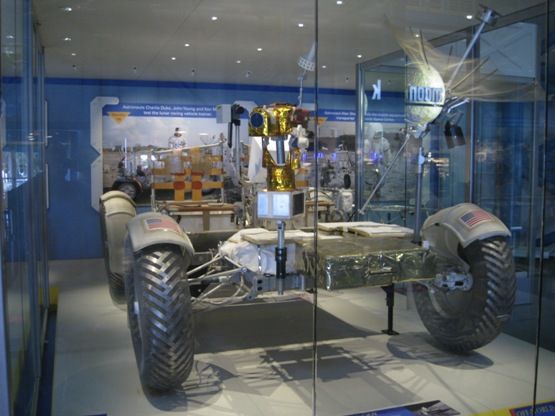
This is the buggy that they used on the moon.

At the end of our visit, on the way out, we saw the construction of a building to house one of the Space Shuttle orbiter. This new attraction will open some time next year. So maybe this is a good reason to come back for another visit.

It was a wonderful experience. But being a physicist, I just wish that we had a tour guide familiar with the scientific/technical aspect of the program. As someone who is used to giving tours at our facilities, I'm always prepared to answer such questions, because you just never know if you get scientists in your audience. And I've had that a few times where physicists or engineers in the tour group started asking more "difficult" or more detailed questions. I supposed one has to know someone working there to be able to get a more personalized tour that will answer a more technical question.

So now you know a little bit of what I did on my last vacation! :)

Zz.

Monday, December 10, 2012

Dark Energy Survey

Here's a short video on this project.


You may also visit their website to learn more.

Zz.
Thursday, November 29, 2012

Does The Universe Have A Purpose?

A fun video, no matter which side of the fence you fall into.


At the very least, you can understand why, if we simply look at it "the way it is, rather than the way you want it to be", science has more evidence in favor of the universe having no purpose than the other way around.

I guess I'm with the e-coli bacteria in the video that asked for "more poop!".

Zz.
Wednesday, November 28, 2012

Fermilab's Physics Slam Video

I mentioned earlier about the first Physics Slam at Fermilab, and ended the blog entry with the question on where the video for this event is.

Well, ask and you shall receive. The video for this physics slam is now available online.


Zz.
How Quickly Does A Photon Reach c?

I've seen this question numerous times. The premise here is that while a photon travels at c in vacuum, it wasn't "born" with that speed. Somehow, after a photon is created at some low speed (zero?), it then accelerates to c. So I often get asked on how quickly does it reach c.
There are several problems with such a question, and this certainly qualifies as a "When did you stop beating your wife?"-type of question. Why? Because it assumes, a priori, that photons CAN have speeds other than c in vacuum. This is not verified. So the idea that a photon gets born with some low speeds is not an idea that has any physical basis, and thus, the starting point is all wrong.

Secondly, there is a problem in reconciling our experimental evidence with such a scenario. Let's look at this carefully.

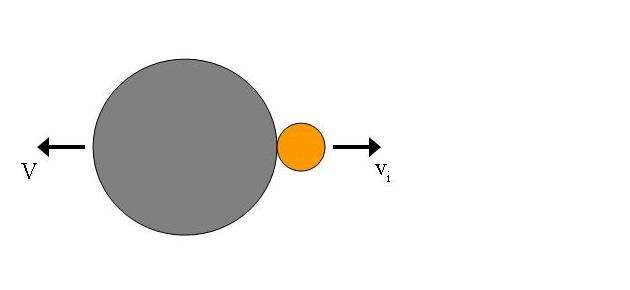
Say we have a body that is initially at rest. at some point, emits a particle, as shown in the figure below.
The larger body moves with velocity V, while the smaller body moves with velocity v_i. These two values are related to each other via conservation of momentum.

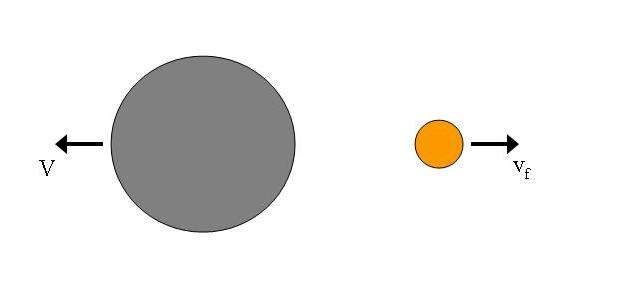
Now, let's say that the smaller body then accelerates, by some means, to some final velocity, as shown below.


However, this final velocity v_f has no directly relations to V, i.e. it isn't correlated to V since the conservation of momentum of the two bodies no longer is relevant here. v_f no longer carries any direct information about V.

So let's look at what we know about such a thing. Atomic recoil, electron recoil, and a while bunch of other experiments on photo emission and photon collision experiments have shown that what we measure in such interactions totally conserve momentum. In other words, we measure v_f (since it was already at c for photon), and this v_f is still correlated to V via a direct conservation of momentum. This clearly means that v_f is equal to v_i, and therefore, there is no "acceleration" of photons

This scenario applies to a whole zoo of fundamental particles as well since the same conservation law applies to many  such interactions involving these particles.

Zz.

Tuesday, November 27, 2012

What Happens When A Theory Is Wrong?

This has happened a lot of times in the history of physics. However, we could be confronting one right now on a very prominent theory - Supersymmetry.

This article by Marcelo Gleiser briefly looks at how physics often proceeds, and what is the fate of Supersymmetry after so many searches for it have failed to produce anything it is predicting that is unique beyond the Standard Model.

Given the lack of data in support of supersymmetry after all these years, why is the theory still considered viable?

The complication comes from the way mathematical models depend on various adjustable parameters. For example, the decay rate of a particle may depend on its mass and the way it interacts with other particles; if certain types of decays aren't seen, parameters can be changed to reflect that. The model may be made to hide from available experiments. And given that technology has more concrete limits than the imagination of theorists, a model may always be beyond the detectable.

How, then, can such types of models be ruled out? Well, simpler versions may be ruled out when the tweaking of parameters becomes so extreme that the model loses its original motivation: it explains nothing and becomes too cumbersome. Or a forbidden particle is discovered. Then there are always the more complicated versions, with more parameters that are harder to rule out.

The point is that there isn't a clear-cut answer. The physicist Max Planck used to say that wrong ideas don't die out, their proponents do. It will be interesting to watch what will happen in the next few years with supersymmetry and its proponents if tests keep producing negative answers.
This will become even more interesting if the LHC sees no convincing evidence after it boots its collision energy in a couple of years. While I am certainly interested in the physics, I am equally fascinated to see how the high energy physics community, and the Supersymmetry advocates, handle the outcome that they will get from that run.

Zz.

Sunday, November 25, 2012

What Is Touch?

I see this question frequently being asked in public forum, especially on Physics Forums. Hopefully, this video provides a good start in answering such a question.


Zz.

Friday, November 23, 2012

Fermilab's First Physics Slam

I'm sure this was a lot of fun and involves a level of performance and entertainment.

Fermilab had its first ever Physics Slam. And from the report, it sounded like it was a Smash! :)

The occasion was the laboratory's first ever physics slam. A physics slam is kind of like a poetry slam—the five contestants were given 12 minutes each to explain a complex particle physics concept to an auditorium filled with laymen. And they had to do it in the most entertaining way they could, because audience applause determined the winner.
Now, where are the videos of the event?

Zz.

Thursday, November 22, 2012

Why Do Physicists Care About Finding The Higgs?

This is a very short and informative article on why many of us care so much about finding the Higgs. The reasons may be quite different from those understood by the general public. This article, along with the one I posted earlier, might help in correcting several misconceptions about the Higgs.

Happy Thanksgiving to those in the US.

Zz.

Wednesday, November 21, 2012

The Origins of the Elements

If you have an hour to spare, here's something you might either want to watch, or just listen in the background.


Zz.

Tuesday, November 20, 2012

Dance To String Theory

It is no secret that I've made fun of many of these efforts to incorporate physics with dance. I'm sure they are of high artistic caliber, but I question the "reason" for doing such a thing, and the effectiveness of it. In other words, if I don't tell you what this is all about, can you decipher it for yourself?

I've mentioned before several attempts at using various physics topics or principles as a dance motif. Read here, here, here, and here. Add this one to the list.

The choreographer has been working with Andrew Melatos, a theoretical physicist at Deakin. Melatos is an expert in string theory, the strand of particle physics that attempts to reconcile quantum mechanics and general relativity. The pair's collaboration has led to Multiverse, an "innovative, animated dance work" that is being workshopped before a premiere next year.

Stewart says Multiverse - taken from the term coined by 19th-century philosopher William James, who put forward the idea of multiple parallel universes - will be a combination of live dance and three-dimensional animation, requiring the audience to wear 3-D glasses.
That sounds like a hoot!

I'd like to ask this: without invoking or being told about the "physics" behind the dance, can you enjoy the performance as is? If yes, then how come one doesn't sell it as such?

I again am curious about why these things are done. I mean, sure, they'll argue that this is another way to "visualize" various aspects of physics, and visualize this from an artistic point of view. But (i) why; (ii) is this really accurate; (iii) is this really necessary? Did someone who had no idea about physics saw this and suddenly got inspired to either study physics, or support physics? Did someone who didn't quite understand a certain aspect of physics suddenly understands it better after seeing such a performance?

I'm not saying this shouldn't be done. I'm just awfully curious on why and what are the consequences of such a thing. After all, a lot of effort, time, and money were spent for one of these things. It has to mean SOMETHING!

Zz.

Monday, November 19, 2012

Finally, A Direct Detection Of Time Reversal Symmetry Violation In Elementary Particles?

It appears that we now have evidence of a direct detection of time reversal symmetry violation in elementary particles. This detection appears to be clearer and less ambiguous than before, and doesn't rely on the detection of CP violation.

It also seems that this is a result out of BaBar, which came from SLAC's linear collider before it was permanently shut down and converted into the LCLS. So that old gal is still giving us results from her grave!

Zz.

Saturday, November 17, 2012

Top 5 Misconceptions About The Higgs

This appeared a few days ago, but better late than never. It lists the top 5 basic misconception about the Higgs, especially as reported in the popular media.

1.      Misconception: The Higgs particle gives other particles mass.
 Correction: The masses of fundamental particles come from interactions with the Higgs field. 

"You see this statement all the time, but how would another particle even 'give' another particle mass?" Kruse asks, explaining truly it's the Higgs field that provides mass to fundamental particles, such as quarks, electrons and neutrinos.

The Higgs particle is a consequence of the Higgs field. By discovering the Higgs particle, it shows the Higgs field exists. In the math that physicists use to understand the Higgs boson and field, there is a piece of an equation that they interpret as the existence of a Higgs boson, which they see as a point-like particle resulting from the Higgs field "curling in" on itself, like a knot in a spider's web. Physicists can't interpret the Higgs boson itself to be giving anything mass, but by interacting with other particles, they can argue that the Higgs field is giving resistance to the particles' motion, thereby giving them mass.

2.      Misconception: The Higgs field generates the mass of everything.
 Correction: The Higgs field generates the mass of about one percent of observable matter and possibly all of dark matter.

The Higgs field generates mass for quarks, which are the building blocks of protons and neutrons. The protons and neutrons, in turn, form the nuclei at the core of atoms, which are the building blocks of molecules, proteins, cells, plants, animals, planets, stars, galaxies and all the stuff we see in the universe. The mass of quarks accounts for only one percent of the mass of a proton or neutron. The other 99 percent of the mass of observable matter comes from the energy that binds protons' and neutrons' constituent quarks together.

It may seem kind of strange to think that the discovery of the Higgs boson, and thereby the existence of the Higgs field, means scientists have discovered an explanation for only one percent of the observable mass of everything we see. But, "that one percent is the mass of the fundamental constituents of the universe," Kruse says, adding that the Higgs field has also incredible consequences for the structure of atoms and molecules. "If the already small mass of electrons was zero, as it would be without a Higgs field, then everything would just disintegrate," he says. "All the atomic structure we are familiar with wouldn’t exist. We wouldn’t exist. There may still be matter, but it wouldn’t be the same. There certainly wouldn’t be life as we know it."
Also, unobservable matter also wouldn't have mass. Scientists believe this unseen, or dark matter, comprises more than 80 percent of the matter of the universe, but it doesn't interact strongly enough with anything to allow its direct observation. Yet, because it has significant mass, "it must interact with the Higgs field and that's another key point," Kruse says. "The Higgs field generates about one percent of observable mass, with the term 'observable' being a very important qualifier, because the Higgs field may be responsible for the mass of all dark matter."

3.      Misconception: The Higgs boson creates the Higgs field.
 Correction: The Higgs field generates the Higgs boson.

Kruse says that some of the best physics writers have shared this misconception, but the Higgs boson does not create the Higgs field. The opposite is true, because the Higgs boson is a consequence of the Higgs field. The field itself became noticeable to fundamental particles existing in the very early universe about a billionth of a second after the Big Bang, when a fundamental symmetry in the universe, called the electroweak symmetry, broke.

4.     Misconception: The Higgs field is what scientists used to call the aether.
Correction: The Higgs field isn't a medium; it's a field of energy. 

In the late 1800s, scientists conceived of the aether as a way to explain how light spreads through space. At the time, scientists reasoned that because sound waves needed a medium through which to travel, then so should light. "With the advent of the theory of relativistic electrodynamics, the need for an aether disappeared," Kruse says.

When physicists and writers try to explain the Higgs field, they often describe it as an "icky, gluey" medium where, as particles move through it, the resistance they experience generates their mass. "It's not a horrible way of thinking about it, except that the field is not any type of sticky mechanical substance. It's not a medium, but rather a type of energy that uniformly pervades all of space," Kruse says.

5.      Misconception: There was a "eureka moment" for discovering the Higgs boson and the   existence of the Higgs field.
 Correction: There will never be eureka moments for discoveries such as the Higgs boson and the Higgs field at the Large Hadron Collider.

"I think this experimental misconception is a whole story in itself," Kruse says. "The discovery is based on a laborious accumulation of evidence, which at a certain point we deem strong enough to claim victory, based on a very low probability that it could be due to something else," he says, adding that "there's no single eureka moment where we look at an event and say that's a Higgs."
Zz.

Friday, November 16, 2012

Why Is Li Atom Ground State In a 1s2 2s Configuration?

You would think that something that is well-established in both physics and chemistry textbooks would not reveal any more surprises, but you (and we) are wrong.

This is an interesting preprint, and it got me captivated for several minutes. First of all, let's set the scenario.

In the periodic table, as one go from H to higher numbered atoms, one start filling up various atomic orbitals. So you have H having 1s^1, He with 1s^2, Li with 1s^2 2s^1, etc.. etc. The interesting thing here is that with just the electron-ion interaction being accounted for, the 2s and 2p states in Li are degenerate, meaning they both have the same energy. So why would the 2s state gets filled first ahead of the 2p?

The standard textbook explanation here is that the 2p states, due to the geometry of the orbitals, tend to get shielded more by the 1s electrons than the 2s states. Thus, the 2p states have a higher energy than the 2s states.

This preprint claim that that explanation is flawed. They showed that what is really at play here is the electron-electron interaction, which is often neglected in many of these multi-electron systems with low atomic number. In their calculation, the interaction between 1s - 2s electrons produced a lower energy state than the interaction between 1s - 2p electrons. This is the main reason for Li ground state to be what it is, and not due to "shielding".

I'm sure this is being submitted for publication somewhere. The paper is not that difficult to follow for advanced undergraduate physics students.

Zz.

Thursday, November 15, 2012

Just The Higgs And Nothing Beyond

The Kyoto conference going on now gets to see more results out of the ATLASand CMS detector at the LHC. So far, they are confirming the data of the apparent Higgs from last year, but nothing much beyond that.

Alas, most of the Higgs results being presented this week at the Hadron Collider Physics symposium in Kyoto, Japan, have been well within our standard understanding. Physicists at ATLAS and CMS, the two largest particle detectors at the LHC, have about double the amount of data they did in July; this new data hasn’t dramatically changed the tentative conclusion that the LHC is seeing a plain-old Standard Model Higgs.

We already heard on the other result that still showed no sign of SUSY. That Standard Model is gripping us real tightly!

Zz

Tuesday, November 13, 2012

Optical Atomic Clock Outperforms Cesium Clock

Our expertise in Metrology seems to be improving quite dramatically nowadays. This is one such example.

Now, in Physical Review Letters, Alan Madej and colleagues at the National Research Council in Canada report they have greatly increased the accuracy with which another atomic frequency standard, the optical transition in an isolated strontium ion, can be measured. Furthermore, the precision of their frequency measurement now supersedes that of the existing cesium standard, which could lead to the adoption of a new frequency standard for defining the second as the basic unit of time.
You can get a free copy of this paper at the link provided above.

Zz.

Monday, November 12, 2012

More Results NOT In Favor Of SUSY

I will admit that I am not sure of significant this or how big of a "setback" it is for SUSY. But this theory is in need of some hint of an experimental rescue, and it didn't get it from this latest result.


If superparticles were to exist the decay would happen far more often. This test is one of the "golden" tests for supersymmetry and it is one that on the face of it this hugely popular theory among physicists has failed.

Prof Val Gibson, leader of the Cambridge LHCb team, said that the new result was "putting our supersymmetry theory colleagues in a spin".

The results are in fact completely in line with what one would expect from the Standard Model. There is already concern that the LHCb's sister detectors might have expected to have detected superparticles by now, yet none have been found so far.
 This certainly does not rule out SUSY, but it is getting to the same level as cold fusion if positive experimental result does not come soon.

Zz.

Sunday, November 11, 2012

Open Letter to the President: Physics Education

Here's a very timely "letter" to the US President regarding physics education in the US.


Zz.

Friday, November 09, 2012

You Can Teach Yourself To Think Like A Scientist - Part 1

It's true, and it isn't that difficult at all!

I'm going to start a series of essays on the things I see everyday in which the person involved either were using the same analytical technique as a scientist would, or the person simply dropped the ball and did not really thought things through as a scientist would. What I'm hoping to show here is that in our everyday lives, we DO make some decision in what to choose, what to believe in, and what to accept as valid. In many cases, these things come instinctively, or they have to be thought out a bit more. However, depending on what methodology we use to arrive at a conclusion, what we accept be not be valid because of the flaw in our reasoning or analysis. And I'm not going to restrict myself just with examples from science. I'm going to point out reasonings, methodologies, flaw in logic, etc.. from all and any parts of our daily lives as I can find.

But to start out with, we'll go back to the world of science and see what we have here. In a post in the Physics Forums, a member asked this question:

Why is it that lower frequency EM waves are aloud to pass through objects, but high..

... frequency are absorbed, like gamma rays. I would think it would be the opposite. So whats the physical reason?
Ignoring the spelling mistake, and without providing an answer to this question, there are already flawed methodology here in which the person who asked this question did not follow.

First is the "general rule" that this person appear to have observed, which is (to paraphrase):

Low frequency EV wave has more penetrating power than high frequency EM wave.

We are then asked to explain this. But wait a second! Is this true? As scientists, before we answer a question, we have to examine what that question is asking, and whether that question itself is true! This is because, if you try to answer a question that is based on faulty premises, then you're wasting your time on something that isn't true! So let's examine this then.

Now, presumably, this person is quite familiar with x-rays. After all, many of us has had to have one for one reason or another. x-rays have higher frequency than, say, visible light. Yet, we know for a fact that x-rays are more penetrating in our bodies than visible light. What just happened here? I've just given an example that thoroughly contradicts the assertion made in the question. I've shown something where a lower frequency is NOT more penetrating than a higher frequency EM radiation. And I've used an example that practically everyone is familiar with, not some exotic physics experiments that only someone with a PhD can comprehend! In other word, if you think you've drawn some sort of a conclusion, see if you can find an example that contradicts that conclusion. If you do, then it should cause you to ponder, at the very least, if your conclusion is universally valid, valid most of the time, valid some of the time, only works in a special case, or it is truly nonsensical.

Now, as scientists, we always try to see if there are any contradictions to things that we thought we understood. If we have a "rule" or theory that we go by with, and then see something that does not seem to fit that description, this means that our understanding or rule either may not be complete, or that something may be governed by descriptions that are different. In fact, contrary to popular beliefs, scientists LOVE such contradictions, because it means that there are things we don't understand and still need to be studied - things things keep us fascinated AND employed!

The moral of the story here is that, even without understanding the physics of what is going on here, a person without any physics knowledge can already do his/her own self-diagnosis and, at the very least, realize that the assertion made in the question is really false. Low frequency EM radiation does NOT ALWAYS penetrate a material more than high frequency EM radiation. One does this simply by being aware of already-established knowledge that most people already know. This is what I mean by thinking things through analytically, and in this case, using just common knowledge. We all posses this ability, but some of us have it more honed than others. It is this ability that needs to be brought out more often, and more deliberately.

Zz.

Measurement of Electron Electric Dipole Using Solid State Experiment

Another example where the so-called "applied" physics field can make as fundamental of a contribution to physics knowledge as any other "pure" field.

A while back, a new and improved measurement of the electron dipole moment using beams of electrons reveals that there is still no internal structure to the electron. A new experiment has significantly improved the ability of a solid state experiment to measure the electron dipole moment.

The electron’s EDM must be collinear with its spin. Solid-state EDM searches, therefore, typically apply an electric field to a sample and try to measure the induced magnetic signal. Stephen Eckel and colleagues at Yale University in Connecticut perform such an experiment with Eu0.5Ba0.5TiO3, a ceramic with a high density of unpaired, unordered spins, and a sizable ferroelectric response. This means that an external electric field creates an even larger internal electric field for the spins. The authors place a sensitive magnetic pickup loop between two 12-mm-diameter, 1.7-mm-thick disks of Eu0.5Ba0.5TiO3 and apply a series of short electric field pulses to modulate the signal from the EDM and cancel out stray fields.

Eckel et al. conclude that if the EDM is nonzero, it cannot be greater than 6.05 x 1025ecm. Compared with the best limit of 1.05 x 1027ecm from atomic beam measurements, it may seem like a losing battle to continue with a solid-state approach, but the prospect of new materials and lower noise measurements motivates continued research.
With the discovery of the same physics for a magnetic monopole in the spin-glass system, possible discovery of skyrmions, and the recent discovery of Majorana fermions, condensed matter experiments are producing a lot of fundamental results that used to be the sole realm of particle physics. The myth that condensed matter physics does not produce "fundamental knowledge" should be thoroughly destroyed by now.

Zz.

Wednesday, November 07, 2012

Another Physicist In the US House of Representatives

Physicist Bill Foster won the seat to the US House of Representatives, beating incumbent Judy Biggert. He will be back in the House after losing his congressional seat 2 years ago.

I mentioned earlier if his talk at last year's TIPP conference on the life of a scientist in the US Congress. Here's a link to the power point document of that talk. Click on his talk titled "Applications of Analog Circuit Design to Life as a Scientist in the United States Congress".

Zz.

Edit 11/9/2012: More coverage on this can be found at PhysicsWorld.

Monday, November 05, 2012

Can We Predict Everything?


This is quite consistent with the very latest result from last week.

Zz.

Saturday, November 03, 2012

"Ridges" In High-Energy Collisions

It looks like Ruffles potato chips are not the only ones that have ridges.

New results out of the CMS detector at the LHC seems to produce "ridge"-like structure in the collision data between proton-lead. This observation has been detected before.

The first data from proton–lead collisions at the Compact Muon Solenoid (CMS) experiment at the Large Hadron Collider (LHC) at CERN include a "ridge" structure in correlations between newly generated particles. According to theorists in the US, the ridge may represent a new form of matter known as a "colour glass condensate".

This is not the first time such correlations have been seen in collision remnants – in 2005, physicists working on the Relativistic Heavy-Ion Collider (RHIC) at Brookhaven National Laboratory in New York found that the particles generated in collisions of gold nuclei had a tendency to spread transversely from the beam at very small relative angles, close to zero. A similar correlation was seen in 2010 at CMS in proton–proton collisions and then later that year in lead–lead collisions.
Of course, as expected, theorists are already out in force presenting various scenarios to explain this phenomenon. We simply have to wait for more data to come in before we can make any kind of rational decision on this.

Zz.

Thursday, November 01, 2012

Oliver Heaviside

This month's issue of Physics Today has a terrific brief biography of Oliver Heaviside. If you've studied physics, mathematical physics, or even electrical engineering, then you would have encountered and used the fruits of his labor.

In physics, there many many of these unsung heroes that do not get the public recognition that they should. It is only through articles such as this, and highlighting them in blogs such as this one, that these figures will at least be known to a few more people that have never heard of them.

Zz