We have the first image ever of photons in an entangled state. You may read the actual paper at the Science Advances page.
Of course, you can't tell that there is any entanglement going on just by looking at the image shown. You have to read the entire thing to see why there is a clear violation of Bell-type inequality here, or more specifically, the CHSH inequality that was meaning measured.
Neat stuff!
Zz.
Showing posts with label Photons. Show all posts
Showing posts with label Photons. Show all posts
Friday, July 12, 2019

Wednesday, July 18, 2018
Khan Academy's Photoelectric Effect Video Lesson
A lot of people use Khan Academy's video lessons. I know that they are quite popular, and I often time get asked about some of the material in the video, both by my students and also in online discussions. Generally, I have no problems with their videos, but I often wonder who exactly design the content of the videos, because I often find subtle issues and problems. It is not unusual for me to find that they were inaccurate in some things, and these are usually not the type of errors that say, an expert in such subjects would make.
I was asked about this photoelectric effect lesson by someone about a month ago. I've seen it before but never paid much attention to it till now. And now I think I should have looked at it closer, because there are a couple of misleading and inaccurate information about this.
Here is the video:
First, let's tackled the title here, because it is perpetuating a misconception.
We need to get people to understand that solid state physics is not identical to atomic/molecular physics. When many atoms get together to form a solid, their behavior as a conglomerate is different than their behavior as individual atoms. For many practical purpose, the atoms lose their individuality and instead, form a collective property. This is the most important message that you can learn from this.
And now, the content of the video. I guess the video is trying to tackle a very narrow topic on how to use Einstein's equation, but they are very sloppy on the language that they use. First of all, if you don't know anything else, from the video, you'd get the impression that a photon is an ordinary type of "particle", much like an electron. The illustration of a photon reinforced this erroneous picture. So let's be clear here. A "photon" is not a typical "particle" that we think of. It isn't defined by its "size" or shape. Rather, it is an entity that carries a specific amount of energy and momentum (and angular momentum). That's almost all that we can say without getting into further complications of QED.
But the most serious inaccuracy in the video is when it tackled the energy needed to liberate an electron from the metal. This energy was labelled as E_0. This was then equate to the work function of the metal.
E_0 is equal to the work function of the metal ONLY for the most energetic photoelectrons. It is not the work function for all the other photoelectrons. Photoelectrons are emitted with a range of energies. This is because they came from conduction electrons that are at the Fermi energy or below it. If they came from the Fermi energy, then they only have to overcome the work function. These will correspond to the most energetic photoelectrons. However, if they come from below the Fermi energy, then they have to overcome not only the work function, but also the binding energy. So the kinetic energy of these photoelectrons are not as high as the most energetic ones. So their "E_0" is NOT equal to the work function.
This is why when we have students do the photoelectric effect experiments in General Physics courses, we ask them to find the stopping potential, which is the potential that will stop the most energetic photoelectrons from reaching the anode. Only the info given by these most energetic photoelectrons will give you directly the work function.
Certainly, I don't think that this will affect the viewers ability to use the Einstein equation, which was probably the main purpose of the video. But there is an opportunity here to not mislead the viewers and make the video tighter and more accurate. It also might save many of us from having to explain to other people when they tried to go into this deeper (especially students of physics). For a video that is viewed by such a wide audience, this is not the type of inaccuracies that I expect for them to have missed.
Zz.
I was asked about this photoelectric effect lesson by someone about a month ago. I've seen it before but never paid much attention to it till now. And now I think I should have looked at it closer, because there are a couple of misleading and inaccurate information about this.
Here is the video:
First, let's tackled the title here, because it is perpetuating a misconception.
Photoelectric effect | Electronic structure of atomsFirst of all, the photoelectric effect doesn't have anything to do with "structure of atoms". It has, however, something to do with the structure of the solid metal! The work function, for example, is not part of an atom's energy level. Rather, it is due to the combination of all the atoms of the metal, forming this BANDS of energy. Such bands do not occur in individual atoms. This is why metals have conduction band and atoms do not.
We need to get people to understand that solid state physics is not identical to atomic/molecular physics. When many atoms get together to form a solid, their behavior as a conglomerate is different than their behavior as individual atoms. For many practical purpose, the atoms lose their individuality and instead, form a collective property. This is the most important message that you can learn from this.
And now, the content of the video. I guess the video is trying to tackle a very narrow topic on how to use Einstein's equation, but they are very sloppy on the language that they use. First of all, if you don't know anything else, from the video, you'd get the impression that a photon is an ordinary type of "particle", much like an electron. The illustration of a photon reinforced this erroneous picture. So let's be clear here. A "photon" is not a typical "particle" that we think of. It isn't defined by its "size" or shape. Rather, it is an entity that carries a specific amount of energy and momentum (and angular momentum). That's almost all that we can say without getting into further complications of QED.
But the most serious inaccuracy in the video is when it tackled the energy needed to liberate an electron from the metal. This energy was labelled as E_0. This was then equate to the work function of the metal.
E_0 is equal to the work function of the metal ONLY for the most energetic photoelectrons. It is not the work function for all the other photoelectrons. Photoelectrons are emitted with a range of energies. This is because they came from conduction electrons that are at the Fermi energy or below it. If they came from the Fermi energy, then they only have to overcome the work function. These will correspond to the most energetic photoelectrons. However, if they come from below the Fermi energy, then they have to overcome not only the work function, but also the binding energy. So the kinetic energy of these photoelectrons are not as high as the most energetic ones. So their "E_0" is NOT equal to the work function.
This is why when we have students do the photoelectric effect experiments in General Physics courses, we ask them to find the stopping potential, which is the potential that will stop the most energetic photoelectrons from reaching the anode. Only the info given by these most energetic photoelectrons will give you directly the work function.
Certainly, I don't think that this will affect the viewers ability to use the Einstein equation, which was probably the main purpose of the video. But there is an opportunity here to not mislead the viewers and make the video tighter and more accurate. It also might save many of us from having to explain to other people when they tried to go into this deeper (especially students of physics). For a video that is viewed by such a wide audience, this is not the type of inaccuracies that I expect for them to have missed.
Zz.
Friday, February 16, 2018
Observation of 3-Photon Bound States
They seem to be making a steady and impressive success along this line.
A new paper in Science[1] has shown an impressive result of the possibility of causing 3 different photons to be "bound" or entangled with one another after traversing through a cold rubidium atom gas.
Now, without going overboard with the superlatives, it must be stressed that this does not occur in vacuum, i.e. 3 photons just don't say hi to one another and decide to hang out together. The presence of the cold rubidium gas is essential for a photon to bound with one of the atoms to form a polariton:
This has almost the same flavor as the "attraction" between two electrons in a superconductor to form the bound Cooper pairs, which requires a background of lattice ion vibration or virtual phonons to mediate the coupling.
So photons can talk to one another, and in this case, 3 of them can hang out together. They just need a matchmaker as an intermediary, since they are just way too shy to do it on their own.
And with that sugary concoction, I think I need more coffee this morning.
Zz.
[1] Q-Y Liang et al., Science v.359, p.783 (2018).
A new paper in Science[1] has shown an impressive result of the possibility of causing 3 different photons to be "bound" or entangled with one another after traversing through a cold rubidium atom gas.
In controlled experiments, the researchers found that when they shone a very weak laser beam through a dense cloud of ultracold rubidium atoms, rather than exiting the cloud as single, randomly spaced photons, the photons bound together in pairs or triplets, suggesting some kind of interaction — in this case, attraction — taking place among them.
Now, without going overboard with the superlatives, it must be stressed that this does not occur in vacuum, i.e. 3 photons just don't say hi to one another and decide to hang out together. The presence of the cold rubidium gas is essential for a photon to bound with one of the atoms to form a polariton:
The researchers then developed a hypothesis to explain what might have caused the photons to interact in the first place. Their model, based on physical principles, puts forth the following scenario: As a single photon moves through the cloud of rubidium atoms, it briefly lands on a nearby atom before skipping to another atom, like a bee flitting between flowers, until it reaches the other end.
If another photon is simultaneously traveling through the cloud, it can also spend some time on a rubidium atom, forming a polariton — a hybrid that is part photon, part atom. Then two polaritons can interact with each other via their atomic component. At the edge of the cloud, the atoms remain where they are, while the photons exit, still bound together. The researchers found that this same phenomenon can occur with three photons, forming an even stronger bond than the interactions between two photons.
This has almost the same flavor as the "attraction" between two electrons in a superconductor to form the bound Cooper pairs, which requires a background of lattice ion vibration or virtual phonons to mediate the coupling.
So photons can talk to one another, and in this case, 3 of them can hang out together. They just need a matchmaker as an intermediary, since they are just way too shy to do it on their own.
And with that sugary concoction, I think I need more coffee this morning.
Zz.
[1] Q-Y Liang et al., Science v.359, p.783 (2018).
Tuesday, April 18, 2017
Testing For The Unruh Effect
A new paper that is to appear in Phys. Rev. Lett. is already getting quite a bit of advanced publicity. In it, the authors proposed a rather simple way to test for the existence of the long-proposed Unruh effect.
So obviously, this is a very difficult effect to detect, which explains why we haven't had any evidence for it since it was first proposed in 1976. That is why this new paper is causing heads to turn, because the authors are proposing a test using our existing technology. You may read the two links above to see what they are proposing using our current particle accelerators.
But what is a bit amusing is that there are already skeptics about this methodology of testing, but each camp is arguing it for different reasons.
If there's one thing that experimenters like, it is to prove theorists wrong! :) So which ever way an experiment on this turns out, it will bound to disprove one group of theorists or another. It's a win-win situation! :)
Zz.
Things get even weirder if one observer accelerates. Any observer traveling at a constant speed will measure the temperature of empty space as absolute zero. But an accelerated observer will find the vacuum hotter. At least that's what William Unruh, a theorist at the University British Columbia in Vancouver, Canada, argued in 1976. To a nonaccelerating observer, the vacuum is devoid of particles—so that if he holds a particle detector it will register no clicks. In contrast, Unruh argued, an accelerated observer will detect a fog of photons and other particles, as the number of quantum particles flitting about depends on an observer's motion. The greater the acceleration, the higher the temperature of that fog or "bath."
So obviously, this is a very difficult effect to detect, which explains why we haven't had any evidence for it since it was first proposed in 1976. That is why this new paper is causing heads to turn, because the authors are proposing a test using our existing technology. You may read the two links above to see what they are proposing using our current particle accelerators.
But what is a bit amusing is that there are already skeptics about this methodology of testing, but each camp is arguing it for different reasons.
Skeptics say the experiment won’t work, but they disagree on why. If the situation isproperly analyzed, there is no fog of photons in the accelerated frame, says Detlev Buchholz, a theorist at the University of Göttingen in Germany. "The Unruh gas does not exist!" he says. Nevertheless, Buchholz says, the vacuum will appear hot to an accelerated observer, but because of a kind of friction that arises through the interplay of quantum uncertainty and acceleration. So,the experiment might show the desired effect, but that wouldn't reveal the supposed fog of photons in the accelerating frame.
In contrast, Robert O'Connell, a theorist at Louisiana State University in Baton Rouge, insists that in the accelerated frame there is a fog of photons. However, he contends, it is not possible to draw energy out of that fog to produce extra radiation in the lab frame. O'Connell cites a basic bit of physics called the fluctuation-dissipation theorem, which states that a particle interacting with a heat bath will pump as much energy into the bath as it pulls out. Thus, he argues, Unruh's fog of photons exists, but the experiment should not produce the supposed signal anyway.
If there's one thing that experimenters like, it is to prove theorists wrong! :) So which ever way an experiment on this turns out, it will bound to disprove one group of theorists or another. It's a win-win situation! :)
Zz.
Monday, April 10, 2017
"Genuine" 3-Photon Interference
I continue to be amazed at the creativity and capability of many of these experiments. This is one such example, and there were two groups that achieved this independently.
Two papers in PRL this week are reporting the first genuine observation of 3-photon interference. This is a purely quantum mechanical effect and not explained by any classical light wave description. In case you are not familiar with the background info that is needed here, the "interference" phenomenon that we are familiar with are really single-photon interference, i.e. one photon capable of making multiple paths and taking multiple slits to produce the interference pattern that we know and love. 2-photon interference has been done and is not that commonly observed. 3-photon interference is even more difficult. That is why this is such a spectacular result coming from 2 different groups.
BTW, this is another experiment that can only be described using the photon picture.
Zz.
Two papers in PRL this week are reporting the first genuine observation of 3-photon interference. This is a purely quantum mechanical effect and not explained by any classical light wave description. In case you are not familiar with the background info that is needed here, the "interference" phenomenon that we are familiar with are really single-photon interference, i.e. one photon capable of making multiple paths and taking multiple slits to produce the interference pattern that we know and love. 2-photon interference has been done and is not that commonly observed. 3-photon interference is even more difficult. That is why this is such a spectacular result coming from 2 different groups.
BTW, this is another experiment that can only be described using the photon picture.
Zz.
Monday, February 06, 2017
Photons Steal Momentum From Sun's Surface?
We all know that photons carry momentum. But who knew that photons leaving the sun's surface actually may cause the varying rotation of the sun with its radius?
This new paper from PRL makes the confirmation that the sun's surface has a greater drag and a slower angular rotation than the deeper part of the sun. But not only that, it also proposes that this slowdown is due to the loss of momentum when photons are emitted from the plasma on the surface.
Zz.
This new paper from PRL makes the confirmation that the sun's surface has a greater drag and a slower angular rotation than the deeper part of the sun. But not only that, it also proposes that this slowdown is due to the loss of momentum when photons are emitted from the plasma on the surface.
Kuhn and his colleagues also developed a model to explain their data. Photons are created in the Sun’s dense core, where the plasma behaves nearly like a solid. As they diffuse outward, they experience plasma that is less dense, faster flowing, and subject to turbulent convection. As the photons interact with the moving plasma, they exchange angular momentum with it. Inside the Sun, the photons scatter so frequently that they lose as much angular momentum as they gain. But in the photosphere, where photons escape the Sun, the plasma-photon momentum transfer results in a net loss of the plasma’s angular momentum, as photons radiate away. The effect on the plasma is a mild braking force, which slows its overall rotation. This braking is most effective at the outer edge of the Sun, where the plasma density is at its lowest.Those photons! They can create havoc!
Zz.
Tuesday, March 18, 2014
Single-Photon Detectors
This topic came up a few times during the past month in online discussions and with a few people that I've met. Most of these were in context with the photon detectors used in the EPR-type experiments, but a few came up due to the photon detectors used in detecting Cerenkov light from neutrino experiments.
A lot of people are confused with, and misinterpret, the meaning of "single-photon detectors". Most of them who are not familiar with it think that such detectors can detect every single photons that the detector comes in contact with, i.e. if there's a photon hitting a detector, it will detect it.
This is false. A single-photon detector is sensitive down to detecting single photons. So this is a sensitivity issue. However, it doesn't mean that it has a 100% efficiency. It doesn't detect every single photons that it encounters.
A photodetector such as a photomultiplier tube used in many photon detector is often made up of a photocathode (it converts the incoming photon into a photoelectron), an electron amplifier (something that multiply that single photoelectron into many electrons), and a signal generator/converter that converts the many electrons into an electrical signal. This is what we eventually detect in our electrical signal.
The problem here is that the photocathode does not have a 100% quantum efficiency. In fact, most photocathodes used in photodetector tubes have quantum efficiency less than 50%. What this means that if 100 photons hit the photocathode, less than 50 of them will be successful in generating a photoelectron each. The rest of the photons that hit the photocathode will generate no photoelectron and are lost.
So while the detector is sensitive down to the single-photon level, it is not 100% efficient. Single-photon detectors refer to the sensitivity, not the efficiency, of the detectors.
Zz.
A lot of people are confused with, and misinterpret, the meaning of "single-photon detectors". Most of them who are not familiar with it think that such detectors can detect every single photons that the detector comes in contact with, i.e. if there's a photon hitting a detector, it will detect it.
This is false. A single-photon detector is sensitive down to detecting single photons. So this is a sensitivity issue. However, it doesn't mean that it has a 100% efficiency. It doesn't detect every single photons that it encounters.
A photodetector such as a photomultiplier tube used in many photon detector is often made up of a photocathode (it converts the incoming photon into a photoelectron), an electron amplifier (something that multiply that single photoelectron into many electrons), and a signal generator/converter that converts the many electrons into an electrical signal. This is what we eventually detect in our electrical signal.
The problem here is that the photocathode does not have a 100% quantum efficiency. In fact, most photocathodes used in photodetector tubes have quantum efficiency less than 50%. What this means that if 100 photons hit the photocathode, less than 50 of them will be successful in generating a photoelectron each. The rest of the photons that hit the photocathode will generate no photoelectron and are lost.
So while the detector is sensitive down to the single-photon level, it is not 100% efficient. Single-photon detectors refer to the sensitivity, not the efficiency, of the detectors.
Zz.
Monday, September 16, 2013
Graphene - The Aspirin Of Microelectronics
A while back, aspirin was touted as a miracle drug. Its use beyond just being a pain killer was being discovered constantly, ranging from an efficient blood thinner to prevent heart attack and stroke.
That is why I'm calling graphene as the aspirin of microelectronics. It seems that almost every year we hear more and more use of this miracle material. It's a good conductor, it is very strong, and now, in the latest chapter of what graphene can do, it has been touted as a very efficient converter of light into electricity.
Zz.
That is why I'm calling graphene as the aspirin of microelectronics. It seems that almost every year we hear more and more use of this miracle material. It's a good conductor, it is very strong, and now, in the latest chapter of what graphene can do, it has been touted as a very efficient converter of light into electricity.
Now the one-atom-thick lattice of carbon has added another string to its bow. Three research groups have independently shown that graphene can efficiently convert infrared light into electrical signals, as part of devices known as photodetectors. As fast and accurate translators of optical data, graphene photodetectors could speed up computers and significantly cut their power consumption. The devices, each with a slightly different architecture, are reported in Nature Photonics.I expect it to be able to clean windows soon.
This performance already rivals that of existing photodetectors. “We’re seeing graphene getting to a point where it can compete with today’s technologies,” says Dirk Englund, a physicist at the Massachusetts Institute of Technology in Cambridge who developed one of the graphene photodetectors. “That’s an important new step.”
Zz.
Friday, February 08, 2013
"Quantum photonic devices in single-crystal diamond"
A very interesting report on the ability to control single-photons in photonic devices.
You can get free access to the paper at the New Journal of Physics website.
Notice that this work was partly funded by DARPA.
Zz.
Physicists in the US are the first to make an integrated device that extracts photons from a tiny piece of diamond before the light is sent through a waveguide to the outside world. The photons all have the same frequency and originate in a nitrogen vacancy (NV), which is a defect that occurs in diamond when two neighbouring carbon atoms are replaced by a nitrogen atom and an empty lattice site. According to the researchers, the chip could be used to create quantum-information technology such as quantum repeaters.
.
.
Researchers are particularly interested in extracting photons that do not interact with the surrounding lattice because these "zero phonon line" (ZPL) photons have a well defined frequency. Unfortunately, one challenge in building NV-based quantum systems is how to reliably get ZPL photons out of the diamond and into an integrated optical system, where it can be processed further. What Andrei Faraon and colleagues from Caltech, Hewlett Packard and the University of Washington have managed to do is to create an integrated optical system that does just that.
You can get free access to the paper at the New Journal of Physics website.
Notice that this work was partly funded by DARPA.
Zz.
Wednesday, November 28, 2012
How Quickly Does A Photon Reach c?
I've seen this question numerous times. The premise here is that while a photon travels at c in vacuum, it wasn't "born" with that speed. Somehow, after a photon is created at some low speed (zero?), it then accelerates to c. So I often get asked on how quickly does it reach c.
There are several problems with such a question, and this certainly qualifies as a "When did you stop beating your wife?"-type of question. Why? Because it assumes, a priori, that photons CAN have speeds other than c in vacuum. This is not verified. So the idea that a photon gets born with some low speeds is not an idea that has any physical basis, and thus, the starting point is all wrong.
Secondly, there is a problem in reconciling our experimental evidence with such a scenario. Let's look at this carefully.
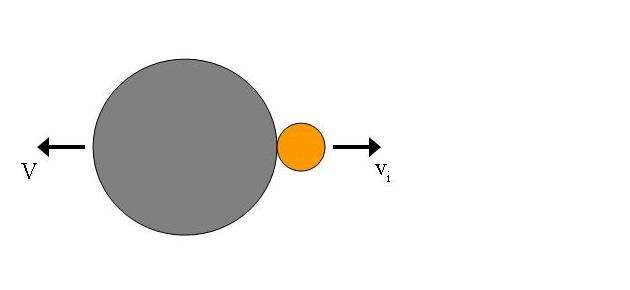
Say we have a body that is initially at rest. at some point, emits a particle, as shown in the figure below.
 The larger body moves with velocity V, while the smaller body moves with velocity v_i. These two values are related to each other via conservation of momentum.
Now, let's say that the smaller body then accelerates, by some means, to some final velocity, as shown below.

There are several problems with such a question, and this certainly qualifies as a "When did you stop beating your wife?"-type of question. Why? Because it assumes, a priori, that photons CAN have speeds other than c in vacuum. This is not verified. So the idea that a photon gets born with some low speeds is not an idea that has any physical basis, and thus, the starting point is all wrong.
Secondly, there is a problem in reconciling our experimental evidence with such a scenario. Let's look at this carefully.
Say we have a body that is initially at rest. at some point, emits a particle, as shown in the figure below.
Now, let's say that the smaller body then accelerates, by some means, to some final velocity, as shown below.
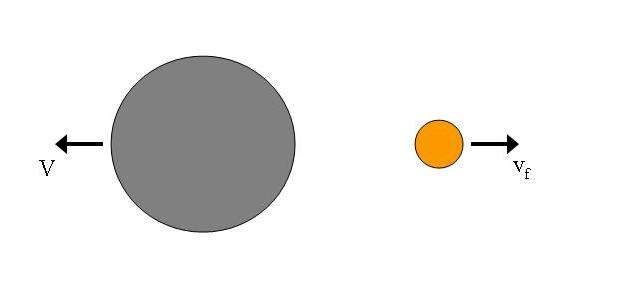
However, this final velocity v_f has no directly relations to V, i.e. it isn't correlated to V since the conservation of momentum of the two bodies no longer is relevant here. v_f no longer carries any direct information about V.
So let's look at what we know about such a thing. Atomic recoil, electron recoil, and a while bunch of other experiments on photo emission and photon collision experiments have shown that what we measure in such interactions totally conserve momentum. In other words, we measure v_f (since it was already at c for photon), and this v_f is still correlated to V via a direct conservation of momentum. This clearly means that v_f is equal to v_i, and therefore, there is no "acceleration" of photons
This scenario applies to a whole zoo of fundamental particles as well since the same conservation law applies to many such interactions involving these particles.
Zz.
Thursday, June 07, 2012
Light Shows Non-Classical Properties, But I Don't Get It
OK, this is where you can help me understand this paper in the context of the press report.
This is the paper:
E. Kot et al., "Breakdown of the Classical Description of a Local System", Phys. Rev. Lett., v.08, p.233601 (2012).
Abstract: We provide a straightforward demonstration of a fundamental difference between classical and quantum mechanics for a single local system: namely, the absence of a joint probability distribution of the position x and momentum p. Elaborating on a recently reported criterion by Bednorz and Belzig [ Phys. Rev. A 83 052113 (2011)] we derive a simple criterion that must be fulfilled for any joint probability distribution in classical physics. We demonstrate the violation of this criterion using the homodyne measurement of a single photon state, thus proving a straightforward signature of the breakdown of a classical description of the underlying state. Most importantly, the criterion used does not rely on quantum mechanics and can thus be used to demonstrate nonclassicality of systems not immediately apparent to exhibit quantum behavior. The criterion is directly applicable to any system described by the continuous canonical variables x and p, such as a mechanical or an electrical oscillator and a collective spin of a large ensemble.
From a quick reading of the paper, they are trying to show this:
Fine. However, here's the press release of this work. The lead author was interviewed, and said this:
Zz.
This is the paper:
E. Kot et al., "Breakdown of the Classical Description of a Local System", Phys. Rev. Lett., v.08, p.233601 (2012).
Abstract: We provide a straightforward demonstration of a fundamental difference between classical and quantum mechanics for a single local system: namely, the absence of a joint probability distribution of the position x and momentum p. Elaborating on a recently reported criterion by Bednorz and Belzig [ Phys. Rev. A 83 052113 (2011)] we derive a simple criterion that must be fulfilled for any joint probability distribution in classical physics. We demonstrate the violation of this criterion using the homodyne measurement of a single photon state, thus proving a straightforward signature of the breakdown of a classical description of the underlying state. Most importantly, the criterion used does not rely on quantum mechanics and can thus be used to demonstrate nonclassicality of systems not immediately apparent to exhibit quantum behavior. The criterion is directly applicable to any system described by the continuous canonical variables x and p, such as a mechanical or an electrical oscillator and a collective spin of a large ensemble.
From a quick reading of the paper, they are trying to show this:
Classically, the phase space distribution Wðxi; piÞ is the joint probability of finding the system in an infinitesimal area around x = x_i, p = p_i, and hence it obeys all the requirements of a probability distribution including being a non-negative function. As mentioned, in the case of a quantum phase space formulation, introduced by Wigner [9], the Heisenberg uncertainty renders this definition meaningless, as a joint probability distribution for x and p does not exist. The phase space distribution is only defined through the single coordinate (marginal) distributions, projected from the distribution function [10] and this relaxation of constraints allows for negative values of the function in areas smaller than hbar. This negativity is not directly observable due to the vacuum fluctuations preventing simultaneous measurement of x and p. However, one can still infer the phase space distribution from measurements of only a single observable at a time and detect such negativities, thereby illuminating the failure of classical theory.I think they showed this in Fig. 2.
Fine. However, here's the press release of this work. The lead author was interviewed, and said this:
Based on a series of experiments in the quantum optics laboratories, they examined the state of light. In classical physics, light possesses both an electric and a magnetic field.Electric and magnetic field? Not at the same time? What did I miss? The press release doesn't seem to have any resemblance (at least in terms of the experiment and what is being measured) with the actual paper. Can someone clarify this for me?
“What our study demonstrated was that light can have both an electric and a magnetic field, but not at the same time. We thus provide a simple proof that an experiment breaks the classical principles. That is to say, we showed light possesses quantum properties, and we can expand this to other systems as well” says Eran Kot.
Zz.
Thursday, June 16, 2011
Single Photons Obey Light Speed Limit
A very interesting report on the latest effort to measure the speed of light of single photons[1]. Even in an anomalous dispersive material where the group velocity can be "superluminal" such as in the infamous NEC experiment, no part of the wave actually moves faster than c. This experiment confirms it.
Zz.
[1] S. Zhang et al., Phys. Rev. Lett. v.106, p.243602 (2011).
Zz.
[1] S. Zhang et al., Phys. Rev. Lett. v.106, p.243602 (2011).
Saturday, June 11, 2011
"Improved PMTs for the Cherenkov Telescope Array"
A talk at the TIPP conference going on now in the Photon Detector session. This one is presented by Razmik Mirzoyan of Max Planck Institute. It's a fascinating look at what can already be achieved now for the CTA effort, and a hint of what might be possible in the future simply based on existing technology.
The core people in the CTA are MAGIC, HESS and VERITAS collaborations. It is an initiative to buld the next generation of large ground-based gamma ray detector, with 10 times higher sensitivity. They want to study AGNs, Black holes, gamma ray burst, and galactic sources (pulsars, supernovae, etc. Energy range is from 10 GeV to 100 TeV. Try to answer long-standing question about origin of cosmic rays. Planning on ~100 telescope, 2-arrays (south and north pole).
3 types of telescopes are planned, Large: 23 m, midsize 12 m, and small 4-7 m diameter. Use standard PMTs and maybe SiPM.
PMTs mainly from Hamamatsu and Electron Tubes, with QE peaking around 35-40% at around 400 nm. He selected the 1.5" PMT and discussed at length the property of the PMTs from the two companies. These are the ones being considered for the CTA, I presumed, if not used already.
Zz.
The core people in the CTA are MAGIC, HESS and VERITAS collaborations. It is an initiative to buld the next generation of large ground-based gamma ray detector, with 10 times higher sensitivity. They want to study AGNs, Black holes, gamma ray burst, and galactic sources (pulsars, supernovae, etc. Energy range is from 10 GeV to 100 TeV. Try to answer long-standing question about origin of cosmic rays. Planning on ~100 telescope, 2-arrays (south and north pole).
3 types of telescopes are planned, Large: 23 m, midsize 12 m, and small 4-7 m diameter. Use standard PMTs and maybe SiPM.
PMTs mainly from Hamamatsu and Electron Tubes, with QE peaking around 35-40% at around 400 nm. He selected the 1.5" PMT and discussed at length the property of the PMTs from the two companies. These are the ones being considered for the CTA, I presumed, if not used already.
Zz.
Wednesday, April 14, 2010
Photon Detector With 99% Efficiency?
Whoa!
NIST scientists are reporting a new detection scheme that reportedly can get up to 99% efficiency.
I wonder if such a detector can be employed in the Bell-type experiments. This type of efficiency can greatly reduce the background subtraction and also lay to rest the detection loophole argument.
Zz.
NIST scientists are reporting a new detection scheme that reportedly can get up to 99% efficiency.
Using essentially the same technology that permitted them to achieve 88 percent detection efficiency five years ago,** the team has enhanced its ability to detect photons largely by improving the alignment of the detector and the optical fibers that guide photons into it. The basic principle of the detector is to use a superconductor as an ultra-sensitive thermometer. Each individual photon hitting the detector raises the temperature—and increases electrical resistance—by a minute amount, which the instrument registers as the presence of a photon.
According to team member Sae Woo Nam, the advantage of this type of single photon detector is that the new detector design not only measures lower levels of light than have ever been possible, but does so with great accuracy.
I wonder if such a detector can be employed in the Bell-type experiments. This type of efficiency can greatly reduce the background subtraction and also lay to rest the detection loophole argument.
Zz.
A Hands-On Introduction to Single Photons and Quantum Mechanics for Undergraduates
This is another very useful demonstration for undergraduate students on the quantum effect of light, and how it differs from the classical description. Fascinatingly enough, it appears that this is a lab at the sophomore level. Maybe sophomores nowadays are more "sophisticated" than when I was in college, but this certainly would require quite a bit more knowledge of QM than I would have had back then at this level.
Abstract: We describe a series of experiments used in a sophomore-level quantum physics course that are designed to provide students with a hands-on introduction to quantum mechanics. By measuring correlations, we demonstrate that a helium-neon laser produces results consistent with a classical model of light. We then demonstrate that a light source derived from a spontaneous parametric down-conversion process produces results that can only be described using a quantum theory of light, thus providing a (nearly) single-photon source. These single photons are then sent into a Mach–Zehnder interferometer, and interference fringes are observed whenever the path of the photons cannot be determined. These experiments are investigated theoretically using straightforward quantum-mechanical calculations.
B.J. Pearson and D.P. Jackson, Am. J. Phys. v.78, p.471 (2010).
What makes this paper so wonderful is that it is full of various references and resources, and also discussed many of the physics background information. So for someone who wants to learn about the physics of the phenomena, this is almost a one-stop shop.
This paper compliments the ones that I've mentioned earlier that were also undergraduate laboratory or demonstration.
Zz.
Abstract: We describe a series of experiments used in a sophomore-level quantum physics course that are designed to provide students with a hands-on introduction to quantum mechanics. By measuring correlations, we demonstrate that a helium-neon laser produces results consistent with a classical model of light. We then demonstrate that a light source derived from a spontaneous parametric down-conversion process produces results that can only be described using a quantum theory of light, thus providing a (nearly) single-photon source. These single photons are then sent into a Mach–Zehnder interferometer, and interference fringes are observed whenever the path of the photons cannot be determined. These experiments are investigated theoretically using straightforward quantum-mechanical calculations.
B.J. Pearson and D.P. Jackson, Am. J. Phys. v.78, p.471 (2010).
What makes this paper so wonderful is that it is full of various references and resources, and also discussed many of the physics background information. So for someone who wants to learn about the physics of the phenomena, this is almost a one-stop shop.
This paper compliments the ones that I've mentioned earlier that were also undergraduate laboratory or demonstration.
Zz.
Wednesday, October 07, 2009
Yoctosecond Photon Pulse?
We have had attosecond and zeptosecond time scale for photon pulses, but now comes yoctosecond! I'm not all that up on these various terminology, and I had to go look up what yoctosecond is. It is 10^-24 second. A new paper published in PRL this week talks about the possibility of producing photon pulses of that time scale from heavy-ion collisions such as from the one at RHIC[1].
What comes after yoctosecond?
Zz.
[1] A. Ipp et al., Phys. Rev. Lett. v.103, p.152301 (2009).
Edit : There's a coverage of this work in APS Physics. You might even get free access to the paper!
What comes after yoctosecond?
Zz.
[1] A. Ipp et al., Phys. Rev. Lett. v.103, p.152301 (2009).
Edit : There's a coverage of this work in APS Physics. You might even get free access to the paper!
Wednesday, February 11, 2009
Nanocrystals Shown to Generate More Than One Electron Per Absorbed Photon
This is rather interesting, especially when I missed all the controversy regarding the earlier, similar claim.
Scientists out of Los Alamos have reconfirmed their findings that in certain nanocrystal, one absorbed photon can produce more than one free electron in the conduction band.
If this finding is true, then one immediate direct implication is that one could produce a more efficient solar cells.
I'll try to hunt for the exact reference (I hate press releases like this since they do not include the exact citation) and post it here when I find it.
Zz.
Scientists out of Los Alamos have reconfirmed their findings that in certain nanocrystal, one absorbed photon can produce more than one free electron in the conduction band.
When a conventional solar cell absorbs a photon of light, it frees an electron to generate an electrical current. Energy in excess of the amount needed to promote an electron into a conducting state is lost as heat to atomic vibrations (phonons) in the material lattice. Through carrier multiplication, excess energy can be transferred to another electron instead of the material lattice, freeing it to generate electrical current—thereby yielding a more efficient solar cell.
Klimov and colleagues have shown that nanocrystals of certain semiconductor materials can generate more than one electron after absorbing a photon. This is partly due to strengthened interactions between electrons squeezed together within the confines of the nanoscale particles.
If this finding is true, then one immediate direct implication is that one could produce a more efficient solar cells.
I'll try to hunt for the exact reference (I hate press releases like this since they do not include the exact citation) and post it here when I find it.
Zz.
Monday, January 07, 2008
Quantum Behavior of Light In Undergraduate Laboratory
While the Compton effect and the photoelectric effect are often used as "evidence" of photons, they actually cannot rule out completely the wave picture. The more definitive experiment would be the which-way experiment or the coincidence experiment. I find it rather amazing that such experiments are now within the realm of an undergraduate laboratory exercise.
There were 2 papers published in the American Journal of Physics that provided a very detailed description of such experiments suitable for such undergraduate laboratory. The first one is by J.J. Thorn et al. Here, they did the coincidence measurement that basically reproduced (with better equipment) an earlier Graingier et al. experiment. The second one by C.H. Holbrow et al. describes 5 different possible experiments (and theory to accompany them) to illustrate the photon pictures. No experimental result was reported in this paper.
Both papers contain a wealth of references, especially to other similar experiments that have already been done. That alone is worth keeping these two papers handy.
Zz.
There were 2 papers published in the American Journal of Physics that provided a very detailed description of such experiments suitable for such undergraduate laboratory. The first one is by J.J. Thorn et al. Here, they did the coincidence measurement that basically reproduced (with better equipment) an earlier Graingier et al. experiment. The second one by C.H. Holbrow et al. describes 5 different possible experiments (and theory to accompany them) to illustrate the photon pictures. No experimental result was reported in this paper.
Both papers contain a wealth of references, especially to other similar experiments that have already been done. That alone is worth keeping these two papers handy.
Zz.
Friday, September 28, 2007
Quantum Weirdness In A Lab
A terrific experiment has been reported in the new issue of Science which you shouldn't miss.
V. Parigi et al., "Probing Quantum Commutation Rules by Addition and Subtraction of Single Photons to/from a Light Field", Science v.317, p.1890 (2007).
Abstract: The possibility of arbitrarily "adding" and "subtracting" single photons to and from a light field may give access to a complete engineering of quantum states and to fundamental quantum phenomena. We experimentally implemented simple alternated sequences of photon creation and annihilation on a thermal field and used quantum tomography to verify the peculiar character of the resulting light states. In particular, as the final states depend on the order in which the two actions are performed, we directly observed the noncommutativity of the creation and annihilation operators, one of the cardinal concepts of quantum mechanics, at the basis of the quantum behavior of light. These results represent a step toward the full quantum control of a field and may provide new resources for quantum information protocols.
Read also the Perspective on this paper by R. Boyd et al. in the same issue of the journal. In that Perspective, the description of what has been accomplished can be summed up in these 2 paragraphs:
This is such a clever experiment. And one would think that for people who are still dissing the photon concept, this is almost a smack in the face. One can only hope....
Zz.
V. Parigi et al., "Probing Quantum Commutation Rules by Addition and Subtraction of Single Photons to/from a Light Field", Science v.317, p.1890 (2007).
Abstract: The possibility of arbitrarily "adding" and "subtracting" single photons to and from a light field may give access to a complete engineering of quantum states and to fundamental quantum phenomena. We experimentally implemented simple alternated sequences of photon creation and annihilation on a thermal field and used quantum tomography to verify the peculiar character of the resulting light states. In particular, as the final states depend on the order in which the two actions are performed, we directly observed the noncommutativity of the creation and annihilation operators, one of the cardinal concepts of quantum mechanics, at the basis of the quantum behavior of light. These results represent a step toward the full quantum control of a field and may provide new resources for quantum information protocols.
Read also the Perspective on this paper by R. Boyd et al. in the same issue of the journal. In that Perspective, the description of what has been accomplished can be summed up in these 2 paragraphs:
In an intriguing and illustrative report on page 1890 of this issue, Parigi et al. present the results of a laboratory demonstration of what happens in the quantum mechanical operations of photon creation and annihilation, which lacks commutativity. These authors add a single photon to a light beam, which corresponds to the action of the standard quantum mechanical creation operator â. They can also subtract a single photon from the light beam, which corresponds to the annihilation operator a.
Parigi et al. measure the quantum mechanical state of a thermal light field after performing these two operations on it, and they show that the final state depends on the order in which the operations are performed. This result is a striking confirmation of the lack of commutativity of quantum mechanical operators. Moreover, the authors present the strongly counterintuitive result that, under certain conditions, the removal of a photon from a light field can lead to an increase in the mean number of photons in that light field, as predicted earlier.
This is such a clever experiment. And one would think that for people who are still dissing the photon concept, this is almost a smack in the face. One can only hope....
Zz.
Wednesday, August 22, 2007
Light Collapses Step-By-Step
This is such a cool experiment. They are able to make non-destructive measurement of the photon number in a superconducting cavity, and then as they successively make this measurement, they begin to see the result converging (collapsing?) to a single number. Just exactly what quantum mechanics described!
The exact citation for this paper is C. Guerlin et al. Nature 448, 889 (2007).
Zz.
The exact citation for this paper is C. Guerlin et al. Nature 448, 889 (2007).
Zz.
Subscribe to:
Posts (Atom)