Showing posts with label Photoemission. Show all posts

Wednesday, April 06, 2022

Signature of Tc Inside the ARPES Pseudogap?

The physics of high-Tc superconductors (or the cuprate superconductors) continues to be elusive. After its first discovery in mid 1980's, a coherent and consistent theory on why this family of material becomes superconducting is still up for debate. There are candidate theories, but we do not have an accepted consensus as of yet.

One of the main reason for this is that this is such a rich and complex material, exhibiting so many different characteristics and puzzles. As a result, different versions of theories are competing to describe as many of the experimental results as possible. But the target is also moving. As our instrumentation improves, we are discovering new, more subtle, and more refined behavior of these material that we haven't seen before.

The existence of the so-called pseudogap in the cuprates is well-known. I've posted several articles on them. This is the gap in the single-particle spectral function that opens up well above the transition temperature Tc. In conventional superconductors, the formation of this gap coincides with Tc, below which the material becomes superconducting. However, in the cuprates, and especially in the underdoped cuprates (less oxygen doping than the optimally-doped), a gap opens up well above the Tc. The material doesn't become superconducting yet even as you lower the temperature even more. It is only when the temperature gets to Tc will the material becomes superconducting.

The origin of this pseudogap has long been debated. The posts that I had made discussed all this. However, in this new paper published in Nature (the article I linked too erroneously wrote "Science" at the time of this citation), the Z-X Shen group out of Stanford has detected the signature of Tc in the pseudogap region from ARPES measurement. But what is interesting here is that it was detected in the overdoped cuprate Bi2212.

Typically, the overdoped regime of the cuprates does not exhibit clear pseudogap signatures. When I studied a highly-overdopped Bi2212 using ARPES a long time ago, we did not detect any pseudogap at all since we saw the opening of the gap only at the bulk Tc value. Of course, this does not mean it wasn't there because it depends on the temperature resolution of our experiment. So it is rather interesting that this study decided to focus on the overdoped region where the pseudogap is more difficult to detect, as opposed to the optimally-doped or underdoped region where the pseudogap is much more obvious.

In any case, they apparently saw spectroscopic signatures of Tc within the pseudogap as the material cools down through Tc. According to them, this seems to be a strong evidence in support of a phase fluctuation (spin fluctuation?) model as the driving mechanism for superconductivity in these materials.

I tell ya, almost 40 years since its discovery, the cuprates continue to amaze and surprise us!

Zz.

Wednesday, September 26, 2018

How Fast Is The Photoelectric Effect?

Every student who studied modern physics in an undergraduate General Physics course would have encountered the photoelectric effect. It is a phenomenon that has a special place in the history of physics, and the theoretical description of this phenomenon gave Einstein his Nobel Prize.

So one would think that this is a done deal already, and we should know all there is to know about it. In some sense, we do. We know enough about it that we have expanded this phenomenon to be included in a more general phenomenon called photoemission. We use this phenomenon to study many things, including band structure of materials. So it is very well-known.

Yet, as with so many things in physics, the more we study it, the more we want to know the minute details of it. In this case, the current study is on how fast an electron is emitted from a material once light impinges upon it. In other words, from the moment a photon is absorbed, how quickly does the electron is liberated from the material?

This is not that easy to answer because, well, one can already guess at how would one determine (i) the exact time when one photon is absorbed into a material, and (ii) the exact time when an electron  is liberated due to that absorbed photon. On top of that, this may be a very fast process, so how does one measure a time scale that is almost instantaneous?

The authors of this latest paper[1] came up with a very ingenious method to determine this, and in the process, they have elucidated even more the various stages of what is involved in the photoelectric effect. But before we continue, let's get one thing very clear here.

The "photoelectric effect" that we know and love, and the one that Millikan studied, is the phenomenon whereby UV light is shown onto a metallic surface (cathode). We know now that this is an emission process of electrons coming from the metal's conduction band. This is important because, as this new study shows, this process is different than the emission from core levels (i.e. not from the continuous conduction band). Those of us who have done photoemission work using both UV and x-rays can attest to such differences.

The experiment in this report was done on a tungsten surface, or more specifically, W(110) surface. The hard UV light that was used allowed them to get photoemission from the conduction band and a core-level state.

What they found was that from the time that a photon is absorbed to the moment that an electron is emitted, the time for the process for a conduction electron is ~ 45 as, while for a core-level electron is ~100 as.

{as = attosecond = 1 x 10^(-18) second}

So the emission from core-level takes more than twice as long to occur. In their analysis, the authors stressed this conclusion:

These findings highlight that proper accounting for the initial creation, origin, transport and scattering of electrons is imperative for the proper description of the photoelectric effect.

Bill Spicer's 3-step model of photoemission process certainly highlighted the fact that it isn't a simple process. This paper not only reinforce that, but also included the effect of surface states in the influence to emission time and thus, possibly influencing other properties of the emitted photoelectron. 

There are many things in physics which we know a lot of. But these are also areas in which we continue to dig deeper to find out even more. There will never be a point where we know everything there is to know, even with established ideas and phenomena.

Zz.

[1] M. Ossiander et al., Nature 561, 374 (2018). https://www.nature.com/articles/s41586-018-0503-6
Summary of this work can be found here.

Friday, September 14, 2018

Bismuthates Superconductors Appear To Be Conventional

A lot of people overlooked the fact that during the early days of the discovery of high-Tc superconductors, there was another "family" of superconductors beyond just the cuprates (i.e. those compounds having copper-oxide layers). These compounds are called bismuthates, where instead of having copper-oxide layers, they have bismuth-oxide layers. Otherwise, their crystal structures are similar to the cuprates.

They didn't make that much of a noise at that time because Tc for this family of material tends to be lower than the cuprates. And, even back then, there were already evidence that the bismuthates superconductors might be "boring", i.e. the results that they have produced looked like they might be a conventional superconductor. This is supported by several experiments, including a tunneling experiment[1] that showed that the phonon density of states obtained from tunneling data matches that of the density of states obtained from neutron scattering.

Now it seems that there is more evidence that the bismuthates are conventional BCS superconductors, and it comes from ARPES experiment[2]. There have been no ARPES measurement done on bismuthates before this because it had been a serious challenge to get a single-crystal of this compound large enough to perform such an experiment. But obviously, large-enough single-crystals have been synthesized.

In this latest experiment, they look at the band structure of this compound, and extract, among others, the strong electron-phonon coupling that matches the superconducting gap. This strongly indicates that phonons are the "glue" in the superconducting mechanism for this compound.

So this adds another piece of the puzzle for the whole mystery of the origin of superconductivity in the cuprates. Certainly, having similar layered crystal structure does not discount being a conventional superconductor. Yet, the cuprates have very different behavior when we perform tunneling and ARPES experiments, and they certainly have higher Tc's.

The mystery continues.

Zz.

[1] Q. Huang et al. Nature v347, p369 (1990).
[2] CHP. Wen et al. PRL  121, 117002 (2018). https://arxiv.org/abs/1802.10507

Wednesday, July 18, 2018

Khan Academy's Photoelectric Effect Video Lesson

A lot of people use Khan Academy's video lessons. I know that they are quite popular, and I often time get asked about some of the material in the video, both by my students and also in online discussions. Generally, I have no problems with their videos, but I often wonder who exactly design the content of the videos, because I often find subtle issues and problems. It is not unusual for me to find that they were inaccurate in some things, and these are usually not the type of errors that say, an expert in such subjects would make.

I was asked about this photoelectric effect lesson by someone about a month ago. I've seen it before but never paid much attention to it till now. And now I think I should have looked at it closer, because there are a couple of misleading and inaccurate information about this.

Here is the video:


First, let's tackled the title here, because it is perpetuating a misconception.

Photoelectric effect | Electronic structure of atoms
First of all, the photoelectric effect doesn't have anything to do with "structure of atoms". It has, however, something to do with the structure of the solid metal! The work function, for example, is not part of an atom's energy level. Rather, it is due to the combination of all the atoms of the metal, forming this BANDS of energy. Such bands do not occur in individual atoms. This is why metals have conduction band and atoms do not.

We need to get people to understand that solid state physics is not identical to atomic/molecular physics. When many atoms get together to form a solid, their behavior as a conglomerate is different than their behavior as individual atoms. For many practical purpose, the atoms lose their individuality and instead, form a collective property. This is the most important message that you can learn from this.

And now, the content of the video. I guess the video is trying to tackle a very narrow topic on how to use Einstein's equation, but they are very sloppy on the language that they use. First of all, if you don't know anything else, from the video, you'd get the impression that a photon is an ordinary type of "particle", much like an electron. The illustration of a photon reinforced this erroneous picture. So let's be clear here. A "photon" is not a typical "particle" that we think of. It isn't defined by its "size" or shape. Rather, it is an entity that carries a specific amount of energy and momentum (and angular momentum). That's almost all that we can say without getting into further complications of QED.

But the most serious inaccuracy in the video is when it tackled the energy needed to liberate an electron from the metal. This energy was labelled as E_0. This was then equate to the work function of the metal.

E_0 is equal to the work function of the metal ONLY for the most energetic photoelectrons. It is not the work function for all the other photoelectrons. Photoelectrons are emitted with a range of energies. This is because they came from conduction electrons that are at the Fermi energy or below it. If they came from the Fermi energy, then they only have to overcome the work function. These will correspond to the most energetic photoelectrons. However, if they come from below the Fermi energy, then they have to overcome not only the work function, but also the binding energy. So the kinetic energy of these photoelectrons are not as high as the most energetic ones. So their "E_0" is NOT equal to the work function.

This is why when we have students do the photoelectric effect experiments in General Physics courses, we ask them to find the stopping potential, which is the potential that will stop the most energetic photoelectrons from reaching the anode. Only the info given by these most energetic photoelectrons will give you directly the work function.

Certainly, I don't think that this will affect the viewers ability to use the Einstein equation, which was probably the main purpose of the video. But there is an opportunity here to not mislead the viewers and make the video tighter and more accurate. It also might save many of us from having to explain to other people when they tried to go into this deeper (especially students of physics). For a video that is viewed by such a wide audience, this is not the type of inaccuracies that I expect for them to have missed.

Zz.

Wednesday, July 06, 2016

Photoemission Spectroscopy - Fundamental Aspects

I don't know if this is a chapter out of a book, or if this is a lecture material, or what, but it has a rather comprehensive coverage of photoionization, Auger, and photoemission in solids. I also don't know how long the document will be available (web links come and go, it seems). So if this is something you're interested in, it might be something you want to download.

At the very least, it has an extensive collection of references, ranging from Hertz's discovery of the photoelectric effect, to Einstein's photoelectric effect paper of 1905, all the way to Spicer's 3-step model and recent progress in ARPES.

Zz.

Tuesday, September 08, 2015

Another Discovery of Weyl Fermions

We had an earlier report out of Science by the Princeton group on the discovery of the Weyl fermions in TaAs. This looks like another confirmation of that discovery on the same material using the same technique, out of a group in China.

In their experiments, Hasan and colleagues and Ding and colleagues used angle-resolved photoemission spectroscopy (ARPES) to detect the Fermi arcs, characteristic of Weyl nodes, on the surface of TaAs. ARPES is an ideal tool for such a purpose. The technique involves shining light on a surface and measuring the energy and momentum of ejected electrons. This allows for the explicit determination of both bulk nodes and the Fermi-arc surface states. Ding’s team used an interesting strategy to identify a Fermi arc and distinguish it from a more conventional closed Fermi surface (Fig. 1). They defined a closed contour in the momentum space spanned by their measurements and investigated how many times surface states at the Fermi energy crossed this contour. Such a contour will intersect a regular Fermi surface an even number of times. But it will intersect a Fermi arc an odd number of times if the arc encloses the projection of a Weyl point, thus providing a clean signature.

Click the link to get a copy of the actual paper.

Zz.

Wednesday, July 29, 2015

Weyl Fermions

This is a bit late, but what they hey....

Here is another triumph out of condensed matter physics experiment. This is the first reported discovery of the Weyl fermions, first predicted and now found in a Tantalum arsenide compound.

Another solution of the Dirac equation – this time for massless particles – was derived in 1929 by the German mathematician Hermann Weyl. For some time it was thought that neutrinos were Weyl fermions, but now it looks almost certain that neutrinos have mass and are therefore not Weyl particles.

Now, a group headed by Zahid Hasan at Princeton University has found evidence that Weyl fermions exist as quasiparticles – collective excitations of electrons – in the semimetal tanatalum arsenide (TaAs).

For those who are keeping score, this means that these condensed matter systems have, so far, detected Majorana fermions, and analogous signatures of magnetic monopoles.

And many people still think condensed matter physics is all "applied" and not "fundamental"?

Zz.

Monday, October 08, 2012

Work Function And Photoemission Threshold

It is no secret to anyone who has read this blog for a while that I do not like Wikipedia. I think that there's a fundamental flaw with the whole concept and philosophy of it. While I think that it may be useful to many who need a quick lookup for something, it is unfortunate that even more are using it almost as their primary source of information. And this is scary considering that (i) the validity of the information being presented is never guaranteed and (ii) the pedagogical presentation of the material is often shoddy, making the subject even more confusing.

I often get asked to look at such-and-such Wikipedia entry, or someone is trying to convince me of something and using a Wikipedia entry as a "reference" to back up his/her argument. It is usually during such instances that I find inaccuracies, confusing statements, and something outright errors in such entries. I was doing my own search on something a few minutes ago, and I decided, out of curiosity, to see what Wikipedia has to say about "Work Function". Now, keep in mind that this is a common terminology, especially for physics students, since the photoelectric effect is a "must-know" topic for these students. One would think that this should be a topic that a Wikipedia entry would get it right, considering how many people would look up such a thing, AND, the fact that errors and inaccuracy would, by now, be ironed out.

WRONG!

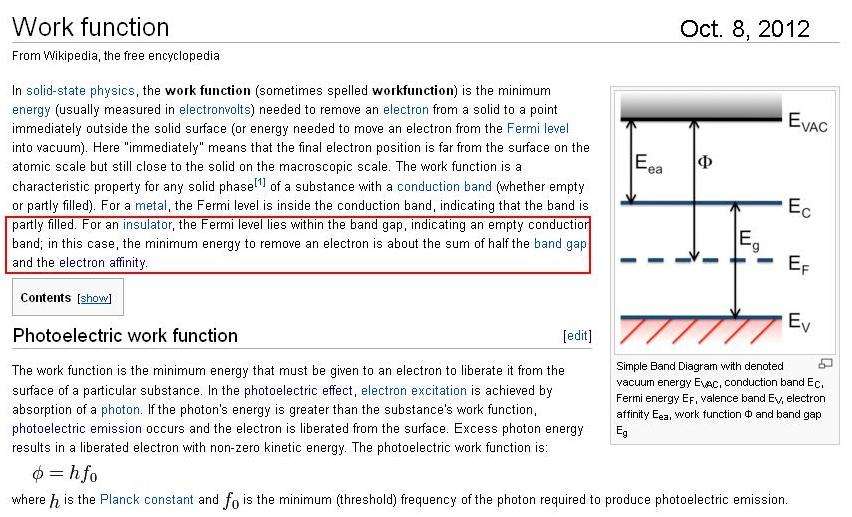
This is what I saw on the Wikipedia page TODAY.

I posted today's date in the screen capture as a date stamp on when this was viewed.

The offending passage has been highlighted with a red box. Let's look at it closely, shall we?

The description here is on what happened for an insulator (or a semiconductor, for that matter). The figure shown is the simplified band diagram for such a system (i.e. an intrinsic semiconductor, for example), and defines the various quantities such as the work function, band gap, electron affinity, etc. The problematic statement says this:

For an insulator, the Fermi level lies within the band gap, indicating an empty conduction band; in this case, the minimum energy to remove an electron is about the sum of half the band gap and the electron affinity.
 The first part of that paragraph which says ".... For an insulator, the Fermi level lies within the band gap, indicating an empty conduction band ..." is OK. However, the second part is very puzzling and an outright error : "... in this case, the minimum energy to remove an electron is about the sum of half the band gap and the electron affinity ..."

Whoever wrote this is STILL thinking that the work function (Phi) is still the minimum energy needed to produce photoemission, as in the case of a metal. This is FALSE, and anyone who looks at the band diagram can tell. Half of the band gap plus the electron affinity is the work function Phi, but this is the energy between the vacuum level and the Fermi level. The Fermi level for insulator/semiconductor has NO STATES, and thus, no electrons to excite! After all, it resides in the band gap! So what is being excited here?

For an insulator/semiconductor, while the work function may still be defined as the energy between the Fermi level and the vacuum level, it no longer corresponds to the photoemission threshold! The photoemission threshold now is the full band gap energy PLUS the electron affinity. You need to excite, at the minimum, the electrons from the top of the valence band to the vacuum level. One can see this clearly by looking at the band diagram in the figure.

I hope no one was using on this Wikipedia entry for something useful or important.

Zz.

Thursday, May 05, 2011

Bosons In High Temperature Superconductors: An Experimental Survey

This is a wonderful review article on the issue of the bosonic mode that couples to the quasiparticle in the cuprate superconductors[1]. Deciphering the nature of this boson is THE key issue in the mechanism of superconductivity for this family of material. This article compiles the relevant experimental data from angle-resolved photoemission spectroscopy (ARPES), optical measurement, and tunneling spectroscopy, to present the state of knowledge about this bosonic mode.

What makes this article even more useful is that, if you're not familiar with the physics surrounding these techniques, especially for ARPES and optical conductivity, it provides a nice brief summary of these techniques and what they actually measure that can provide the information needed.

A highly useful article, in more ways than one.

Zz.

[1] http://arxiv.org/abs/1105.0726

Friday, March 25, 2011

Mind The Pseudogap

If there is a sequel to "Beware of the Pseudogap", this would be it.

In the earlier paper, they reported observing two distinctive gaps for the cuprate superconductors - one that is associated with the superconducting gap, while the other is of a different nature and thus, competes with superconductivity. Finding the true nature of the pseudogap is extremely important, since it can be determined, once and for all, if this gap that exists above Tc, the critical temperature, has anything to do with superconducting mechanism at all - is it a precursor to superconductivity, or is it competing with it. This paper said yes to both.

Now comes another interesting report[1]. This time they studied the optimally-doped cuprate superconducting compound Bi2201 using three different techniques: ARPES, polar Kerr effect, and time-resolved reflectivity. What they discovered is quite interesting. They claim that the onset of T* (the pseudogap temperature) is a phase transition into a non-superconducting broken-symmetry state.

But then, what about the question on whether there are two distinctive gaps in the superconducting phase, as claimed in the earlier paper? This is what they have to say:

Below Tc, the nodal arc is gapped with a dwave–like structure suggestive of a dominantly superconducting origin (38). In contrast, in the antinodal region, rather than one order being dominant, or the two gaps of both orders adding in quadrature, the spectral function develops a complex structure with two energy scales below EF of mixed origin, a larger one being primarily associated with the pseudogap order and a smaller one with the superconducting order.

Fascinating! Essentially, they observe the same thing, i.e. two different gaps, albeit it in the antinodal region of the Brillouin zone. So there is some consistencies here with this respect.

I certainly don't doubt that more studies on this will be forthcoming. But at least now we can start to consider separating the two different origins of the gaps this amazingly-complex material.

Zz.

[1] R.-H. He et al., Science v.331, p.1579 (2011).

Monday, January 10, 2011

High-Tc Superconductors Are Very Kinky - Update 10

A new preprint on arXiv today analyzes the low-energy kink in the dispersion curve on Bi-2212 high-Tc superconductor. They concluded that this low energy kink (smaller than the gap) is due to an in-plane acousting phonon branch.

So this adds more intrigue to the picture. The cuprate superconductors seems to have a lot of "kinks" in the band structure. Last count, we now have 3. To catch up on all the issues surrounding this, read my first entry on the kink structure that we have seen from ARPES measurement. That entry will be continually updated as more papers and new stuff are published.

Zz.

Thursday, October 14, 2010

Photocathode for Photoinjectors

I've been attending a workshop this week on photocathodes for photoinjectors. With more stringent requirements and more demanding environment that these photocathodes are subjected to (example: higher field gradients, extremely low emittance, etc.), there is a deliberate effort to understand even more the physics of photocathodes and photoemission processes using various materials and processing techniques.

Historically, most of the emphasis has been on getting a stable photocathode, or something with sufficient quantum efficiency (QE) with long lifetimes. Metal photocathdoes have been the workhorse for many photoinjectors (such as synchrotron light sources) because they are relatively easier to fabricate, long life times, and not very fussy. But metals such as copper or niobium have very low QE, and with new demands on producing high brightness electron beam, new materials, or new processing/treatment are being investigated.

What is very exciting now in this area of study is that, there is a new influx of experts from the condensed matter/material science field studying photocathodes specifically for accelerator photoinjectors. This is important because, while there have been such experts scattered around studying these photocathodes, there hasn't been a coordinated effort to get more of these experts in, both with theorists or experimentalists. CM theorists are needed because there are many aspects of the photoemission process that resulted in high QE and low emittance beam that needed to be modeled or explained. Experimentalists are needed because they have a wealth of material characterization knowledge that are needed to study the nature of the surface and the nature of the material, and they provide feedback to theorists to make accurate models. At this workshop, there is a major presence CM theorists and experimentalists, and I think people in both accelerator physics and condensed matter/material science/physical chemistry realize that there's A LOT of work that can be done in the study of photocathodes, even though a lot has already been known.

I'm very excited with this development. As someone who came from condensed matter physics and now working in accelerator physics, I've always realized the importance of these two fields getting together and combining their expertise to solve the various problems in photocathodes. In fact, this issue doesn't just affect the application of photocathodes to accelerator photoinjector. It has a direct consequence to many photocathode applications, such as photodetectors, and this includes things such as high energy physics detector (neutrino detectors) and even night-vision goggles. So the impact of the understanding of a better understanding of the physics can be very wide.

Zz.

Monday, May 24, 2010

High-Tc Superconductors Are Very Kinky - Update 9

More theoretical analysis of the "kink" in the band structure of the cuprate superconductors. This time the analysis of the low and high energy kink in the ARPES spectrum can be reproduced using phonons via the extended Eliasberg theory[1].

Abstract: Eliashberg theory generalized for the account of the electron-hole nonequivalence and electron correlations in the vertex function is used. The phonon contribution to the nodal electron Green function in cuprates is viewed. At non- zero temperatures the singularities (kinks) in the frequency behavior of a real and imaginary part of an electron nodal Green function, and also in the nodal part of the density of the electron states modified by an electron-phonon interaction are studied. It is shown that near the optimal doping both the low-energy and high-energy nodal Green function kinks and also the abnormal broadening of a band in cuprates are reproduced with the electron-phonon interaction in the extended Eliashberg theory.

So here's another argument in favor of phonons for the origin of these kinks. The original blog entry that lists all of these development has been updated.

Zz.

[1] E.A. Mazur http://arxiv.org/abs/1005.3930

Monday, February 15, 2010

High-Tc Superconductors Are Very Kinky - Update 8

Looks like the cuprate high-Tc superconductors are kinkier than we originally thought!

In the compilation that I've done so far, we first discovered the 70 meV "kink", or band dispersion renormalization. Later on, came another kink at a significantly higher energy scale, at ~350 meV. Now comes news of another kink. This time, due to improved resolution using laser-based ARPES, a lower energy kink has been observed at about 8 meV below the gap.

Two publications/preprints have reported on this. The first one[1] reports that this kink seen in optimally-doped Bi2212 is tied to the optical phonon mode. The second one[2] appears to be reporting the nature of this kink over a wide doping range, and showing that it becomes stronger in the underdoped range. I said "appears", because I couldn't see the PDF document of this preprint on ArXiv. It won't open for me.

So now there are THREE kinks in the band dispersion of these cuprates! Anyway, both of these have been added to my original blog entry.

Zz.

[1] J.D. Rameau et al. Phys. Rev. B v.80, p.184513 (2009) http://arxiv.org/abs/1002.1990
[2] http://arxiv.org/abs/1002.2630

Tuesday, February 02, 2010

High-Tc Superconductors Are Very Kinky - Update 7

A new preprint appearing on ArXiv today adds another argument for the phonon mode (or modes) as being responsible for the kink in the band dispersion of high-Tc superconductors observed from ARPES measurement. The work studied the heavily-overdoped (Bi,Pb)2Sr2CuO6 and used a very high resolution, laser-based ARPES technique.

Abstract: Super-high resolution laser-based angle-resolved photoemission spectroscopy measurements have been carried out on a heavily overdoped (Bi,Pb)2Sr2CuO6 (Tc> 5 K) superconductor. Taking advantage of the high-precision data on the subtle change of the quasi-particle dispersion at different temperatures, we develop a general procedure to determine the bare band dispersion and extract the bosonic spectral function quantitatively. Our results show unambiguously that the 70 meV nodal kink is due to the electron coupling with the multiple phonon modes, with a large mass enhancement factor Lamda= 0.42 even in the heavily over-doped regime.

I've updated my original blog entry on this topic to reflect this new preprint.

Zz.

Wednesday, September 23, 2009

More on Spin-Charge Separation

It appears that a lot of new results are coming out on this lately. A while back I reported on the possibility of a clearer observation of spin-charge separation in a 1D system via the tunneling phenomenon.

This time, the observation of spin-charge separation comes from photoemission spectroscopy. The link in the article also gives you free access to the publication. What is interesting here is that they may have found something that isn't consistent with the Luttinger Liquid theory that describes such 1-D system and spin-charge separation.

These findings are surprising, given the generality of the previous argument and the robustness of Luttinger-liquid physics. If the relation between η and ν would hold, the positive value of η would imply a very fast decay of the single-particle correlation function (i.e., a much larger exponent ν) than anticipated, or indeed directly measured. There could be several ways out of this predicament. The simplest one would be some experimental artifact or surface problem, but that hardly seems compatible with the good quality of the data, the observation of the momentum dependence, the observed scaling, and the agreement between the ARPES and STM measurements. Salvation could come from the theory side: the fact that the material is not a system that can be directly mapped to a single-chain one-dimensional system, but rather to a double-chain one—a ladder system. Those systems are known to develop gaps in their excitation spectrum, in contrast to single-chain ones. Such gaps would be compatible with rapid decay of the single-particle correlations. Of course this would not explain the measured value of ν, or the more severe catch: such gaps should normally be seen in both STM and ARPES, and none have been observed at the relevant energy scales here. Other routes, such as disorder, can be explored but, as of today, the question remains.


I love surprises like this. It means that there's a lot more physics to be done and studied.

Zz.

Wednesday, August 05, 2009

Phonon Signatures Found for "Kink" in High-Tc Superconductors?

Anyone following this blog would have seen my catalog of publications on the renormalization effect of the high-Tc cuprate band structure, resulting in the so-called "kink". We have something new to add here.

A new publication in PRL from the Stanford group[1] has reported on ARPES measurement on single and multilayer Tl cuprate family. They look at the kink for single, bilayer, and trilayer compounds and found that the kink has a momentum dependence.

Now this is significant because of two things:

1. If the coupling is electron-magnetic mode, then they argue that one should not expect any significant changes between these set of compounds.

2. But if it is electron-phonon (buckling phonon) coupling, then such changes is expected.

So the major conclusion here is that the latest ARPES data is not consistent with the magnetic spin coupling as the cause of the kink in the band dispersion. Whether this rules out such coupling as the "glue" that causes superconductivity, that remains to be seen.

Zz.

[1] W.S. Lee, Phys. Rev. Lett. v.103, p.067003 (2009).

Tuesday, July 14, 2009

Are Iron Pnictides New Cuprates?

This is a very good review of a new PRB paper that explores a new possibility for the iron pnictides superconductors. This has become one of the hottest (notice the irony) area in condensed matter physics, not just because this is new and everyone wants to be the first to look at it from a certain angle, but because of the possibility that it provides a new insight into the cuprate superconductors.

The review provides a very good intro to the differences between the two families of superconductors, AND, of course, a free access to the paper being reviewed.

Zz.

Tuesday, June 16, 2009

High-Tc Superconductors Are Very Kinky - Update 6

Another preprint appears today on the origin of the "kink" that in ARPES spectra of high-Tc superconductors. This time, there is a careful analysis of the role of phonons in producing such an effect[1]. By making the assumption that the magnetic effects play no role at all, they calculated the possible outcome of the phonon mode as the sole source of the band kink. They concluded that for optimally-doped Bi2212, phonons contribute only 10% to this effect.

So from this work, phonons are not the dominant factor in causing the kink.

I have updated the original blog entry to contain this reference.

Zz.

[1] http://arxiv.org/abs/0906.2627

Tuesday, April 14, 2009

High-Tc Superconductors Are Very Kinky - Update 5

The origin of the energy energy kink in the cuprates' ARPES data continue to be debated. This is while the low-energy kink remains a mystery after all these years. One of the issue that has been brought up is that the high energy kink could be nothing more than an artifact of the photoemission matrix element and thus, has nothing to do with superconductivity.

This issue has been tackled in the latest manuscript appearing on arXiv. Basak et al.[1] have performed a calculation to see to what extent the matrix element effects come into play in shaping the band dispersion. Their conclusion is that the high energy kink isn't due to the matrix element and is more of a signature of the coupling of the quasiparticle to the electronic mode.

I've updated my original essay on the kinks in the high-Tc superconductors to include this manuscript.

Zz.

[1] Basak et al. http://arxiv.org/abs/0904.1749