Hey, you should read this blog post by Tommaso Dorigo. It touches upon many of the myths regarding particle physics, especially the hype surrounding the name "god particle", as if that means something.
I've touched upon some of the issues he brought up. I think many of us who are active online and deal with the media and the public tend to see and observe the same thing, the same mistakes, and misinformation that are being put in print. One can only hope that by repeatedly pointing out such myths and why they are wrong, the message will slowly seep into the public consciousness.
I just wish it is seeping through faster.
Zz.
Showing posts with label Higgs. Show all posts
Showing posts with label Higgs. Show all posts
Monday, January 21, 2019

Thursday, November 08, 2018
The Origin Of Matter's Mass
I can't believe it. I'm reporting on Ethan Siegel's article two days in a row! The last one yesterday was a doozy, wasn't it? :)
This one is a bit different and interesting. The first part of the article describes our understanding of where mass comes from for matter. I want to highlight this because it clarify one very important misconception that many people have, especially the general public. After all the brouhaha surrounding the Higgs and its discovery, a lot of people seem to think that all the masses of every particle and entity can be explained using the Higgs. This is clearly false as stated in the article.
So while we may use the Higgs to point to the origin of mass in, say, leptons, for hadrons/partons, this is not sufficient. The strong force itself contributes a significant amount to the origin of mass for these particles. The so-called "God Particles" are not that godly, because it can't do and explain everything.
The other interesting part of the article is that he included a "live blog" of the talk by Phiala Shanahan at occurred yesterday at the Perimeter Institute, related to this topic. So you may want to read through the transcript and see if you get anything new.
Zz.
This one is a bit different and interesting. The first part of the article describes our understanding of where mass comes from for matter. I want to highlight this because it clarify one very important misconception that many people have, especially the general public. After all the brouhaha surrounding the Higgs and its discovery, a lot of people seem to think that all the masses of every particle and entity can be explained using the Higgs. This is clearly false as stated in the article.
Yet if we take a look at the proton (made of two up and one down quark) and the neutron (made of one up and two down quarks), a puzzle emerges. The three quarks within a proton or neutron, even when you add them all up, comprise less than 0.2% of the known masses of these composite particles. The gluons themselves are massless, while the electrons are less than 0.06% of a proton's mass. The whole of matter, somehow, weighs much, much more than the sum of its parts.
The Higgs may be responsible for the rest mass of these fundamental constituents of matter, but the whole of a single atom is nearly 100 times heavier than the sum of everything known to make it up. The reason has to do with a force that's very counterintuitive to us: the strong nuclear force. Instead of one type of charge (like gravity, which is always attractive) or two types (the "+" and "-" charges of electromagnetism), the strong force has three color charges (red, green and blue), where the sum of all three charges is colorless.
So while we may use the Higgs to point to the origin of mass in, say, leptons, for hadrons/partons, this is not sufficient. The strong force itself contributes a significant amount to the origin of mass for these particles. The so-called "God Particles" are not that godly, because it can't do and explain everything.
The other interesting part of the article is that he included a "live blog" of the talk by Phiala Shanahan at occurred yesterday at the Perimeter Institute, related to this topic. So you may want to read through the transcript and see if you get anything new.
Zz.
Wednesday, February 21, 2018
The Dark Life Of The Higgs Boson
I decided to modify a bit the title of the Symmetry article that I'm linking to, because in that article, the possible link between the Higgs boson and dark matter is made. This allows for the study of the decay of the Higgs to be used to detect the presence of dark matter.
So there you have it.
If you are not up to speed on the discovery of the Higgs (i.e. you've been living under a rock for the past few years), I've mentioned a link to a nice update here.
Zz.
The Standard Model not only predicts all the different possible decays of Higgs bosons, but how favorable each decay is. For instance, it predicts that about 60 percent of Higgs bosons will transform into a pair of bottom quarks, whereas only 0.2 percent will transform into a pair of photons. If the experimental results show Higgs bosons decaying into certain particles more or less often than predicted, it could mean that a few Higgs bosons are sneaking off and transforming into dark matter.
Of course, these kinds of precision measurements cannot tell scientists if the Higgs is evolving into dark matter as part of its decay path—only that it is behaving strangely. To catch the Higgs in the act, scientists need irrefutable evidence of the Higgs schmoozing with dark matter.
So there you have it.
If you are not up to speed on the discovery of the Higgs (i.e. you've been living under a rock for the past few years), I've mentioned a link to a nice update here.
Zz.
Tuesday, July 11, 2017
The Higgs - Five Years In
In case you've been asleep the past 5 years or so and what to catch up on our lovable Higgs, here is a quick, condensed version of the saga so far.
This story promises to have lots of sequels, just like the movies released so far this year.
Zz.
Where were you on 4 July 2012, the day the Higgs boson discovery was announced? Many people will be able to answer without referring to their diary. Perhaps you were among the few who had managed to secure a seat in CERN’s main auditorium, or who joined colleagues in universities and laboratories around the world to watch the webcast.
This story promises to have lots of sequels, just like the movies released so far this year.
Zz.
Friday, January 15, 2016
2 Most Dangerous Numbers? Phooey!
Baloney!
This is a report on a TED talk by a CERN physicist Harry Cliff. In it, he discussed the conundrum theoretical physicists are facing with the current knowledge of the Higgs and dark energy.
So in the attempt to make this story more "sexy", we of course have to make sound as if we are reaching an apocalyptic problem that will spell "the end of physics" (how many times have you heard that already?). There are several problems with this reporting:
1. The degree of certainty on the validity of ANY of these theories is LOW. Anyone wants to argue that? So while it is certainly important to pursue it, the TED talk can only be seen as being a very quick and superficial snapshot of an ONGOING and still preliminary investigation! Our knowledge of the Higgs and dark energy are still in the extreme infancy when compared to many of the more established areas. This is like groping in the dark and then pronouncing that we're doom because someone heard something moving.
2. The claim that "getting answers could be impossible" is false. In that section of the report, nothing that was described is impossible. The limit on the energy of the LHC isn't a limitation on the physics or our ability. We can certainly build a bigger, more energetic collider (the Superconducting Supercollider that was supposed to be built in Texas in the 80's would have had a higher energy than the LHC!). New research on advanced acceleration scheme, led by a slew of wakefield-type accelerators, has the potential of boosting particle energy even higher while making the accelerator more compact. So no, there is no ceiling yet, in terms of the physics, in going to higher and higher energies. What is hindering the building of such machines is the economics! This is not a physical impossibility, but rather a social "impossibility".
I am always skeptical whenever someone, or even a scientist, claim of "maybe" we might reach the end of something, or that we'll never get beyond such-and-such. Again, we seem to have never learned what happened when we claim that, with the state of our knowledge of superconductivity in the early 1980's being a prime example. Almost everyone thought that the field was fully matured, and that there's nothing left to discovery there other than refining our knowledge and the production of the material. Then high-Tc superconductors were discovered and all hell broke loose!
Scientists need to be aware that talks like this can be latched on by the public because news reporters like to over-emphasize the "dramatic" parts. Without intending it, something that many of us know to be still very much a "work in progress" becomes a "fact" to many people outside the field.
Zz.
This is a report on a TED talk by a CERN physicist Harry Cliff. In it, he discussed the conundrum theoretical physicists are facing with the current knowledge of the Higgs and dark energy.
At the core of Cliff's argument are what he calls the two most dangerous numbers in the universe. These numbers are responsible for all the matter, structure, and life that we witness across the cosmos.
So in the attempt to make this story more "sexy", we of course have to make sound as if we are reaching an apocalyptic problem that will spell "the end of physics" (how many times have you heard that already?). There are several problems with this reporting:
1. The degree of certainty on the validity of ANY of these theories is LOW. Anyone wants to argue that? So while it is certainly important to pursue it, the TED talk can only be seen as being a very quick and superficial snapshot of an ONGOING and still preliminary investigation! Our knowledge of the Higgs and dark energy are still in the extreme infancy when compared to many of the more established areas. This is like groping in the dark and then pronouncing that we're doom because someone heard something moving.
2. The claim that "getting answers could be impossible" is false. In that section of the report, nothing that was described is impossible. The limit on the energy of the LHC isn't a limitation on the physics or our ability. We can certainly build a bigger, more energetic collider (the Superconducting Supercollider that was supposed to be built in Texas in the 80's would have had a higher energy than the LHC!). New research on advanced acceleration scheme, led by a slew of wakefield-type accelerators, has the potential of boosting particle energy even higher while making the accelerator more compact. So no, there is no ceiling yet, in terms of the physics, in going to higher and higher energies. What is hindering the building of such machines is the economics! This is not a physical impossibility, but rather a social "impossibility".
I am always skeptical whenever someone, or even a scientist, claim of "maybe" we might reach the end of something, or that we'll never get beyond such-and-such. Again, we seem to have never learned what happened when we claim that, with the state of our knowledge of superconductivity in the early 1980's being a prime example. Almost everyone thought that the field was fully matured, and that there's nothing left to discovery there other than refining our knowledge and the production of the material. Then high-Tc superconductors were discovered and all hell broke loose!
Scientists need to be aware that talks like this can be latched on by the public because news reporters like to over-emphasize the "dramatic" parts. Without intending it, something that many of us know to be still very much a "work in progress" becomes a "fact" to many people outside the field.
Zz.
Monday, November 16, 2015
Symmetry And Higgs Physics Via Economic Analogy?
Juan Maldacena is trying to do the impossible: explain the symmetry principles and the Higgs mechanism using analogies that one would find in economics.
I'm not making this up! :)
If you follow the link above, you will get the actual paper, which is an Open Access article. Read for yourself! :)
I am not sure if non-physicists will be able to understand it. If you are a non-physicist, and you went through the entire paper, let me know! I'm curious.
Zz.
I'm not making this up! :)
If you follow the link above, you will get the actual paper, which is an Open Access article. Read for yourself! :)
I am not sure if non-physicists will be able to understand it. If you are a non-physicist, and you went through the entire paper, let me know! I'm curious.
Zz.
Thursday, September 03, 2015
Higgs Mass Refined
The combined data from ATLAS and CMS from LHC Run 1 has produced a Higgs mass with greater accuracy.
But what is important is the report on the measurement of the coupling strength in the Higgs interactions.
This is why there is still a lot more to be measured and refined in Run 2.
Zz.
ATLAS reported the mass of this new boson to be in the mass region of 126 billion electronvolts, and CMS found it to be in the region of 125. In May 2015, the two experiments combined their measurements, refining the Higgs mass closer to 125.09 GeV.
But what is important is the report on the measurement of the coupling strength in the Higgs interactions.
This particular analysis focused on the interaction of the Higgs boson with other particles, known as coupling strength. The combined measurements are more precise than each experiment could accomplish alone, and results establish that the Higgs mechanism grants mass to both the matter and force-carrying particles as predicted by the Standard Model of particle physics.
.
.
In the Standard Model, how strongly the Higgs boson couples to another particle determines that particle’s mass and the rate at which a Higgs boson decays into other particles.
For instance, the Higgs boson couples strongly with the bottom quark and very weakly with the electron; therefore, the bottom quark has a much greater mass than the electron and the Higgs will commonly decay into a bottom quark and its antiquark.
This is why there is still a lot more to be measured and refined in Run 2.
Zz.
Tuesday, May 19, 2015
Record Number of Authors In Physics Paper
I don't know why this has been making the news reports a lot since last week. I suppose it must be a landmark even or something.
The latest paper on the Higgs is making the news, not for its results, but for setting the record for the largest number of authors on a paper, 5154 of them.
And oh yeah, they reduced the uncertainty in the Higgs mass to 0.25%, but who cares about that!
This is neither interesting nor surprising to me. The number of collaborators in each of the ATLAS and CMS detector is already huge by themselves. So when they pool together their results and analysis, it isn't surprising that this happens.
Call me silly, but what I was more surprised with, and it is more unexpected, is that the research article itself is "nine pages". I thought PRL always limits its papers to only 4 pages!
BTW, this paper is available for free under the Creative Commons License, you may read it for yourself.
Zz.
The latest paper on the Higgs is making the news, not for its results, but for setting the record for the largest number of authors on a paper, 5154 of them.
Only the first nine pages in the 33-page article, published on 14 May in Physical Review Letters, describe the research itself — including references. The other 24 pages list the authors and their institutions.
The article is the first joint paper from the two teams that operate ATLAS and CMS, two massive detectors at the Large Hadron Collider (LHC) at CERN, Europe’s particle-physics lab near Geneva, Switzerland. Each team is a sprawling collaboration involving researchers from dozens of institutions and countries.
And oh yeah, they reduced the uncertainty in the Higgs mass to 0.25%, but who cares about that!
This is neither interesting nor surprising to me. The number of collaborators in each of the ATLAS and CMS detector is already huge by themselves. So when they pool together their results and analysis, it isn't surprising that this happens.
Call me silly, but what I was more surprised with, and it is more unexpected, is that the research article itself is "nine pages". I thought PRL always limits its papers to only 4 pages!
BTW, this paper is available for free under the Creative Commons License, you may read it for yourself.
Zz.
Thursday, April 16, 2015
Tevatron Data Reveals No Exotic, Non-Standard Model Higgs
She may be long gone, but the old gal still has something to say.
A new paper that combined the data from CDF and D0, the two old Tevatron detectors at Fermilab, has revealed that the Higgs that has been found is indeed consistent with the Standard Model Higgs. It strengthens the much-heralded discovery made at CERN a while back.
Zz.
A new paper that combined the data from CDF and D0, the two old Tevatron detectors at Fermilab, has revealed that the Higgs that has been found is indeed consistent with the Standard Model Higgs. It strengthens the much-heralded discovery made at CERN a while back.
...... the two Tevatron-based experiments, CDF and D0, uncovered evidence in 2012 of a Higgs boson decaying into fermions, specifically, a pair of bottom quarks. The two collaborations have again combined their data to check for exoticness in this fermion decay channel. The Tevatron data show no signal consistent with a Higgs boson having spin zero and odd parity (a so-called pseudoscalar) or spin2 and even parity (gravitonlike). The results are important for building the case that the Higgs boson seen in particle colliders is indeed the standard model Higgs.
Zz.
Saturday, September 13, 2014
When Stephen Hawking Burps, The World Media Goes Crazy!
Yes, I categorize this as a burp, which reveals how uninteresting and how little importance I put on this piece of news that has somehow garnered such widespread attention.
Whenever the name Stephen Hawking and the phrase "destruction of our universe" appear on the same sentence, that is just an incendiary combination that usually caused a world-wide explosion (pun intended). That's what happened when Hawking said that the Higgs boson that was discovered a couple of years ago at the LHC will result in the destruction of our universe.
My first reaction when I read this was: YAWN!
But of course, the public, and the popular media, ran away with it. After all, what more eye-catching headline can one make beyond something like "Higgs boson destroys the universe - Hawking". However, I think those strangelets in the LHC collisions that were going to form micro blackholes that will swallow our universe were here first, and they demand that they'd be the first to destroy our universe.
There is an opinion piece on the CNN webpage that addressed this issue. When CNN had to invite someone to write an opinion piece of a physics news, you know that it had gotten way too much attention!
Whenever the name Stephen Hawking and the phrase "destruction of our universe" appear on the same sentence, that is just an incendiary combination that usually caused a world-wide explosion (pun intended). That's what happened when Hawking said that the Higgs boson that was discovered a couple of years ago at the LHC will result in the destruction of our universe.
My first reaction when I read this was: YAWN!
But of course, the public, and the popular media, ran away with it. After all, what more eye-catching headline can one make beyond something like "Higgs boson destroys the universe - Hawking". However, I think those strangelets in the LHC collisions that were going to form micro blackholes that will swallow our universe were here first, and they demand that they'd be the first to destroy our universe.
There is an opinion piece on the CNN webpage that addressed this issue. When CNN had to invite someone to write an opinion piece of a physics news, you know that it had gotten way too much attention!
So, the simplified argument goes like something like this -- the Higgs particle pervades space roughly uniformly, with a relatively high mass -- about 126 times that of the proton (a basic building block of atoms). Theoretical physicists noted even before the Higgs discovery that its relatively high mass would mean lower energy states exist. Just as gravity makes a ball roll downhill, to the lowest point, so the universe (or any system) tends toward its lowest energy state. If the present universe could one day transition to that lower energy state, then it is unstable now and the transition to a new state would destroy all the particles that exist today.This would happen spontaneously at one point in space and time and then expand throughout the universe at the speed of light. There would be no warning, because the fastest a warning signal could travel is also at the speed of light, so the disaster and the warning would arrive at the same time.
That was the pedestrian description of what Hawking is talking about. But don't just stop there or you'll miss the CONTEXT of the probability of this happening.
Back to the universe. Whether the existence of Higgs boson means we're doomed depends on the mass of another fundamental particle, the top quark. It's the combination of the Higgs and top quark masses that determine whether our universe is stable.Experiments like those at the Large Hadron Collider allow us to measure these masses. But you don't need to hold your breath waiting for the answer. The good news is that such an event is very unlikely and should not occur until the universe is many times its present age...So don't lose any sleep over possible danger from the Higgs boson, even if the most famous physicist in the world likes to speculate about it. You're far more likely to be hit by lightning than taken out by the Higgs boson.
See what I mean when I said that I yawned when I first read about Hawking's speculation?
Zz.
Friday, September 05, 2014
Particle Physics In A Superconductor
It has finally come full circle.
The Higgs mechanism, which came out of the phenomenon of superconductivity and were then used in elementary particle physics, has come back to superconductivity with the latest result published in Science. In this report, physicists see the similar Higgs boson signature in superconductors as those described in particle physics.
Again, this is similar to the discovery of magnetic monopole in spin-glass system and the discovery of Majorana fermions. A lot of particle physics can be done in condensed matter!
The Higgs mechanism, which came out of the phenomenon of superconductivity and were then used in elementary particle physics, has come back to superconductivity with the latest result published in Science. In this report, physicists see the similar Higgs boson signature in superconductors as those described in particle physics.
To find it in a superconductor in its normal state, Shimano and colleagues violently shook the superconductor with a very brief pulse of light. Shimano says it is similar to how particle physicists create the real Higgs boson with energetic particle collisions. They first created the superconducting Higgs last year, and have now studied its properties to show that, mathematically speaking, it behaves almost exactly like the particle physics Higgs.
Again, this is similar to the discovery of magnetic monopole in spin-glass system and the discovery of Majorana fermions. A lot of particle physics can be done in condensed matter!
Saturday, August 02, 2014
The Origins Of Mass
We have covered this before in this blog, but here's another one to drill the point in, especially if you missed it during earlier coverage. You just have to excuse the bad pun at the beginning of the video.
Zz.
Zz.
Wednesday, March 26, 2014
"Brief history for the search and discovery of the Higgs particle - A personal perspective"
I find this "personal perspective" on the search for the Higgs to be extremely enjoyable. Don't be deceived by the title. This article has a lot of tabulated values and information that one can easily refer. It also explained why physicists were looking for the Higgs and why there was such a huge range of mass that had to be explored before it could be narrowed down during the final years before its discovery at the LHC.
Highly recommended.
Zz.
Highly recommended.
Zz.
Friday, December 13, 2013
Would You Hire Peter Higgs Today?
This is a rather thought-provoking piece on how competitive it is now in the physics job market, especially for academic position. Peter Higgs was asked if he thinks that he could get a job in today's environment. His answer was "No".
We need to keep in mind that times have changed. Things that used to work, or things that one can get away with a couple of decades ago, may no longer work now. I cringe every time I hear advices being given to people by using the examples of Einstein and Galileo and Dyson, etc. as indicating that something can be done that way. This totally ignored the reality of today and how things no longer work the way they did back then.
Zz.
Low productivity, Higgs believes, would sink his chances for an academic post in today's job market. In the 49 years since he wrote the papers laying out what physicists now call the Higgs model, he has "published fewer than 10 papers," The Guardian notes.
Fortunately for his career, at the time Higgs did his groundbreaking work he had a faculty post at the University of Edinburgh, where he is now a professor emeritus. His scanty publication record made him "an embarrassment to the department when they did research assessment exercises," he says, as quoted in The Guardian. Only a 1980 nomination for the Nobel Prize kept him from being let go, he told the paper.
We need to keep in mind that times have changed. Things that used to work, or things that one can get away with a couple of decades ago, may no longer work now. I cringe every time I hear advices being given to people by using the examples of Einstein and Galileo and Dyson, etc. as indicating that something can be done that way. This totally ignored the reality of today and how things no longer work the way they did back then.
Zz.
Friday, November 01, 2013
"The Higgs and all that. How the universe works and why we should care"
A rather elementary-level lecture that I would imagine many people can comprehend. And yes, I know that there has been a lot of videos and resources on this topic, but I keep getting the same question over and over again. So I'm going to post over and over again the same stuff that have been newly-produced on this topic.
Zz.
Zz.
Wednesday, October 23, 2013
MOOC On "The Discovery Of The Higgs Boson"
The registration is now open for the massive online open course (MOOC) on "The Discovery of the Higgs Boson".
Note the knowledge requirement to enroll for this course:
So there ya go! If you are a non-physicist, and you are serious about learning about the Higgs and also a bit about elementary particle physics and the Standard Model, this is your chance! There are people trying to make it accessible for you to understand these things.
Zz.
This MOOC introduces the theoretic tools needed to appreciate the discovery, and presents the elementary particles at the tiniest scales ever explored. Beginning with basic concepts in classical mechanics, the story unfolds through relativity and quantum mechanics, describing forces, matter and the unification of theories with an understanding driven by the tools of mathematics.
Narrating the journey through experimental results which led to the discovery in 2012, the course invites you to learn from a team of world-class physicists at Edinburgh University. Learners participate in discussion of the consequences of the Higgs boson, to physics and cosmology, and towards a stronger understanding and new description of the universe.
Note the knowledge requirement to enroll for this course:
The course requires a basic level of mathematical skills, at the level of a final-year school pupil. A basic knowledge of physics is helpful, but not required.
So there ya go! If you are a non-physicist, and you are serious about learning about the Higgs and also a bit about elementary particle physics and the Standard Model, this is your chance! There are people trying to make it accessible for you to understand these things.
Zz.
Monday, October 14, 2013
The Higgs Bosuns?
One sometimes wonder if news outlets have done away completely with copy editors, who should catch obvious mistakes and typos such as this.
This morning, while browsing through the news, I stumbled upon the Economist page reporting the Nobel Prizes, and had a chuckle with the title line read "Higgs's Bosuns". Maybe this is on purpose, I don't know, because the rest of the article had the correct spelling. Still, there's nothing in the article to imply anything about Higgs's "bosuns".

Zz.
This morning, while browsing through the news, I stumbled upon the Economist page reporting the Nobel Prizes, and had a chuckle with the title line read "Higgs's Bosuns". Maybe this is on purpose, I don't know, because the rest of the article had the correct spelling. Still, there's nothing in the article to imply anything about Higgs's "bosuns".
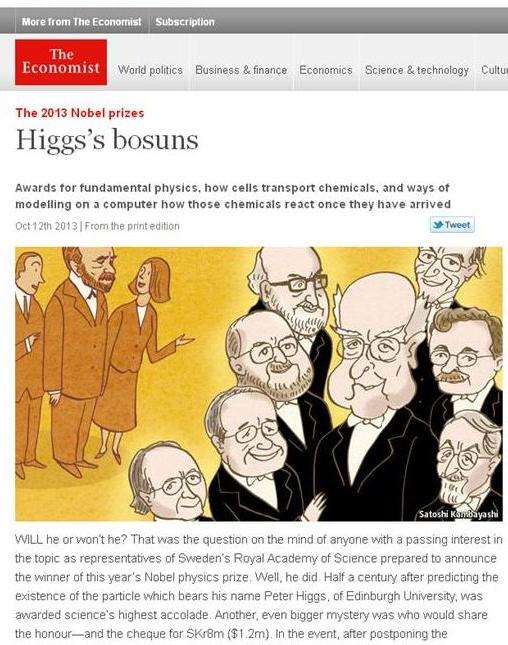
Zz.
Tuesday, October 08, 2013
2013 Physics Nobel Prize
So it is not a surprise at all that this year's Nobel Prize in Physics goes to two theorists who were the prominent figures in the development of the Higgs mechanism.
The link above also gives you access to free copies of the two relevant papers.
I think that the Nobel committee might be reserving another round to award the Nobel Prize for the experimental discovery.
Zz.
The 2013 Physics Nobel Prize has been awarded to two physicists who were instrumental in developing the theory that helps explain the origin of mass of elementary particles and predicts the existence of the Higgs Boson discovered last year. The prize, which recognizes the contributions of François Englert (Universite Libre de Bruxelles) and Peter Higgs (University of Edinburgh) for the theory of broken symmetry in electroweak physics, echoes the announcement of the 2010 American Physical Society’s J. J. Sakurai prize, which was awarded to the two Nobel Laureates as well as four additional physicists who made comparable contributions to the symmetry breaking work.
The link above also gives you access to free copies of the two relevant papers.
I think that the Nobel committee might be reserving another round to award the Nobel Prize for the experimental discovery.
Zz.
Tuesday, September 24, 2013
Any Guesses For 2013 Nobel Prize In Physics?
As the leaves turn color (at least here in the higher latitude in the Northern Hemisphere), the thoughts of many physics academics and professionals turn to Sweden and guessing at who will win this year's Nobel Prize for physics.
The obvious front runner is anything related to the Higgs. It's confirmed discovery this year means that it will not be a surprise if the award goes to people related to it. Questions remains on how they will be honored, considering that only a maximum of three individuals can be awarded the prize at any given time. Will they honor the theorists and the experimentalists in separate years? After all, there are already at least 4 deserving theorists who could easily be given the honors for formulating the Higgs mechanism, and the number is even larger for leading the experimental discovery of the Higgs.
The outcome of this will be very interesting. Or maybe the Nobel committee will forgo awarding the prize for the Higgs another year, and go with some other discovery in physics. That will be a fascinating surprise in itself!
:)
Zz.
The obvious front runner is anything related to the Higgs. It's confirmed discovery this year means that it will not be a surprise if the award goes to people related to it. Questions remains on how they will be honored, considering that only a maximum of three individuals can be awarded the prize at any given time. Will they honor the theorists and the experimentalists in separate years? After all, there are already at least 4 deserving theorists who could easily be given the honors for formulating the Higgs mechanism, and the number is even larger for leading the experimental discovery of the Higgs.
The outcome of this will be very interesting. Or maybe the Nobel committee will forgo awarding the prize for the Higgs another year, and go with some other discovery in physics. That will be a fascinating surprise in itself!
:)
Zz.
Saturday, August 10, 2013
Subscribe to:
Posts (Atom)