If you haven't come across this yet, don't miss it. This is a very good review of what is essentially the most comment topic in Quantum Mechanics - randomness that is inherent in the standard interpretation of QM. The co-author of this article is Anton Zeilinger, so you are getting some of considerable authority on the subject. The review on the Bell-type experiments are excellent - pay attention to why this doesn't violate SR.
Zz.
Thursday, January 17, 2013

Wednesday, January 16, 2013
"How many dominoes does one need to topple a domino as tall as the Domtoren?"
Supposedly, that was a question in a 2012 Dutch Science Quiz.
Anyone who has followed this blog for any considerable period of time would know that I love reading and studying about mundane phenomena and physics, and this one qualifies as one. PhysicsWorld is reporting a study appearing on ArXiv recently to answer that very question.
Of course, he had to make some simplification to his model:
And of course, there's a video demo, but it isn't related to this particular preprint:
Fun!
Zz.
Anyone who has followed this blog for any considerable period of time would know that I love reading and studying about mundane phenomena and physics, and this one qualifies as one. PhysicsWorld is reporting a study appearing on ArXiv recently to answer that very question.
The Domtoren is a 112-m-tall cathedral tower in Utrecht and the idea is to begin with a standard-sized domino, which topples a larger domino. This then topples an even larger domino and so on until a Domtoren-sized domino can be felled. The process is called "domino multiplication" because a tiny tap on the first domino can, in principle, topple a huge monolith. Now, Van Leeuwen has calculated the upper limit on how much larger each successive domino can be. In principle, his calculations suggest that the maximum ratio of successive domino heights can be about 30% larger than the widely accepted value of 1.5.
Of course, he had to make some simplification to his model:
But in the real world not all that energy is channelled into bringing down the next domino in line. First off, the dominoes bounce a little as they strike one another. Next, they have a tendency to slip along the surface they are stood on as they are nudged, lessening the chance of a fall or causing them to fall back towards the striking domino. And finally, once in contact, they drag against one another as they fall.
In his model, Van Leeuwen simplifies the situation by assuming that the collisions are completely inelastic, that the friction between the dominoes and the surface they stand on is infinite, and that the dominoes, once touching, experience zero friction and simply slide over one another.
And of course, there's a video demo, but it isn't related to this particular preprint:
Fun!
Zz.
Tuesday, January 15, 2013
Misconception of the Heisenberg Uncertainty Principle - The Video
Back in 2006, I wrote an entry on the misconception of the Heisenberg Uncertainty Principle. I used light going through a single slit to illustrate what the HUP really is.
Now, I've found a video illustrating JUST THAT!
I hope that with the video, what I was trying to explain is even clearer than before.
Zz.
Now, I've found a video illustrating JUST THAT!
I hope that with the video, what I was trying to explain is even clearer than before.
Zz.
Monday, January 14, 2013
The "Brian Cox Effect" In The UK
I've heard about this from last year where the enrollment in physics degrees in the UK has seen a significant surge, but this one kinda reinforce it.
I hope this is all good. Like I have said before, physics is too difficult to do for the wrong reasons. I hope that the LHC and Brian Cox are providing inspiration and new pathways that many students just simply didn't think of before, rather than just being enamored by the "celebrity" and "sexy news of the day".
Zz.
Manchester University is the first in the country to require students to gain two elite A* grades – alongside an A – at A-level to get onto its physics degrees.
The news report went on to also include the LHC/search for the Higgs as also being partly responsible for the sudden popularity of physics.It represents the highest entry threshold for any physics course in Britain, including those run by Oxford, Cambridge, Durham and Imperial College London. It is among only a handful of degrees in any subject nationally to demand two A*s.
Manchester has always been a popular choice for physics but the university admitted that a recent rise in applications had been partially driven by the attraction of Prof Cox, one of the department’s academics and presenter of television series such as Stargazing Live and Wonders of the Universe.
I hope this is all good. Like I have said before, physics is too difficult to do for the wrong reasons. I hope that the LHC and Brian Cox are providing inspiration and new pathways that many students just simply didn't think of before, rather than just being enamored by the "celebrity" and "sexy news of the day".
Zz.
Saturday, January 12, 2013
Physics And Sports
I've had many posts on here on how physics is applied to sports. This video presents a lecture on the relationship between physics (classical mechanics) and sports/games. It appears that this was given just before last year's London Olympics.
Zz.
Zz.
Friday, January 11, 2013
Video of the Launch Control Center
A while back I posted photos of my visit to the Kennedy Space Center in Florida. I mentioned in that trip report of the rare visit to the Launch Control Center (or Firing Room), which is normally not opened to most people, much less, the public.
I've put raw video footage of that visit to the LCC on YouTube in case anyone wants to take a look at it. I've done no editing of any kind to it (thus the "raw" description). You'll get to hear a little bit from the tour guide in the background in some shots, but other than that, there's no narration.
Zz.
I've put raw video footage of that visit to the LCC on YouTube in case anyone wants to take a look at it. I've done no editing of any kind to it (thus the "raw" description). You'll get to hear a little bit from the tour guide in the background in some shots, but other than that, there's no narration.
Zz.
Linking A Particle's Mass To Time
This is rather surprising and unique.
A paper to be published in Science claims to have made a clock that measures time by linking it to a mass.
Abstract: Historically, time measurements have been based on oscillation frequencies in systems of particles, from the motion of celestial bodies to atomic transitions. Relativity and quantum mechanics show that even a single particle of mass m determines a Compton frequency ω0 = mc2/ ħ, where c is the speed of light and ħ is the reduced Planck constant. A clock referenced to ω0 would enable high-precision mass measurements and a fundamental definition of the second. We demonstrate such a clock using an optical frequency comb to self-reference a Ramsey-Bordé atom interferometer and synchronize an oscillator at a subharmonic of ω0. This directly demonstrates the connection between time and mass. It allows measurement of microscopic masses with 4 × 10⁻⁹ accuracy in the proposed revision to SI units. Together with the Avogadro project, it yields calibrated kilograms.
That's definitely an astounding accomplishment if this is verified. They actually could somehow get at the frequency associated with a particular mass.
A news report on this work can be found here, which reveals a bit more of the issue surrounding this measurement.
Zz.
A paper to be published in Science claims to have made a clock that measures time by linking it to a mass.
Abstract: Historically, time measurements have been based on oscillation frequencies in systems of particles, from the motion of celestial bodies to atomic transitions. Relativity and quantum mechanics show that even a single particle of mass m determines a Compton frequency ω0 = mc2/ ħ, where c is the speed of light and ħ is the reduced Planck constant. A clock referenced to ω0 would enable high-precision mass measurements and a fundamental definition of the second. We demonstrate such a clock using an optical frequency comb to self-reference a Ramsey-Bordé atom interferometer and synchronize an oscillator at a subharmonic of ω0. This directly demonstrates the connection between time and mass. It allows measurement of microscopic masses with 4 × 10⁻⁹ accuracy in the proposed revision to SI units. Together with the Avogadro project, it yields calibrated kilograms.
That's definitely an astounding accomplishment if this is verified. They actually could somehow get at the frequency associated with a particular mass.
A news report on this work can be found here, which reveals a bit more of the issue surrounding this measurement.
The idea for the clock stemmed from the quantum principle that particles also behave as waves, and vice versa. In particular, Müller and his colleagues wanted to determine how frequently the wave form of a single atom oscillates, a quantity that in quantum mechanics is inherently linked to the atom’s mass. Then the researchers could use those oscillations like swings of a pendulum to create a clock.Let's see this will work out.
The snag in Müller’s plan was that it’s impossible to directly measure the oscillation frequency of waves of matter. The frequency of these waves is about 1025 hertz, 10 orders of magnitude higher than that of visible light waves. So Müller and his colleagues came up with an apparatus that creates two sets of waves — one based on a cesium atom at rest and another on the atom in motion. The researchers measured the frequency difference between the waves and then used that number, a manageable 100,000 hertz or so, to calculate the much larger oscillation frequency of cesium at rest.
Zz.
Wednesday, January 09, 2013
Physics - The Second Most Demanding Major?
We have had reports before on studies or surveys that convey the idea that physics is a difficult subject. Some would even say it is the most difficult subject.
This blog post on Physics Central reports on a survey of students of various majors. One of the survey question is on how much time the students spent per week studying the subject. Physics majors came in 2nd, just behind engineering, in the number of hours per week studying the material.
Zz.
This blog post on Physics Central reports on a survey of students of various majors. One of the survey question is on how much time the students spent per week studying the subject. Physics majors came in 2nd, just behind engineering, in the number of hours per week studying the material.
According to a survey of hundreds of thousands of college students in the U.S. and Canada, 36 percent of physics seniors spend 21+ hours preparing for class every week. Only one other group out-studied the physics majors: engineering students. 42 percent of engineering seniors devoted 21 or more hours to studying every week.There are more to the survey than just this, so you can read the rest either in that blog, or from the actual survey itself. And you can draw your own conclusions from them.
Zz.
Monday, January 07, 2013
LHCb Result Published
Hey, remember when I highlighted the recent result from LHCb where it could not find any hint of anything beyond what the Standard Model predicted? The paper on the result has now been published in PRL and you can get free access to it from the link in this review.
Zz.
Zz.
Wednesday, January 02, 2013
How Not To Teach Physics?
This is an interesting article written by former U. of Ottawa professor Denis Rancourt (you may want to read a bit of his history with his former university). Certainly, article that appeared on this Dissident Voice webpage consistently challenge the establishments and the established notion. I have zero issues with that. However, I question the validity of many conclusions, especially when it is only backed by anecdotal evidence. And just because someone questioned the conventional way of doing stuff does not make him/her immune from being equally questioned for the conclusion he/she is drawing.
Rancourt wrote on how ineffective the standard method of teaching physics is at imparting physics knowledge to students. Certainly, there have been plenty of studies to indicate that such dull methods of teaching is not every effective. He then described how he did it is own way and how, in his opinion (and the opinion of his TA), it showed an improvement.
.
.
1. Many physicists today were taught using the "conventional" methods. I was one of them. While one can argue that these may not have been the best technique, one cannot argue that WE, as a group, didn't learn any physics from them. In fact, I will vehemently argue that my E&M instructor was one of the best teacher that I've ever had and left his permanent imprint on me on how I learn things in physics. He taught things in a conventional means, but he was damn good at it. So then, is the problem here the philosophy of teaching, or the EXECUTION of that philosophy, i.e. how such conventional teaching is presented? Was Rancourt's ineffectiveness in making the student learned early on a problem of the philosophy of teaching, or was it because he simply was not a good teacher executing that philosophy or methodology? I'm not saying he isn't, but this is something we don't know.
2. How effective is his new "technique"? Sure, anecdotally, he could claim that the exam results were better. But this is not how we arrive at things in science. Educational research requires quite a number of sampling, testing, and controlled groups for comparison. One simply can't claim one has discovered something better simply via such anecdotal evidence.
3. Note that other countries, especially Asian countries such as Korea, Singapore, and China, have continually produced masses of students that have tested higher in math and science. As far as I can tell, their teaching and learning techniques are still heavily "conventional" and not approaching anywhere near what Rancourt is doing. So why are these kids able to learn and understand physics?
I fully understand the desire to do things differently. After all, I've written extensively on how I would revamp the undergraduate intro physics labs to fulfill various goals. However, until that is properly tested, I would not make any kinds of claim of its effectiveness, because I'll just be doing what I've criticized a lot of people have done - relying solely on anecdotal evidence before proper, scientific and more-verified evidence are available. And people who dissent should not be quick to dissent by lowering their standards of what can be accepted to be valid.
Zz.
Rancourt wrote on how ineffective the standard method of teaching physics is at imparting physics knowledge to students. Certainly, there have been plenty of studies to indicate that such dull methods of teaching is not every effective. He then described how he did it is own way and how, in his opinion (and the opinion of his TA), it showed an improvement.
I told the students to close their books and not read them, unless they thought they might find something of interest in there that they wanted to know. I told them they could look anywhere they wanted and ask anyone questions to find what they wanted..
I told them that first we needed to figure out what was worth knowing, and what it means to know.
I got blank stares. They worried about how they would be graded in such a system. They wondered what I really meant and what did I want them to do. But they gave me a chance and, luckily, I didn’t know what I was doing, so it was quite authentic.
So I said: “Let’s see. There must be every day things that we want to know, that we can understand…? Things we are curious about?”
They couldn’t find any. Some of them said they had a lot of work to do in their other classes so they did not want me to be too demanding. Many shared that view. But as the conversation continued and as it became clear that, well, it was a conversation; they relaxed. But they still could not think of anything they wanted to know, beyond the latest homework in the other courses. Sad really.
So I said: “Why is the sky blue?” “No really, how does that work?”
Well many of them had heard something about that in high school so we started a class-wide discussion about how and why the sky is blue. And for every answer that did not quite work, we were able to find a flaw in the answer, or a dead-end, where the word answer was not really explaining anything beyond “something something”.
I told them that it maybe had something to do with why the evening sky can be red and also asked why clouds are white, when they are not red.
So this led us to what is light…? Now you can spend a lot of focused time asking yourself what light is if you want to know why the sky is blue. So I discovered… I helped them see, through questions, what it was to truly know or understand something versus just repeat the words… that they could search and explore and critique themselves. So they did.
.
.
And we had a final examination. And, honestly, it was like no final examination I had ever seen before. It was the opposite of depressing and fun to grade. It was full of intelligence and independent thought and evidence of significant research. I had a sense that the students had understood things, could explain them, and owned their knowledge.Now, there's a number of issues here that were not tackled:
I went back to the previous year’s examinations and saw a huge difference. I lent the two piles of examinations to the TA and she concurred that, yes, there was a significant qualitative improvement that could not be denied.
Now know that I was not comparing “bad” teaching to “anything would be better than that”. I was considered one of the best traditional method teachers, by the usual standards. So I was comparing certified bad teaching to something much better.
1. Many physicists today were taught using the "conventional" methods. I was one of them. While one can argue that these may not have been the best technique, one cannot argue that WE, as a group, didn't learn any physics from them. In fact, I will vehemently argue that my E&M instructor was one of the best teacher that I've ever had and left his permanent imprint on me on how I learn things in physics. He taught things in a conventional means, but he was damn good at it. So then, is the problem here the philosophy of teaching, or the EXECUTION of that philosophy, i.e. how such conventional teaching is presented? Was Rancourt's ineffectiveness in making the student learned early on a problem of the philosophy of teaching, or was it because he simply was not a good teacher executing that philosophy or methodology? I'm not saying he isn't, but this is something we don't know.
2. How effective is his new "technique"? Sure, anecdotally, he could claim that the exam results were better. But this is not how we arrive at things in science. Educational research requires quite a number of sampling, testing, and controlled groups for comparison. One simply can't claim one has discovered something better simply via such anecdotal evidence.
3. Note that other countries, especially Asian countries such as Korea, Singapore, and China, have continually produced masses of students that have tested higher in math and science. As far as I can tell, their teaching and learning techniques are still heavily "conventional" and not approaching anywhere near what Rancourt is doing. So why are these kids able to learn and understand physics?
I fully understand the desire to do things differently. After all, I've written extensively on how I would revamp the undergraduate intro physics labs to fulfill various goals. However, until that is properly tested, I would not make any kinds of claim of its effectiveness, because I'll just be doing what I've criticized a lot of people have done - relying solely on anecdotal evidence before proper, scientific and more-verified evidence are available. And people who dissent should not be quick to dissent by lowering their standards of what can be accepted to be valid.
Zz.
Saturday, December 29, 2012
To 10 Reasons We Know The Earth Is Round
As if this needs further convincing, here are those top 10 reasons:
Zz.
Zz.
Wednesday, December 19, 2012
Fabiola Gionotti
It is rare that someone from science is one of the finalists for Time Magazine's Person of the Year. It is even rarer that it is a physicist AND a woman. That is what Fabiola Gionotti has accomplished for her effort at the LHC leading up to the apparent discovery of the Higgs.
Read her story at Time's website before it disappears.
Zz.
The announcement caused the kind of global sensation you don’t always see in response to a scientific discovery, and three names earned an equally unusual level of fame — Gianotti, who headed one of the experiments that confirmed the Higgs; her colleague Joe Incandela, who led the other; and Rolf Heuer, the research director of CERN. It was Gianotti who perhaps received the most attention, principally for her leadership role and her manifest gifts but occasionally for a reason as predictable as it is misguided: her gender. Physics is a male-dominated field, and the assumption is that a woman has to overcome hurdles and face down biases that men don’t.
Read her story at Time's website before it disappears.
Zz.
Tuesday, December 18, 2012
Berkeley Lab Open House 2012
In case you weren't there, here's a short video of this year's open house at Berkeley Lab.
I've said it before and I'll say it again. If you have a chance to visit one of these National Labs, you should do it. You'll see your taxpayers money at work in producing something that either drive knowledge, or drive our economy.
Zz.
I've said it before and I'll say it again. If you have a chance to visit one of these National Labs, you should do it. You'll see your taxpayers money at work in producing something that either drive knowledge, or drive our economy.
Zz.
Saturday, December 15, 2012
CERN Becomes A UN Observer
No, I don't mean an UNobserver. I mean a United Nations Observer.
CERN becomes the first physical science entity to be granted the status of an observer at the United Nations.
Zz.
CERN becomes the first physical science entity to be granted the status of an observer at the United Nations.
The lab joins environmental groups and public health agencies as the first physical sciences research organization in the ranks of UN observers. Observer status grants the right to speak at meetings, participate in procedural votes, and sign and sponsor resolutions, but not to vote on resolutions.I will be curious to know if it can affect anything in the UN with such a status. Time will tell.
Zz.
Physics World's Top 10 2012 Breakthrough
Physics World has listed what it considers to be this year's Top 10 breakthroughs. Not surprisingly, the apparent discovery of the Higgs at the LHC took top honors.
I'm glad to say that many of the breakthroughs listed were also covered in this blog! :)
Zz.
I'm glad to say that many of the breakthroughs listed were also covered in this blog! :)
Zz.
Thursday, December 13, 2012
Is There Poop On The Moon?
I swear, those people at Minute Physics must have heard that I visited the Kennedy Space Center last week! How else do you explain this uncanny timing of them producing this video? :)
Zz.
Zz.
Crystal Growth Under Zero Gravity
This is a rather interesting report on the growth of He4 crystal with and without gravity. They even have a video of the growth, which obviously occurs in a very short time.
Here's the synopsis accompanying the video:
Zz.
Here's the synopsis accompanying the video:
There are several limitations to growing crystals on Earth, which is why a group of researchers from Japan have taken to the skies to grow them under zero gravity.
They have successfully grown helium crystals 10 times larger than can be achieved on Earth with ordinary materials and it took just a matter of seconds -- ordinary, classic crystals can take up to a thousand years to reach their final shape.
This was achieved using high pressures, extremely low temperatures (-270oC) and by splashing the crystals with a superfluid.
From 13 December, the paper can be downloaded from http://iopscience.iop.org/1367-2630/14/12/123023/article
Zz.
Wednesday, December 12, 2012
NASA T-Shirt
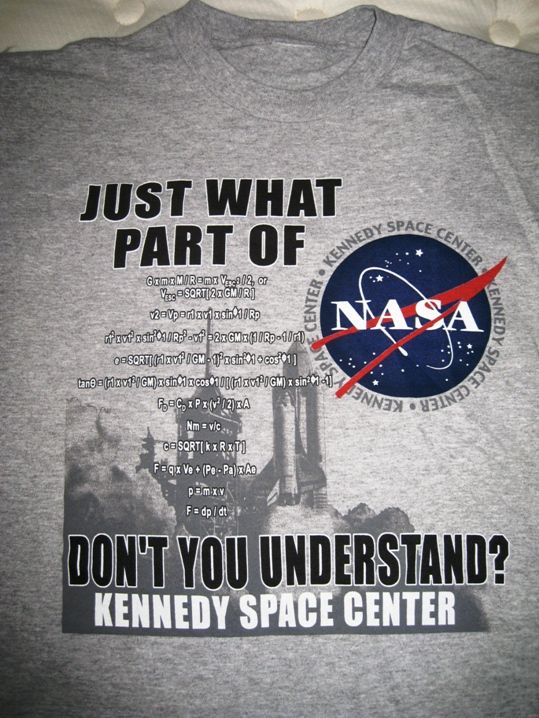
Yesterday, I posted my trip report to NASA's Kennedy Space Center. Of course, as a tourist, I had to buy something. While there were a few things I would like to get, this one t-shirt caught my eye, and it will probably confirmed to everyone what I nerd I am. Still, at least it is not one of those t-shirts that had Maxwell Equations on it that I have seen way too many times.
This is the front of the shirt.
 Here's a closer look at the equations if it isn't clear from that picture:

It's too bad that they had to put all those "x" to indicate a product, which isn't what we normally do when writing such equations, and it also creates a bit of a mess.
Still, I found the t-shirt a bit amusing and had to buy it. I haven't worn it yet (it is winter up here in Chicagoland). The question is, can you identify what each of these equations mean or are supposed to represent?
The back of the shirt has a print of the answer, but I'll hold off in showing that till you had your fun! :)
Zz.
This is the front of the shirt.
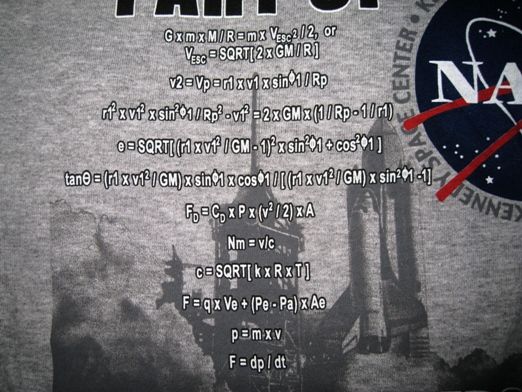
It's too bad that they had to put all those "x" to indicate a product, which isn't what we normally do when writing such equations, and it also creates a bit of a mess.
Still, I found the t-shirt a bit amusing and had to buy it. I haven't worn it yet (it is winter up here in Chicagoland). The question is, can you identify what each of these equations mean or are supposed to represent?
The back of the shirt has a print of the answer, but I'll hold off in showing that till you had your fun! :)
Zz.
Tuesday, December 11, 2012
Kennedy Space Center
If you've followed this blog recently, you'll noticed that I missed a stretch of about 10 days with no posting. I was on vacation.
Still, my vacation had a "physics" component to it. As one of my stops, I visited the Kennedy Space Center in Cape Canaveral, Florida. I've never been to this place before, even though I've always wanted to go there especially during the Shuttle era. However, I never made it there till now, which I later found out, has its advantages. I will explain why that is so when we get to that point.
So this is the entrance to the visitor center. As you can see, there are constructions on new facilities that they are building to expand and enhance the visitor center.


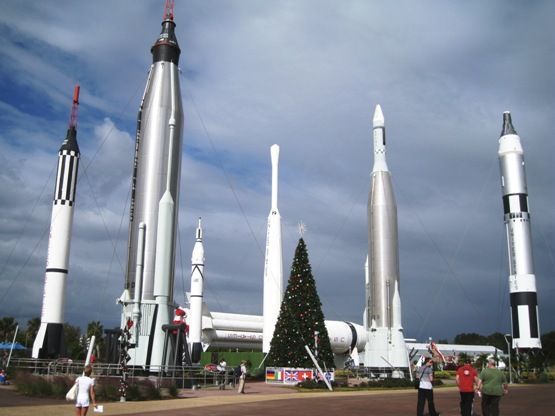
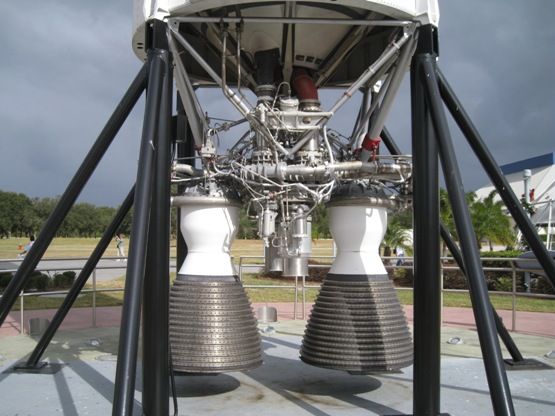
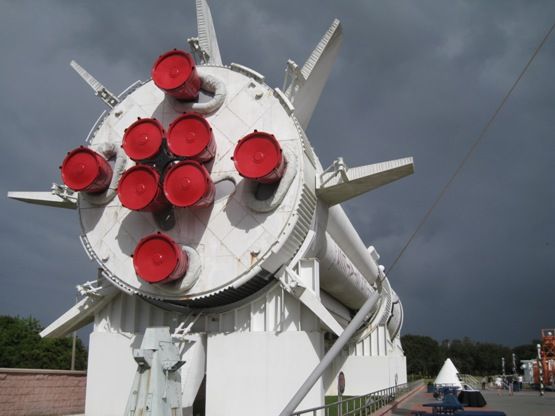
We made it to what I jokingly called the rocket graveyard. These cover the history of rocket propulsion that led to NASA sending satellites and manned space craft into space.


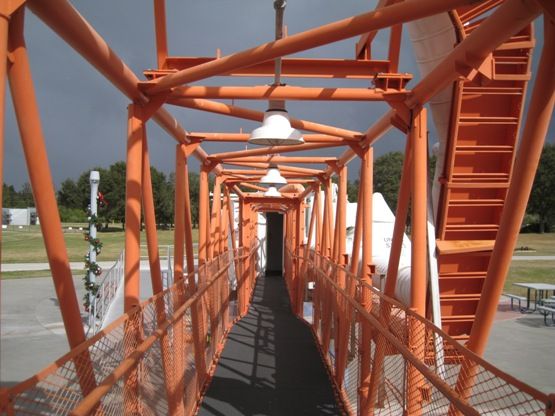
They had the bridge that used to connect the launch structure to the space module. So this is what the Apollo astronauts saw when they are walking into the capsule right before launch.

Here's what one of the capsules looks like. Man, was it tight!

I spent a bit of time looking around more of the visit center, but then took a tour that I signed up months ago. This is not your ordinary tour that they have running almost all day at the Space Center. This was a tour of the Launch Control Center. It appears that they started giving this tour about 2 months ago, and supposedly, they have not received any indication right now if it will go on after the New Year. This tour is only done once a day, and limited to less than 25 persons per tour. We were also not permitted to bring anything that we could not carry all the time, i.e. we were not allowed to put things down on the floor and walk away. This was beside the fact that we will be having 2 security escorts while in the building.
Now this is where coming here after the Shuttles had been retired was a plus. It turns out that they had never given the public access to the Launch Control Center (or what they refer to as the Firing Room) till now. In fact, most people working at the Kennedy Space Center have never been allowed to be in such a room. The reason why they are doing it now is because there are no more Shuttle launches. However, the room is still "operational", and it will be modified for NASA next program. That was the reason for all the restrictions and security.
Well, enough of that. Here are pictures that I took of the LCC. We arrived at the building and this was the lobby.

They have a few things on display in the lobby, including a very old console that, I think, was used during the Apollo program.


But what drew my eyes more was this wall of plaques of all the space launches that were done out of this building.

This includes the Apollo 11 mission,

and the first mission of the Space Shuttle

Each of the plaque had a launch date and the date it landed. However, two of the shuttle mission didn't have a "Landed" date, and those of course corresponded to the two tragic shuttle accidents.


If you look closely at where the "Landed" tag should have been, you'll notice that the wall showed a bit more wear than usual. It turns out that NASA employees rub their fingers at these locations when they walked pass them as a sign that these astronauts are always in their thoughts.
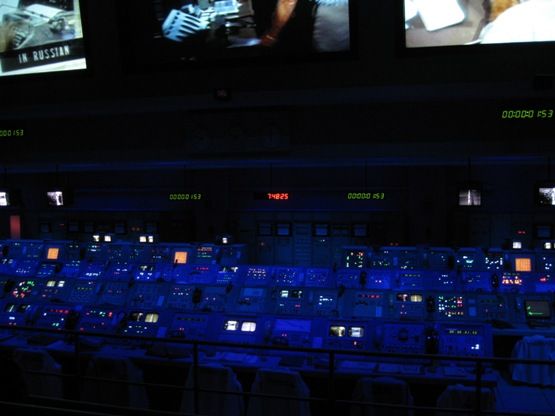
We were then taken into an elevator up to the LCC. I don't quite remember seeing the firing room on TV (I'm more familiar with the Command Center in Houston). But it was still an impressive room, and we got to see it from various locations.


This was the view out of the window from the LCC. You can see the shuttle launch pad in the distance, and also the 2-lane gravel path that the crawler took from the shuttle assembly building to the launch pad.

After a long visit to the LCC building, we then got back on our bus and got a tour of the grounds. First off is the shuttle launch pad. I can only imagine what it would look like if the shuttle is all set and primed to go. Of course, I've seen it on TV, but I'm sure it would have been significantly more impressive in person. I would love to know more about their cryogenic systems to produce all those liquid hydrogen and oxygen.


We were then driven around a new launch pad that they are building for the Orion program (did they get full funding for this? I must have missed it). Our tour guide was continually gushing over this to emphasize that NASA is not dead, and that the space program is back in operation and "we are back in business".


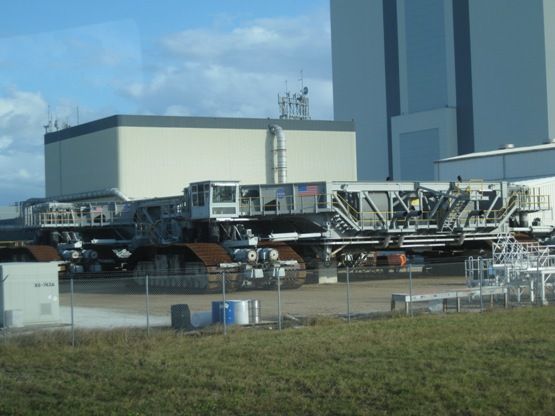
We also drove by the crawler, which is now sitting outdoors. If you don't know this, the crawler was the vehicle that brought the upright Space Shuttle (i.e. the orbiter, the external rocket, and the solid rocket boosters) from the assembly building to the launch pad. It literally crawled at about 1 mile per hour. While this may not have been that different than watching grass grows, I wouldn't have minded to see that either!

Our last stop was the Apollo experience. We were dropped off at a building and entered a room that simulated the firing of an Apollo rocket. The equipment in the room was authentic, and the audio and simulate was incredible because one could hear the windows rattled during take off.


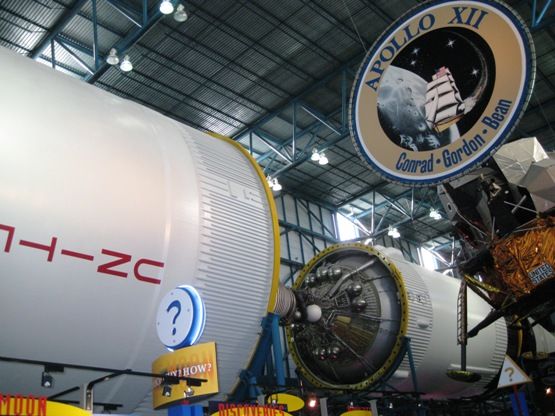
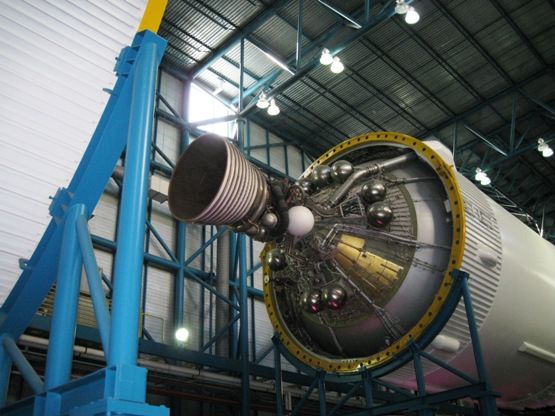
After that bone-jarring presentation, we were led into a huge building that housed the Apollo/Saturn V rocket. This was quite impressive. The Saturn V booster rocket alone is HUGE. Look at the 2nd picture that has human scale for you to compare.


We walked along the length of the rocket and saw various stages that separated at different times during launch.


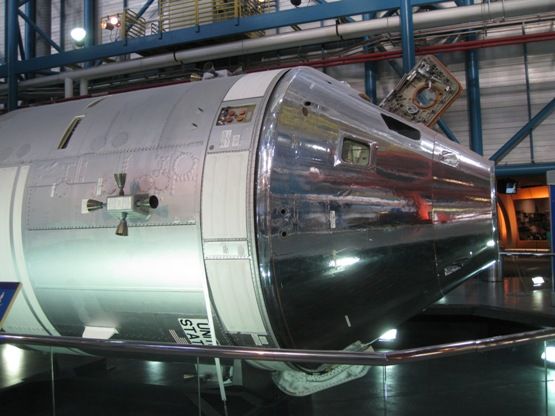
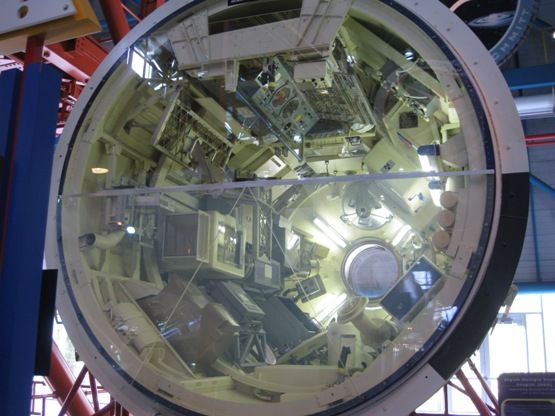
A closer look at the Service Module and the Capsule.


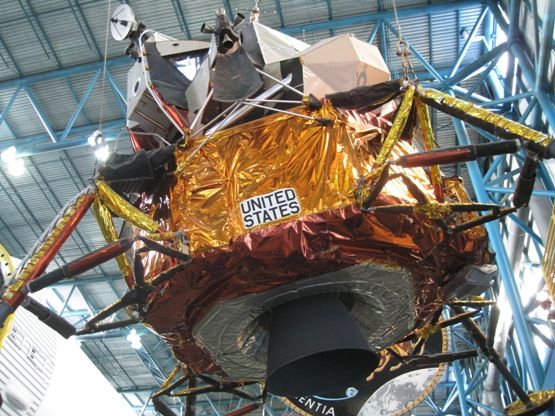
This is the lunar lander, which was the only part of the vehicle that landed on the moon, and which a big part of it gets left behind.

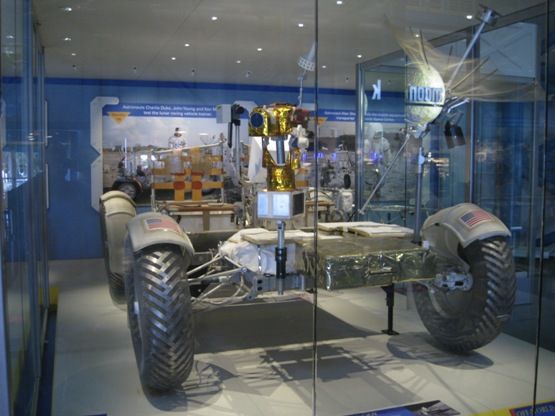
This is the buggy that they used on the moon.

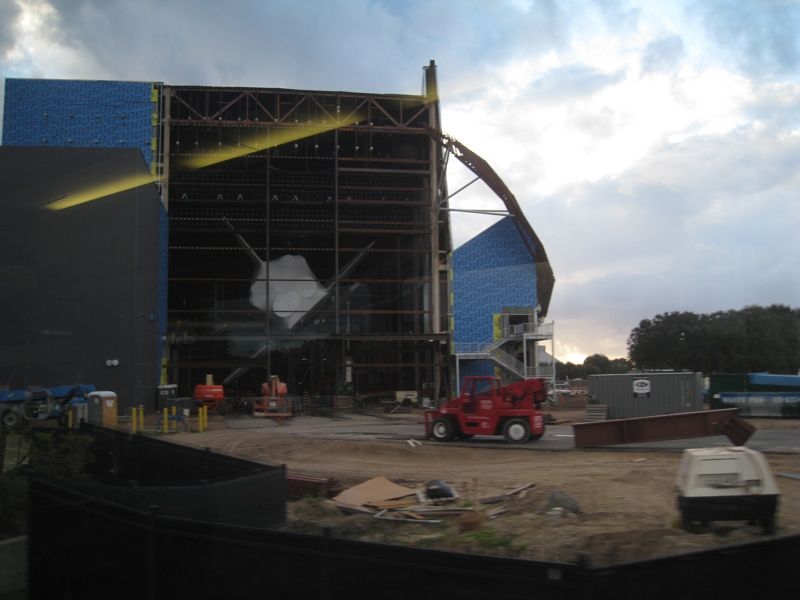
At the end of our visit, on the way out, we saw the construction of a building to house one of the Space Shuttle orbiter. This new attraction will open some time next year. So maybe this is a good reason to come back for another visit.

It was a wonderful experience. But being a physicist, I just wish that we had a tour guide familiar with the scientific/technical aspect of the program. As someone who is used to giving tours at our facilities, I'm always prepared to answer such questions, because you just never know if you get scientists in your audience. And I've had that a few times where physicists or engineers in the tour group started asking more "difficult" or more detailed questions. I supposed one has to know someone working there to be able to get a more personalized tour that will answer a more technical question.
So now you know a little bit of what I did on my last vacation! :)
Zz.
Still, my vacation had a "physics" component to it. As one of my stops, I visited the Kennedy Space Center in Cape Canaveral, Florida. I've never been to this place before, even though I've always wanted to go there especially during the Shuttle era. However, I never made it there till now, which I later found out, has its advantages. I will explain why that is so when we get to that point.
So this is the entrance to the visitor center. As you can see, there are constructions on new facilities that they are building to expand and enhance the visitor center.
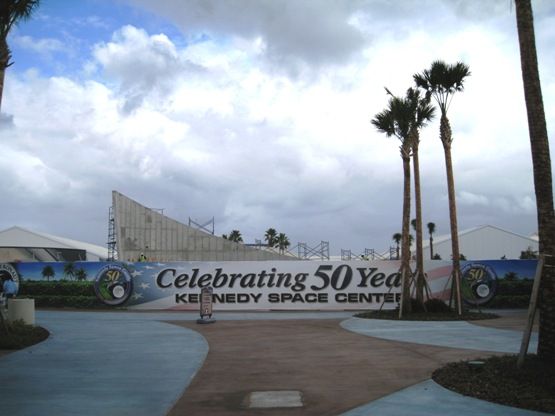
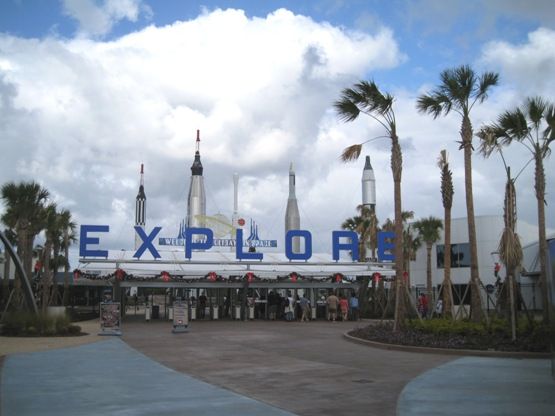
We made it to what I jokingly called the rocket graveyard. These cover the history of rocket propulsion that led to NASA sending satellites and manned space craft into space.
They had the bridge that used to connect the launch structure to the space module. So this is what the Apollo astronauts saw when they are walking into the capsule right before launch.
Here's what one of the capsules looks like. Man, was it tight!
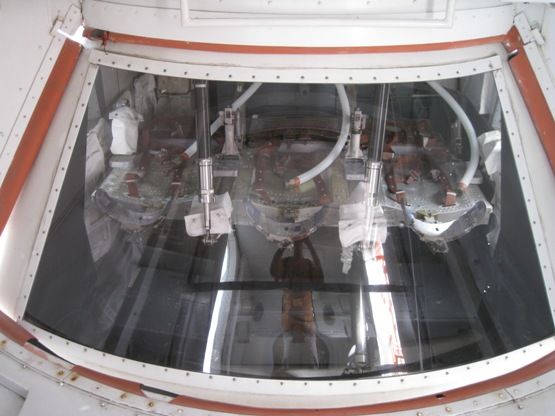
I spent a bit of time looking around more of the visit center, but then took a tour that I signed up months ago. This is not your ordinary tour that they have running almost all day at the Space Center. This was a tour of the Launch Control Center. It appears that they started giving this tour about 2 months ago, and supposedly, they have not received any indication right now if it will go on after the New Year. This tour is only done once a day, and limited to less than 25 persons per tour. We were also not permitted to bring anything that we could not carry all the time, i.e. we were not allowed to put things down on the floor and walk away. This was beside the fact that we will be having 2 security escorts while in the building.
Now this is where coming here after the Shuttles had been retired was a plus. It turns out that they had never given the public access to the Launch Control Center (or what they refer to as the Firing Room) till now. In fact, most people working at the Kennedy Space Center have never been allowed to be in such a room. The reason why they are doing it now is because there are no more Shuttle launches. However, the room is still "operational", and it will be modified for NASA next program. That was the reason for all the restrictions and security.
Well, enough of that. Here are pictures that I took of the LCC. We arrived at the building and this was the lobby.
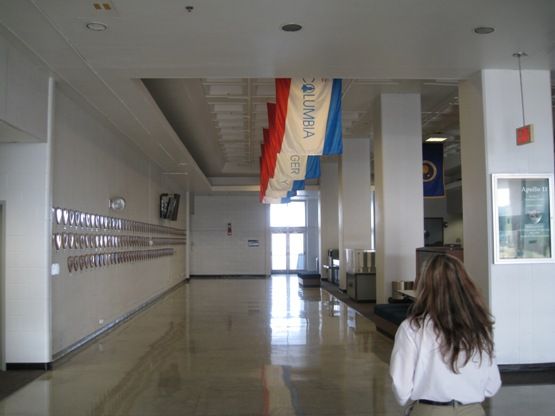
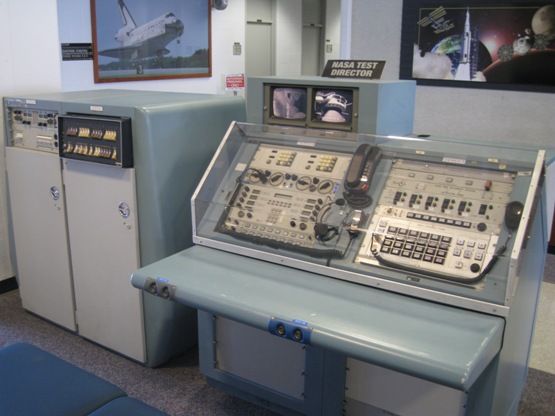
They have a few things on display in the lobby, including a very old console that, I think, was used during the Apollo program.
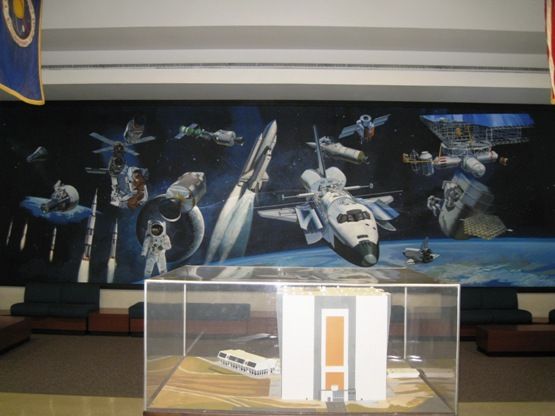
But what drew my eyes more was this wall of plaques of all the space launches that were done out of this building.
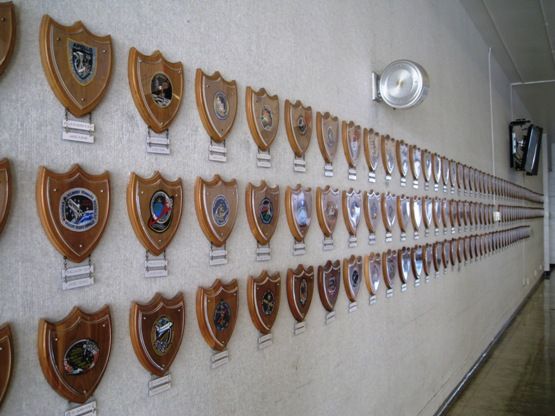
This includes the Apollo 11 mission,
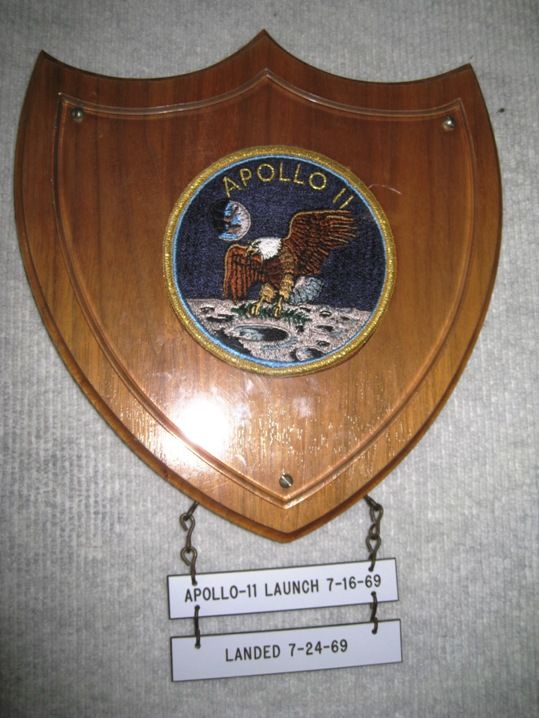
and the first mission of the Space Shuttle
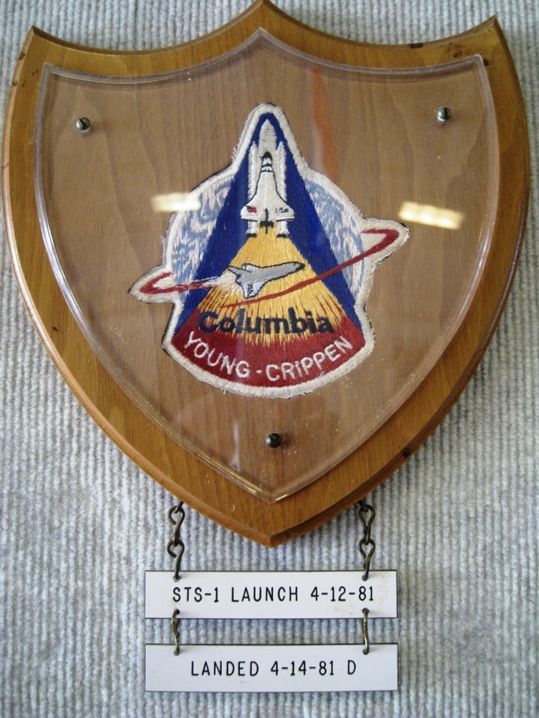
Each of the plaque had a launch date and the date it landed. However, two of the shuttle mission didn't have a "Landed" date, and those of course corresponded to the two tragic shuttle accidents.
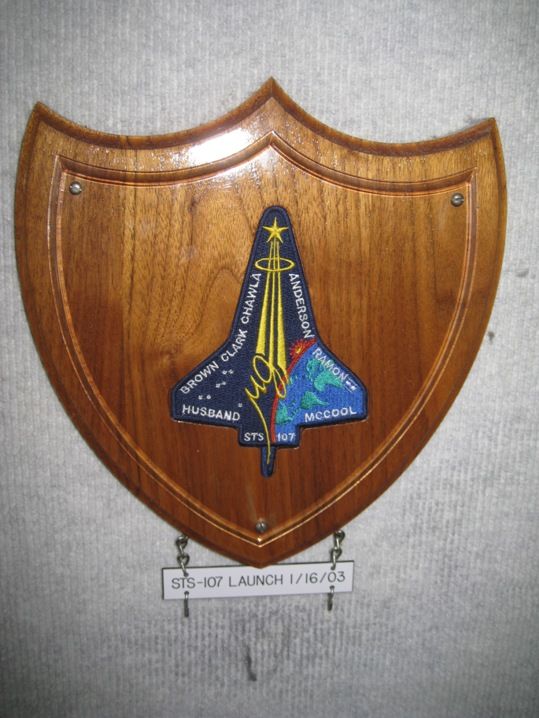
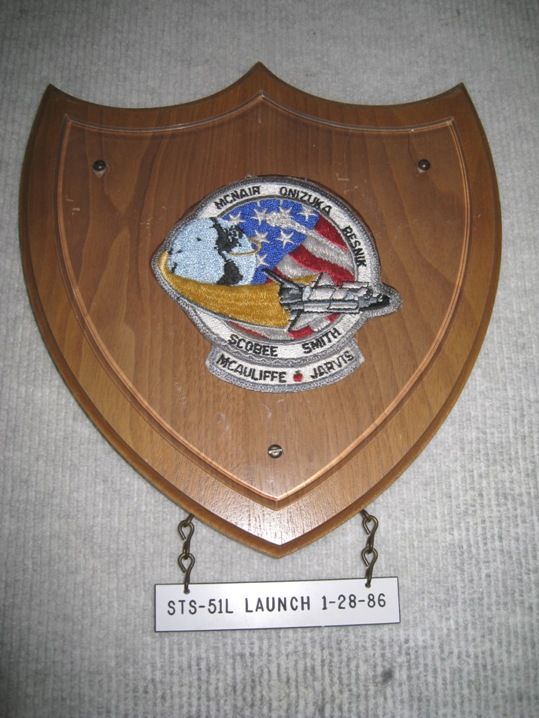
If you look closely at where the "Landed" tag should have been, you'll notice that the wall showed a bit more wear than usual. It turns out that NASA employees rub their fingers at these locations when they walked pass them as a sign that these astronauts are always in their thoughts.
We were then taken into an elevator up to the LCC. I don't quite remember seeing the firing room on TV (I'm more familiar with the Command Center in Houston). But it was still an impressive room, and we got to see it from various locations.
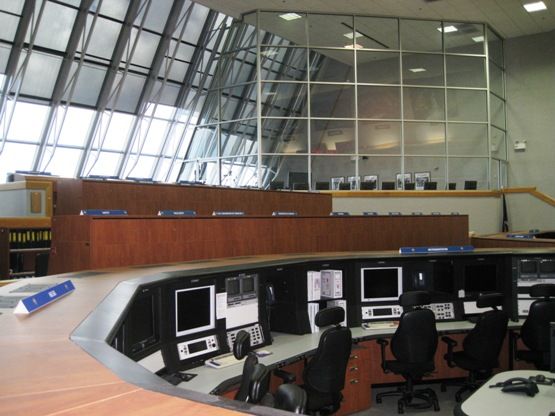
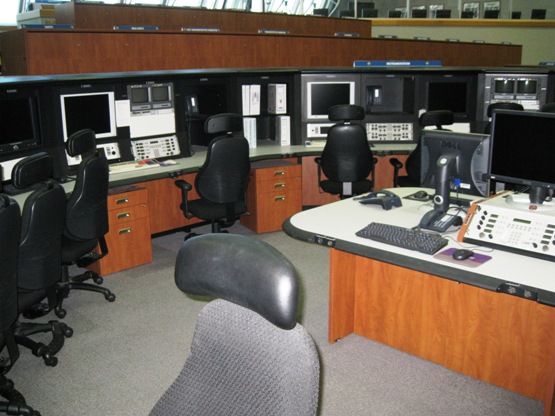
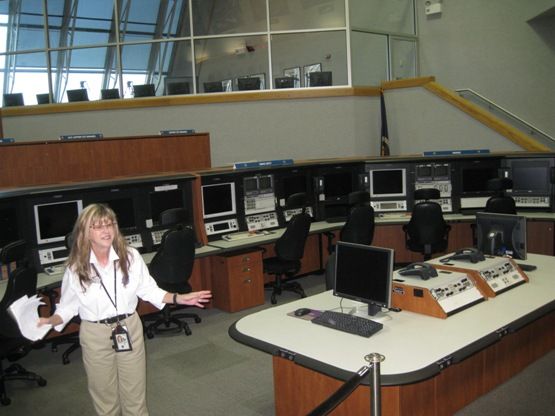
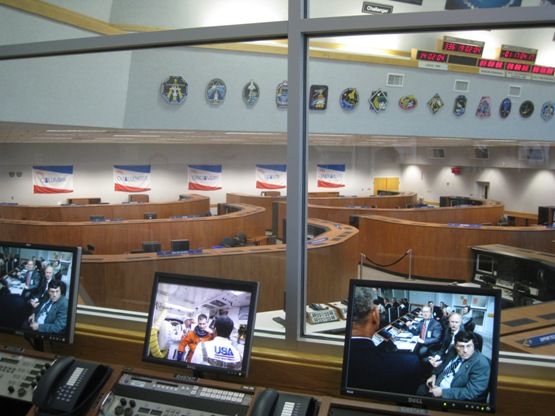
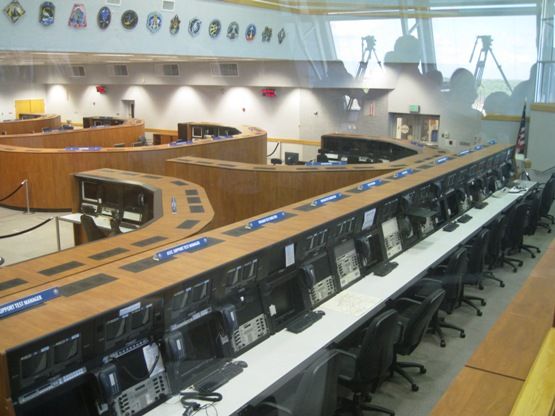
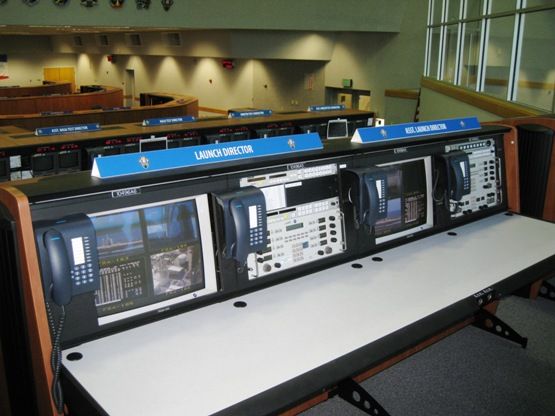
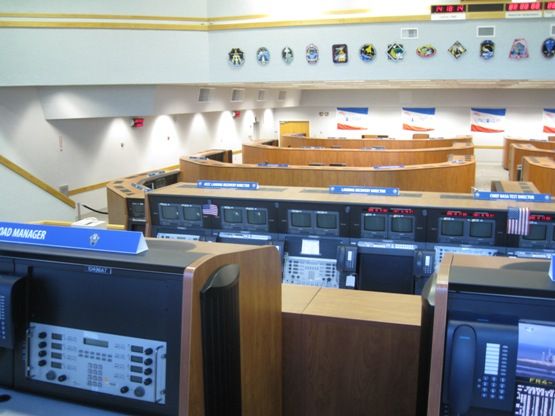
This was the view out of the window from the LCC. You can see the shuttle launch pad in the distance, and also the 2-lane gravel path that the crawler took from the shuttle assembly building to the launch pad.
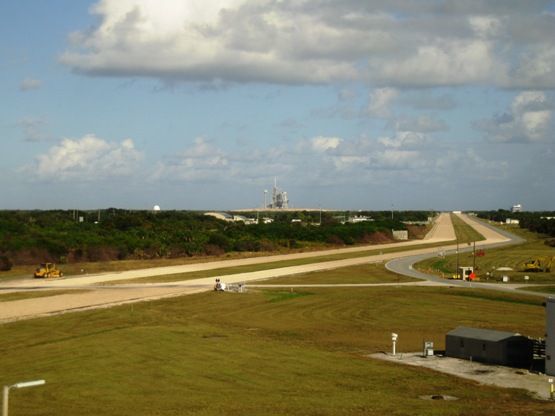
After a long visit to the LCC building, we then got back on our bus and got a tour of the grounds. First off is the shuttle launch pad. I can only imagine what it would look like if the shuttle is all set and primed to go. Of course, I've seen it on TV, but I'm sure it would have been significantly more impressive in person. I would love to know more about their cryogenic systems to produce all those liquid hydrogen and oxygen.
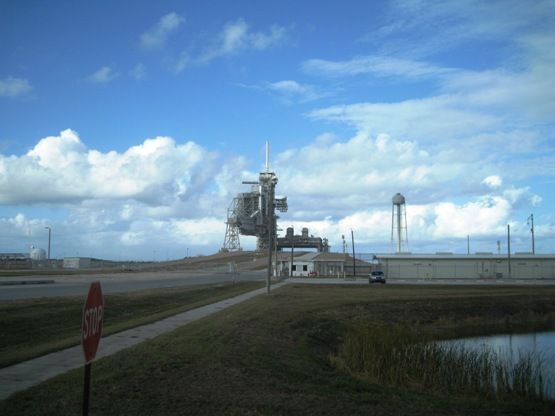
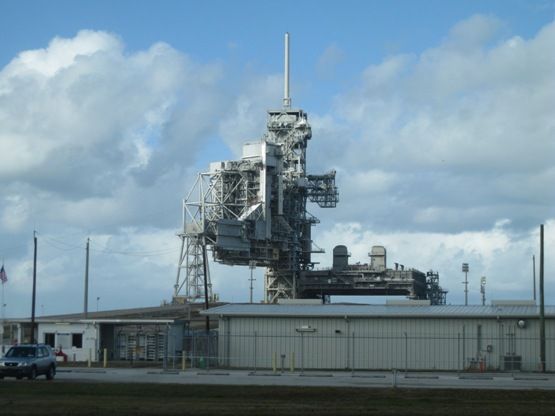
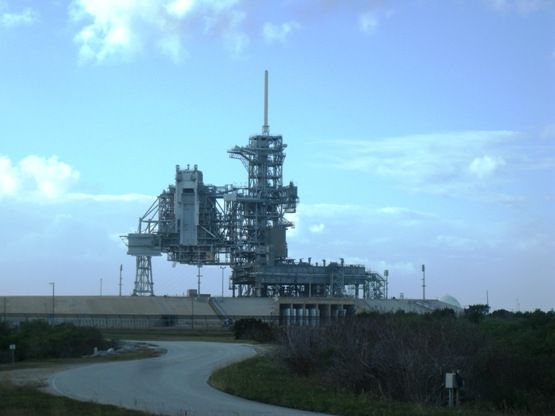
We were then driven around a new launch pad that they are building for the Orion program (did they get full funding for this? I must have missed it). Our tour guide was continually gushing over this to emphasize that NASA is not dead, and that the space program is back in operation and "we are back in business".
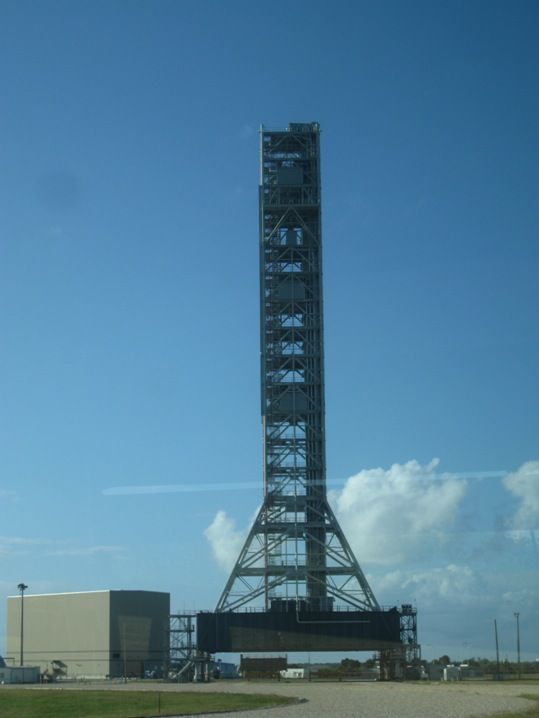
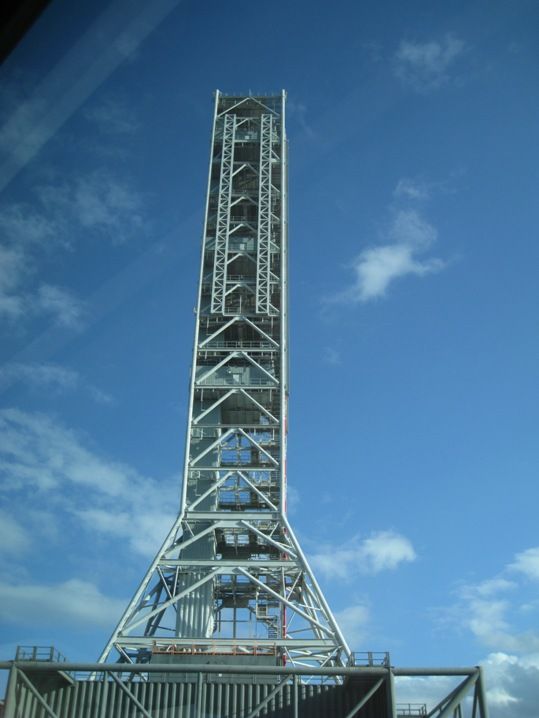
We also drove by the crawler, which is now sitting outdoors. If you don't know this, the crawler was the vehicle that brought the upright Space Shuttle (i.e. the orbiter, the external rocket, and the solid rocket boosters) from the assembly building to the launch pad. It literally crawled at about 1 mile per hour. While this may not have been that different than watching grass grows, I wouldn't have minded to see that either!
Our last stop was the Apollo experience. We were dropped off at a building and entered a room that simulated the firing of an Apollo rocket. The equipment in the room was authentic, and the audio and simulate was incredible because one could hear the windows rattled during take off.
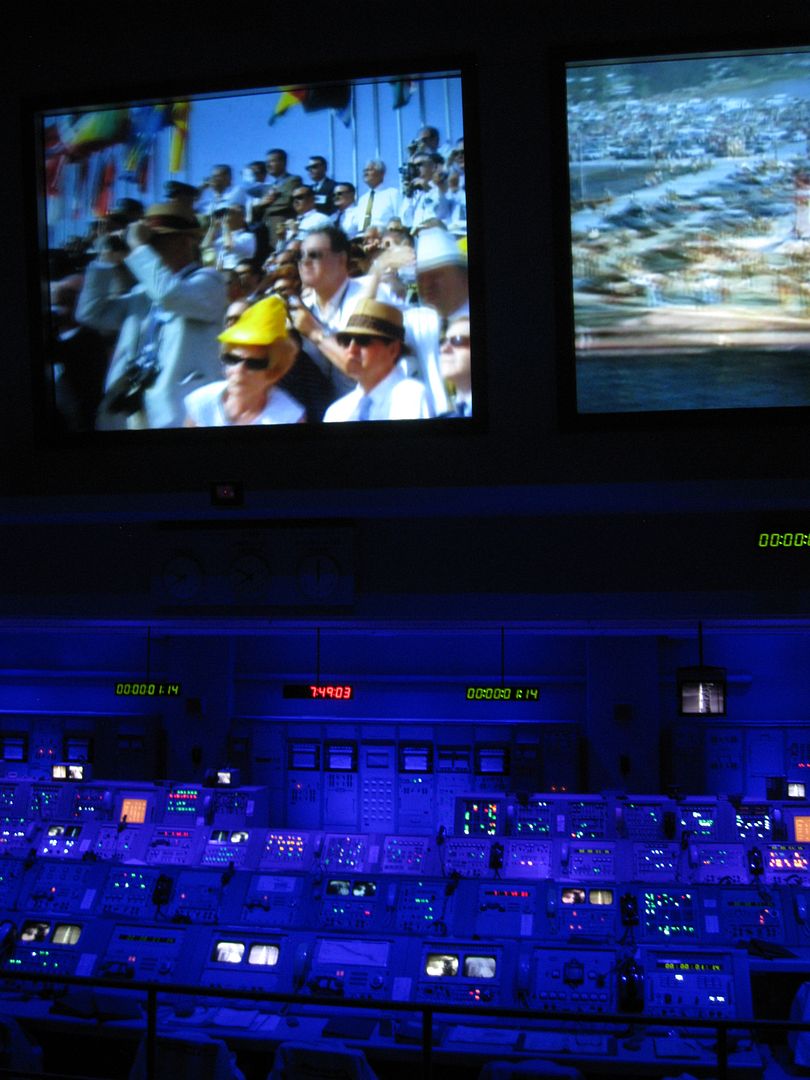
After that bone-jarring presentation, we were led into a huge building that housed the Apollo/Saturn V rocket. This was quite impressive. The Saturn V booster rocket alone is HUGE. Look at the 2nd picture that has human scale for you to compare.
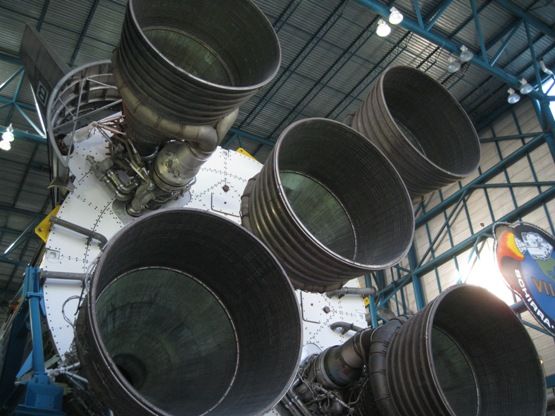
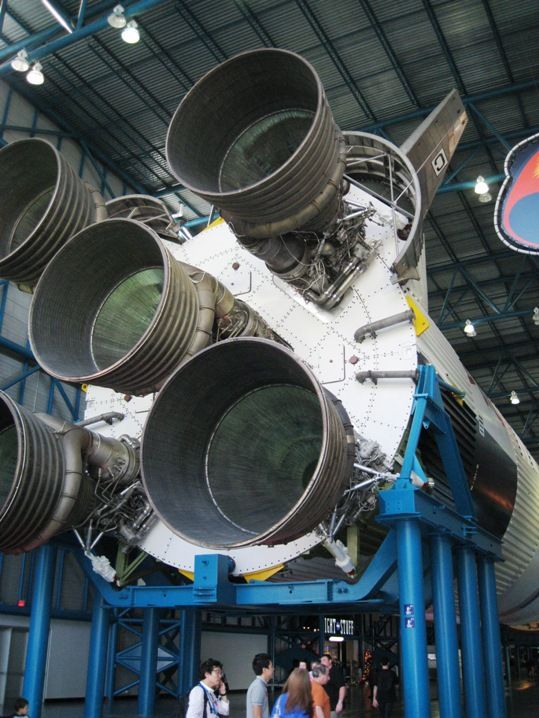
We walked along the length of the rocket and saw various stages that separated at different times during launch.
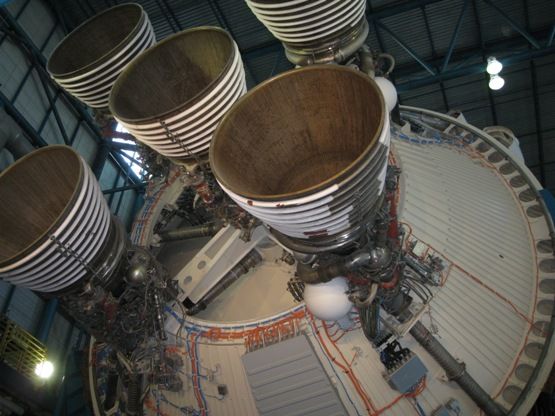
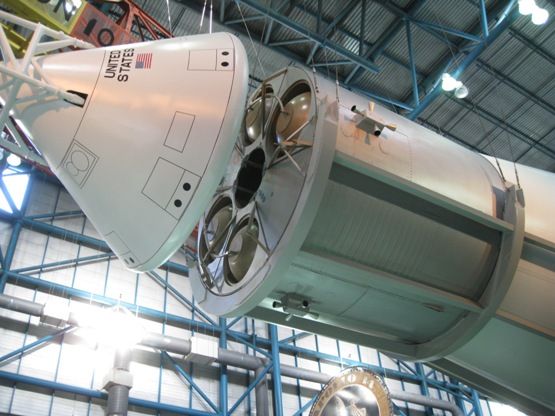
A closer look at the Service Module and the Capsule.
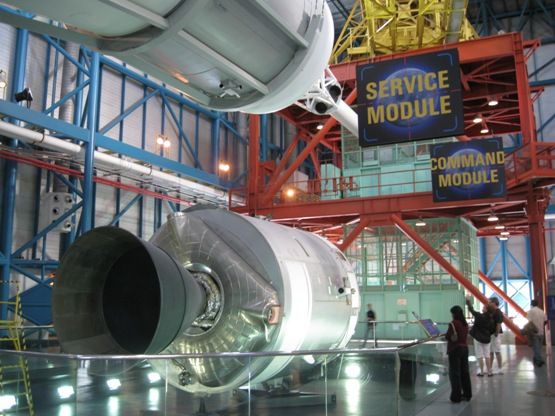
This is the lunar lander, which was the only part of the vehicle that landed on the moon, and which a big part of it gets left behind.
This is the buggy that they used on the moon.
At the end of our visit, on the way out, we saw the construction of a building to house one of the Space Shuttle orbiter. This new attraction will open some time next year. So maybe this is a good reason to come back for another visit.
It was a wonderful experience. But being a physicist, I just wish that we had a tour guide familiar with the scientific/technical aspect of the program. As someone who is used to giving tours at our facilities, I'm always prepared to answer such questions, because you just never know if you get scientists in your audience. And I've had that a few times where physicists or engineers in the tour group started asking more "difficult" or more detailed questions. I supposed one has to know someone working there to be able to get a more personalized tour that will answer a more technical question.
So now you know a little bit of what I did on my last vacation! :)
Zz.
Monday, December 10, 2012
Subscribe to:
Posts (Atom)