Wednesday, February 11, 2009

Nanocrystals Shown to Generate More Than One Electron Per Absorbed Photon

This is rather interesting, especially when I missed all the controversy regarding the earlier, similar claim.

Scientists out of Los Alamos have reconfirmed their findings that in certain nanocrystal, one absorbed photon can produce more than one free electron in the conduction band.

When a conventional solar cell absorbs a photon of light, it frees an electron to generate an electrical current. Energy in excess of the amount needed to promote an electron into a conducting state is lost as heat to atomic vibrations (phonons) in the material lattice. Through carrier multiplication, excess energy can be transferred to another electron instead of the material lattice, freeing it to generate electrical current—thereby yielding a more efficient solar cell.

Klimov and colleagues have shown that nanocrystals of certain semiconductor materials can generate more than one electron after absorbing a photon. This is partly due to strengthened interactions between electrons squeezed together within the confines of the nanoscale particles.


If this finding is true, then one immediate direct implication is that one could produce a more efficient solar cells.

I'll try to hunt for the exact reference (I hate press releases like this since they do not include the exact citation) and post it here when I find it.

Zz.

Tuesday, February 10, 2009

Conflict Brews Over Science in US Stimulus Package

With the stimulus bill passing through the US Senate already, it is now the tedious and difficult task to reconcile the bill's version that passed though the US House of Representatives early. The differences are still quite big as far as funding for science is concerned.

Overall, science fared well in the Senate. According to an analysis by the American Association for the Advancement of Science (pdf format), the Senate bill includes $17.8 billion for research and development, including $2 billion for new facilities and equipment - compared to $13.2 billion in the version previously passed by the House of Representatives.

This boost is mostly due to an extra $6.5 billion provided by the Senate for biomedical research at the National Institutes of Health. But the two main agencies that support the physical sciences - National Science Foundation and the Department of Energy's Office of Science - were not so favoured. In the Senate bill, they get only $1.2 billion and $330 million respectively, compared to $3 billion and $2 billion in the House version.


So how come the physical sciences ALWAYS get the short end of the stick? I've never had any politician flat out explain this. It's not something they can't deny since we have all the evidence these past few years.

Zz.

University of Idaho Physics Not Going Without A Fight

I highlighted earlier of the news that the undergraduate physics program at the University of Idaho is one of those on the chopping block of programs for elimination. It appears that this past week, there was a public hearing on the proposal, and there was a unanimous support for the program to continue.

More than a dozen students and faculty members made their plea to keep the physics program to the committee members. Members outside of the physics department, including faculty from the College of Education and the College of Engineering, also offered their requests to “save” the program. A high school student who is interested in studying physics also asked the committee to reconsider the current proposal.

No one spoke in favor of cutting the program.


There's nothing much for a blogger like me can do other than voice my support and hopefully publicize it.

Zz.

Monday, February 09, 2009

AAAS Annual Meeting

The annual meeting of the American Association for the Advancement of Science (AAAS) is meeting in Chicago this week. If you are in the area, there are plenty of activities for you and/or the whole family either at the conference itself (the Exhibits area in the Hyatt Regency hotel) or at various locations around the city. Click on the program at the webpage or the Family Science Days.

Zz.

Science and Astrology: the Proof in Astrophysics?

PUHLEEEZE!!

This article shows exactly why astrologers have no clue on how things are accepted to be valid in science. This person is trying to grasp as the flimsiest straw based simply on one, ONE, hypothetical musings on a "theoretical astrophysicist". I'll let you read the rest of the article, which really provides ZERO evidence to accept the validity of astrology. But what gets my goat is what was said at the end of the article:

Thus far, the few scientific studies that support astrology have shown significant correlations, but correlations are measurable observed links between one happening and another....they don't reveal predictable outcomes. So, perhaps astrology will never be confirmed by the majority of scientists, but even Seymour points out that scientific thought...both ancient and modern...is fallible due to preconceptions and that astrology is dismissed without study by the average scientist.


But what about not accepting something FIRST before valid and convincing evidence are presented? It is NOT the job of science to prove that you are wrong, it is the job of whoever is trying to show that something is valid to find convincing evidence. Every single scientific discovery and new ideas have to go through that process. Einstein had many doubters to all of his idea when presented. Quantum mechanics had a lot of challenges against it. It is when these ideas are backed by overwhelming body of evidence (as in empirical evidence), only THEN are they accepted to be a scientific idea and considered to be valid. Not before then.

Yet, so many people, including this "astrologer" have already accepted astrology to be valid, despite the lack of any valid evidence. Astrology is dismissed because of that. And considering that such a belief has been around for hundreds of year and it still can't get beyond the phase of trying to prove its existence, it has been understandably categorized as crackpottery. A valid phenomenon never languishes in the land of "is it true, or is it not true" for that long. Our understanding of every single valid phenomenon improves with time, from the moment of discovery to making even more careful measurement of its various properties. We know more about the top quark mass now when compared to when it was first discovered at the Tevatron. We know more about the behavior and puzzling properties of high-Tc cuprate superconductors, even though we still don't quite fully have a valid theory for it. All of these phenomena have gone way past the "discovery" phase and into more detailed studies. One cannot say that about "astrology", that is still stuck at first base.

It is crackpottery.

Zz.

Sunday, February 08, 2009

A Musical Tribute To Einstein Inspired By Mozart

Unlike the very puzzling "Einstein's Physics on Violins", this one is actually kinda interesting and creative.

Einstein's love of Mozart, and the inspiration it provided him, is the theme behind ''Einstein's Mozart: Two Geniuses'' by Kate Light. The composition -- an integration of two of Mozart's great string works with the narration of Light's original poetry and prose -- will be performed today at the Zoellner Arts Center by the Serafin String Quartet, with Light as narrator.


See, something like this, I can sit through, mainly because it is more of an entertainment. And they don't try to "interpret" physics into music, especially by musicians who are not trained in physics, which is rather pretentious.

Zz.

Saturday, February 07, 2009

The World's Top Ten Telescopes

Based on science impact, the Sloan Digital Sky Survey is the top telescope of the year {link open for free only for a limited time}. The list of the top 10 telescopes was compiled in this report.

Zz.

Physics vs. Medicine in the Stimulus Bill

It may have happened again.

Remember all those optimism regarding funding for DOE and NSF in the Stimulus bill? And remember when I said that I am not going to buy all this until I see the money? Well, my pessimism may be justified.

The bill that has been agreed to may have cut the money going to DOE and NSF.

According to a version of a memo describing the cuts, the stimulus for N.S.F. and the energy department’s Office of Science would be cut to zero and there would be cuts to the NASA and NIST portions as well.

Clay Westrope, Sen. Nelson’s spokesman, said the senator was not anti-science, but that he felt the stimulus bill was the wrong place to add financing for long-term research. “If they were in a spending bill, he would probably support them,” Mr. Westrope said.

Mr. Westrope said he could not explain why biomedical research was regarded as a stimulus, but physics research would not.


The NIH should be given the responsibility to construct its own synchrotron centers and use some of the obscene amount of money it gets, rather than benefiting from the physical sciences and their facilities. Maybe then, the people in congress can get their heads out of the hole in the ground and see who supports what.

Zz.

Friday, February 06, 2009

CERN to Set Goals for First LHC Physics

This is the latest press release out of CERN regarding the start-up of the LHC. It includes not only the plan for the start-up, but also on the cause of the shut-down.

At the conclusion of a workshop held in Chamonix this week, recommendations have been made to the CERN1 management for the restart schedule of the Large Hadron Collider (LHC). If accepted in a management meeting on Monday, these recommendations will ensure that the LHC starts to produce physics data in late 2009, running through the winter and on to autumn 2010 at an energy of 5 TeV per beam and ensuring sufficient data for the experiments to produce their first new physics results.


Zz.

Thursday, February 05, 2009

IoP President Gives Her Thoughts

The current president of the UK's Institute of Physics, Jocelyn Bell-Burnell, gives her thoughts on the state of physics, physics education, and IoP's function in this video.


Zz.

Wednesday, February 04, 2009

Neal Lane Warns of Science Gaps

Neal Lane, the former Presidential Science Adviser for Bill Clinton, was interviewed recently. In this news article, he expressed his opinion on the current state of science in the US, the damage done to science, and what he expects from the Obama administration. In particular, he echoed what I have been saying on here all along:

Q. Are there other areas of concern within science where the United States is losing ground relative to the rest of the world?

A. There are other examples of where we have started to fall back from a position of leadership because of many years of under-investment in basic research, particularly the physical sciences.

Q. Can you give me an example?

A. High-energy physics. Over 1,000 U.S. physicists are now going with their students to Switzerland to work on the Large Hadron Collider, the high-energy accelerator. That’s partly because Congress killed the Superconducting Super Collider a number of years ago, a terrible mistake in my view. Had that not happened, scientists from all over the world would have been working here, along with the small companies that grow up around these large experiments. If we don’t provide these experimental facilities, eventually people just aren’t going to come here, and we’ll be left in the dust.


Zz.

The Seeker of Novel Materials

There are MANY well-known physicists among other physicists who are not well-known to the public. In fact, in each of the different field of studies in physics, there are plenty of "giants" in those fields who are quite well-known and prominent.

This is one such physicist in the field of condensed matter. Practically everyone in that field know Paul Canfield pretty well. And now it is your turn. This news article profiles this prolific physicist and what he does well.

There are many people who are not household names, but are significant contributors to the body of knowledge that we call Physics.

Zz.

Dynamics of Coin Tossing is Predictable

Y'know, sometime when I'm bored, I browse various journals that I seldom read just to find something I could occupy my time, or even something to read in bed that can put me to sleep! :) It is during such browsing time that I often find many articles that often is more interesting than what I anticipated.

This could possibly one such article, and I find that I'm spending way more time than I should reading it. The article discusses in great detail the dynamics of coin tossing[1], and that, as we expected, it isn't random once we know the initial condition even when we include various other complexities such as air resistance, and the various strange trajectory and spinning motion.

Abstract: The dynamics of the tossed coin can be described by deterministic equations of motion, but on the other hand it is commonly taken for granted that the toss of a coin is random. A realistic mechanical model of coin tossing is constructed to examine whether the initial states leading to heads or tails are distributed uniformly in phase space. We give arguments supporting the statement that the outcome of the coin tossing is fully determined by the initial conditions, i.e. no dynamical uncertainties due to the exponential divergence of initial conditions or fractal basin boundaries occur. We point out that although heads and tails boundaries in the initial condition space are smooth, the distance of a typical initial condition from a basin boundary is so small that practically any uncertainty in initial conditions can lead to the uncertainty of the results of tossing.

Sometime it is nice to see what we know should happen, and someone else did all the dirty and tedious work to show this. :)

Zz.

[1] J. Strzałko et al., Phys. Rep. v.469, p.59 (2008).

Debating the Source of a Rare Particle

This is a very good comprehensive review of the recent excitement surrounding the PAMELA results that may have detected dark matter. Not only that, the article contains FREE access to the actual PAMELA paper published in PRL. What more could you want?

:)

Edit: a review of this publication can also be found at PhysicsWorld.

Zz.

Invisibility Umbrella Would Let Future Harry Potters See the Light

This is a report on a very clever scheme where an object is placed next to a left-handed material, resulting in both having a "cloaking" property.

The trick, they report in a paper to be published in Physical Review Letters, is to embed a matching "antiobject"--the metamaterial equivalent of a voodoo doll--in the outer layer of the post. The scattering from the embedded antiobject exactly cancels the scattering from the object, Chan says, "so it looks as if there is nothing there." Because the hidden object remains outside the post or umbrella, it can detect light from its surroundings.

The scheme does have limitations, Pendry notes. The umbrella works for only a single frequency, has to be specifically tailored to the object to be hidden, and won't completely hide something that absorbs light. Still, Pendry says, "that's carping on my part--it's really a neat idea."


The application for left-handed materials is very vast. I just wish that we don't attach it to such popularization and suffer from the same misunderstanding as the "teleportation" phenomenon.

Zz.

Tuesday, February 03, 2009

Sudden Death of Entanglement

This is a very nice review of essentially the phenomenon of decoherence[1]. I finally had a chance to read through it. If nothing else, it has a wealth of references that I find highly valuable. What the review indicates is that the loss of quantum correlation (or decoherence) can occur a lot faster than "half-life decay".

What is more important, at least to me, is that this clearly shows why all the pseudoscience, mystical claims, and other crackpotteries that attempted to use QM and entanglement in particular to justify their claims completely and clearly show their ignorance of the subject matter. Many claims, such as this and this, only apply the physics that was probably gathered from popular science sources without understanding the physics, and without getting the whole picture. They only hear about "entanglement", without realizing what it is, how difficult it is to maintain, and how it can easily be destroyed. So they attempted to use it to justify something else without knowing all the "ground rules".

One would hope that these people would read a paper like this, but that's asking way too much, I'm sure. So if you encounter another of these crackpots trying to sell you on how we are all "entangled" with each other because QM says so, show him/her this paper.

Edit: a press release of this publication can be found here.

Zz.

[1] Ting Yu and J.H. Eberly, Science v.323 p.598 (2009).

Monday, February 02, 2009

Einstein's Physics on Violin

Einstein's physics on violin..... Er.... what?

Professor Brian Foster of the Experimental Physics department at the University of Oxford will deliver a lecture on Einstein’s contribution to physics, including his Theory of Relativity.

Violinist Jack Liebeck will join Professor Foster on stage at various points to provide musical analogies to some of the points raised by the lecture.


Er.... what?!

I'm going to stop scratching my head before I go bald. But what the hey....? It is difficult enough to explain such a thing in plain English, but this? I'd like to know what is expected out of such "musical analogies". Or maybe I don't understand and appreciate something like this because I am musically illiterate?

If you get to go to this one (and it should be a doosey), can you please tell me how the photoelectric effect analogy sound? I'm awfully curious with that one.

Zz.

Gender Bias Found in Student Ratings of High School Science Teachers

OK, so we have gender issues with female students in science and engineering. Now, even the students themselves are showing gender bias against female science teachers!

Most notably, say the researchers, the physics students in the survey showed the largest bias toward female physics teachers. In biology and chemistry, male students tended to underrate their female teachers, but female students did not. In physics, both male and female students tended to underrate their female teachers.


I don't have access to this publication since my institution doesn't subscribe to it, so I could not tell you more about the content than what's being reported here. If you do have access to it and have read it, I would like to hear a bit more on the content, especially if they have made any proposal on the possible reason for such a bias.

My initial inclination is that in physics, the predominant "role model" of a physicist is typically a "nerdy man" with ruffled hair, a lab coat, and may be horribly absent-minded. So a female physics teacher doesn't fit into what these students probably think a physicist should look like and so, give them less credibility.

We need not only more female physicists to be pushed to the limelight (I guess that's what Lisa Randall is doing), but also more studly and handsome male physicists to dispel the nerdy myth! :)

Zz.

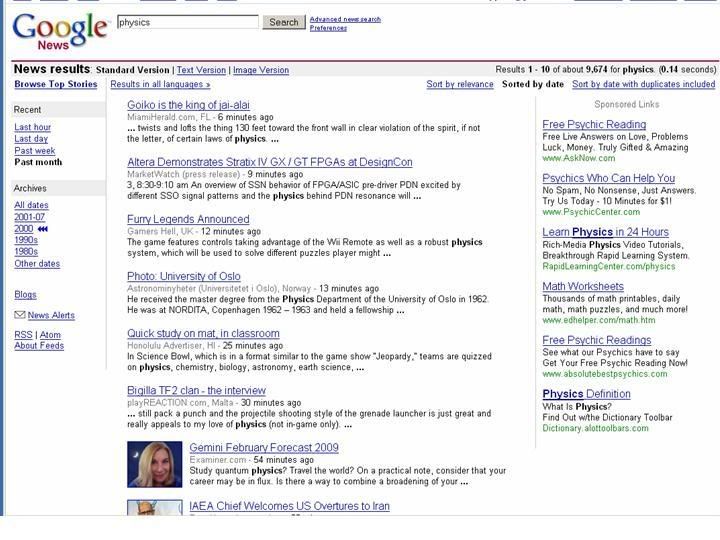
Google Has Gone "Psychic"

I harped on Yahoo search a while back for displaying not only crackpot websites when one does a search on "physics", but also listing psychic websites, which is the antithesis of physics. So now, to be fair, I will have to whine also at Google search for doing almost the same thing.

It appears that lately (or it could just be my imagination), that the psychic websites are appearing more frequently when one does a "physics" search. I don't remember this occurring this often before. Did something changed? Here's an example:


Of course, as with the result of a Yahoo search, this is annoying but not unexpected. These search engines are trying to be too clever and anticipate all possible spelling mistakes that might people make. In the process, it'll list things that are of a complete opposite to the subject matter that one is looking for. As intelligent as they try to make it to be, this shows that the search logic is still pretty dumb.

Zz.

More On The Physics Of Basketball

Here's something that sorta re-enforced what was mentioned earlier. John Fontanella, the author of "The Physics of Basketball", explains why tall men in the game seems to have more problems in making either a jump shot or a free throw. It has to do with the angle and trajectory of the ball.

“This gives an extra reason that Wilt and Shaq are poor free-throw shooters,” Fontanella wrote in an e-mail. “If they were trained by people of average height, they were probably trained incorrectly. They were probably taught to shoot like a shorter person and that’s wrong. A big man needs to shoot the ball in a slightly different way in order to take advantage of the physics.”

Fontanella said that launch angle and angle of approach of the ball are pivotal in free throw shooting. Angle of approach is the angle between the horizontal and the velocity of the ball when the ball is directly above the front of the hoop. It’s the angle in which a basketball “sees” the hoop at its largest opening as opposed to a ball coming toward the hoop at an acute angle.


It also means that to improve the "effective surface area" of the hoop that the ball sees, one might want to consider shooting the ball underhanded, which was the argument used earlier. Unfortunately, this might work only for free throws, because doing such a shot during the rest of the game is just inviting it to be blocked way too easily.

Zz.