{There was a pun in there.}
Here's a good video to introduce you to FLASH, the FEL facility at DESY.
This, of course, is a counterpart to LCLS at SLAC. It looks like FEL facilities are popping up all over the place as the new "in-fashion" light source. This is almost like 20 years ago when synchrotron centers were the rage as light sources.
Zz.
Wednesday, September 15, 2010

Last Day To Nominate The Most Attractive Physicist
This is your last day to send in your nomination for the Most Attractive Physicist. Remember, you can nominate as many as you like. It has been fun so far (at least for me), but I see a lot of work ahead in organizing all the nominations and setting up the ballot. We will have separate polls for the male contenders and the female contenders. That much I've decided. The rest are still up in the air.
It'll take some time for the first poll to appear, be patient! :)
Zz.
It'll take some time for the first poll to appear, be patient! :)
Zz.
Tuesday, September 14, 2010
A Day At RHIC
I mentioned a while back about the Brookhaven Lab's Summer Sunday Tours that they have each year. If you have a chance, this is something you shouldn't miss.
They highlight a particular facility on each of the Sunday tour. In this news report (more like a trip report), the writer went on the Summer Sunday tour that was highlighting the Relativistic Heavy Ion Collider (RHIC). It appears to be quite an extensive tours, with a look at the main detectors.
Sounds like fun! Don't you wish you could have been there?
Zz.
They highlight a particular facility on each of the Sunday tour. In this news report (more like a trip report), the writer went on the Summer Sunday tour that was highlighting the Relativistic Heavy Ion Collider (RHIC). It appears to be quite an extensive tours, with a look at the main detectors.
Our group then got on a bus headed for STAR, one of two detectors we would see. STAR stands for Solenoidal Tracker At Relativistic. Xian Li, a brilliant doctorate student, told us how heavy ions are smashed together in a structure that looks like a huge roulette wheel. Even more brilliant was a 12-year-old girl named Mikaela Egbert, who showed me how to use my cell phone to take pictures.
Our next stop was the other detector, PHENIX, which stands for Pioneering High Energy Nuclear Interactions eXperiment. Aside from not being in Arizona, PHENIX also is where scientists collide heavy ions. Protons are collided in both detectors as well.
Sounds like fun! Don't you wish you could have been there?
Zz.
Monday, September 13, 2010
What Is The Shape Of A Roller Coaster That Gives A Normal Force Of Constant Amplitude?
I love reading stuff like this. While most people (I'm guessing) are fascinated by the Higgs, Cosmology, Dark Energy, etc., I'm more of a sucker for "simple stuff" that really isn't that simple nor trivial. This is one such example.
The authors of this paper[1] is investigating what they call the "comfortable roller coaster". It is a roller coaster that has a constant magnitude of the normal force acting on the rider. In other words, you don't get multiple g's pressing on you and don't get lifted off your seat.
Abstract: A particle that moves along a smooth track in a vertical plane is influenced by two forces: gravity and normal force. The force experienced by roller coaster riders is the normal force, so a natural question to ask is, what shape of the track gives a normal force of constant magnitude? Here we solve this problem. It turns out that the solution is related to the Kepler problem; the trajectories in velocity space are conic sections.
You can follow the derivation at your leisure. The resulting trajectories are shown in several figures, such as Fig. 1 and 2. Each of the trajectory corresponds to a particular ratio of N/mg. If you look at the trajectory of the loop-the-loop, you'll see that it is more of teardrop shape, rather than a circle or an oval. This shape is what you see at amusement parks and an important design to make sure that the riders are not subjected to unusually high g's during the ride.
A fun paper!
Zz.
[1] A.B. Nordmark and H. Essén, Eur. J. Phys. v.31, p.1307 (2010). You may also obtain the paper for free during the first 30 days of online publication at this link.
The authors of this paper[1] is investigating what they call the "comfortable roller coaster". It is a roller coaster that has a constant magnitude of the normal force acting on the rider. In other words, you don't get multiple g's pressing on you and don't get lifted off your seat.
Abstract: A particle that moves along a smooth track in a vertical plane is influenced by two forces: gravity and normal force. The force experienced by roller coaster riders is the normal force, so a natural question to ask is, what shape of the track gives a normal force of constant magnitude? Here we solve this problem. It turns out that the solution is related to the Kepler problem; the trajectories in velocity space are conic sections.
You can follow the derivation at your leisure. The resulting trajectories are shown in several figures, such as Fig. 1 and 2. Each of the trajectory corresponds to a particular ratio of N/mg. If you look at the trajectory of the loop-the-loop, you'll see that it is more of teardrop shape, rather than a circle or an oval. This shape is what you see at amusement parks and an important design to make sure that the riders are not subjected to unusually high g's during the ride.
A fun paper!
Zz.
[1] A.B. Nordmark and H. Essén, Eur. J. Phys. v.31, p.1307 (2010). You may also obtain the paper for free during the first 30 days of online publication at this link.
Dance Review Article Has Wrong Information
Some time I waste my time and read something that I almost have no interest in. This is one such example. It would not have been memorable had it not been one little but glaring mistake in the report.
The report is a review of a dance that tries to incorporate a lot of physics in it. I never understand why people try to do that, and as if such a thing can actually convey any sense of understanding of physics. (I'd like to see if the audience, without knowing the subtext behind the dance, will actually get what the dance is all about.) Don't get me wrong, I appreciate amazing dance. I just don't have that much of a patience when it is taken to this level of 'seriousness'.
In any case, that's besides the point. I was reading along the review when the reviewer decided to provide more information than necessary, and that's when she made a mistake.
Er.. hello? The LHC will be shut down in 2010 to make repairs of all the relevant electrical connections they didn't get to during the previous shutdown. This is to allow for the LHC to get to its targeted energy at 14 TeV.
If this was written for some obscure publication, I wouldn't have cared. But the Washington Post? One can only hope that the proof-reading isn't as critical when it is a review of a dance.
Zz.
The report is a review of a dance that tries to incorporate a lot of physics in it. I never understand why people try to do that, and as if such a thing can actually convey any sense of understanding of physics. (I'd like to see if the audience, without knowing the subtext behind the dance, will actually get what the dance is all about.) Don't get me wrong, I appreciate amazing dance. I just don't have that much of a patience when it is taken to this level of 'seriousness'.
In any case, that's besides the point. I was reading along the review when the reviewer decided to provide more information than necessary, and that's when she made a mistake.
Yet the matter of our origins is only tangentially addressed here. The title is a playful twist on the search for the origins of matter underway in experiments to replicate the big bang at CERN (research now in question, given recent news that the particle accelerators will shut down in 2012, to cut costs).
Er.. hello? The LHC will be shut down in 2010 to make repairs of all the relevant electrical connections they didn't get to during the previous shutdown. This is to allow for the LHC to get to its targeted energy at 14 TeV.
If this was written for some obscure publication, I wouldn't have cared. But the Washington Post? One can only hope that the proof-reading isn't as critical when it is a review of a dance.
Zz.
Sunday, September 12, 2010
3 Days Left To Nominate The Most Attractive Physicist
We have 3 days left for the nomination of the Most Attractive Physicist. If you have someone in mind, please click on that link and send in your nomination soon.
I'll compile all the nominations after the deadline has passed. Depending on the number of nomination for each gender, I may change the rules and put all of them up for voting. We'll see after I do a count.
I'm utterly curious to see how this will end up! :)
Zz.
I'll compile all the nominations after the deadline has passed. Depending on the number of nomination for each gender, I may change the rules and put all of them up for voting. We'll see after I do a count.
I'm utterly curious to see how this will end up! :)
Zz.
Saturday, September 11, 2010
"The Grand Design" Book Review
It is a no-brainer that when The Grand Design was released this week that it would garner a lot of attention and reviews. Still, this review of the already-infamous book has a bit more insight into it. It was written by Sean Carroll and has a bit more clarity to it. In it, he basically stressed almost the same point that I made earlier.
This is what I wrote earlier when I illustrate it with my example of the eclipse. In other words, what we originally do not have a mechanism for (creation of the universe), now we find that we do have such possibility. It is an argument directed towards those who use the "god of the gaps" to prove the existence of god.
As with most things, people get into a tiff over nothing. There are MORE DAMNING books against the existence of god than this one. Vic Stenger's book "God: The Failed Hypothesis" is a lot more "combative" against the existence of God than Hawking's book. Yet, there's hardly a ripple about it when it came out.
Zz.
Putting the word "design" in the book's title is the kind of cheeky humor that Mr. Hawking has become known for. The authors' answer to the riddle of the universe has nothing to do with intelligent design or with religion generally. "Some would claim the answer to these questions is that there is a God who chose to create the universe that way. . . . We claim, however, that it is possible to answer these questions purely within the realm of science, and without invoking any divine beings."
The Hawking vs. God debate has featured prominently in the news of late. He and Mr. Mlodinow don't claim to have proved that God doesn't exist; their argument is somewhat more confined, but still important in its implications. We understand enough about the ultimate laws of physics, the authors say, to conclude that we don't need God to understand the universe.
This is what I wrote earlier when I illustrate it with my example of the eclipse. In other words, what we originally do not have a mechanism for (creation of the universe), now we find that we do have such possibility. It is an argument directed towards those who use the "god of the gaps" to prove the existence of god.
As with most things, people get into a tiff over nothing. There are MORE DAMNING books against the existence of god than this one. Vic Stenger's book "God: The Failed Hypothesis" is a lot more "combative" against the existence of God than Hawking's book. Yet, there's hardly a ripple about it when it came out.
Zz.
Friday, September 10, 2010
Hitchhiker's Guide to First Year Physics Labs
I've only skimmed through this quickly, but I think that if you are still in school, and especially if you are in your first year intro physics class, this might be a "book" that you might want to read! It appears to be a supplemental material to accompany the laboratory session at University College Dublin. Nevertheless, it can be read by itself, and has quite a good selection of important basic lessons. But more importantly, a lot of the physics have been reduced to concise description, which makes it a suitable accompaniment to an intro physics text.
Read it, and tell me what you think.
Zz.
Read it, and tell me what you think.
Zz.
Thursday, September 09, 2010
Larry King to Host Robert Spitzer Versus Stephen Hawking
I have no idea how this will turn out, especially when Hawking will be severely handicapped {no pun intended} in such a debate. Still, CNN's Larry King will host a debate between Stephen Hawking, and his strong critic Robert Spitzer. It will air on Friday, at 9 pm US Eastern Daylight Time.
Zz.
Zz.
Wednesday, September 08, 2010
The Most Attractive Physicist Contest - 1 Week Left
We have one week left in the nomination process for the most attractive physicist contest. If you think you have a candidate for this superficial honor, you do not have much time left to submit your nomination. Please click on the link to the blog entry of the contest, and post your nomination as a comment to that blog entry.
Zz.
Zz.
The Spontaneous Universe
It looks like Lawrence Krauss decided to join in the fun with regards to Hawking's claim that our universe does not need a creator. Krauss made an even more straightforward argument simply by using energy balance:
This, of course, has more verification than Hawking's argument of using M-theory. At the very least, the presence and nature of dark energy can be tested. So such an argument is a lot more compelling and more difficult to refute than using an unverified theory that has yet to gain wide acceptance among physicists.
Of course, Krauss got into all of of this because he has his own book that will come out in 2011.
I bet you the subject matter is as controversial as Hawking, but will it get the same level of attention? Probably not.
Zz.
The existence of this energy, called dark energy, has another consequence: It changes the picture so that knowing the geometry of the universe is no longer enough to determine its future. While this may be a disappointment, the existence of dark energy and a flat universe has profound implications for those of us who suspected the universe might arise from nothing.
Why? Because if you add up the total energy of a flat universe, the result is precisely zero. How can this be? When you include the effects of gravity, energy comes in two forms. Mass corresponds to positive energy, but the gravitational attraction between massive objects can correspond to negative energy. If the positive energy and the negative gravitational energy of the universe cancel out, we end up in a flat universe.
Think about it: If our universe arose spontaneously from nothing at all, one might predict that its total energy should be zero. And when we measure the total energy of the universe, which could have been anything, the answer turns out to be the only one consistent with this possibility.
This, of course, has more verification than Hawking's argument of using M-theory. At the very least, the presence and nature of dark energy can be tested. So such an argument is a lot more compelling and more difficult to refute than using an unverified theory that has yet to gain wide acceptance among physicists.
Of course, Krauss got into all of of this because he has his own book that will come out in 2011.
Mr. Krauss, a cosmologist, is director of the Origins Project at Arizona State University. His newest book, "A Universe From Nothing" will be published by Free Press in 2011.
I bet you the subject matter is as controversial as Hawking, but will it get the same level of attention? Probably not.
Zz.
Tuesday, September 07, 2010
Gender Disparities in Second-Semester College Physics
This paper is a followup[1] to the authors' earlier paper that described the gender disparity in the first semester intro college physics class. I covered the earlier paper in a previous blog entry. This new paper follows the students in a second semester intro physics class.
Abstract: Our previous research [Kost et al., Phys. Rev. ST Phys. Educ. Res. 5, 010101 (2009)] examined gender differences in the first-semester, introductory physics class at the University of Colorado at Boulder. We found that: (1) there were gender differences in several aspects of the course, including conceptual survey performance, (2) these differences persisted despite the use of interactive engagement techniques, and (3) the post-test gender differences could largely be attributed to differences in males’ and females’ prior physics and math performance and their incoming attitudes and beliefs. In the current study, we continue to characterize gender differences in our physics courses by examining the second-semester, electricity and magnetism course. We analyze three factors: student retention from Physics 1 to Physics 2, student performance, and students’ attitudes and beliefs about physics, and find gender differences in all three of these areas. Specifically, females are less likely to stay in the physics major than males. Despite males and females performing about equally on the conceptual pretest, we find that females score about 6 percentage points lower than males on the conceptual post-test. In most semesters, females outperform males on homework and participation, and males outperform females on exams, resulting in course grades of males and females that are not significantly different. In terms of students’ attitudes and beliefs, we find that both males and females shift toward less expertlike beliefs over the course of Physics 2. Shifts are statistically equal for all categories except for the Personal Interest category, where females have more negative shifts than males. A large fraction of the conceptual post-test gender gap (up to 60%) can be accounted for by differences in males’ and females’ prior physics and math performance and their pre-Physics 2 attitudes and beliefs. Taken together, the results of this study suggest that it is an accumulation of small gender differences over time that may be responsible for the large differences that we observe in physics participation of males and females.
Zz.
[1] L.E. Kost-Smith et al., Phys. Rev. ST Physics Ed. Research v.6, p.020112 (2010). This is an open access journal. You may obtain the paper at this link.
Abstract: Our previous research [Kost et al., Phys. Rev. ST Phys. Educ. Res. 5, 010101 (2009)] examined gender differences in the first-semester, introductory physics class at the University of Colorado at Boulder. We found that: (1) there were gender differences in several aspects of the course, including conceptual survey performance, (2) these differences persisted despite the use of interactive engagement techniques, and (3) the post-test gender differences could largely be attributed to differences in males’ and females’ prior physics and math performance and their incoming attitudes and beliefs. In the current study, we continue to characterize gender differences in our physics courses by examining the second-semester, electricity and magnetism course. We analyze three factors: student retention from Physics 1 to Physics 2, student performance, and students’ attitudes and beliefs about physics, and find gender differences in all three of these areas. Specifically, females are less likely to stay in the physics major than males. Despite males and females performing about equally on the conceptual pretest, we find that females score about 6 percentage points lower than males on the conceptual post-test. In most semesters, females outperform males on homework and participation, and males outperform females on exams, resulting in course grades of males and females that are not significantly different. In terms of students’ attitudes and beliefs, we find that both males and females shift toward less expertlike beliefs over the course of Physics 2. Shifts are statistically equal for all categories except for the Personal Interest category, where females have more negative shifts than males. A large fraction of the conceptual post-test gender gap (up to 60%) can be accounted for by differences in males’ and females’ prior physics and math performance and their pre-Physics 2 attitudes and beliefs. Taken together, the results of this study suggest that it is an accumulation of small gender differences over time that may be responsible for the large differences that we observe in physics participation of males and females.
Zz.
[1] L.E. Kost-Smith et al., Phys. Rev. ST Physics Ed. Research v.6, p.020112 (2010). This is an open access journal. You may obtain the paper at this link.
Popular Science Books Taking Off
The Telegraph has a very interesting piece on the rise in popularity of pop-science books, including physics.
This popularity is a double-edged sword. On one hand, it is heartening to know that people are interested in knowing more about subject areas that we, as physicists, are passionate about. We can only hope that these books not only convey some information on the subject matter, but also simulates interest in these areas and gather support from the public.
But on the other hand, pop-science is just that, popular science that lacks the details that separate a knowledge from being superficial to in-depth knowledge. Pseudoscience figures such as Deepak Chopra appear to learn about physics from such books without realizing that they are only seeing the shadow of the animal, rather than the animal itself. Many of the bastardization of physics can be traced to applying such superficial knowledge to justify something that science has never deemed to be valid. The popularity of these pop-science books can easily trigger even more of such bastardization by people who don't know any better.
These books will be most effective if they trigger the readers to ask questions and to learn more in the effort to try and understand these things. It will backfire if it initiates more bastardization by people who think they've understood all they need to know to apply such things to dubious phenomena.
Zz.
But since Dennett wrote that in 1995, evolutionary theory has been fighting for shelf space, as quantum physics and relativity mount a comeback. The past few weeks have seen Stephen Hawking’s new book, The Grand Design, move from the books pages to the front pages with its provocative argument that physicists do not need a creator to explain the universe’s existence. But a reader could equally well pick up We Need to Talk about Kelvin by Marcus Chown; In Search of the Multiverse by John Gribbin; Quantum by Manjit Kumar; Void by Frank Close; and dozens more.
This popularity is a double-edged sword. On one hand, it is heartening to know that people are interested in knowing more about subject areas that we, as physicists, are passionate about. We can only hope that these books not only convey some information on the subject matter, but also simulates interest in these areas and gather support from the public.
But on the other hand, pop-science is just that, popular science that lacks the details that separate a knowledge from being superficial to in-depth knowledge. Pseudoscience figures such as Deepak Chopra appear to learn about physics from such books without realizing that they are only seeing the shadow of the animal, rather than the animal itself. Many of the bastardization of physics can be traced to applying such superficial knowledge to justify something that science has never deemed to be valid. The popularity of these pop-science books can easily trigger even more of such bastardization by people who don't know any better.
These books will be most effective if they trigger the readers to ask questions and to learn more in the effort to try and understand these things. It will backfire if it initiates more bastardization by people who think they've understood all they need to know to apply such things to dubious phenomena.
Zz.
Monday, September 06, 2010
Hawking And God
At first, I didn't feel like commenting on all the brouhaha surrounding Stephen Hawking's new book "The Grand Design". Various critics and their grandmother are taking shots either at or with Hawking, and in the process, I've seen some rather ridiculous and downright dumb arguments. All that such controversy has accomplished is to ensure that Hawking's new book will be a top seller, and I wouldn't doubt that the book's publisher has something to do with creating and pumping up this whole thing. It's a great publicity stunt, something that Madonna or Lady Gaga would be proud of.
There are several issues surrounding this that I don't quite understand:
1. Hawking's view of god and the universe isn't surprising. I mean, is this really shocking that such a view came from him now? So why is this suddenly news?
2. His main argument here is to say that (paraphrasing) "Look, something that we didn't have a possible description before, we have that now!" It used to be that people thought an eclipse is some supernatural occurrence. All Hawking is doing is to show that, look, there's a natural explanation for the eclipse.
3. I don't know why people are so up in arms about this. He is using an unverified theory (M-theory) as the foundation for this explanation for the existence of our universe. It is still unverified, and as far as we can tell, can't be verified yet based on what we can do now and in the near future. Theorists have a habit some time to extrapolate beyond what can be verified (see Kaku, Michio), often going into laa-laa land when they are not careful (again, see Kaku, Michio). It is the public who often makes the mistake of not understanding when something is based on speculation versus facts. If I were "religious", I would not give this type of argument even the time of day. It is not worth the effort considering that physics hasn't accepted these theories as being valid yet.
4. Graham Farmelo, I think, wrote the sanest article so far on this whole affair. I wish we can all do what he wrote at the end of his article. Of course, he also indicated that it is wishful thinking:
It will never happen because religion (or more specifically, religious zealots) will continue to intrude upon science's domain, while science will continue to be weary of religion based on the historical persecution of scientists. I'd go even further that I also wish pseudoscience should also leave science alone and not try to justify their crackpottery by invoking various principles of physics that they do not comprehend.
One thing is for sure. It will certainly generate a lot of sales for his book this coming week.
Zz.
There are several issues surrounding this that I don't quite understand:
1. Hawking's view of god and the universe isn't surprising. I mean, is this really shocking that such a view came from him now? So why is this suddenly news?
2. His main argument here is to say that (paraphrasing) "Look, something that we didn't have a possible description before, we have that now!" It used to be that people thought an eclipse is some supernatural occurrence. All Hawking is doing is to show that, look, there's a natural explanation for the eclipse.
3. I don't know why people are so up in arms about this. He is using an unverified theory (M-theory) as the foundation for this explanation for the existence of our universe. It is still unverified, and as far as we can tell, can't be verified yet based on what we can do now and in the near future. Theorists have a habit some time to extrapolate beyond what can be verified (see Kaku, Michio), often going into laa-laa land when they are not careful (again, see Kaku, Michio). It is the public who often makes the mistake of not understanding when something is based on speculation versus facts. If I were "religious", I would not give this type of argument even the time of day. It is not worth the effort considering that physics hasn't accepted these theories as being valid yet.
4. Graham Farmelo, I think, wrote the sanest article so far on this whole affair. I wish we can all do what he wrote at the end of his article. Of course, he also indicated that it is wishful thinking:
Even religious scientists never use the God concept in their scientific work. Perhaps it is time for a moratorium on the use of the concept in popularizations, too? I think it wise for scientists and religious believers to keep out of each others' territory -- no good has come out of their engagement and I suspect it never will.
But this is naive. The science-religion relationship, insofar as there is one, continues to be a crowd-pleaser. It seems to be a fundamental law of PR that the God-science debate is a surefire source of publicity. Always welcome when one has a book to sell.
It will never happen because religion (or more specifically, religious zealots) will continue to intrude upon science's domain, while science will continue to be weary of religion based on the historical persecution of scientists. I'd go even further that I also wish pseudoscience should also leave science alone and not try to justify their crackpottery by invoking various principles of physics that they do not comprehend.
One thing is for sure. It will certainly generate a lot of sales for his book this coming week.
Zz.
Saturday, September 04, 2010
The Discovery of Superconductivity
This is an amazing historical research of the first few years of the discovery of superconductivity by Heike Kamerlingh Onnes. In particular, the authors, using archived documents and notes from Onnes lab, try to address the myth that the phenomenon was discovered by a sleepy assistant.
I read this article with utter awe, because we now know what a momentous event this was. But it was even more incredible than what I had known, because it appears that Onnes' lab had discovered more than just superconductivity, but without realizing it.
That just plan incredible!
Of course, while this was during the throes of the early formulation of quantum mechanics, no one knew at that time that superconductivity (and superfluidity) was the clearest manifestation of quantum effects.
An amazing article. Highly recommended.
Zz.
I read this article with utter awe, because we now know what a momentous event this was. But it was even more incredible than what I had known, because it appears that Onnes' lab had discovered more than just superconductivity, but without realizing it.
The experiment continued into the late afternoon. At the end of the day, Kamerlingh Onnes finished with an intriguing notebook entry: "Dorsman [who had controlled and measured the temperatures] really had to hurry to make the observations." the temperature had been surprisingly hard to control. "Just before the lowest temperature [about 1.8 K] was reached, the boiling suddenly stopped and was replaced by evaporation in which the liquid visibly shrank. So, a remarkable strong evaporation at the surface." Without realizing it, the Leiden team had also observed the superfluid transition of liquid helium at 2.2 K. Two different quantum transition had been seen for the first time, in one lab on one and the same day!
That just plan incredible!
Of course, while this was during the throes of the early formulation of quantum mechanics, no one knew at that time that superconductivity (and superfluidity) was the clearest manifestation of quantum effects.
An amazing article. Highly recommended.
Zz.
Friday, September 03, 2010
Lady Gaga's "Poker Face" In PRD Paper
Some time you just have to shake your head and smile.
Symmetry Breaking has a rather hilarious account on how a Lady Gaga song title made it onto the title of a Physical Review D paper. Having the title of "Poker face of inelastic dark matter: Prospects at upcoming direct detection experiments", no one who has an awareness of pop culture could have missed the reference. And it got there all because of a bet.
But just in case you are one of the few who has no clue on any of this, here's "Poker Face" by Lady Gaga.
If you want to read the preprint, you can click on this link.
Zz.
Symmetry Breaking has a rather hilarious account on how a Lady Gaga song title made it onto the title of a Physical Review D paper. Having the title of "Poker face of inelastic dark matter: Prospects at upcoming direct detection experiments", no one who has an awareness of pop culture could have missed the reference. And it got there all because of a bet.
But just in case you are one of the few who has no clue on any of this, here's "Poker Face" by Lady Gaga.
If you want to read the preprint, you can click on this link.
Zz.
Confronting Fraud In Science
{Reminder: We have an ongoing nomination for the Most Attractive Physicist contest. Submit your nomination today!}
This is a good review of the book titled "On Fact and Fraud: Cautionary Tales from the Front Lines of Science" by David Goodstein. It is a good review because Laura Greene, who herself is an acclaimed physicist, gave a few examples highlight from the book that represents the various categories highlighted by the book's author. In the process, Greene conveys a little bit of an idea on how science works and why the idea of reproducibility is utterly crucial in science.
I think this concept has been severely underemphasized. In 'soft science' areas such as economics, social science, etc., this concept is almost non-existent. In science, it is what distinguish between a valid observation versus a fleeting "accident". It is why Fleishmann and Pons' "cold fusion" didn't make it. It is also what distinguishes anecdotal evidence from scientific evidence. This is an idea that needs a lot more coverage to be conveyed to the public.
Zz.
This is a good review of the book titled "On Fact and Fraud: Cautionary Tales from the Front Lines of Science" by David Goodstein. It is a good review because Laura Greene, who herself is an acclaimed physicist, gave a few examples highlight from the book that represents the various categories highlighted by the book's author. In the process, Greene conveys a little bit of an idea on how science works and why the idea of reproducibility is utterly crucial in science.
Then, in 1986, Georg Bednorz and Alex Müller reported that they had measured a Tc of about 40 K in a LaBaCuO compound. Their discovery was first made known to most of the community at a Materials Research Society meeting in Boston, where two other independent and eminent scientists, Ching-Wu (Paul) Chu from Houston and Koichi Kitazawa from Tokyo, reported similar findings. Many of those present were convinced enough to repeat the experiments. Within weeks, the results were being reproduced in dozens of laboratories worldwide. The following January, a new compound with Tc ~ 90 K was announced; it too was widely reproduced within a month. Today, any new claim of HTS is met with well-equipped and capable laboratory scientists all over the world, so if the claim is not reproduced broadly and quickly, then it is not taken seriously. We have learned from this field that the most important diagnostic for determining scientific fact is reproducibility.
I think this concept has been severely underemphasized. In 'soft science' areas such as economics, social science, etc., this concept is almost non-existent. In science, it is what distinguish between a valid observation versus a fleeting "accident". It is why Fleishmann and Pons' "cold fusion" didn't make it. It is also what distinguishes anecdotal evidence from scientific evidence. This is an idea that needs a lot more coverage to be conveyed to the public.
Zz.
String Theory's Coverage In Physics Today
The timing couldn't have been more perfect. Just the day after I reported a new PRL paper that claim to present a possible test of a part of String Theory, Charles Day at Physics Today asked himself an interesting question: "Why has Physics Today's news coverage of string theory been so sparse?"
That's very interesting, and something I never realized, and it is also something I didn't miss. He offered a couple of possible reasons:
Both of which I agree on. But this brings out an important observation, especially to the public. Considering how "sexy" and "hot" string theory is that has captured the public's imagination ever since Brian Greene's "The Elegant Universe" aired, the public should now recognize that string theory isn't "big news" in the physics circle. Not only is the percentage of "practitioners" of string theory a small number among practicing physicists, but its impact are currently rather small in the world of physics. The lack of coverage of String Theory in Physics Today isn't the cause, but rather the symptom, of this fact. One also could look at the physics papers published in Science, Nature, and PRL. Now, compare that to, say, topological insulators. Now only is this topic getting widespread coverage in many science magazine, but the impact is also widespread beyond just condensed matter physics. But things like this, which a large percentage of physicists consider to be important, are not sexy subject and do not get media and public attention.
So, in my opinion, Physics Today's coverage of String Theory is just right, and commensurate with the level of impact and validity. If and when it achieves some level of validity and testing, then I'm sure that will change.
Zz.
That's very interesting, and something I never realized, and it is also something I didn't miss. He offered a couple of possible reasons:
But when we ask our readers to follow a technical story—one that we've struggled to make as accessible as possible—they deserve a payoff for investing their time. Speculative theories whose prospects for vindication are remote don't quite deliver.
There's another, more mundane explanation for the dearth of string theory news in Physics Today. Search stories tend to be about one or two papers. In fields where significant individual advances are hard to spot, the expert-written feature article is often the better editorial option.
Both of which I agree on. But this brings out an important observation, especially to the public. Considering how "sexy" and "hot" string theory is that has captured the public's imagination ever since Brian Greene's "The Elegant Universe" aired, the public should now recognize that string theory isn't "big news" in the physics circle. Not only is the percentage of "practitioners" of string theory a small number among practicing physicists, but its impact are currently rather small in the world of physics. The lack of coverage of String Theory in Physics Today isn't the cause, but rather the symptom, of this fact. One also could look at the physics papers published in Science, Nature, and PRL. Now, compare that to, say, topological insulators. Now only is this topic getting widespread coverage in many science magazine, but the impact is also widespread beyond just condensed matter physics. But things like this, which a large percentage of physicists consider to be important, are not sexy subject and do not get media and public attention.
So, in my opinion, Physics Today's coverage of String Theory is just right, and commensurate with the level of impact and validity. If and when it achieves some level of validity and testing, then I'm sure that will change.
Zz.
Thursday, September 02, 2010
An Experimental Test Of String Theory?
The biggest and major criticism against string theory is that it is untestable, or make predictions that is beyond the capability of it being tested. For a theory that has existed for this long, and grown this popular, not being able to test any part of its development is a serious shortcoming. No other theory in the history of physics has gone this long without producing a shred of empirical verification. Because of that, string theory comes in multiple different flavors, each one vying for attention and being accepted or rejected simply based on a matter of taste.
However, now comes a rather interesting proposal. A team out of Imperial College and Stanford has proposed a way to test an aspect of string theory using 4-qubit entangled particles. The paper is reported to appear in Phys. Rev. Lett. this week, but you can get a preprint at the link above.
Hum... let's see if the many different labs that are doing Bell-type experiments might jump into this.
Edit: This paper has now appeared in print. The exact reference is:
L. Borsten et al., Phys. Rev. Lett. v.105, p.100507 (2010).
Zz.
However, now comes a rather interesting proposal. A team out of Imperial College and Stanford has proposed a way to test an aspect of string theory using 4-qubit entangled particles. The paper is reported to appear in Phys. Rev. Lett. this week, but you can get a preprint at the link above.
Professor Duff recalled sitting in a conference in Tasmania where a colleague was presenting the mathematical formulae that describe quantum entanglement: “I suddenly recognised his formulae as similar to some I had developed a few years earlier while using string theory to describe black holes. When I returned to the UK I checked my notebooks and confirmed that the maths from these very different areas was indeed identical.”
The discovery that string theory seems to make predictions about quantum entanglement is completely unexpected, but because quantum entanglement can be measured in the lab, it does mean that at last researchers can test predictions based on string theory. There is no obvious connection to explain why a theory that is being developed to describe the fundamental workings of our universe is useful for predicting the behaviour of entangled quantum systems. “This may be telling us something very deep about the world we live in, or it may be no more than a quirky coincidence”, concluded Professor Duff. “Either way, it’s useful."
Hum... let's see if the many different labs that are doing Bell-type experiments might jump into this.
Edit: This paper has now appeared in print. The exact reference is:
L. Borsten et al., Phys. Rev. Lett. v.105, p.100507 (2010).
Zz.
Heisenburg Uncertainty Principle Demonstrated With Electron Diffraction Experiment
In my entry discussing the misconception of the HUP, I tried to illustrate it using a single-slit diffraction. Many people do not realize that this single-slit diffraction is the HUP effect staring right in their faces. So this phenomenon can certainly be observed at the macroscopic scale.
A new paper in Eur. J. Phys. tries to do the same thing, but this time, using electron diffraction from a circular opening.[1]
The discussion in the paper is very similar to what I tried to convey. Hopefully, people will have a clearer understanding of the HUP from this.
Zz.
[1] G. Matteucci et al., Eur. J. Phys. v.31, p.1287 (2010). You may also obtain the paper for free during the first 30 days of online publication at this link.
A new paper in Eur. J. Phys. tries to do the same thing, but this time, using electron diffraction from a circular opening.[1]
Abstract: An experiment analogous to the classical diffraction of light from a circular aperture has been realized with electrons. The results are used to introduce undergraduate students to the wave behaviour of electrons. The diffraction fringes produced by the circular aperture are compared to those predicted by quantum mechanics and are exploited to present and discuss the Heisenberg uncertainty principle.
The discussion in the paper is very similar to what I tried to convey. Hopefully, people will have a clearer understanding of the HUP from this.
Zz.
[1] G. Matteucci et al., Eur. J. Phys. v.31, p.1287 (2010). You may also obtain the paper for free during the first 30 days of online publication at this link.
Wednesday, September 01, 2010
IPAC 10 Summary
{Reminder: We have an ongoing nomination for the Most Attractive Physicist contest. Submit your nomination today!}
If you missed the first International Particle Accelerator Conference at Kyoto this year, this report gives you a summary of the conference. It also should give you, if you don't have it already, an overview of all the possible applications of particle accelerators, especially in areas that most people are not aware of.
Zz.
If you missed the first International Particle Accelerator Conference at Kyoto this year, this report gives you a summary of the conference. It also should give you, if you don't have it already, an overview of all the possible applications of particle accelerators, especially in areas that most people are not aware of.
Zz.
Physics And The Art Of Motorcycle Maintenance
OK, so I was trying to be cute with the title. Still, that would make for a great book, don't you think?
This physics education paper looks at how to illustrate basic kinematics using vehicular motion, which is a very common example in intro physics classes.
Abstract: A priority of physics instruction is to help students make the connection between the formulae they think they are required to memorize and the real world in which they interact every day. If you ask students to describe a situation in real life involving physical principles, the most commonly cited examples will pertain to vehicular motion. One situation in real life involving physical principles is vehicle dynamics. Even students who have little interest in physics eagerly discuss problems like how much a car can decelerate travelling in a flat turn or how tricks like the Wheely can be performed on a motorcycle. In the physics classroom, the motion of automotive vehicles is probably the most interesting manifestation of the principles of physics. The laws of physics limiting movements of vehicles are deduced here in a simple derivation suited for classroom demonstration as well as for homework. Due to limits on frictional forces there are subsequent limits for acceleration, deceleration and speed in a flat turn. Frictional forces also determine the behaviour of a vehicle at rapid speed in a turn.
While it is certainly true that many students can and do know about cars, I hate to think that this is another one of those examples where we unconsciously are using illustrations that have an implicit bias towards boys. Boys tends to like and understand cars. Girls typically don't. While the basic physics here can be understood by both genders, the point here is not the teaching of basic physics, but the raising of interest in the illustration of basic physics. The authors explicitly wanted the subject matter to be appealing by choosing something he thought students would have a keen interest in. The girls that I frequently encounter don't typically find cars that interesting, certainly not to the same level as boys find cars to be.
It is certainly true that it could be very difficult to find an example that doesn't appeal more to one gender versus another. However, so far, many of the examples tend to appeal to just one gender. Examples using canons, cars, etc. tend to favor the typical interests of boys. Where are the examples that girls are more familiar with to give some balance?
Of course, a potential issue with my bringing all of this up is that I could easily be making a stereotypical characterization of boys and girls. Girls may find that associating them with 'girlie' stuff in physics classes may be insulting to them. So trying to be fair to both gender could easily backfire. That is why we tend to stick to the standard examples that we've been using all these years.
And if you think that I've been flip-floping back and forth in this blog entry, you're absolutely correct!
Zz.
This physics education paper looks at how to illustrate basic kinematics using vehicular motion, which is a very common example in intro physics classes.
Abstract: A priority of physics instruction is to help students make the connection between the formulae they think they are required to memorize and the real world in which they interact every day. If you ask students to describe a situation in real life involving physical principles, the most commonly cited examples will pertain to vehicular motion. One situation in real life involving physical principles is vehicle dynamics. Even students who have little interest in physics eagerly discuss problems like how much a car can decelerate travelling in a flat turn or how tricks like the Wheely can be performed on a motorcycle. In the physics classroom, the motion of automotive vehicles is probably the most interesting manifestation of the principles of physics. The laws of physics limiting movements of vehicles are deduced here in a simple derivation suited for classroom demonstration as well as for homework. Due to limits on frictional forces there are subsequent limits for acceleration, deceleration and speed in a flat turn. Frictional forces also determine the behaviour of a vehicle at rapid speed in a turn.
While it is certainly true that many students can and do know about cars, I hate to think that this is another one of those examples where we unconsciously are using illustrations that have an implicit bias towards boys. Boys tends to like and understand cars. Girls typically don't. While the basic physics here can be understood by both genders, the point here is not the teaching of basic physics, but the raising of interest in the illustration of basic physics. The authors explicitly wanted the subject matter to be appealing by choosing something he thought students would have a keen interest in. The girls that I frequently encounter don't typically find cars that interesting, certainly not to the same level as boys find cars to be.
It is certainly true that it could be very difficult to find an example that doesn't appeal more to one gender versus another. However, so far, many of the examples tend to appeal to just one gender. Examples using canons, cars, etc. tend to favor the typical interests of boys. Where are the examples that girls are more familiar with to give some balance?
Of course, a potential issue with my bringing all of this up is that I could easily be making a stereotypical characterization of boys and girls. Girls may find that associating them with 'girlie' stuff in physics classes may be insulting to them. So trying to be fair to both gender could easily backfire. That is why we tend to stick to the standard examples that we've been using all these years.
And if you think that I've been flip-floping back and forth in this blog entry, you're absolutely correct!
Zz.
Silly LHC Court Case Thrown Out
We all know it would come to that, but it is nice to finally hear it. The appeals by Walter Wagner and Luis Sancho has been thrown out. We knew that it had no ground based on the physics, but in the end, it was thrown out on procedural grounds.
Zz.
"Wagner cannot demonstrate that he has standing. A plaintiff alleging a procedural injury, such as Wagner, must still establish injury in fact. See Laub v. U.S. Dep’t. of Interior, 342 F.3d 1080, 1086 (9th Cir. 2003). Injury in fact requires some 'credible threat of harm.' Cent. Delta Water Agency v. United States, 306 F.3d 938, 950 (9th Cir. 2002). At most, Wagner has alleged that experiments at the Large Hadron Collider (the 'Collider') have 'potential adverse consequences.' Speculative fear of future harm does not constitute an injury in fact sufficient to confer standing. Mayfield, 599 F.3d at 970.So there!
"Even if Wagner has demonstrated injury in fact, he nevertheless fails to satisfy the causality or redressability prongs set out in Lujan. The European Center for Nuclear Research ('CERN') proposed and constructed the Collider, albeit with some U.S. government support. The U.S. government enjoys only observer status on the CERN council, and has no control over CERN or its operations. Accordingly, the alleged injury, destruction of the earth, is in no way attributable to the U.S. government's failure to draft an environmental impact statement.
Zz.
Tuesday, August 31, 2010
2009 US Physics Department Roster
The AIP has just released the latest 2009-2010 academic year roster for the Physics Departments at US institutions. Both the number of physics bachelor degree granted continues to increase.
Zz.
The number of physics bachelor’s granted continues to climb, with 5,908 degrees in the class of 2009. As physics undergraduate enrollments continue to increase, bachelor’s production will also see increases. PhD’s are also on the rise with 1,554 conferred in the class of 2009.
Zz.
Science Fights Back Against A Homeopath Fight-Back
I read this blog entry, and I find the same fight that I've been waging against physics quacks. And since this is a truly wonderful argument against a pseudoscience, I am more than happy to give this blog entry ample air time on here.
This is a response to a response. The author had thoroughly argued against a peer-reviewed paper that purportedly claimed to have seen a positive impact of homeopathy. Both the author, and another, have severely criticized the paper for several shortcomings. But it appears that these criticisms irked a writer at a homeopathy website (surprise!). What you can read is not only a rebuttal, but also a very pointed attack against pseudoscience in general.
The issue that keeps coming back is the fact that many people cannot tell the difference between anecdotal evidence and scientific evidence. They also cannot reason why an anecdotal evidence is insufficient to claim validity of something. To me, that is the fundamental reason why we are having this discussion, and on why pseudoscience flourishes.
It would be interesting to see if this paper will get a ton of rebuttals in the coming months.
Zz.
This is a response to a response. The author had thoroughly argued against a peer-reviewed paper that purportedly claimed to have seen a positive impact of homeopathy. Both the author, and another, have severely criticized the paper for several shortcomings. But it appears that these criticisms irked a writer at a homeopathy website (surprise!). What you can read is not only a rebuttal, but also a very pointed attack against pseudoscience in general.
The issue that keeps coming back is the fact that many people cannot tell the difference between anecdotal evidence and scientific evidence. They also cannot reason why an anecdotal evidence is insufficient to claim validity of something. To me, that is the fundamental reason why we are having this discussion, and on why pseudoscience flourishes.
It would be interesting to see if this paper will get a ton of rebuttals in the coming months.
Zz.
A "Designer Universe" Created By Mortals Like Us?
This is a rather interesting and certainly provocative piece by John Gribbin. In it, he is pushing out the idea that our universe could have been by a designer - but not a 'god' - that is not too far from us, using nothing more than a giant particle accelerator!
You have to read the entire article to get the full picture. For me, it makes for a very good science fiction novel or movie. Again, there's nothing here that we can rule out as being impossible, but is it probable?
Zz.
The black holes that could be created in a particle accelerator would be far smaller: tiny masses squeezed into incredibly tiny volumes. But because of gravity's negative energy, it doesn't matter how small such holes are: they still have the potential to inflate and expand in their own dimensions (rather than gobbling up our own). Such expansion was precisely what our universe did in the Big Bang, when it suddenly exploded from a tiny clump of matter into a fully-fledged cosmos.
You have to read the entire article to get the full picture. For me, it makes for a very good science fiction novel or movie. Again, there's nothing here that we can rule out as being impossible, but is it probable?
Zz.
Monday, August 30, 2010
"Misconception About Science" Seminars
The public often complains that they do not have access to many scientists, and are not given proper guidance and education about science issues. This actually isn't true unless one expect things like this to be spoon-fed. A little bit of effort is involved, including finding proper resources on the web.
Still, there are efforts to educate the public, and this is one just respectable endeavor. A series of seminars on popular misconception about science will be held at the Appalachian State University campus in North Carolina, starting from Sept. 14 and will run till Dec. 9. A look at some of the topics that will be presented makes this sounds very interesting:
Sept. 14—“Hypotheses, Theories, Laws and Facts in Science: What’s the Big Deal and Why Should You Care?”
Sept. 30-“Science, Pseudoscience and Junk Science: How Knowing the Difference Between Good and Bad Science is Important for Maintaining a Scientifically Literate and Democratic Society,”
If you are in the neighborhood, this would be a good thing to attend.
Still, there are efforts to educate the public, and this is one just respectable endeavor. A series of seminars on popular misconception about science will be held at the Appalachian State University campus in North Carolina, starting from Sept. 14 and will run till Dec. 9. A look at some of the topics that will be presented makes this sounds very interesting:
Sept. 14—“Hypotheses, Theories, Laws and Facts in Science: What’s the Big Deal and Why Should You Care?”
Sept. 30-“Science, Pseudoscience and Junk Science: How Knowing the Difference Between Good and Bad Science is Important for Maintaining a Scientifically Literate and Democratic Society,”
If you are in the neighborhood, this would be a good thing to attend.
Saturday, August 28, 2010
On Vacation
I'm on a short vacation, so probably no new updates until Monday. In the mean time, keep those nominations coming for our contest to select the Most Attractive Physicist. I've been quite impressed by the nomination so far.
Zz.
Zz.
Wednesday, August 25, 2010
The Last Leg Of The Alpha Magnetic Spectrometer Saga
{Reminder: We have an ongoing nomination for the Most Attractive Physicist contest. Submit your nomination today!}
In the continuing saga of the alpha magnetic spectrometer, it is now being transported from CERN to the shuttle where, hopefully, it will get to be lifted to the space station. We hope that this will mark the end of its painful saga to be deployed, and the beginning of the science that it promises to produce.
Zz.
In the continuing saga of the alpha magnetic spectrometer, it is now being transported from CERN to the shuttle where, hopefully, it will get to be lifted to the space station. We hope that this will mark the end of its painful saga to be deployed, and the beginning of the science that it promises to produce.
Zz.
Tuesday, August 24, 2010
High Heels, Physics, and Finance
While we have seen Physics and Finance being mixed, it isn't everyday that we see high heels and physics being mentioned in the same breath. But that's what is happening in this profile of a physicist who have made that jump into the world of finance, but still try to retain some feminine quality.
It's good that, even though she has left the science world, she is still dedicating her effort towards encouraging more female into science. The timing of this article is also rather appropriate, because I'm in the middle of running the contest to find the most attractive physicist. Wonder if someone will nominate this "science babe"? :)
Zz.
At work, Debbie Berebichez is a quantitative risk analyst. On her own time, she's the Science Babe. She's also an inspiration to young women interested in righted-brained careers, including finance.
It's good that, even though she has left the science world, she is still dedicating her effort towards encouraging more female into science. The timing of this article is also rather appropriate, because I'm in the middle of running the contest to find the most attractive physicist. Wonder if someone will nominate this "science babe"? :)
Zz.
Joe Biden Will Speak on Stimulus Impact on Science and Technology
At 11:45 am US Central Time, US Vice President Joe Biden, will speak on the impact of the American Recovery and Reinvestment Act on innovation, science, and technology. You can view the speech at http://www.whitehouse.gov/live.
Zz.
Zz.
Monday, August 23, 2010
Probing The Order Parameter Of Cuprate Superconductors
{Reminder: We have an ongoing nomination for the Most Attractive Physicist contest. Submit your nomination today!}
This is an utterly comprehensive review of the study of the order parameter of the cuprate high-Tc superconductors using SQUID microscopy. It is written by one of the world's foremost expert in this topic, so if you have any interest in how we know the gap symmetry for this family of superconductor, this is a review article that you won't want to miss. The wealth of the reference materials alone is a sufficient reason to keep a copy of this article.
Zz.
This is an utterly comprehensive review of the study of the order parameter of the cuprate high-Tc superconductors using SQUID microscopy. It is written by one of the world's foremost expert in this topic, so if you have any interest in how we know the gap symmetry for this family of superconductor, this is a review article that you won't want to miss. The wealth of the reference materials alone is a sufficient reason to keep a copy of this article.
Zz.
Sunday, August 22, 2010
The Most Attractive Physicist Contest!
Yes, folks, If you are looking for deep, profound physics issues, this blog post is NOT IT! :) I've decided, for this one post, to be shallow, perky, and superficial! After all, we know that such characteristics are what draws in the attention of the public and politicians! So I've decided to become just that!
I had a discussion with a friend regarding my post on the fact that I don't "look" like a physicist, at least, to many people who didn't have an a priori knowledge of my profession. In all my years of interacting with other physicists and scientists in general, there certainly is a type of "look" that one would associate with a physicist. I don't mean the absent-minded, hair-sticking-out-in-all-direction, socks-don't-match type of look. That's too stereotypical and inaccurate. I'm talking about the look of "intelligence", some might even called "dignified", and maybe even a few thick glasses here and there, that many people associate with being a physicist. But this also does not cover everyone. One would be very surprised to learn (or maybe not) that there are physicists, both men and women, who are quite attractive. I mean, there are those who could easily grace the covers of Vogue, GQ, etc. In fact, in my post on The Science Channel silly "documentary" on the Big Bang, I commented on the fact that the host of that show, physicist João Magueijo, might be one of the most attractive physicists that I've seen. And anyone who has met Lisa Randall would have to admit that she is also very easy on the eyes.
So there's ample evidence there that there are physicists, both male and female, who clearly tip the scale in terms of attractiveness. So what about this contest? Ah, this is where we dive into the depth of the world of superficial. I want to have a contest where we nominate the physicist who we think is attractive, and then we all vote on them! How much fun is that? :)
So here are the rules:
1. Anyone can nominate a physicist who he/she thinks is a candidate for being the most attractive. The deadline for nomination is Sept. 15, 2010.
2. You may nominate as many as you want. HOWEVER, you should include either a picture, or at least a link to a picture, so that the voters have an idea what this physicist looks like. The links can also be videos, etc., i.e. anything to give the rest of us a good idea on this person's feature. This will be useful especially if it is someone who is not a household name.
3. You may nominate someone based on his/her attractiveness at a different age. For example, the Albert Einstein who worked at the Swiss Patent Office may be more attractive than the one that landed at Institute for Advanced Study in Princeton. So if you are nominating Einstein in his younger years, you have to accompany that nomination with a picture of him in that age.
4. If you are submitting someone who isn't a household name, it would also help that you include a link to show that this person is a physicist. A link to either a paper, or university position, etc. would be sufficient. But how do I define a physicist, you ask? To me, anyone with a physics degree, even if that person isn't a practicing physicist, qualifies! I may have to contact you if I can't verify a nominee's credentials.
5. Don't be afraid to nominate yourself, if you are a physicist, and if you think you might qualify as being attractive. Or nominate your colleagues, with their permission, of course! I want as many good-looking physicists as I can get for this contest.
6. Submit your vote by adding a comment to this blog post. If you do not wish to have your nomination made public, please clearly indicate as such and your nomination will not be released (all comments to this blog are moderated and will only be made public upon release by me).
7. At the end of the nomination period, I will tally up all the nomination, and will select the Top 5 the male and a separate Top 5 for the female physicist.
8. I will then open up the voting to all readers of this blog, so YOU get to choose who you think is the most attractive male and female physicist. I haven't decided yet on what I'll do if we end up with a tie, so I'll just make things up as I go along if that happens.
So off we go!!
Edit: Nomination period is now over. No more nominations please. New comments submitting nominations will not be approved, not because I disagree, but I don't want to include it on here so that I won't be confused on who got nominated when.
Zz.
I had a discussion with a friend regarding my post on the fact that I don't "look" like a physicist, at least, to many people who didn't have an a priori knowledge of my profession. In all my years of interacting with other physicists and scientists in general, there certainly is a type of "look" that one would associate with a physicist. I don't mean the absent-minded, hair-sticking-out-in-all-direction, socks-don't-match type of look. That's too stereotypical and inaccurate. I'm talking about the look of "intelligence", some might even called "dignified", and maybe even a few thick glasses here and there, that many people associate with being a physicist. But this also does not cover everyone. One would be very surprised to learn (or maybe not) that there are physicists, both men and women, who are quite attractive. I mean, there are those who could easily grace the covers of Vogue, GQ, etc. In fact, in my post on The Science Channel silly "documentary" on the Big Bang, I commented on the fact that the host of that show, physicist João Magueijo, might be one of the most attractive physicists that I've seen. And anyone who has met Lisa Randall would have to admit that she is also very easy on the eyes.
So there's ample evidence there that there are physicists, both male and female, who clearly tip the scale in terms of attractiveness. So what about this contest? Ah, this is where we dive into the depth of the world of superficial. I want to have a contest where we nominate the physicist who we think is attractive, and then we all vote on them! How much fun is that? :)
So here are the rules:
1. Anyone can nominate a physicist who he/she thinks is a candidate for being the most attractive. The deadline for nomination is Sept. 15, 2010.
2. You may nominate as many as you want. HOWEVER, you should include either a picture, or at least a link to a picture, so that the voters have an idea what this physicist looks like. The links can also be videos, etc., i.e. anything to give the rest of us a good idea on this person's feature. This will be useful especially if it is someone who is not a household name.
3. You may nominate someone based on his/her attractiveness at a different age. For example, the Albert Einstein who worked at the Swiss Patent Office may be more attractive than the one that landed at Institute for Advanced Study in Princeton. So if you are nominating Einstein in his younger years, you have to accompany that nomination with a picture of him in that age.
4. If you are submitting someone who isn't a household name, it would also help that you include a link to show that this person is a physicist. A link to either a paper, or university position, etc. would be sufficient. But how do I define a physicist, you ask? To me, anyone with a physics degree, even if that person isn't a practicing physicist, qualifies! I may have to contact you if I can't verify a nominee's credentials.
5. Don't be afraid to nominate yourself, if you are a physicist, and if you think you might qualify as being attractive. Or nominate your colleagues, with their permission, of course! I want as many good-looking physicists as I can get for this contest.
6. Submit your vote by adding a comment to this blog post. If you do not wish to have your nomination made public, please clearly indicate as such and your nomination will not be released (all comments to this blog are moderated and will only be made public upon release by me).
7. At the end of the nomination period, I will tally up all the nomination, and will select the Top 5 the male and a separate Top 5 for the female physicist.
8. I will then open up the voting to all readers of this blog, so YOU get to choose who you think is the most attractive male and female physicist. I haven't decided yet on what I'll do if we end up with a tie, so I'll just make things up as I go along if that happens.
So off we go!!
Edit: Nomination period is now over. No more nominations please. New comments submitting nominations will not be approved, not because I disagree, but I don't want to include it on here so that I won't be confused on who got nominated when.
Zz.
Friday, August 20, 2010
Mary J. Blige Teams With NASA To Promote STEM To Women
Kind of an odd pairing, but maybe it'll work, or at least, draws attention.
Superstar Mary J. Blige has teamed up with NASA to promote more women into STEM careers. Here's a brief synopsis accompanying the video:
Zz.
Superstar Mary J. Blige has teamed up with NASA to promote more women into STEM careers. Here's a brief synopsis accompanying the video:
In this second of two public service announcements, award-winning recording artist Mary J. Blige appears with veteran NASA space shuttle astronaut Leland Melvin to encourage young women to expand their career choices by studying science, technology, engineering and mathematics (STEM). Both PSAs are now on NASA TV and the agency's website at: http://www.nasa.gov. NASA's Summer of Innovation (SoI) project and Blige's Foundation for the Advancement of Women Now (FFAWN) both show students the many possibilities available if they follow their dreams and reach for the stars
Zz.
Thursday, August 19, 2010
Transforming Students' "Common-Sense" Beliefs Into Newtonian Thinking
I've sometime been given an argument that such-and-such is correct because ".. it makes sense...", as if the human concept of things that makes sense is perfectly valid. My argument is that "common sense" is nothing more than an accumulation of knowledge. There will be things that won't make sense to someone who hasn't had that particular knowledge.
I was reading this article in Phys. Rev. Special Topics - Physics Ed. Research. In it, the authors were studying the effectiveness of a particular teaching technique - the Just-In-Time teaching - in correcting the students' "common sense" understanding of motion and kinematics mechanics[1]. But what drawn my interest more was the background info that I've been meaning to read, but only until now did I had a chance to actually read (quickly) them, thanks to the references given in this article.
The first paper that I wanted to read was something I've encountered many times already in many of these educational research papers: the Force Concept Inventory[2]. The link should give you an online copy of the paper. But another interesting paper is the one by Halloun and Hestenes titled "Common sense concepts about motion"[3]. Here, they pointed out several erroneous "beliefs" of many incoming college students about basic kinematics.
Strangely enough, some of the students still tried to hang on to their faulty beliefs even when faced with an observation/experiment that clearly contradicted those beliefs.
Quite an entertaining reading. I would imagine that these things would be something an caring instructor would want to know, i.e. the state of mind of the students in the class, to be an effective instructor.
Zz.
[1] S.P. Formica et al., Phys. Rev. ST Physics Ed. Research v.6, p.020106 (2010). Papers in this journal are open access, you may obtain a copy of this paper here.
[2] D. Hestenes, et al., Phys. Teach. v.30, p.141 (1992).
[3] A.B. Halloun Am. J. Phys. v.53, p.11 (1985).
I was reading this article in Phys. Rev. Special Topics - Physics Ed. Research. In it, the authors were studying the effectiveness of a particular teaching technique - the Just-In-Time teaching - in correcting the students' "common sense" understanding of motion and kinematics mechanics[1]. But what drawn my interest more was the background info that I've been meaning to read, but only until now did I had a chance to actually read (quickly) them, thanks to the references given in this article.
The first paper that I wanted to read was something I've encountered many times already in many of these educational research papers: the Force Concept Inventory[2]. The link should give you an online copy of the paper. But another interesting paper is the one by Halloun and Hestenes titled "Common sense concepts about motion"[3]. Here, they pointed out several erroneous "beliefs" of many incoming college students about basic kinematics.
(a) On the pretest (post-test), 47% (20%) of the students showed, at least once, a belief that under no net force, an object slows down. However, only 1% (0%) maintained that belief across similar tasks.
(b) About 66% (54%) of the students held, at least once, the belief that under a constant force an object moves at constant speed. However, only 2% (1%) held that belief consistently.
(c) About 65% (44%) of the students exhibited, at least once, the belief that an impetus is required to maintain the motion of an object. About 40% (24%) were consistent in that belief. About 37% (15%) maintained, at least once, that the trajectory of an object depends on an impressed impetus, but only 3% (1%) were consistent in this belief. Students with quasi-Newtonian beliefs were far more consistent than the other students.
Strangely enough, some of the students still tried to hang on to their faulty beliefs even when faced with an observation/experiment that clearly contradicted those beliefs.
During the interviews with several of the students, typical classroom demonstrations were given of the physical situations described in a few of the talks on the diagnostic test. The demonstrations appeared to have no more effect on their opinions than mere discussions of the phenomena. As a rule, students held firm to mistaken beliefs even when confronted with phenomena that contradicted those beliefs. When a contradiction was recognized or pointed out, they tended at first not to question their own beliefs, but to argue that the observed instance was governed by some other law or principle and the principle they were using applied to a slightly different case.
Quite an entertaining reading. I would imagine that these things would be something an caring instructor would want to know, i.e. the state of mind of the students in the class, to be an effective instructor.
Zz.
[1] S.P. Formica et al., Phys. Rev. ST Physics Ed. Research v.6, p.020106 (2010). Papers in this journal are open access, you may obtain a copy of this paper here.
[2] D. Hestenes, et al., Phys. Teach. v.30, p.141 (1992).
[3] A.B. Halloun Am. J. Phys. v.53, p.11 (1985).
Pressure-Driven Competition of the Electronic Order Can Increase Tc in the Cuprates
A rather interesting paper that appeared in Nature this week. The authors studied the trilayer Bi2223 by observing Tc, the critical temperature, as they increase the pressure on the material[1]. [Side note: trilayer Bi2223 is called that because it has 3 copper-oxide planes per unit cell.] The interesting thing is that they first noticed an increase in Tc with increasing pressure, but then it started to drop before increasing again, to a maximum of around 136 K at 34 GPa.
The explanation given here is that Tc is first determined by two temperature scales: the critical temperature of pairing, i.e. when the Cooper pairs start to form, and the critical temperature for phase coherence, when all the pairs become "stiff" from phase fluctuation. This last part is when one gets the long-range phase coherence in a superconductor.
But it gets more interesting than that. It appears that with increasing pressure, one gets more hole doping onto the two outer copper-oxide planes. These two outer planes start to become more doped with holes and thus, might actually have a higher Tc, while the center copper-oxide plane remains underdoped. This is what the authors called "... The natural appearance of an inhomogeneous charge distribution among the inner and outer CuO2 planes...."
It is certainly an interesting proposal for a possible increase in Tc for these material.
Zz.
[1] X.-J. Chen et al., Nature v.466, p.950 (2010).
The explanation given here is that Tc is first determined by two temperature scales: the critical temperature of pairing, i.e. when the Cooper pairs start to form, and the critical temperature for phase coherence, when all the pairs become "stiff" from phase fluctuation. This last part is when one gets the long-range phase coherence in a superconductor.
But it gets more interesting than that. It appears that with increasing pressure, one gets more hole doping onto the two outer copper-oxide planes. These two outer planes start to become more doped with holes and thus, might actually have a higher Tc, while the center copper-oxide plane remains underdoped. This is what the authors called "... The natural appearance of an inhomogeneous charge distribution among the inner and outer CuO2 planes...."
It is certainly an interesting proposal for a possible increase in Tc for these material.
Zz.
[1] X.-J. Chen et al., Nature v.466, p.950 (2010).
Tuesday, August 17, 2010
Why Econophysics Will Never Work
First we have the issue of the debate about the differences between Economics and Econophysics. Then there's an argument on why Economics will never be like Physics. Now comes an argument on why Econophysics will never work!
It will be interesting to see if the writer has actually read Christophe Schinckus AJP's paper (my guess is he hasn't), and if Schinckus has a response to this.
The question whether something works or is valid in field of studies such as economics, social science, politics, etc. is rather interesting. In the physical sciences, there's usually no ambiguity because we can either test it out, or go look for it. Something works when what it predicts can be observed and reproducible. So how does one determines if the various principles and models in economics, social science, politics, etc. are valid and do work? Simply based on previous data and observation that somehow fit into the model? But as this writer has stated, there's no model to fit because the model keeps changing due to such model-changing feedback. It appears that the whole field is more based on "intuition" than on any rational reasoning.
If that's the case, then it truly isn't a science but more of an art. So why do people who graduate with a degree in economics, social "science", or politics, sometime get a "Bachelor of Science" degree?
Zz.
The markets are not physical systems. They are systems based on creating an informational advantage, on gaming, on action and strategic reaction, in a space that is not structured with defined rules and possibilities. There is feedback to undo whatever is put in place, to neutralize whatever information comes in.
The natural reply of the physicist to this observation is, “Not to worry. I will build a physics-based model that includes feedback. I do that all the time”. The problem is that the feedback in the markets is designed specifically not to fit into a model, to be obscure, stealthy, coming from a direction where no one is looking. That is, the Knightian uncertainty is endogenous. You can’t build in a feedback or reactive model, because you don’t know what to model. And if you do know – by the time you know – the odds are the market has changed. That is the whole point of what makes a trader successful – he can see things in ways most others do not, anticipate in ways others cannot, and then change his behavior when he starts to see others catching on.
It will be interesting to see if the writer has actually read Christophe Schinckus AJP's paper (my guess is he hasn't), and if Schinckus has a response to this.
The question whether something works or is valid in field of studies such as economics, social science, politics, etc. is rather interesting. In the physical sciences, there's usually no ambiguity because we can either test it out, or go look for it. Something works when what it predicts can be observed and reproducible. So how does one determines if the various principles and models in economics, social science, politics, etc. are valid and do work? Simply based on previous data and observation that somehow fit into the model? But as this writer has stated, there's no model to fit because the model keeps changing due to such model-changing feedback. It appears that the whole field is more based on "intuition" than on any rational reasoning.
If that's the case, then it truly isn't a science but more of an art. So why do people who graduate with a degree in economics, social "science", or politics, sometime get a "Bachelor of Science" degree?
Zz.
Monday, August 16, 2010
A New Source of CP Violation?
CP-violating events seem to be a more frequent news lately. We just had, earlier this month, the observation of CP-violation in the leptonic sector for the first time. Now comes a more convincing evidence of CP-violation in dimuon systems. This is an excellent and well-written review of the two relevant papers from the D0 collaboration at Fermilab. Not only that, you also get free access to the two papers in question.
Zz.
Zz.
Can Science And Religion Exist Side-By-Side?
The more I read this article, the more annoyed I got. The writer is arguing that science and religion can co-exist because (i) they are both "religions" and (ii) they should stick to within their own boundaries where each of them works best.
He listed what he called as the "similarities" between religion and science:
And oh, let's not forget one GLARING fact here. In religion, there is no one unique god! In fact, there could also be multiple gods in the same religion! In physics, when a concept is accepted, no matter what religion, society, economic background, social standing, etc. you come from, you use the SAME, IDENTICAL principle! In other words, we all agree on the physical formalism!
Not only that, since when is the HUP become the "cornerstone of modern physics"? The HUP, despite its name, isn't a "principle". It is a CONSEQUENCE of how we define observable operators and wavefunctions in QM. In other words, many of us use it as a back-of-the-envelope type calculation and very seldom (I don't know of any) use it as a starting point. It isn't that important as far as day-to-day "operations".
Er.. how is this even the same? A miracle has never been verified. Emergent properties have! Emergent properties just doesn't come out nowhere. Superconductivity didn't just appear for not apparent reason. We can also create those ON DEMAND. So when was the last time one can call in for a miracle?
He then described the "differences" between science and religion. I'll pick just one example here:
Wow! Where should I even start?
He seems to think that there's a clear boundary between issues that are within the domain of religion, and issues within the domain of science. This is obviously wrong! Religion cannot help but describe the physical and natural world and offer explanations for them. The Genesis is nothing but the creation of the universe and human beings! So he wants cosmology and physics and biology to stay out of such topics? Or does he want the Genesis to be removed completely from the Bible? After all, there is a clear overlap here!
Secondly, he is implicitly invoking the "god of the gaps" here. Here's arguing that where science broke down and offers no explanation, this is where religion comes in. Baloney! Back in the dark ages, there are many phenomena that science and rational understanding could not explain. Various gods and spiritual explanations were used to explain those things, ranging from eclipses, the flooding of the Nile, the explosions of volcanoes, etc. If we buy into this writer's argument, since religion is already the explanation for such things, science has no business going into such areas. But it did and showed why and how these things have a natural and rational explanation. The "god of the gaps" has been shrunk, and continues to shrink. Science may not have any "tale of everlasting life", but this is not a criticism about science. It is more of a criticism about religion for perpetuating such Santa Clause-equivalent to the dying. If all we care about is sedating a dying patient, I hear that morphine can do as good of a job without lying to the patient.
The one thing about science is that we ACKNOWLEDGE the deficiencies and things we do not fully understand. In fact, that is why we continue to have employment in science. Scientists, by definition, studies things that we do not understand, look into new things, and tries to find explanations for things we don't know about. No such thing exists in religion. Scientific knowledge expands and changes as we know more and more. This is not true for religions. Religion, by definition, is "perfect"! When was the last time you hear any preacher preaching things about the various things that his/her religion can't do, or don't have an understanding of, or can't explain? There are so many things stated as FACTS in religions, and even when there's contradiction between religion and science, many still cling to the religious description even when there isn't any shred of evidence to support that.
I don't know what his definition of existing "side-by-side" really means, but I can see both of them existing in separate, parallel universe! :)
Zz.
He listed what he called as the "similarities" between religion and science:
Both have ubiquitous entities that permeate everything. In religion it is called a god, in science a force. If one wants to know the entity, in religion one prays to find out the "will" of god, while in science, one does experiments to discover the "properties" of the force.When I read this, I scrolled to the bottom of the page to see if it listed the credential of the writer, and it did. "Wolfgang Baer teaches graduate-level courses in Monterey and received his doctorate in physics from the UC Berkeley...." No! He has a Ph.D in physics and still thinks that science cares more about discovering the properties of "the force"? What force? In QM, there's no "force". In fact, in classical mechanics, one can use the Hamiltonian/Lagrangian approach and not deal with forces at all!
And oh, let's not forget one GLARING fact here. In religion, there is no one unique god! In fact, there could also be multiple gods in the same religion! In physics, when a concept is accepted, no matter what religion, society, economic background, social standing, etc. you come from, you use the SAME, IDENTICAL principle! In other words, we all agree on the physical formalism!
Both have the nasty habit of defending embarrassing facts by turning them into features.
This is puzzling. The fact that we have particle accelerators clearly shows that we CAN predict the trajectory of an individual electron. That's how we can design such accelerators. But if the writer is invoking QM and the superposition principle that's inherent in phenomena such as the double slit, then he has it all wrong. This is NOT a matter of physics not being able to predict such a trajectory. It is rather that this is what nature is! Unless he is claiming that there is an underlying description of the physical world that physics either does not understand or have no access to, then he is making an a priori assumption that is based on no physical evidence.
How embarrassing is Mary's conception until it is turned into further proof of God's divine intervention? How embarrassing is our inability to predict the trajectory of an individual electron until uncertainty is elevated to become the cornerstone of modern physics by Heisenberg's Uncertainty Principle.
Not only that, since when is the HUP become the "cornerstone of modern physics"? The HUP, despite its name, isn't a "principle". It is a CONSEQUENCE of how we define observable operators and wavefunctions in QM. In other words, many of us use it as a back-of-the-envelope type calculation and very seldom (I don't know of any) use it as a starting point. It isn't that important as far as day-to-day "operations".
In religion, a divine intervention is called a miracle; in science it is called a singularity or an emergent property.
Er.. how is this even the same? A miracle has never been verified. Emergent properties have! Emergent properties just doesn't come out nowhere. Superconductivity didn't just appear for not apparent reason. We can also create those ON DEMAND. So when was the last time one can call in for a miracle?
He then described the "differences" between science and religion. I'll pick just one example here:
The logic of science and religion have opposite starting points, but neither is right nor wrong. The differing starting points are tailored to serve specific domains of applicability. Science has clear advantages in supporting engineers to build and control machines, while religion has advantages when dealing with the human experience of feelings and emotions.
When we apply these belief systems beyond their domain of applicability we run into trouble. Few would seriously pray to God to direct the trajectory of a bullet instead of taking careful aim along the sights. Science clearly dominates in this application.
However, consider a priest who is called to the bedside of a dying patient to provide comfort and hope with a tale of everlasting life. Compare this with a medical establishment that plasters the patients with tubes, needles, and an irrational fear of dying when there is not a shred of scientific evidence that the "first person I" ceases to exist simply because body functions stop. This is like concluding the radio station is dead because one's receiver box quit.
Wow! Where should I even start?
He seems to think that there's a clear boundary between issues that are within the domain of religion, and issues within the domain of science. This is obviously wrong! Religion cannot help but describe the physical and natural world and offer explanations for them. The Genesis is nothing but the creation of the universe and human beings! So he wants cosmology and physics and biology to stay out of such topics? Or does he want the Genesis to be removed completely from the Bible? After all, there is a clear overlap here!
Secondly, he is implicitly invoking the "god of the gaps" here. Here's arguing that where science broke down and offers no explanation, this is where religion comes in. Baloney! Back in the dark ages, there are many phenomena that science and rational understanding could not explain. Various gods and spiritual explanations were used to explain those things, ranging from eclipses, the flooding of the Nile, the explosions of volcanoes, etc. If we buy into this writer's argument, since religion is already the explanation for such things, science has no business going into such areas. But it did and showed why and how these things have a natural and rational explanation. The "god of the gaps" has been shrunk, and continues to shrink. Science may not have any "tale of everlasting life", but this is not a criticism about science. It is more of a criticism about religion for perpetuating such Santa Clause-equivalent to the dying. If all we care about is sedating a dying patient, I hear that morphine can do as good of a job without lying to the patient.
The one thing about science is that we ACKNOWLEDGE the deficiencies and things we do not fully understand. In fact, that is why we continue to have employment in science. Scientists, by definition, studies things that we do not understand, look into new things, and tries to find explanations for things we don't know about. No such thing exists in religion. Scientific knowledge expands and changes as we know more and more. This is not true for religions. Religion, by definition, is "perfect"! When was the last time you hear any preacher preaching things about the various things that his/her religion can't do, or don't have an understanding of, or can't explain? There are so many things stated as FACTS in religions, and even when there's contradiction between religion and science, many still cling to the religious description even when there isn't any shred of evidence to support that.
I don't know what his definition of existing "side-by-side" really means, but I can see both of them existing in separate, parallel universe! :)
Zz.
Sunday, August 15, 2010
The Doppler Effect Explained
This is a rather informative article out of MIT that is suitable for everyone. If you are ever curious on how astronomers can tell what elements are present in stars that are very far away, and how fast that celestial body is moving, this article will give you a good general idea on how such a determination is made.
Zz.
In astronomy, that source can be a star that emits electromagnetic waves; from our vantage point, Doppler shifts occur as the star orbits around its own center of mass and moves toward or away from Earth. These wavelength shifts can be seen in the form of subtle changes in its spectrum, the rainbow of colors emitted in light. When a star moves toward us, its wavelengths get compressed, and its spectrum becomes slightly bluer. When the star moves away from us, its spectrum looks slightly redder.
Zz.
I Don't Look Like A Physicist
Hum... maybe I don't look "smart" enough for people to think I'm a physicist. Or maybe I dress and act "differently" than what people envision a physicist should look and behave.
I've gone to many social events, and even hosted many myself, where I interact with a lot of people from many different backgrounds. In my "obsession" with my other hobbies, I often mingle with a wide variety of people and have lots of fun. Inevitably, once you get a conversation going and people start being interested in you, the question on "what do you do for a living" comes up. When I tell them I'm a physicist, it never fails to generate a surprise, and often followed by a subsequent interest in a number of things, such as:
1. What exactly do you do?
2. Where do you work?
3. Are you creating black holes?
4. Do you blow things up?
5. Do you smash particles?
6. Do you work with nuclear bombs?
7. Do you work at Fermi?
8. What are they doing at that big particle accelerator?
9. etc.
I suppose such reaction is because of the obvious. One doesn't encounter a physicist that often in real life. Almost everyone gets their impression of what a scientist or physicist looks like from TV and movies. But I think, in my case, there's an "added bonus". I don't think one expects a physicist to have an obsession with "Disney", or to actually enjoy shopping for clothes and home furnishing/accessories! :)
But there's another twist to this as well. Those who do know me already and aware that I'm a physicist, often are surprised at some of the other things that I can do, as if being a physicist renders me socially incompetent, can't dress properly, and have no sense of style. When I bought a new home recently and furnished it myself, I invited friends over to the new digs. People were thoroughly surprised at the decor and that how good it looks. In fact, I've had more than a few comments telling me that if my job as a physicist doesn't work out, I should seriously consider interior decorating! I'm not sure if I should take that as a compliment or not! :)
So maybe I don't look like a physicist and don't behave as one in the social setting. But maybe, that is simply another "barrier" and misconception we have to break about people in this profession.
Zz.
I've gone to many social events, and even hosted many myself, where I interact with a lot of people from many different backgrounds. In my "obsession" with my other hobbies, I often mingle with a wide variety of people and have lots of fun. Inevitably, once you get a conversation going and people start being interested in you, the question on "what do you do for a living" comes up. When I tell them I'm a physicist, it never fails to generate a surprise, and often followed by a subsequent interest in a number of things, such as:
1. What exactly do you do?
2. Where do you work?
3. Are you creating black holes?
4. Do you blow things up?
5. Do you smash particles?
6. Do you work with nuclear bombs?
7. Do you work at Fermi?
8. What are they doing at that big particle accelerator?
9. etc.
I suppose such reaction is because of the obvious. One doesn't encounter a physicist that often in real life. Almost everyone gets their impression of what a scientist or physicist looks like from TV and movies. But I think, in my case, there's an "added bonus". I don't think one expects a physicist to have an obsession with "Disney", or to actually enjoy shopping for clothes and home furnishing/accessories! :)
But there's another twist to this as well. Those who do know me already and aware that I'm a physicist, often are surprised at some of the other things that I can do, as if being a physicist renders me socially incompetent, can't dress properly, and have no sense of style. When I bought a new home recently and furnished it myself, I invited friends over to the new digs. People were thoroughly surprised at the decor and that how good it looks. In fact, I've had more than a few comments telling me that if my job as a physicist doesn't work out, I should seriously consider interior decorating! I'm not sure if I should take that as a compliment or not! :)
So maybe I don't look like a physicist and don't behave as one in the social setting. But maybe, that is simply another "barrier" and misconception we have to break about people in this profession.
Zz.
Friday, August 13, 2010
When Nitrogen Attacks
I posted several fun videos out of Jefferson Lab that presented a number of rather interesting and educational experiments and observations. See Balloons and Liquid Nitrogen, and Radioactive Half-Life Experiment. Well, those fun and crazy folks have posted a video of their bloopers!
Zz.
Zz.
Thursday, August 12, 2010
CP-Violation For Neutrinos
I'm a bit late in reporting this, but better late than never.
It appears that there's a first sighting of possible CP-violation in the lepton sector. An analysis of the MiniBooNE experiment seems to suggest that the flavor oscillation for neutrino and antineutrino differs from each other.
Still, I'm going to nitpick this report a bit for a possible misleading information.
Zz.
It appears that there's a first sighting of possible CP-violation in the lepton sector. An analysis of the MiniBooNE experiment seems to suggest that the flavor oscillation for neutrino and antineutrino differs from each other.
A team of physicists including some from MIT has found surprising differences between the flavor-switching behavior of neutrinos and antineutrinos. If confirmed, the finding could help explain why matter, and not antimatter, dominates our universe.This would be very exciting indeed.
“People are very excited about it because it suggests that there are differences between neutrinos and antineutrinos,” says Georgia Karagiorgi, an MIT graduate student and one of the leaders of the analysis of experimental data produced by the Booster Neutrino Experiment (MiniBooNE) at the Fermi National Accelerator Laboratory.
Still, I'm going to nitpick this report a bit for a possible misleading information.
Neutrinos, elementary particles generated by nuclear reactions in the sun, suffer from an identity crisis as they cross the universe, morphing between three different “flavors.” Their antimatter counterparts (which are identical in mass but opposite in charge and spin) do the same thing.If you read this carefully, you'll get the impression that antineutrinos are counterpart to neutrinos (which is true), and have opposite charge and spin. Of course, this would be in error because neutrinos are neutral. The passage is describing "antimatter" in general, but the way it is written makes it sound as if this is a description of antineutrinos. If someone who didn't know any better understood it that way, then he/she will become confused later on when the article gets it right:
In an effort to help nail down the number of neutrinos, MiniBooNE physicists send beams of neutrinos or antineutrinos down a 500-meter tunnel, at the end of which sits a 250,000-gallon tank of mineral oil. When neutrinos or antineutrinos collide with a carbon atom in the mineral oil, the energy traces left behind allow physicists to identify what flavor of neutrino took part in the collision. Neutrinos, which have no charge, rarely interact with other matter, so such collisions are rare.Communicating to the public is a very tough task where our words and how we convey the message can make a difference. Hopefully, this apparent contradiction doesn't diminish the message. This comment is not really a criticism of the article. It is easy to do such a thing, and I know I've done it myself where I know what I intended to write, but it came out differently after I've written it.
Zz.
Wednesday, August 11, 2010
BCS as Foundation and Inspiration: The Transmutation of Symmetry
This is Frank Wilczek's contribution to a volume on the 50th Anniversary of the BCS theory. It shows clearly the connection and influence of this amazing theory to the rest of theoretical physics.
Zz.
The influence of BCS theory on the broader discipline of theoretical physics has been no less profound. Two key ideas abstracted from BCS theory, that have been widely transplanted and borne abundant fruit, are pairing and dynamical symmetry breaking. Pairing was an essentially new idea, introduced by Cooper and brought to fruition by BCS. The symmetry breaking aspect was mostly implicit in the original BCS work, and in earlier ideas of Fritz London and Landau-Ginzburg; but the depth and success of the BCS theory seized the imagination the theoretical physics community, and catalyzed an intellectual ferment. The concept of spontaneous symmetry breaking was promptly made explicit, generalized, and put to use by several physicists including Anderson, Josephson, Nambu, and Goldstone. The flexibility and transformative power of these ideas revealed itself gradually, in applications to phenomena that at first sight appear to have little or nothing in common with superconductivity.
Zz.
The Physics of Weight Loss
I thought I'd post a link to this article about simple, basic, physics on weight loss. Although one can quibble a bit about 'arguing with Newton', I would say that nothing in here is surprising as far as the physics is concerned.
There ya go! That's your health info for the day! :)
Zz.
And we are all governed by the prevailing laws of physics that relate matter and energy. Calories are a measure of energy, and matter cannot be created without energy input. Arguments against the fundamental role of energy balance in weight regulation -- against calories in versus calories out -- are arguments with Isaac Newton. Folks, nobody wins an argument with Isaac Newton!
.
.
There are, once we are done growing up, three ways we burn calories: physical activity, the generation of heat and just existing. There are technical terms for the second and third: thermogenesis, and resting energy expenditure (sometimes referred to as basal metabolic rate). What should be noteworthy right away is that you are not in charge of two out of the three!
You can choose how much exercise to do. But you don't get to choose how thermogenic you tend to be, and that can matter quite a lot. Like exercise, thermogenesis accounts for roughly 15 percent of total energy expenditure on average, but there is lots of variation on the theme of average. People who generate more heat from calories have fewer available with which to make fat. They tend to be people who can eat a bit more, and stay thin anyway.
There ya go! That's your health info for the day! :)
Zz.
Tuesday, August 10, 2010
Precision Tests of Gravity
This is a wonderful overview (or "Resource Letter" as it will be called when it is published in AJP) of the test of General Relativity written by Clifford Will.
Abstract: This resource letter provides an introduction to some of the main current topics in experimental tests of general relativity as well as to some of the historical literature. It is intended to serve as a guide to the field for upper-division undergraduate and graduate students, both theoretical and experimental, and for workers in other fields of physics who wish learn about experimental gravity. The topics covered include alternative theories of gravity, tests of the principle of equivalence, solar-system and binary-pulsar tests, searches for new physics in gravitational arenas, and tests of gravity in new regimes, involving astrophysics and gravitational radiation.
Zz.
Abstract: This resource letter provides an introduction to some of the main current topics in experimental tests of general relativity as well as to some of the historical literature. It is intended to serve as a guide to the field for upper-division undergraduate and graduate students, both theoretical and experimental, and for workers in other fields of physics who wish learn about experimental gravity. The topics covered include alternative theories of gravity, tests of the principle of equivalence, solar-system and binary-pulsar tests, searches for new physics in gravitational arenas, and tests of gravity in new regimes, involving astrophysics and gravitational radiation.
Zz.
Monday, August 09, 2010
A Brief Review of Atoms .... After A Flirt At A Supermarket
I initially didn't know what to make of this. It started out with a story of an 8-year old calling the woman behind him "old". I think most men would get a slap on the face for doing that. Still, it turned into a rather humorous flirting.
And if you can get past that, there's a rather concise description of atoms, especially the role of neutrons in atoms! I suppose the "connection" here is that both the boy and neutrons are "social butterfly".
Er..... oookaayyy.....
I'm guessing that this is part of a series, and this is one of the middle article.
Zz.
And if you can get past that, there's a rather concise description of atoms, especially the role of neutrons in atoms! I suppose the "connection" here is that both the boy and neutrons are "social butterfly".
Er..... oookaayyy.....
I'm guessing that this is part of a series, and this is one of the middle article.
Zz.
Sunday, August 08, 2010
Physics Abuse So Bad, It Is Hysterically Funny
When I was in my undergraduate years at UW-Madison, there was this show late at night that telecast really, really bad movie. I mean, we're talking about monster movies so bad, some time those that need to be voice-over, the dialog not only didn't match the mouth, it some time didn't even match the gender of the actor! The tag line for the TV show was "The moves are so bad, they're good!"
This is the case here. I've always criticized those pseudoscience advocates who invoked physics as justification or evidence that the garbage they are pushing is valid. Inevitably, they bastardized what little physics they thought they understood, especially their superficial understanding of QM. Now, this time, the bastardization comes in from a different angle. Here, physics is being used in a rather hilarious fashion either as an explanation, or as an analogy, to issues on ..... get this .... RELATIONSHIPS! I kid you not.
There are just things that simply don't make any sense. For example:
It's time to nitpick. I don't need to have something going "around and around" to have an angular momentum. All I have to show is that L = r x p (where L is the angular momentum, r is the vector position of the object, and p is the momentum of the object {"x" is the vector cross product}) is not zero. This means that something moving with a constant velocity can have an angular momentum ABOUT A POSITION THAT ISN'T ALONG THE LINE OF MOTION. Such object isn't going "around and around" at all. Any undergraduate intro physics student would know this.
The moon feels the earth more than the earth feels the moon? Presumably, "feels" here corresponds to "force", then this person is violating Newton's 3rd law. Again, any intro physics student would have seen the force on the moon, due to the earth, is equal to the force on the earth, due to the moon.
Still, this is where it starts to get utterly nonsensical and becomes laughably funny.
Do you feel my angular momentum right now? But oh, it gets better!
Those poor atoms, they are such failures. Imagine these atoms, moving in all different directions, while those electrons revolving around their "partner", the nucleus. Those selfish nucleus never get to feel the electrons' angular force. Their relationships are heading towards probable failures!
After this, this writer completely lost me. Or maybe, he actually was completely lost in his elementary geometry class.
Besides the fact that the x, y, and z axes are all mutually orthogonal to each other and thus, have no components/effect on the other axes, I was almost rolling on my floor at how bad this was! The best part is that if you do something in x, and your partner does something in y, one would expect that the resultant is a vector in the x-y plane. But no, you would be wrong! In this convoluted geometry, you produce an "off spring" in the z-axis!!! How much fun is that??!!!
OK, I need to get out of the house and find a hobby. I'm having way too much fun with nonsense like this.....
Zz.
This is the case here. I've always criticized those pseudoscience advocates who invoked physics as justification or evidence that the garbage they are pushing is valid. Inevitably, they bastardized what little physics they thought they understood, especially their superficial understanding of QM. Now, this time, the bastardization comes in from a different angle. Here, physics is being used in a rather hilarious fashion either as an explanation, or as an analogy, to issues on ..... get this .... RELATIONSHIPS! I kid you not.
There are just things that simply don't make any sense. For example:
When I graduated high school, I had speed. I was going somewhere, just not sure which direction. By and large my relationships were similar, going somewhere but concentrated on self. In college, I like to think I got a little direction vector going in both my professional life and my personal life. I was learning about angular momentum but I just didn’t realize it. Instead of revolving around my own center of mass, I began to revolve around another.
So just what is this angular momentum? Momentum has a specific physics definition involving an equation I’d like to gloss over. We can usefully think of it as energy in a direction. A vector direction. The angular part comes in when this energy in a direction is going around and around another object. Even if it travels at a constant speed it’s always accelerating since the direction vector is always changing.
It's time to nitpick. I don't need to have something going "around and around" to have an angular momentum. All I have to show is that L = r x p (where L is the angular momentum, r is the vector position of the object, and p is the momentum of the object {"x" is the vector cross product}) is not zero. This means that something moving with a constant velocity can have an angular momentum ABOUT A POSITION THAT ISN'T ALONG THE LINE OF MOTION. Such object isn't going "around and around" at all. Any undergraduate intro physics student would know this.
An example is the moon going around the earth. The moon has acceleration (both speed and direction), and it has the magic property of changing its vector of motion second by second as it curls around the earth. Because of the big difference in mass, the moon “feels” the earth more than the earth “feels” the moon, but both do feel each other. That’s angular momentum without an equation.
The moon feels the earth more than the earth feels the moon? Presumably, "feels" here corresponds to "force", then this person is violating Newton's 3rd law. Again, any intro physics student would have seen the force on the moon, due to the earth, is equal to the force on the earth, due to the moon.
Still, this is where it starts to get utterly nonsensical and becomes laughably funny.
I think in some relationships, both people may share the same velocity vector. Rushing through life in the same general direction. They are going parallel. But if they don’t start revolving around each other they never get to feel the angular momentum of each other. These relationships often fail since neither partner gets to feel the other’s angular force.
Do you feel my angular momentum right now? But oh, it gets better!
Another example of a relationship has one person unconditionally revolving around the other while the other simply continues in a straight line. Particularly damaging for the revolving partner, he or she never gets to feel the others angular force. These relationships often end in failure too.
Those poor atoms, they are such failures. Imagine these atoms, moving in all different directions, while those electrons revolving around their "partner", the nucleus. Those selfish nucleus never get to feel the electrons' angular force. Their relationships are heading towards probable failures!
After this, this writer completely lost me. Or maybe, he actually was completely lost in his elementary geometry class.
We have to do one quick math review. Remember in geometry and algebra we use Cartesian coordinates X, Y and Z. These were named after René Descartes, who is credited with inventing them in the 17th century. (he also founded analytic geometry, and is credited with the quote “Cogito ergo sum” — I think, therefore I am.) You might recall the X, Y and Z axis used to chart or plot equations in math class. Make a picture in your mind.
Lets pretend the woman has the X axis (appropriate chromosomally) and the man has the Y axis (also appropriate chromosomally). What happens when each revolves around the other? A new, magic force vector is produced, and it comes out their Z axis! If you want to see one of the Z axis products, observe closely the next little baby you see (ask permission). They are magic.
But you don’t have to be married or have a child to share your angular momentum. Examples of the Z vector force are the products of any loving relationship that involves shared angular momentum. The foundation and volunteer folks are familiar with these feelings. The hospice workers I know are chuck full of angular momentum. That’s how they can do such a difficult job. Magic.
Besides the fact that the x, y, and z axes are all mutually orthogonal to each other and thus, have no components/effect on the other axes, I was almost rolling on my floor at how bad this was! The best part is that if you do something in x, and your partner does something in y, one would expect that the resultant is a vector in the x-y plane. But no, you would be wrong! In this convoluted geometry, you produce an "off spring" in the z-axis!!! How much fun is that??!!!
OK, I need to get out of the house and find a hobby. I'm having way too much fun with nonsense like this.....
Zz.
Saturday, August 07, 2010
What To Do With A Degree In Physics?
I've highlighted several articles on career paths of people with physics degrees, especially undergraduate degrees. This is another article from the UK that examines the same thing.
This of course, is not surprising and nothing new. Other articles have mentioned something similar. It is consistent with previous entries on "What Does One "Do" With an Undergraduate Physics Degree?", and the most recent statistics for initial employment for physics B.Sc. degree holder here in the US.
Zz.
Physics is concerned with observing and understanding the natural universe. However, studying the subject will help you gain skills useful to many employers, not just in the science sector. You will be highly proficient at problem solving and have demonstrated your ability to solve challenges by thinking creatively. A physics degree will also give you a grounding in advanced mathematics. The practical skills gained through planning experiments will also be appreciated by recruiters.
This of course, is not surprising and nothing new. Other articles have mentioned something similar. It is consistent with previous entries on "What Does One "Do" With an Undergraduate Physics Degree?", and the most recent statistics for initial employment for physics B.Sc. degree holder here in the US.
Zz.
Friday, August 06, 2010
"Simple" Projectile Motion Problem
I was reading the July 2010 issue of Physics Education, one of IoP journals, and came across this rather interesting, seemingly-simple projectile motion problem. Supposedly, this was taken out of Eric Mazur's "Peer Instruction" book. I will post the figure here:

The question is rather simple based on that figure. If the battleship simultaneously fires two shells at enemy ships and follow the shown parabolic trajectories, which ship gets hit first?
The question gives 4 possible answers: (1) Ship A, (2) Both at the same time, (3) Ship B, and (4) Need more information.
The level of physics needed to solve this is first year undergraduate intro physics, or even AP physics. It is how you approach the problem to solve this that may require a little bit of sophistication. See if you can find the answer, and I'll post mine in another blog post later... :)
Zz.
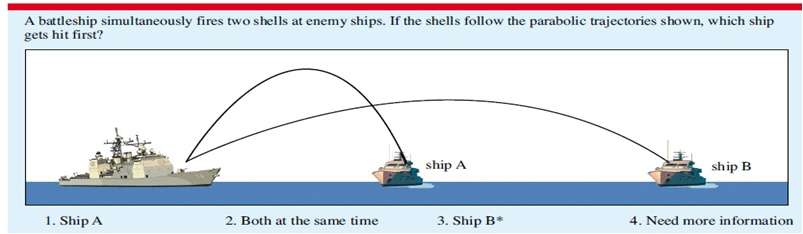
The question is rather simple based on that figure. If the battleship simultaneously fires two shells at enemy ships and follow the shown parabolic trajectories, which ship gets hit first?
The question gives 4 possible answers: (1) Ship A, (2) Both at the same time, (3) Ship B, and (4) Need more information.
The level of physics needed to solve this is first year undergraduate intro physics, or even AP physics. It is how you approach the problem to solve this that may require a little bit of sophistication. See if you can find the answer, and I'll post mine in another blog post later... :)
Zz.
Thursday, August 05, 2010
Failed Theories of Superconductivity
We always focus on what works and what became successful. But in getting there, there are many ideas and concepts that didn't work, and some that were just plain wrong. But all of these were important in trying to understand a phenomenon.
This is such a good paper to read. Joerg Schmalian has dug up and illustrated all the failed theories in trying to describe the phenomenon of superconductivity before the BCS theory came along. In the process, we realize how amazing BCS theory is for what it accomplished.
Abstract: Almost half a century passed between the discovery of superconductivity by Kammerlingh Onnes and the theoretical explanation of the phenomenon by Bardeen, Cooper and Schrieffer. During the intervening years the brightest minds in theoretical physics tried and failed to develop a microscopic understanding of the effect. A summary of some of those unsuccessful attempts to understand superconductivity not only demonstrates the extraordinary achievement made by formulating the BCS theory, but also illustrates that mistakes are a natural and healthy part of the scientific discourse, and that inapplicable, even incorrect theories can turn out to be interesting and inspiring.
You get a clearer picture of his intention in the introduction.
A highly recommended reading.
Zz.
This is such a good paper to read. Joerg Schmalian has dug up and illustrated all the failed theories in trying to describe the phenomenon of superconductivity before the BCS theory came along. In the process, we realize how amazing BCS theory is for what it accomplished.
Abstract: Almost half a century passed between the discovery of superconductivity by Kammerlingh Onnes and the theoretical explanation of the phenomenon by Bardeen, Cooper and Schrieffer. During the intervening years the brightest minds in theoretical physics tried and failed to develop a microscopic understanding of the effect. A summary of some of those unsuccessful attempts to understand superconductivity not only demonstrates the extraordinary achievement made by formulating the BCS theory, but also illustrates that mistakes are a natural and healthy part of the scientific discourse, and that inapplicable, even incorrect theories can turn out to be interesting and inspiring.
You get a clearer picture of his intention in the introduction.
When discussing failed attempts to understand superconductivity, we must keep in mind that they are a natural and healthy part of the scientific discourse. They are an important part of the process of finding the right answers. These notes are not written to taunt those who tried and did not succeed. On the contrary, it is the greatness that comes with names like Joseph John Thompson, Albert Einstein, Niels Bohr, Léon Brillouin, Ralph Kronig, Felix Bloch, Lev Landau, Werner Heisenberg, Max Born, and Richard Feynman that demonstrates the dimension of the endeavor undertaken by John Bardeen, Leon N Cooper and J. Robert Schrieffer. Formulating the theory of superconductivity was one of the hardest problems in physics of the 20th century.
A highly recommended reading.
Zz.
Wednesday, August 04, 2010
Beware of Green Laser Pointer
This is rather disconcerting.
A team at NIST has discovered a potential safety hazard with the increasingly-popular common green laser pointer.
You may read the full report at the link given in that press release.
This is a serious problem because your eye can't react to shield itself from IR until it is too late. For many people who do laser alignment, working with IR laser is one of the most dangerous endeavor, even with proper eye wear.
So if you have one of these green laser pointer, try testing it as described in the report to see if you have a dangerous level of IR from it.
Zz.
A team at NIST has discovered a potential safety hazard with the increasingly-popular common green laser pointer.
Late last year, the research team purchased three low-cost green laser pointers advertised to have a power output of 10 milliwatts (mW). Measurements showed that one unit emitted dim green light but delivered infrared levels of nearly 20 mW—powerful enough to cause retinal damage to an individual before he or she is aware of the invisible light. NIST’s Jemellie Galang and her colleagues repeated the tests with several other laser pointers and found similarly intense infrared emissions in some but not all units.
The problem stems from inadequate procedures in manufacturing quality assurance, according to the research team. Inside a green laser pointer, infrared light from a semiconductor diode laser pumps infrared light at a wavelength of 808 nm into a transparent crystal of yttrium orthovanadate doped with neodymium atoms (Nd:YVO4), causing the crystal to lase even deeper in the infrared, at 1064 nm. This light passes through a crystal of potassium titanyl phosphate (KTP), which emits light of half the wavelength: 532 nm, the familiar color of the green laser pointer.
However, if the KTP crystal is misaligned, little of the 1064 nm light is converted into green light, and most of it comes out as infrared. Excess infrared leakage can also occur if the coatings at both ends of the crystal that act as mirrors for the infrared laser light are too thin.
You may read the full report at the link given in that press release.
This is a serious problem because your eye can't react to shield itself from IR until it is too late. For many people who do laser alignment, working with IR laser is one of the most dangerous endeavor, even with proper eye wear.
So if you have one of these green laser pointer, try testing it as described in the report to see if you have a dangerous level of IR from it.
Zz.
Rumors Travel At The Speed Of Light
This NY Times news article looks at how science rumors can spread like a bush wildfire on the 'net, devouring all sense of credibility and standards.
I've mentioned this before with respect to the recent rumors of the Higgs. Even though this is only a blog and not a news source, I still refused to be suckered like other news agencies to report such rumors, especially when it came from a previously unreliable source. I mean, how many times do you have to get whacked on your head before you yell "Stop!"? Even when I'm reporting something that I've heard via 2nd hand news, such as the suicide at Fermilab, I would not have reported it had it came from someone's blog!
This is one downside of having such easy access to "information" and communications. News spread very fast without regards to accuracy. One must always keep that in mind.
Zz.
One culprit here is the Web, which was invented to foster better communication among physicists in the first place, but has proved equally adept at spreading disinformation. But another, it seems to me, is the desire for some fundamental discovery about the nature of the universe — the yearning to wake up in a new world — and a growing feeling among astronomers and physicists that we are in fact creeping up on enormous changes with the advent of things like the Large Hadron Collider outside Geneva and the Kepler spacecraft.
I've mentioned this before with respect to the recent rumors of the Higgs. Even though this is only a blog and not a news source, I still refused to be suckered like other news agencies to report such rumors, especially when it came from a previously unreliable source. I mean, how many times do you have to get whacked on your head before you yell "Stop!"? Even when I'm reporting something that I've heard via 2nd hand news, such as the suicide at Fermilab, I would not have reported it had it came from someone's blog!
This is one downside of having such easy access to "information" and communications. News spread very fast without regards to accuracy. One must always keep that in mind.
Zz.
Monday, August 02, 2010
God of Quantum Flapdoodle
I like that name "quantum flapdoodle". Supposedly, it was coined by Murray Gell-Mann to describe "..stringing together a series of terms and phrases from quantum physics and asserting that they explain something in our daily experience.." In this article, Michael Shermer continues to rebutt Deepak Chopra and his quantum flapdoodle.
One would think that, since they're making things up as they go along, that they could make their own reality and use that, rather than piggybacking onto something they clearly do not understand.
Zz.
Chopra believes that the weirdness of the quantum world (such as Heisenberg’s uncertainty principle) can be linked to certain mysteries of the macro world (such as consciousness). This supposition is based on the work of Roger Penrose and Stuart Hameroff, whose theory of quantum consciousness has generated much heat but little light in scientific circles.
Inside our neurons are tiny hollow microtubules that act like structural scaffolding. Penrose and Hameroff conjecture that something inside the microtubules may initiate a wave-function collapse that leads to the quantum coherence of atoms, causing neurotransmitters to be released into the synapses between neurons. This, in turn, triggers the neurons to fire in a uniform pattern, thereby creating thought and consciousness. Since a wave-function collapse can only come about when an atom is “observed” (that is, affected in any way by something else), “mind” may be the observer in a recursive loop from atoms to molecules to neurons to thought to consciousness to mind to atoms to molecules to neurons . . . and so on.
In reality, the gap between quantum effects and the world of ordinary events is too large to bridge. In his 1995 book The Unconscious Quantum, the University of Colorado particle physicist Victor Stenger demonstrates that for a system to be described in terms of quantum mechanics, its typical mass m, speed v, and distance d must be on the order of Planck’s constant h. “If mvd is much greater than h, then the system probably can be treated classically,” that is, according to the physical laws discovered by Newton. Stenger computed the mass of neural transmitter molecules and their speed across the distance of a synapse, and he concluded that both are about three orders of magnitude too large for quantum effects to be influential. It is important to note one very common practice with physicists, and scientists/engineers in general. When one makes off-the-cuff supposition, one can make quick back-of-the-envelope calculations to figure out not if something is possible, but if something can be ruled out immediately simply based on what we know. So such a thing that Vic Stenger did in calculating the mass and speed of a neural transmitter may not be accurate, but it is of the order-of-magnitude value that clearly shows that quantum effects are just not significant. This is part of science. This is something people like Chopra can't do and have no skill to do. They typically make handwaving argument with no quantitative analysis to back what they say. Yet, they claim to base their speculation on science/physics.
One would think that, since they're making things up as they go along, that they could make their own reality and use that, rather than piggybacking onto something they clearly do not understand.
Zz.
Subscribe to:
Posts (Atom)