Friday, September 12, 2008

The Origins of the Universe: A Crash Course

In case you missed the Op-Ed by Brian Greene in yesterday's NY Times, here is the link. He detailed why the LHC is so darn important and exciting. It could, after all, falsify String Theory! {no, of course he didn't say that! I did!} :)

And of course, he had to address the silliness of the "black hole" controversy. Here, if anyone has any doubt on the answer, one should look at his response.

Why might one worry that this would be a problem? Because black holes have a reputation for rapacity. If a black hole is produced under Geneva, might it swallow Switzerland and continue on a ravenous rampage until the earth is devoured?

It’s a reasonable question with a definite answer: no.


No wishy-washy answer. No hiding behind long, lengthy explanation that the public has no ability to comprehend. Unless you question Greene's integrity and intelligence as a physicist, there is no getting around that clear and direct answer.

Zz.

UConn's Year of Science - With One Small Error

The University of Connecticut is celebrating a "Year of Science" in 2009. I guess this is a natural successor to Year of Physics in 2005.

UConn will celebrate the Year of Science 2009 with lectures, workshops, performances, and exhibits to mark the 200th anniversary of Darwin’s birth and the 150th anniversary of his publication of On the Origin of Species.

The year 2009 is also the 400th anniversary of Johannes Kepler’s publication of the first two laws of planetary motion, and the 400th anniversary of the first telescope made by Galileo.

The American Institute of Biological Sciences, the National Academy of Science, and more than 185 professional societies, colleges and universities, museums, and corporations also are expected to participate in Year of Science 2009, a national, year-long celebration of science.


Unfortunately, the announcement has one error. See if you can find it. In fact, I'll even quote the paragraph that has the obvious mistake and see if you can spot it. I suspect that if enough people write in, it will be corrected and you won't see this error soon enough. So here it is:

production of a play on March 25 at the Health Center and March 26 in Storrs called Manya: A Living History of Marie Curie, presented by performance artist Susan Frontcak. The play will look at Curie’s childhood in Poland, her developing interest in science, and her collaboration with Pierre Curie. It will also examine the political, financial, and medical challenges she faced. Marie Curie discovered radium and radioactivity and recognized that radiation could be used to cure cancer. She was the first woman to receive the Nobel Prize, and the only person to receive two Nobels (one in physics and the other in chemistry);


Did you catch it? :)

Zz.

Greenhouse Theory Violates the Laws of Thermodynamics? NOT!

File this as another one of the "Imagination without knowledge is ignorance waiting to happen" case. It isn't the first time that someone tried to use physics in a rather interesting way to falsify something. Creationists had tried the same thing against evolution.

In this case, it is questioning the greenhouse effect whereby the earth gets heated due to the presence of greenhouse gasses. The website presented a typical faulty argument being presented, and then a rather good responses to it. This might be something one might want to read and understand in case one encounters the same type of argument.

Note that the American Institute of Physics has a website that includes various physical description related to global warming. The directly link to the site can be found from this Blog's favorite links.

Zz.

Talking To The Media About Your Research

If you are ever in the position of getting popular publicity for your work, you will encounter the situation where you will have to talk and deal with the media. While not many scientists have to deal with this situation, there are certainly those who have been put through such an "ordeal", and many more will be.

This article in the Science Career section has many useful advice and tips on dealing with the media. However, what I found to be more useful is that this actually is how a scientist should also deal with the public when speaking about his/her research work. Many of the issues that surround the problem in dealing with the media appears to be the same problem that one would deal with in one's interactions with the public.

Indeed, scientists frequently complain about mistakes and inaccuracies. "Scientists regard different things as being incorrect: firstly, the fact that particular aspects are omitted; secondly, simplifications; and thirdly, actual errors," Scherzler says. Scientists need to understand that communicating science to the public is very different from communicating it to one's scientific peers. "Omissions are ... always necessary in journalism, because space or airtime is restricted. Simplifications are also inevitable so that the audience can follow the topic. Errors are, of course, annoying," she adds.


This should warn the public on the nature of the reporting that they are reading. It should give them some perspective on how things have been simplified for their consumption. So at no time should they be deluding themselves that they are getting the full picture. You'd be surprised how many people think that what they read about science in the newspaper is entirely accurate and complete.

And then, there's the issue of how and what are being reported.

There's a chance, of course, that journalists won't represent your research accurately, and this concerns many scientists. Nine out of 10 researchers Peters surveyed worried about being misquoted, and eight out of 10 thought journalists were unpredictable. In Crockett's experience, "popular press' takes on the paper [can be] quite far removed from what the research presented," she says. In her Science paper, Crockett and her colleagues found that healthy people are more prone to retaliate to unfairness when their brain serotonin levels are reduced through diet. In some accounts, the coverage "somehow inferred that we should eat more chocolate so we can be nicer to each other," Crockett says.


In other words, just because you said something with one particular meaning, doesn't mean that the receiver of that message understood it with the SAME meaning! Many scientists have been guilty of using "buzzwords", either to simplify something, or to catch the public's imagination (example: teleportation). Unfortunately, the public has a wide range of imagination that isn't necessarily based on reality or what was meant in the first place. We are then left with dealing with the misinterpretation and trying to correct it.

The other part of the article even re-emphasized this point.

If you're not careful, your expertise could be used for topics you'd rather not be associated with. Some time ago, "a tabloid journalist called an astronomer at the Max Planck Institute. He wanted to know when Venus, Mercury, and Saturn would be especially close to each other. ... The next morning, the name of the scientist could be found in the same breath as recommendations regarding the best time to have sex according to the planets," says Diane Scherzler , who gives media training courses for academics and is an editor in the online department of Suedwestrundfunk, a German public broadcasting company. Before agreeing to an interview, "it is very important to make clear with whom I am talking, what is this journalist working on, what kind of story, for which magazine or program," Peters adds.


That last part is what I have called the "bastardization of ..." so-and-so. I've listed several bastardizations of quantum mechanics in this blog. One should no longer be surprised that something in science is taking way beyond what it says and can do and gets bastardized into some crackpottery. That's a fact of life it seems nowadays.

Zz.

Thursday, September 11, 2008

Difference Between Research in Academic and Business Settings

This is a very good article. It tries to present the differences in doing research work within Academia and Business/Industry settings. This is good to know for those who wish to pursue work in industries, especially after coming off doing a Ph.D work that is within the academia world.

Highly recommended reading.

Zz.

Peter Higgs Responds To Hawking's Bet

OOooh.. this is getting good!

While not quite a spat on the same level as some of the spoiled Hollywood brats, Peter Higgs and Stephen Hawking are going after each other. Hawking, as you recall, put a bet of $100 that the Higgs boson/s will not be found, and stated that it would be more interesting if it/they were not found. Peter Higgs has now replied in a news conference to mark the LHC's first beam that Hawking deduction on why it may not be found isn't correct.

“My understanding is he puts together theories in particle physics with gravity . . . in a way which no theoretical particle physicist would believe is the correct theory.

“From a particle physics, quantum theory point of view, you have to put a lot more than just gravity into the theory to have a consistent theory and I don’t think Stephen has done that. I am very doubtful about his calculations.” Other members of the panel moved swiftly to cut off the discussion, suggesting that he had taken Professor Hawking’s views out of context.


C'mon, we can do better than that! When do we get them to duke it out. Some hair-pulling fight would be appropriate, similar to that infamous fight from Dynasty!

OK, I think I just dated myself....

Zz.

Wednesday, September 10, 2008

Virginia Announces Physics 'Flexbook' Solicitation

The state of Virginia in the US has began an open source physics textbook project called "Flexbook". They are now seeking solicitations for contributions from various institutions.

The Virginia Physics "Flexbook" project is seeking statements of participation from school divisions and others that have teachers willing to contribute physics content to the open source platform and participate in the pilot. Please visit www.technology.virginia.gov for application instructions or contact Tristen Pegram at Tristen.pegram@governor.virginia.gov.


It will be interesting to see how this might turn out. It is still several years away, though.

Zz.

First Beam at LHC

Obviously by now, everyone has heard of the successful test of the first proton beam at the LHC this morning.

As interesting as that, what's more fascinating to me is how the detectors are observing this beam. Since there's no collision yet, these detectors are not observing what they're designed to do, but they can still detect the beam pretty well. This link shows what the ATLAS detector saw this morning as the proton beam passed through it.

Edit: CORRECTIONS. I was just told that this is NOT from the proton beam passing through the detector. They have a beam stop right before the entrance to the detector, and what they detected were muons from the beam stop that were created when the high energy protons hit the beam stop.

Zz.

Tuesday, September 09, 2008

The End of the World at the Large Hadron Collider?

Hardly, but nothing like an attention-grabbing title like that, eh?

Just in time for the first circulating proton beam at the LHC tomorrow morning, we have an excellent viewpoint review article by Micheal Peskin of SLAC. In this article, he analyzes the points made by Steven Giddings and Michelangelo Mangano in their PRD paper on the possibility of a catastrophic black hole formation at the LHC.

Again, nothing here is new, but it now presented hopefully in a clearer fashion for the general public to read and maybe understand. And this is based on a peer-reviewed paper in a respected journal written by an expert in the field, not just some amateur writing his/her opinion on some blog or website, or even some "ArXiv" publication. If you consider your sources carefully, you should be able to draw up your own conclusion on who you should believe.

This article actually brought up an interesting and often overlooked point.

Nonetheless, there is one case that is especially subtle, the idea that the LHC will produce microscopic black holes that will grow to macroscopic size, slowly turning the whole earth into a black hole. Let me stress, first of all, that there is no actual theory that leads to this conclusion. You may judge this from the fact that my well-informed colleagues are all planning sabbaticals at CERN in Geneva, while none of them are moving to Melbourne.


I can unequivocally tell you without a doubt that no one is MORE concerned about my safety and my family's safety and well-being than I do. And I am extremely certain that no one is more concerned about the well-being and safety of those people working at CERN than .... those people working at CERN! You can bet your Stephen Hawking dollar that if there is a distinct chance that such a disaster will occur, these bright and intelligent people would not be there, and would have voiced their opinion. After all, they, more than anyone else, understand both the physics and the intricate detail of the experiment. This is a fact that cannot be denied. Considering that these knowledgeable people (certainly more knowledgeable than most blog and webpage writers, present company included) chose to be there and present during first collision should be a very loud and clearest message on the issue of safety of the LHC experiment.

Zz.

Hawking Bets That LHC Won't Find Higgs

On the eve of a major test of the LHC start-up procedure, Stephen Hawking has thrown a damper on the event (although not much of a damper) by betting "one hundred dollars" that it won't find the Higgs boson.

"I think it will be much more exciting if we don't find the Higgs. That will show something is wrong, and we need to think again. I have a bet of 100 dollars that we won't find the Higgs," added Hawking, whose books including "A Brief History of Time" have sought to popularise study of stellar physics.


He does think that we might find a supersymmetric particle. Still, he has been wrong (or has been shown to be wrong) before. And he is also not the first person who has stated that while finding the Higgs would be monumental, not finding it would be even more exciting. C.N. Yang said almost the same thing.

Either way, the LHC will produce a lot of things to ponder over.

Zz.

Science and Politicians

I was watching the CNN American Morning program on TV this morning while doing my workout (not by choice - it is the show of choice for most of the people doing the work out at the gym at work). At one point, they were showing the "energy plans" of the 2 US presidential candidates, i.e. what both Barak Obama and John McCain plan on doing and achieving during their presidency to tackle both environmental concerns due to energy consumption and to reduce the US dependence on imported oil. The plans include off-shore drilling, increasing the use of "renewable energy sources", giving incentives to use more hybrid vehicles, more nuclear power plants, etc.. etc. (both candidates do not have all of these items on their lists - I'm just giving a sampling of what I got from both candidates).

Immediately, 2 things came to my mind while I was huffing and puffing on the treadmill:

1. How did these two candidates come up with such a plan? I mean, I'm hoping that these things just didn't come to them in a dream, or they didn't just grab them (and the timeline) out of thin air.

2. How come CNN did not have experts in this area to analyze the feasibility or effectiveness of these plans? I mean, whenever they have certain issues involved, such as medical questions, they always had some "experts" to give their professional opinions. Why didn't they have one there to dissect these plans? Instead, they had their "chief economic correspondent" to present what is essentially a technical/scientific issue.

Here's what I would like to know whenever something like this is presented:

Who is the expert (or experts if there are more than one) advising the candidates on such technical/scientific matters? If, for example, they instead rely on some "economist" to help them make a decision, then I already know that they simply have very low respect to getting accurate advice from people who should know the subject matter, and that they are more interested in the political aspect of the decision rather than being technically/scientifically sound. Who they listen to and who is advising them is important here since none of these candidates are obviously scientists or engineers who are capable to understand such issues. Furthermore, these are also probably the pool of people that might be considered for various cabinet positions when they are in office. So who are they? Who is whispering in Obama and McCain's ears when it comes to science and technological decisions such as this?

I find coverage on scientific and technical issues severely lacking in the media, which is of no surprise since most of the general public has no clue on its importance. Plus, they think it is BORING. Oh, we have certainly seen many coverage of energy and environmental issues. But really, when was the last time you actually see on TV an in-depth discussion on the technological and scientific aspect of these issues, rather than a political/economic angle? Whenever I see energy issues being discussed, it never fails to be presented from the political and economic point of view. The fact that the US has so many experts in this field, not to mention, the presence of the US National Academy of Sciences, somehow do not impress any of the media enough to seek these credible sources for advice or input.

At some point, the public needs to pay attention to their sources. At some point, the public needs to distinguish and separate the STYLE from SUBSTANCE. And at some point, the public needs to figure out the validity of the "information" they are being given. If not, then we all deserve what we get, or going to get.

Zz.

Monday, September 08, 2008

Quantum Spin Liquids

There is an excellent review of the state of knowledge in quantum spin liquids that was published in Science last week (Science, 5 Sept, 2008). It was written by Patrick Lee of MIT, and it covers not only the state of knowledge, but also a brief history of spin liquids and why it may be a new state of matter that we haven't seen before.

Note the role that high-Tc cuprates play in all this. It is just another example on why the problem of high-Tc cuprate superconductors isn't just an issue of superconductivity. I've mentioned this before that the physics behind the high-Tc superconductors is so rich that it touches almost every aspect of condensed matter physics. This is just one example of that point. It is why the quest for the mechanism of high-Tc superconductors is one of the most important problem in physics. It isn't just about superconductivity, but about a whole bunch of other related phenomena as well.

Zz.

Proton Beam at LHC

Supposedly, Sept. 10 is still the schedule for the first test of the LHC proton beam to make it all the way around the LHC ring. It will go counterclockwise first. The operators will have to adjust all those superconducting magnets to get the beam to go all the way around the huge ring in the exact intended location. After that is done, they will make the proton beam go clockwise, and adjust the SAME magnet (that has a rather interesting design to produce a different field geometry for the opposite beam).

Most people and the media thinks that this event is the "monumental" and important milestone for the LHC start-up. While they are certainly important, what will be even more important is what may happen the next day on Sept. 11 (a rather unfortunate date to pick), where they are scheduled to make the beam go back to going counterclockwise and see if the previous 2 magnet adjustments have changed the original beam path. Depending on how much off the beam is, this could take a while to get the exactly requirement alignment, and may require going back and forth between clockwise and counterclockwise beams.

In all of this, there's still no collision yet, which is right now, still scheduled for Oct. All of the above activities are the responsibility of a number of accelerator physicists who are in charge of the beam dynamics. So they and various magnet designers are the ones not getting enough sleep at the moment. :)

Edit: BTW, I forgot to mention that Fermilab will be hosting the LHC "Pajama Party" for this event on Sept. 10, starting at 1:30 AM (yes, AM, that is not a typo. It will be morning at CERN). You must register to attend it, though, and unfortunately, the registration is closed already.

Zz.

Saturday, September 06, 2008

The Next Big Bang

If you get the History Channel, you may want to see this:


Nearly two years ago, the Silent Crow team began looking cinematically at physics. Not just your everyday physics, but the quantum world of particle physics. Over my head? Yes. So, we were joined by the best physicists in the world.

On September 9, at 8 PM (Eastern),on the EVE of the first beam in the biggest particle collider on the planet,the History Channel will air the film we've created. It's called Next Big Bang, and it is just that. It's a deep look at the physics of the very beginning of time. We battled hard with the network to create something that isn't simply sensational or dumbed down, something stunningly beautiful, and something that you will want to watch again, because it sparks so many questions about the nature of the universe. This is really compelling, fascinating, challenging and did I mention gorgeous(?) immersive stuff.

I am proud of the Next Big Bang, even if it is TV. Which is the reason for this email:

The network is not promoting the show for fear their audience doesn't want to be intellectually inspired, enlightened or challenged. Prove them wrong. Watch the show. Tape it. Tivo it, and most importantly, call your friend down the block who you know loves science and physics, and tell him to watch it. Tell your school physics teacher that there's a show her students should watch.

It's VERY cool, and it sends the networks a message that we actually do like entertaining programming that inspires us... to think.

So, from the many producers and physicists that toiled to create this visionary piece, please enjoy the Next Big Bang.

TUESDAY, Sept 9, at 8 PM EST - HISTORY CHANNEL

Thank you!

MATT BENNETT
Silent Crow


Zz.

Wednesday, September 03, 2008

Graphene Pioneers Follow in Nobel Footsteps

I guess it is a no-brainer to consider both Andre Geim and Kostya Noveselov as one of the possible candidates for the physics Nobel Prize some time soon with their discovery of graphene. I guess that since October is approaching fast, more of talks of Nobel prize dreams inevitably comes up.

Presented since 1975, the Europhysics Prize is one of the world’s most prestigious awards for condensed matter physics.

Many winners have subsequently been awarded the Nobel Prize in recognition of their achievements, including the last year Nobel Laureates Albert Fert, Peter Grünberg and Gerhard Ertl.


The "equivalent" prize in the US would be the Buckeley Prize for condensed matter physics, which also had many of its winners going on to win the Nobel prize.

With graphene being as "hot" of a research area as it is now, I wouldn't be surprised if Geim and Noveselov win it this year.

Zz.

Tuesday, September 02, 2008

Barak Obama Takes A Stand On Science

They may not be willing (so far) to participate in the Science Debate, but at least they are addressing the questions being asked to them regarding science issues. So far, Barak Obama has outlined his science policies, and we are still waiting for responses from John McCain.

I'm actually not surprised that the McCain camp has been slow in responding. From all that I've read earlier, I don't think he puts science and science issues high on his agenda and importance (just like the rest of the general public, I suppose). Both Physics Today and Science had done analysis on the candidates' view on science policies, and John McCain had the vaguest and least well-defined policies of all the major candidates during the primaries.

Zz.

The Length of Time's Arrow

A wonderful paper addressing the 2nd Law of Thermodynamics at the microscopic scale. In this case, they set up an 'experiment' on a single RNA molecule.

Abstract: An unresolved problem in physics is how the thermodynamic arrow of time arises from an underlying time reversible dynamics. We contribute to this issue by developing a measure of time-symmetry breaking, and by using the work fluctuation relations, we determine the time asymmetry of recent single molecule RNA unfolding experiments. We define time asymmetry as the Jensen-Shannon divergence between trajectory probability distributions of an experiment and its time-reversed conjugate. Among other interesting properties, the length of time's arrow bounds the average dissipation and determines the difficulty of accurately estimating free energy differences in nonequilibrium experiments.

The reference to the actual PRL paper is included in the ArXiv version.

Zz.

Monday, September 01, 2008

James Clerk Maxwell

It is strange to find a short and concise biography of Maxwell in the business section of Yahoo, but there it is.

Frank Wilczek, an MIT professor and winner of the 2004 Nobel Prize in physics, said his prize-winning equation for subatomic quarks and gluons is "very much an extension" of Maxwell's work. He compared his Nobel output to "Maxwell's equations on steroids."

"Maxwell changed our picture of the world and introduced a basically new and extremely fruitful way of thinking about nature," he told IBD.


It's a fair article to read if you don't have the time and patience to read a whole book on Maxwell.

Zz.

Homeopathy Degree Suspended

I mentioned more than a year ago of a university in the United Kingdom that started to offer degrees in homeopathy, despite the fact that this is still considered as a pseudoscience. It now appears that the University of Central Lancashire has decided to end that program due to "... low recruitment levels..."

Whatever is the reason, this is an utter embarrassment for that university. If they were thinking that doing such a stunt would give their institution "publicity", they have succeeded. Only, I don't think this is the type of publicity that any institution wants, and certainly not any RESPECTABLE institution.

Zz.

Sunday, August 31, 2008

Art Hobson's Selected Papers

I found the link to Art Hobson's selected papers a while back and added it to my favorite Physics Links, but if you've missed it, it might be very educational and useful for you to look at it. He covers quite a bit of material that you might find interesting. One in particular is his treatise on the so-called wave-particle duality or paradox. Read that, and compare that with what I had written earlier about his wave-particle duality. I think we both are of the agreement that there's no such thing as a paradox or a duality, since ALL of the phenomena associated with light can be described via a single-consistent theory without having to change a picture from "wave" to "particle" and back to "wave". This is not the sign of a "duality".

There are other great essays to read on that page.

Zz.

Saturday, August 30, 2008

A High Energy Physics Experiment For A Mere US$1.2 Million

That's unheard of! But that's what SciBooNE cost from start to finish, and finished they did in less than 3 years!

So besides the amazing low cost and the recycling of equipment, a graduate student working on this project could actually be involved in the building and taking data in the project, instead of just being a small part in the long construction period.

Brilliant!

Zz.

Friday, August 29, 2008

The Rise of the FFAG

Fixed-Field Alternating Gradient (FFAG) accelerator has an unfortunate acronym, which I talked about a while back. Still, it does not diminish its potential and importance in the field of particle accelerators.

This article provides a nice summary of what it is, its history, and why this technique is being pursued. I still haven't found out yet how that acronym is pronounced by the people in that field.

Zz.

How Cooper Pairs Vanish Approaching the Mott Insulator in Bi2Sr2CaCu2O8+d

This paper appeared in Nature this week, but the authors have uploaded it to ArXiv and it appeared today. Using STM/STS technique, they were able to obtained the spectroscopy in both real and momentum space as a function of doping along the nodal direction of the Fermi surface of a high-Tc superconductor. The results show that as the compound approaches the Mott insulating phase, the mobile Bogoliubov quasiparticles from the Cooper pairs are slowly being replaced by the localized electrons.

A first-rate experiment!

Edit: A BNL press release on this work can be found here.

Zz.

Fraud Charges Cast Doubt on Claims of DNA Damage From Cell Phone Fields

This news was reported in the latest issue of Science (August 29, 2008).

The only two peer-reviewed scientific papers showing that electromagnetic fields (EMFs) from cell phones can cause DNA breakage are at the center of a misconduct controversy at the Medical University of Vienna (MUV). Critics had argued that the data looked too good to be real, and in May a university investigation agreed, concluding that data in both studies had been fabricated and that the papers should be retracted.

The technician who worked on the studies has resigned, and the senior author on both papers initially agreed with the rector of the university to retract them. But since then, the case has become murkier as the senior author has changed his mind, saying that the technician denies wrongdoing. He will now agree to retract only one paper, and he also says his critics have been funded by the cell phone industry, which has an obvious interest in discrediting any evidence of harm from its products.


Er.. no! Whether the result of the study is valid or not, the CREDIBILITY of the study is now gone, especially when a retraction of one paper will occur. I don't think these people get it, or have learned anything from the Schon debacle from a few years ago, or from the cold-fusion embarassment. When you lose your credibility, it really doesn't matter how good of a result you produce. Not many will pay that much attention to you anymore unless someone else comes in and verify what you got. And last time I checked, cold fusion hasn't been touted as the solution to our energy crisis.

I also wonder if the Director of the University of Pittsburgh Cancer Institute actually based his recommendations for children/teens to limit their cell phone usage on these studies. If he did, that would certainly be a dubious source to use, I would think.

Zz.

Thursday, August 28, 2008

Physics Education Research: Resources for Graduate Student Instructors

I've only looked quickly at this, but off-hand, it definitely sounds like a good idea. This article gives a bunch of resources to graduate student teaching assistance in his/her classroom responsibilities.

Abstract: This resource letter intends to provide physics instructors - particularly graduate student teaching assistants - at the introductory university level with a small but representative collection of resources to acquire a familiarity with research in physics education for guidance in everyday instruction. The resources are in the form of books, articles, websites, journals, and organizations.

Of course, this assumes that a particular graduate assistant actually care that much in his/her job to teach the students. I'm sure we've heard many horror stories of teaching assistants simply doing their job as a chore, rather than something they wish to excel in. I've had experiences with both good and bad TA's, and everything in between, and I'm sure many students have similar experiences as well.

Still, for those who do take their responsibilities seriously, these resources could be of some help.

Zz.

Taleyarkhan Punished for Scientific Misconduct

Rusi Taleyarkhan has been stripped of his professorships by Purdue and barred from being the primary advisor for any students for 3 years. This is the result of his failed appeal against the guilty verdict of scientific misconduct.

Purdue University today reprimanded and sanctioned one of its nuclear engineers for research misconduct. Rusi Taleyarkhan was stripped of his named professorship, which includes $25,000 annually in discretionary resources from the West Lafayette, Indiana-based university, $14,000 of which went into his salary. He will also not be allowed to serve as the primary adviser or co-adviser for students for at least 3 years, at which time he can apply for reinstatement to full faculty status.


Things, of course, are far from over, as you can tell from the article.

Zz.

Wednesday, August 27, 2008

Physics of the LHC

It is very difficult to try and condensed all the things that can and will be done and studied at the LHC, especially in trying to present such a thing in the most comprehensible manner to a large audience. Still, this Physics World article does a very good job of what we have to look forward to in terms of discovery. This doesn't yet count all the surprises that we are bound to get along the way that makes this profession such an interesting one.

So, if you are one of the few people who still don't quite know what the LHC is up to and what they hope to hunt for, that article is a highly recommended reading material.

Zz.

GLAST Renamed to Honor Fermi

What's in a name, right?

NASA has renamed the Gamma-Ray Large Area Space Telescope (GLAST) to Fermi Gamma-ray Space Telescope. So that makes it FGST? FGRST? FERGARASPT?

The Fermi spacecraft -- launched June 11 -- has begun its mission of exploring the universe in high-energy gamma rays, with the spacecraft and its revolutionary instruments passing their orbital checkout "with flying colors," NASA said.

"Enrico Fermi was the first person to suggest how cosmic particles could be accelerated to high speeds," said Paul Hertz, chief scientist for NASA's Science Mission Directorate. "His theory provides the foundation for understanding the new phenomena his namesake telescope will discover."


Just don't name it for Pluto. It might get demoted to a "Observatoroid".

More on what this observatory can and will do can be found here.

Zz.

Tuesday, August 26, 2008

Transversality of Electromagnetic Waves in the Calculus-Based Introductory Physics Course

First of all, let's get this out of the way. I love, love, LOVE, this type of articles. I like it when someone makes an effort to go over things that we learn as part of our basic physics education at the undergraduate level, and explains things in painful detail of things that either were not covered, or were not explained in great detail. In fact, some of these things can be quite puzzling at that time because of such deficiencies, and only later on, if we're lucky, do we finally understand why some of them are as described.

This preprint appearing on arXiv today, tries do to just that. The author had meticulously explained and derived why EM wave have transversed electric and magnetic components, something that isn't covered in great details at the introductory level. I like the fact that he used both physical arguments (observation from polarization) and rigorous mathematical proof based on Maxwell equations.

This is along the same spirit as the Marcella's paper "Quantum Interference with Slits" that I highlighted recently. In Marcella's paper, he painfully derived all the wave-like behavior one observes in single, double, and multiple slits without invoking any wave formalism at all, just purely quantum mechanical. It shows how QM can derive such a thing, something we all know it could, but never actually sat down and did it.

The other paper that I wish to highlight here is an old paper (if you call 1984 old) that explains something that just did not appear right when it is used in many standard intermediate E&M textbooks. The paper is titled "Force on a Dielectric Slab Inserted into a Parallel-Plate Capacitor" by S. Margulies (Am. J. Phys. v.52, p.515 (1984)). Here, he tackled on a confusing description of the origin of the force acting on a piece of dielectric slab that is partially inserted into a parallel-plate capacitor.

For example, how can the force act to pull the slab into the volume between the plates when the electric field there is perpendicular to this direction? If this is explained - the force is, of course, due to the fringe field - an apparent paradox arises: How can the virtual-work calculation yield an answer when it is explicitly based on the assumption of a uniform electric field existing only in the region between the plates, and so does not include the fringe field at all?


He then gave a very detailed derivation on this force that eventually matches what we get in standard textbooks, and in the process, explained the origin of this force based on the fringe fields that were neglected in the first place. It's a Tour de Force paper on details, details, details.

Does anyone have any similar papers that deal with the same type of revelations? I'd love to collect more of these.

Zz.

Speed of Tennis Serves

In baseball, they monitor the speed of the pitcher's ball all the time. I'm guessing that they have a radar gun that monitors such a thing.

Now, with the US Open tennis championship starting this week and already in full swing, I thought we tackle something that have been a small puzzle for me. Maybe someone has a good explanation for it.

The one thing they also do in many of these tennis tournaments, especially the bigger ones, is to also monitor the speed of the serves. Venus Williams, for example, is cited to have the current fastest serve in women's tennis, at 129 miles per hour, I think. So naturally, my curiosity wonders on how they determine that. Unlike baseball, if they use the same type of radar gun, there is a possibility that they may not get an accurate reading of the speed of the ball. Here's why:

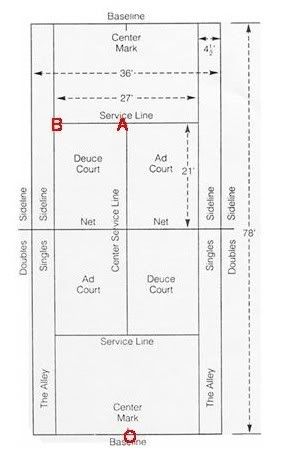
The layout below is a standard tennis court with all the dimensions.

Now, let's say the radar gun is placed directly in line with the center line of the court (i.e. in line with OA). Now, already you can tell that such device will only give the most accurate reading if the ball is coming towards it, i.e. moving along OA. If the ball is moving at an angle to OA, it won't give an accurate reading.

I did a quick calculation on how much the reading would be different. For simplicity sake, we have a person standing at O, hits a serve that lands at B. Let's say the ball travels at v_OB = 130 mph. For a radar gun that is placed directly along the OA line, it will measure only that component of the velocity v_OA, i.e. the component moving in the direction of OA. The angle AOB is ~13 degrees. Thus

v_OA = v_OB * cos(13).

In this case, with v_OB = 130 mph, we get v_OA = 126 mph This means that the radar gun will only read 126 mph, 4 mph less than the actual speed of the ball. Does that mean that Venus Williams actually served faster than 130 mph when she hit that serve? And this is only a more conservative scenario where I placed the server at O. In practice, the server can be at an even more severe angle and serving even wider off the court, meaning that the angle we are dealing with is larger than 13 degrees. This makes the reading of the speed even more inaccurate.

Now, the only caveat here is that I'm assuming that they're using this "antiquated" technique in determining the speed of the ball. With the use of Hawk-Eye system that is in place at all the 4 major tournaments (and others), that system could be the one being used to determine the speed of the ball. In that case, the actual trajectory of the ball isn't determined by just one radar gun placed along the center line. So the actual reading of the speed is more accurate that what I've described. Still, I don't know if they use Hawk-Eye to determine the speed of the serve, and I think that for many tennis tournaments, especially the ones without Hawk-Eye, they might still be using a radar gun.

The consolation here is that the determination of the speed of the serve is irrelevant in the playing of the game. It's nice to have a fast serve, but knowing how fast it is doesn't enter into the game at all. So maybe that's why not much effort is put into making such an accurate determination of the speed of the serve.

Zz.

Monday, August 25, 2008

Full Documentation for the Large Hadron Collider

Symmetry Breaking has an article on the availability, for free, the full documentation of the LHC. Not sure why anyone outside of the field would want to own a copy, but there they are, published in IoP's Journal of Instrumentation.

It was also interesting to read the saga of SLAC's The Blue Book. It's nice to know they finally got that straighten out and made it available online as well.

Zz.

Physics and the Flight Risk of Lap Children

Before the next time you fly with an infant that you will put on your lap, you might want to read this first.

But the FAA has acknowledged the inherent danger: While most parents would do anything for their child - including holding on for dear life in an airborne emergency - the simple fact is they can't always hold onto the child.

That's because commercial aircraft are designed to withstand tremendous G-forces, but humans are not. And therefore a 25-pound baby could easily weigh three or four times that amount when a parent is struggling to hold onto it during an emergency, let alone dealing with impact, smoke or fire.

In addition, a baby strapped inside a parent's seat belt can be crushed by the parent's weight during an emergency.

These laws of physics have been proven time and again, in the most heartbreaking of circumstances. In several cases, lap children have been severely injured and killed in accidents that were survivable.


Certainly the odds of such an emergency situation for airline travel is less than automobile travel. However, when it does happen, it would be horrible that a lap child did not make it through a situation that is survivable.

Zz.

Sunday, August 24, 2008

Quantum Interference With Slits

I find that I make references to this paper quite often, so I thought I might as well post it here so that it would easy for me to find. :)

We tend to point to the interference observation as an "evidence" for the wave nature of something. This is certainly true about light when we continue to describe it as having "wave-particle duality" (which, if you've read my earlier post, I don't agree with). On the other hand, if we believe that QM is also a valid description of light, then QM formalism should also describe the wave behavior that we observe. Yet, whenever we want to describe such interference, we continue to invoke the classical wave description rather than the "particle" nature of light.

Of course, the main reason why we do this is because it is a lot easier (and more transparent for most people/students) to use the wave picture. Still, QM should, in principle, be able to arrive at the same interference effect that we know and love. Most basic QM texts do not go into this, with the argument that such derivation is to complicated for that level.

So it was quite a joy to discover this paper a few years ago. Thomas Marcella[1] has written a rather useful paper in which he explicitly used only QM formalism to derive all the interference phenomena, without invoking any classical wave picture. In it, he solved for the single, double, and multiple slits scenario. Of course, this technique can also be reformulated via Feynman's superposition of paths, but Marcella's technique is a lot more familiar with what undergraduate QM students would have seen.

A useful reference to have whenever someone argues with you that the particle/QM picture cannot describe the interference/diffraction patterns.

Zz.

[1]T.V. Marcella Eur. J. Phys. v.23, p.615 (2002). The preprint can be obtained here.

Saturday, August 23, 2008

Presidential Physics Quiz Winner and Answers

Did any of you attempted to answer the Richard Muller's Presidential Physics Quiz? It sounds like a fun endeavor.

The winner of the quiz has been announced, and there is a very good discussion of each of the question that was asked. There's a lot of science/physics here, and what I like is that this is just the type of estimation/back-of-the-envelope calculation that many scientists resort to in the beginning to come up with some order-of-magnitude answers.

Great stuff! Don't miss it!

Zz.

Quantum Leaps in Physics Instruction

In my series of proposals for revamping the Intro physics labs, I emphasized on 2 important factors: (i) the physical skills that the students get by doing the lab exercises, and (ii) the analytical skills that they get in trying to find the relationships between the variables that they measure, with the hope they can find some form of a pattern. In other words, I'm trying to make them find out for themselves certainly laws or relationships between physical measurements without even telling them the physics behind them. So this will allow them to discover the physics concepts for themselves.

Well, it seems that a similar idea to this is being tried already at Florida State University, although I don't think it is as "free flowing" as the one I'm suggesting. They are doing what is called the General Physics Studio courses, where students spend minimal amount of time per week in lectures, but spend most of their time in groups working on discovering the physics concepts themselves.

"What we want to make sure is that before they jump into solving those problems, that they understand the concepts behind them," said Capstick. "Otherwise they may just learn how to do a particular problem, and then when they hit the next problem, they won't know what to do because they didn't understand the basic idea behind the first one."

To help them to better gain this understanding, students in the new studio course work together in groups on hands-on experiments and problems, giving them a chance to experience the scientific process in action as they uncover the laws of physics for themselves.

"Instead of having somebody lecturing and then having the students try to learn the material based on the lecture and a book, and then doing homework exercises and tests based on what they've put together, the idea is to have the students actively engaged in doing physics questions in class," said Capstick. "There's very little lecturing, so there might be 15 minutes or half an hour at most a week, but most of the time the students are either doing in-class activities that we call whiteboards, or they are doing a lab."


Sounds familiar? :)

It would be wonderful if a student going through one of these courses could write his/her experience on here. Anyone know of anybody taking this course this coming semester? Please contact me.

Zz.

Methodist Advocates Evolution

Holy Cow! Some time, the timing of these things are uncanny.

I had just finished writing (or maybe it is more accurately described as "ranting") against a newspaper article that argued that more pastors and ministers should be teaching "science" as part of religious studies. Then along comes this news article of someone within the United Methodist Church to explicitly accept evolution and to declare that it isn't in conflict the the church's teachings.

One of Kuelling’s proposals amends the Science and Technology section of the church’s Book of Discipline. It was approved by 80 percent of voting delegates.

It now states, in part: “We find that science’s descriptions of cosmological, geological and biological evolution are not in conflict with theology.”

The second proposal, which passed with 96 percent of the vote, was added to the church’s Book of Resolutions. It endorses The Clergy Letter Project led by David Zimmerman, an ecologist and dean of the College of Liberal Arts and Sciences at Butler University in Indianapolis.

The proposal encourages Methodist pastors to sign an open letter on evolution that affirms that “the timeless truths of the Bible and the discoveries of modern science may comfortably coexist” and supports the teaching of evolution alone in schools instead of as “one theory among others.”

A third evolution resolution, advanced by a church regional body in Kansas, puts the church on record as opposing the teaching of “faith-based theories such as Creationism and Intelligent Design” in public-school science classes.


There ya go!

This implies one very important conclusion: that the view of life and the universe within the christian church does not have one single, unique interpretation! This is a FACT. Even within those who accept the literal interpretation of creationism, there is still conflicts between "Old Earth" versus "Young Earth" creationism. So when you have such varying view even among religious scholars and experts, how can someone holds such a definitive stand in accepting creationism based simply on religious grounds?

But the kicker of that article, which the writer in the previous article that I ranted about should read, is this passage:

If the church doesn’t acknowledge the legitimacy of evolution in science, religion comes off as “out of touch with reality” and loses credibility when it makes moral statements on areas involving science and technology,” he says.

“What we’re saying is the Bible … tells us who created the world and what we should do to care for it,” he says. “Genesis teaches about relationships and responsibility. But it does not teach science.”


BINGO! Who's going to tell that other guy that he shouldn't be teaching science? :)

Zz.

Science Was Once Part of Religious Study - Big Deal!

This writer seems to want to argue that the religious point of view of science is perfectly valid simply because "science" was once taught as part of religious studies. So he is saying that since B was once a part of A, then whatever A says about B must be valid. What kind of pretzel logic is this?

He seems to have completely ignored one little incident way back when... Galileo. What happened when the church's doctrine contradicts the findings of science? One simply can't ignore such a thing because it HAS happened, and will continue to occur.

But the worse is yet to come.

This other book is important because the dominant reason, even today, why people hold to theism is the argument best articulated by William Paley in his 1802 book appropriately titled “Natural Theology.” Paley argued that if one came across a watch lying on the road, he would conclude that the watch had an intelligent designer. Likewise, one who studies science is led to ask the same question: Who is the intelligent designer of the universe and the life in it? Paley’s book of science argued in over 400 pages that, after studying the wonders of creation, one could only conclude that, like the watch, it must have had an intelligent watchmaker to explain its origin.

Likewise, the living creation must also have a creator behind it. Thomas Aquinas, often regarded as the greatest Christian philosopher who ever lived, eloquently argued that wherever complex design exists there must have been an intelligent designer. Life, the most specified complex machine in the universe, likewise must have had an intelligent designer. The key is not complexity, but specified complexity. A junkyard is complex, as is a modern jet airplane, but only the airplane is complexity specified for a purpose, to rapidly carry passengers in the air from one point to another.


You'll notice that NONE of these arguments are actually based on science, but rather, guess work and personal tastes. Let's tackle the first one, shall we?

"Life must have an intelligent "watchmaker"".

This one is embarrassing to this "intelligent watchmaker". Read my entry on The Best Attack Against Intelligent Design. I will requote that hysterical passage that I cited:

You have a philosophic choice between evolution or belief in ID, so called intelligent design. But even a first-year engineering student would be embarrassed to have designed your lower back with the extreme bend that allows you to stand erect even though your pelvis slants forward for knuckle-dragging like all our near relatives. You probably have had braces or wisdom teeth extracted because there are too many teeth for the size of your mouth. Then there are your sinuses, with a flawed drainage system that would provoke laughter from a plumber. Yet evolution provides a ready and rational explanation for all these design failures: by progressive changes into an erect posture, by shortening of a mammalian muzzle into a face, and by expansion of our large brains to crowd the facial bones. So take your choice: Do you prefer evolution or an ID whose letters may as well stand for Incompetent Design?


If this is the "Intelligent Designer" that is responsible for such blunders that even human beings can design better, then what does it say about the deity that one is worshipping? No. Just because something has appeared today has no indication that it was out of design. There's no scientific evidence to point to such a thing. The argument made in that paragraph isn't scientific, but rather simply based on a matter of tastes.

The second point on the "complexity specified for a purpose", for some odd reason, seems to be argued as if it favors an intelligent designer. It is odd because "complexity specified for a purpose" is the driving mechanism that clearly explains evolution, that nature will select only what it needs.

Still, the "complexity" issue has been used many time by ID proponents without convincing anyone, especially those in the sciences. This is because this can be illustrate simply:

Let's say you have 10 coins in a row. Now, say that "human being" as we know it now corresponds to a specific arrangement of 5 heads, 3 tail, and 2 heads, all in sequence (i.e. a particular, specified complexity as demanded). Now, before you randomly throw those coins, what are the odds of getting exactly that sequence? It is pretty low, isn't it? In fact, it is not very likely that one would get that particular arrangement. It may take a million tries or more to even come close. So this is the argument that many have used to indicate that life is just way too complex with such utter low probability that it isn't possible that we rose out of nothing more than random mutations.

Ah, but this is where they got it wrong, because they forgot one important point. Life as we know it now simply didn't appear out of nowhere spontaneously. In other words, it didn't require someone to flip all those coins all at once. We know that life evolve gradually, from the simplest organism into more complex ones, as the environment and climate change. The formation of single-celled animals are not utterly complex as to make it highly unlikely. So one can imagine that in the beginning, one only had to toss one coin, and with a 50% chance of getting "head", it is quite likely to occur. As more and more complex beings are formed, more and more of those coins are tossed. If you have many, many sets of such coins in series, it is inevitable that you'll still get the "right" sequence that might lead to us human beings. In other words, if you already have 5 heads, 3 tails, and 1 head, what's the likelihood that you'll get 5 heads, 3 tails, and 2 heads, which is the sequence for human being? A considerable chance of 50%! So there is indeed a considerable difference in outlook if one start with trying to get ALL the sequence right out of a random selection in one shot, versus getting the right sequence gradually as it gets more and more likely.

Besides, what is there to argue that 5 heads, 3 tails, and 2 heads is the only sequence acceptable? Maybe if the world had evolved differently, 2 heads, 6 tails, and 2 heads might lead to a different form of beings that could have equally survived. Those beings than may think that they are special and that such intelligent life can only be formed using those coin sequence. There is nothing to indicate that the "complexity" that produced us is the only unique, conscious creature that can be created. So getting 5 heads, 3 tails, and 2 heads is nothing special at all and therefor, has no significant reason why that is where nature was heading towards from the very beginning.

Religion and "religious people" often embarrass themselves when they try to "intellectualize" what they believe in by invoking logic and science, especially when they understand very little science. This is just another one out of the many examples we have already seen.

Zz.

Friday, August 22, 2008

Science Careers Poll Results

Now, just after I posted an article about scientists, especially those about to graduate, having some delusion about the "perfect world", along comes a survey that clearly shows that these scientists-in-the-making do live in a realistic world and have realistic outlook on their possible careers.

Science Careers did a poll of their readerships recently, with most of the responses coming from graduate students and postdoc. While the poll result was interesting, what was more interesting was the comment from various participants. Now keep in mind that this is a survey of participants across all scientific disciplines, and also from various parts of the world. So the situation and scenario faced by one need not be the same as that faced by another. Still, one can get a gist of the situation faced by many of our science graduate students and postdocs.

I think that I've always tried to emphasize anyone wishing to pursue a physics degree to make him or herself as "employable" as possible, and not just in terms of getting good grades and doing everything the requirement asks for. Various skills that one can acquire while in school can turn out to be the difference in being employed and having a bleak outlook on having a career. To set one's goal at being in academia and putting on blinders in the beginning against other possibility is setting one up for failure and disappointment. It is VERY seldom that everything that we aimed and planned for when we enter undergraduate and graduate school will turn out that way.

Zz.

To Succeed in Science You Need More Than Brains

In Chapter XIV my "So You Want To Be A Physicist" essay, I described two reasons why one should try to present one's work orally at a conference at least once during one's graduate program. One of the reason I mentioned was this:

The second major reason is the interaction with others who are your peers, or will be your peers. Presenting a talk at a physics conferences is one way for you to get people in your field to recognize you. Chances are, when you are done with your studies, these might be the very same people who might be the ones you seek employment from. It is never too early to make a name for yourself, and for people to start recognizing your name and your face (not to mention, your ability). Do not underestimate the importance of making contacts.


This wonderful article from Science Careers expanded more on many intangibles surrounding the hiring of scientists that involved more than just hiring someone smart. I think anyone who's about to go into the workforce should pay close attention to what has been written here.

Some of the managers I talked to believe many young scientists acquire this worldview during their training. They are, in the words of one of my clients, caught up in the "perfect world syndrome." Scientists with this ailment have trouble relating to the way things work in thenonperfect world we live and work in. Although most scientists recognize that there is more to success, in the corporate world and in life, than brainpower and purely intellectual feats, many of those same scientists fail to fully recognize the implications. They get upset when people don't hire them just because they're smart.

It's important to realize that companiesdosearch for the best, the very smartest people they can find. There isn't a hiring manager in the world who'd admit to anything less. Every search I've conducted over the past couple of decades bears this out. Except that those people--the people who get hired--have other virtues that are equally important in the workplace.

A busy manager can't be so shortsighted as to look for only smarts. She has to look for a person who can do today's job--plus what the position will morph into in the near future. In addition to that, she's hiring someone who needs to work well with a variety of people throughout the organization, so personality counts as well. That's bound to upset you if you are the "perfect world" sort.

There's the problem in a nutshell. The world of employment differs from this view of perfection because it takes more than just brains to make an imperfect world more perfect.


Zz.

Thursday, August 21, 2008

Black Hole Research Won't Kill Everyone

.... but it may cause some people to go mad or push borderline wackos over the edge! :)

The title of this news article is a bit misleading. It is of course about the LHC and all that black hole hoopla, but it would be trivializing the LHC if all it does is "black hole research". That isn't even something they would be focusing on. Still, the article presents views from Yuval Grossman and Peter Wittich of Cornell trying to reassure the public that the LHC experiment is safe.

The problem we are dealing with here is exactly what Wittich has said:

“I think it shows that people don't really understand how science works,” he said. “It shows selective reasoning or reading of scientific research.”


If you are in the Cornell area, you may want to see if you can free up some time on Sept. 9.

On Sept. 9, the day before the machine is turned on, Wittich and Grossman will hold a public question-and-answer session at Cornell, partly to quell any worries people may have and to explain what their project is all about.

The main question the researchers will study is why things have mass and how it is created, Wittich said. Part of answering that question will be finding nature's most basic building block.


Zz.

Wednesday, August 20, 2008

Bell Labs Bottoms Out

Being reported in this week's issue of Nature {link open only for a limited time} (20 August 2008), it appears that Bell Labs has essentially pulled out of basic physics research.

Just four scientists are left working in Bell's fundamental physics department in Murray Hill, New Jersey, Nature has learned. Others have either left or been reassigned to other parts of the company, and a major materials-fabrication facility has been shut down.

"Four people can't be called a basic research group," says Ronen Rapaport, who left the laboratory last summer for a position at the Hebrew University of Jerusalem. "It's a single project."


It is sad to see what has become of Bell Labs, where at one time, it was THE place to go to do some of the most basic and fundamental work in physics, including material science/solid state physics. This is one example of what happens when a company changes its philosophy and has to put short-term profits as its main goal. Basic research, which may or many not yield such tangible profits and certainly not in the short term time scale, is seldom compatible with that scenario.

It is why the US National Labs are so crucial. Not only do they have to take up the slack due to the gradual pull-back of Bell Labs, but also for the fact that they are the last few remaining centers (other than universities) that can devote sufficient energy and resources towards such fundamental research that for-profit companies simply cannot devote to. Only when people and politicians recognize this would they care on why it is so important to fund these labs.

Edit: Here's Wired article on the same topic.

Zz.

LHC "Blackhole" Crazies Are Coming Out Of The Woodwork

There are crackpots, and then there are utter weirdos and crazies who have lost all sense of reality. This person fits into the latter categories. He somehow managed to get hold of a bunch of e-mail address of various personnel at CERN and started e-mailing out this really stupid and threatening e-mail. It is in French, but I had parts of it translated to me. And the sad thing here is that this guy shows no sense of understanding ANY physics. All that he is going by are all the media hoopla surrounding this, and with that, he's willing to go to such extent! All based on faulty and dubious knowledge!

So here is the e-mail in its entirety:

Subject: Fw: LETTRE OUVERTE AUX PHYSICIENS DU CERN
Date: Tue, 19 Aug 2008 18:43:28 +0200
From: Jean-Guy Lecart

Madame, Monsieur,

Je m’adresse directement à vous dans l’espoir de trouver, enfin, un minimum d’écoute.

Ma première approche est de vous demander si vous êtes d’accord sur le respect du principe de précaution et sur la nécessité de faire l’analyse exhaustive de tous les risques lorsque le devenir de l’humanité est en jeu ?

Ma seconde demande est de faire le constat, comme moi, que *la rencontre naturelle en face à face de deux noyaux lancés à la vitesse proche de la lumière est totalement improbable dans la nature :*

* d’une part parce qu’il est question de protons qui vont se croiser en se repoussant et en créant des photons plutôt que de se heurter de plein fouet.
* d’autre part parce que même les noyaux cosmiques les plus énergétiques n’approchent pas la vitesse de la lumière d’aussi près que la vitesse atteinte dans l’accélérateur du LHC. Loin de leur lieu de création (jets de plasma à la naissance d’un trou noir) leurs voyages dans l’espace sont probablement ralentis.

Dans tous les cas leur probabilité de rencontre dans l’atmosphère terrestre est nulle et l’argumentation que l’on trouve sur le site du CERN concernant l’absence de danger sur les rencontres frontales est sans fondement. Il n'est pas question d'énergie, il est question d'une part de chocs frontaux à quantité de mouvement globalle nulle et de vitesses proches de celle de la lumière. Ces deux caractéristiques étant
réunies, et en tenant compte des fluctuations du vide, il y a un risque de créer un micro-trou noir qui est un objet à quantité de mouvement globale nulle, un double tourbillon dans lequel les éléments du flux pousseur entrent dans un plan et ressortent selon les deux directions de l'axe du tourbillon, toujours à la vitesse de la lumière.

Je ne vous demande pas de partager mes thèses, car cela vous demanderait la remise en question de toute votre formation universitaire et de tout votre savoir acquis par la suite, mais je vous supplie de ne pas faire de collisions frontales à grandes vitesses tant que vous n’aurez pas démontré leur innocuité en considérant tous les cas possibles et notamment celui que je présente dans mes thèses non invalidées jusqu’à ce jour (toujours une prime de 2000 € pour le premier qui le ferait).

Je suis à votre disposition pour vous faire parvenir, pour usage personnel, une copie de mon livre " Les victoires de la Raison" et je me ferais un devoir de répondre à toute remarque que vous voudrez bien me faire parvenir. Vous trouverez également, ci-après, un témoignage de la part d'une personne qui a lu mon livre.

Bonjour,

Après avoir eu quelques problèmes pour intégrer votre perception de la réalité, j'ai englouti la fin du livre en un temps record. Toutes les lois et propositions que vous énoncez dans votre livre m'apparaissent maintenant très claires et LOGIQUES. N'ayant pas suffisament de recul, je ne peux pas véritablement débattre avec vous, tout comme un jeune enfant qui ne retient que ce que ça maman lui dit, je ne peux qu'absorber vos dires. Cependant j'ai apprécié la lecture de ce livre et suis plus ou moins
convaincu que vous avez plus de crédit que les dirigeants de mon organisation.
Je vous souhaite en concéquence de réussir à faire entrer votre théorie dans les esprits (les médias sont la meilleure façon de faire cela) et j'espère que de futures actions du gouvernement arreteront la mise en service du nouvel accelerateur de particules. Je tiens aussi à vous remercier énormement car grâce à vous j'ai répondu
à une question que je me pose depuis un bon nombre d'années: Comment est créée la chaleur et qu'est ce qu'elle est !(sur le net, j'ai trouvé que des modèles de radiateurs... je l'avoue je n'ai pas vraiment cherché, mais même les solutions de wikipedia ou d'autres sites comme ça ne sont jamais claires). La seconde question que je vous ai déja posée sur les ondes a aussi été traitée. Je vous remercie donc pour cela.

Cordialement,

Aurélien.

Je vous réitère mon invitation à vous faire parvenir gratuitement une copie de mon livre.

Je vous serais également très reconnaissant de transmettre ce message à vos confrères chez qui vous avez apprécié un grand esprit d’ouverture.

Je vous prie de ne pas vous offusquer si je qualifie de métaphysiciens les partisans de la Relativité Générale et du Big Bang, c’est tout simplement le point de vue de la Physique du Réel que je défends, parfois avec violence car l'enjeu qui est tout simplement le risque de destruction de l'humanité.

Bien cordialement

JG LECART


Isn't that fun!

I hope someone sends this e-mail to the appropriate authorities over there. This person needs professional help!

The sad thing here is that getting crazy and crackpot e-mail and letters like this is actually pretty common for many physicists and institutions, although not the extent of what this guy has written. The world is filled with many delusional people. Hopefully most of them are harmless. But there are those whose elevators do not go all the way to the top, or just one sandwich short of a happy meal. These are the ones who end up stalking you online, or try to make your life miserable for whatever reason.

Zz.

For RHIC and LHC, Data Is King!

While people are very caught up with the powering up of the LHC and anticipating first collision, many people forget that there's a another monumental task ahead for many people - the handling of an believable amount of data that will be coming out of the various detectors at the LHC. No amount of real-world application comes close to matching the data-handling task that has to be carried out once the LHC is in full operation.

This article looks at the daunting task of distributing just the anticipated data coming from the ATLAS detector at the LHC.

As the sole Tier 1 computing facility for ATLAS in the United States, Brookhaven provides a large portion of the overall computing resources for U.S. collaborators and serves as the central hub for storing, processing and distributing ATLAS experimental data among scientists across the country.

This mission is possible because of the ability to build upon and receive support from the Open Science Grid project, Ernst said. Yet, even after ramping up to 8 petabytes of accessible online storage – a capacity ten times greater than existed when ATLAS joined the RACF eight years ago – the computing center’s scientists still have plenty of testing and problem-solving to conduct before the LHC begins operations this fall.


It is not an understatement that many advances in computing that we see today were driven by the needs of scientific projects such as this. What is being done here will eventually trickle down to various parts of society in a few years.

Zz.

Olympic Science 101: Physics & Physiology Behind the Games

It is inevitable that we get many articles on the physics or the science of sports during the Olympics. I had already highlighted one such article from this month's issue of Physics Today on the Speedo swimsuit that many swimmers are using nowadays. Now comes a rather lengthy article from Popular Mechanics on the science behind various events at the Olympics. There's quite a bit to read here since they covered the mechanics of various disciplines.

Zz.

Tuesday, August 19, 2008

Low-Drag Suit Propels Swimmers

Hot on the heels of the amazing swimming competition at this year's Olympics comes an article in this month's issue of Physics Today regarding the Speedo swimsuit that most of the record-breaking swimmers were using. The low-drag hydrophobic LZR swimsuit initially had many people wondering if it was giving the swimmers an unfair advantage. This article clearly outlines what the swimsuit can do, and from what it has gathered, it doesn't not provide any unfair advantage to the swimmers.

Zz.

The Struggle to Measure Cosmic Expansion

.. or more precisely, the constant struggle to make a more precise measurement of the Hubble constant.

This really is a very understandable article from the NY Times that covers the effort in pinning down the value of the Hubble constant, and how it relates to dark energy. The nature of this field of study is such that any parameters used is highly dependent on a number of important factors. This makes any kind of precise determination subject to be challenged.

“I think Adam’s work is nice,” said Dr. Freedman, who has led a large space telescope effort to measure the constant. But she and others added that some parts of Dr. Riess’s scheme could be vulnerable to the sorts of so-called systematic errors that have embroiled previous generations of astronomers in controversy — the effects of dust and galactic chemistry, for example, on the brightness of distant stars.

In an e-mail message, John Huchra of the Harvard-Smithsonian Center for Astrophysics wrote, “we know of several big bugaboos.”


So stay tune....

Zz.

God Goes Up For Debate

OK, this debate sounds like it's going to be a good one. It certainly won't be boring. I'm guessing it either has occurred, or about to occur, in Sydney, Australia. The topic of the debate is, get this, "Would the world be better of without religion"?

One of the participants in the "Affirmative" camp is Vic Stenger, who certainly will be basing a lot of his argument on his book. In fact, he also has written a short article arguing some of his points in a Sydney newspaper.

Did anyone attended this? I'd like to hear what happened. Did anyone ended up being burnt at the stake? :)

Zz.

Monday, August 18, 2008

Many Believe in Divine Intervention

This is the kind of "general public" that one has to deal with when we try to introduce science and scientific rationality. A new survey being published showed that more than half of Americans surveyed believe in some kind of miraculous, divine intervention to help save and revive a dying patient, despite all professional medical advice.

More than half of randomly surveyed adults -- 57 percent -- said God's intervention could save a family member even if physicians declared treatment would be futile. And nearly three-quarters said patients have a right to demand that treatment continue.


What year is this again?

Now, couple this with the recent report on whether Americans are science-savvy enough to make an informed decision, and then you look at the 2008 Science and Engineering Indicators on the public's understanding of science, and you can understand why I have such a skeptical view of science acceptance by the public. They'll use it, and they'll depend on it, but don't count of them having any degree of acceptance and understanding of it.

Zz.

New Exploratorium Web Site Reveals How Science Works

Got this from the San Francisco Exploratorium Public Information office.

*****************

Evidence
How Do We Know What We Know?
New Exploratorium Web Site Reveals How Science Works
Current Research in Human Origins at The Max Planck Institute for Evolutionary Anthropology Is the Focus www.exploratorium.edu/evidence Launches August 18, 2008

In the media blitz of everyday life, how often do you hear about new ideas and discoveries in science? Do you believe what you hear? What you read? What you see? On August 18, 2008, the Exploratorium introduces Evidence: How Do We Know What We Know? (www.exploratorium.edu/evidence), a thought-provoking new Web site that looks at the role of evidence in science and society.

Evidence premieres with a case study in human evolution that features the work of scientists at the Max Planck Institute for Evolutionary Anthropology in Leipzig, Germany. Researchers share their knowledge and insights in dozens of streaming videos, podcasts and online interactives, and let you explore for yourself: See how DNA is extracted from a 38,000-year-old Neanderthal bone; find telltale microscopic markings on fossil teeth; analyze a peer-reviewed paper; manipulate computer models of ancient fossil skulls‹and much, much more.

Go to: http://www.exploratorium.edu/pr/documents/08-8Evidence.html

***************************

Zz.

Iron-Arsenic High-Tc Superconductors Are Equally Kinky

I wrote a while back on the issues surrounding the observed kinks in the ARPES spectra of the cuprate superconductors. The origin of this kink (both the low energy kink and the recently discovered high energy kink) is still being highly debated.

It is inevitable that the same technique is used on the newly-discovered FeAs-based superconductor, and it has. This latest (first?) ARPES experiment on one of this compound has revealed a number of interesting observations, including ... (wait for it) ... a "kink" in the spectra as well! The preprint appeared on arXiv today and I'm guessing its heading to PRL.

It really isn't unexpected, especially if there's any kind of coupling of the quasiparticle to a bosonic mode. Such strong coupling phenomenon is expected to show up in the spectra, and it does. The only question here is whether this truly is a coupling that is responsible for the superconductivity phenomena. Expect a lot more experimental results in this area in the coming few years.

Zz.

Science of Sports: The Discus

With the Olympics in full swing, it is inevitable that we have something on the physics of sports. This time, it is the physics of discus, and there's a lot of physics involved here.

“To get the best throws, you actually want a slight head wind,” said UMKC physics professor Michael Kruger. “It’s completely counterintuitive. The reason is this: lift is determined by how quickly the air rushes by the discus. (With a headwind), the air is rushing past the discus a bit faster than if it were going in the other direction.

“You know that if you put your hand outside a car while it’s moving. You feel a force backward, but if you tilt it, there’s some force upward. That’s lift. The faster that wind is passing your hand, the greater the lift.”


All the things you wanted to know about throwing a discus but was afraid to ask! :)

Zz.

Presidential Physics Quiz

A lot of publicity seems to be generated by the Richard Muller book "Physics for Future Presidents". It's all in the timing, since it is the presidential election time here in the US.

In any case, the NY Times is presenting a set of questions aimed at the presidential candidates (and everyone else). See if you can answer them correctly and win Muller's book!

Zz.

Sunday, August 17, 2008

The Perception of Pluto

I mentioned earlier that I find this debate on Pluto's classification as being a planet or not as not being physically relevant and utterly superficial. I still think that way, but now a new report on this debate has at least given some legitimate reasons why there is such a debate in the first place.

Despite the debate, Sykes says Pluto isn't the real issue. The public's perception and understanding of science is far more important.

"The IAU damaged the public perception of science by the high-profile spectacle of imposing, by vote, a controversial definition of a commonly used term," Sykes said. "Too often, science is presented as lists of facts to be learned from authority, instead of the dynamic open-ended process that it really is. The IAU reinforced this misconception of science".

"The importance of the ongoing debate is that it provides an opportunity to show the public how science really works in an area of great interest," he added.


I certainly agree that science isn't just a matter of knowing a bunch of disconnected facts or ideas. This often is a misconception to many on what it means to have a knowledge of something and not just having an information about something. It is why I dislike Wikipedia. That is how one get bits and pieces of information, but not how one would learn a subject matter.

In any case, we will see how this Pluto issue resolves itself.

Zz.

Saturday, August 16, 2008

Has the UK's A-Level Physics Been Diluted Over The Years?

I don't know since I have no first-hand knowledge of it. But this letter-writer to The Telegraph seems to think so.

I have taught physics at A-level since 1988, having taken the exam myself in 1983. In the past 25 years, the material on the syllabus has been diluted, with most of the mathematical requirements removed. We are left with a subject more akin to “physics studies” than “physics”.

The style of questions has changed so that there are continuous prompts. The questions frequently occupy more of the paper than the spaces for the answers. The marking has become more lenient and forgiving of terminological errors.


If you are in the UK and have some knowledge of this, I'd like to hear your opinion.

Zz.

Principia Mathematica

While this can certainly be considered as a VERY belated book review (it is a passage taken from another book, actually), it is still a very useful essay on Newton's landmark "Philosophae Naturalis Principia Mathematica", which is the foundation of classical mechanics as we know it today. So there's plenty of historical information in this article that one might find interesting.

Zz.

Friday, August 15, 2008

Beam Dynamics Newsletter No. 46

Hey, if you've never read stuff from the field of accelerator physics, this is a good time to get a general view of some of the issues that are often dealt with in this field. This is the August 2008 issue of the Beam Dynamics Newsletter, produced by the International Committee for Future Accelerators. The theme for this newsletter is all about electron guns, which is the workhorse of the majority of particle accelerators (synchrotron centers require electron accelerators). You'll learn all about electron photoinjectors, beam dynamics, emittance measurement, etc.

You can see other newsletters that have been produced here.

Fun stuff! :)

Zz.

Thursday, August 14, 2008

Testing The Speed Of "Spooky Action At A Distance"

Another extremely important and elegant experiment on quantum entanglement out of the University of Geneva. This time, Nicolas Gisin group[1] tried to put a lower limit on the speed of any possible signal (still undetected, if any) that communicates between a pair of entangled photon.

Abstract:Correlations are generally described by one of two mechanisms: either a first event influences a second one by sending information encoded in bosons or other physical carriers, or the correlated events have some common causes in their shared history. Quantum physics predicts an entirely different kind of cause for some correlations, named entanglement. This reveals itself in correlations that violate Bell inequalities (implying that they cannot be described by common causes) between space-like separated events (implying that they cannot be described by classical communication). Many Bell tests have been performed, and loopholes related to locality and detection have been closed in several independent experiments. It is still possible that a first event could influence a second, but the speed of this hypothetical influence (Einstein's 'spooky action at a distance') would need to be defined in some universal privileged reference frame and be greater than the speed of light. Here we put stringent experimental bounds on the speed of all such hypothetical influences. We performed a Bell test over more than 24 hours between two villages separated by 18 km and approximately east–west oriented, with the source located precisely in the middle. We continuously observed two-photon interferences well above the Bell inequality threshold. Taking advantage of the Earth's rotation, the configuration of our experiment allowed us to determine, for any hypothetically privileged frame, a lower bound for the speed of the influence. For example, if such a privileged reference frame exists and is such that the Earth's speed in this frame is less than 10-3 times that of the speed of light, then the speed of the influence would have to exceed that of light by at least four orders of magnitude.

Don't miss a News and Views article on this in the same issue of Nature. You can read the PhysicsWorld review of this work here, and the news report on it by Science. The comments from the community so far as been unanimous:

Although the research doesn't demonstrate spooky action at a distance directly, it does provide "a lower boundary for the speed" necessary for the phenomenon, says theoretical physicist Martin Bojowald of Pennsylvania State University in State College. Cosmologist Sean Carroll of the California Institute of Technology in Pasadena says that it's "yet another experiment that tells us quantum mechanics is right" and that there "really is an intrinsic connection between entangled particles, not that some signal passes quickly between them when an observation is performed." And physicist Lorenza Viola of Dartmouth College says there's much more to be determined. "I am sure we are not finished unveiling what the quantum [effects] due to entanglement really are and how powerful they can be."


This is another one of the example where the more they test it, the most convincing it becomes.

Zz.

[1] D. Salart et al., Nature v.454, p.861 (2008).

Could PAMELA Have Detected "Dark Matter"?

That seems to be the anticipation and rumors spreading in the astrophysics community.

Nature News is reporting (link open for free only for a limited time) an highly-anticipated report out of the PAMELA collaboration that detected an anomalous surplus of high-energy positrons whizzing through space.

Nature has learned that the PAMELA (Payload for Antimatter Matter Exploration and Light-nuclei Astrophysics) mission — a collaboration between Italy, Russia, Germany and Sweden — has detected a surplus of high-energy antielectrons whizzing through space. The antielectrons, also called positrons, could be the clearest signature yet of the dark matter lurking in the Milky Way, according to Dan Hooper, a theoretical physicist at Fermilab in Batavia, Illinois. “If it's true, it's a major discovery,” he says.

Previous space and balloon missions saw hints of the same positron surplus in the 1990s. But their energy range was limited and their measurements had high uncertainty. PAMELA is, in principle, capable of detecting higher-energy positrons with far better accuracy than any other mission to date.


Now, it doesn't mean that these positrons are the dark matter itself, because it is widely believed that dark matter candidates are neutral, and react very weakly with other particles. But these electrons could come from such dark-matter interactions:

PAMELA's positron surplus could come from dark matter particles described by the supersymmetry theory. This predicts the existence of super-heavy counterparts to everyday particles. The lightest supersymmetric particles are expected to be both massive and stable — making them prime candidates for dark matter. Occasionally, theorists believe, two of these particles will smash together and annihilate each other in a burst of energy. The annihilation will create a stream of more conventional particles that will eventually decay, leaving energetic electrons and positrons. In other words, the positrons detected by PAMELA could be the direct result of dark-matter annihilations.


Of course, there is a very long way to go before something like this gets confirmed, and even longer for it to be accepted as a valid evidence. So let's not jump the gun just yet.

Zz.

"Physics For Future Presidents" - The Book

I mentioned about a college course at Berkeley a while back titled "Physics for Future Presidents" ran by Richard Muller. He has now produced a book of the same title, and it is about time too, considering the report I posted yesterday regarding the lack of science-savvy of the US public in its decision-making.

The book provides the scientific literacy would-be leaders need to challenge ill-informed, partisan advice on science-based issues such as terrorist threats, global warming, the value of manned exploration of space and the dangers of nuclear weapons. With book in hand, candidates and presidents will be able to publicly explain and defend their decisions rather than defer to their science advisors.


He gave one very clear example where basic scientific literacy (we're not talking about having expert-level knowledge here, folks) would have help the current administration.

The need for such advice was demonstrated in 2003, said Muller, when President George W. Bush touted a future hydrogen economy in his State of the Union address, despite the fact that there are many problems with the use of hydrogen as a transportation fuel.

"There was nobody there to stop him and say, "No, this isn't going to work,'" Muller said. "I doubt that he knew, for example, that hydrogen is currently made from fossil fuels in a process that emits greenhouse gases, or that liquid hydrogen contains only a quarter the energy of gasoline per gallon, severely limiting an auto's range."

A year later in Bush's State of the Union message, there was no mention of the hydrogen economy, said Muller, who suspects that the president learned some physics in the interim.


One wonders how many other issues that were decided with similar lack-of-knowledge. I haven't read the book yet and will probably try to borrow one. But if you have read it, I'd love to hear a review based on your background.

Zz.