Wednesday, August 13, 2008

Are Americans Science-Savvy Enough To Make An Informed Decision?

People often wonder why I have such a skeptical view of the general public understanding of science. I think if you've read this blog for any considerable period of time, you'll understand why based on my personal experience that has shaped by "world view" of science understanding. Starting from the ability of movie stars to persuade the public on going against and shutting down the high-flux beam reactor neutron source at Brookhaven Lab, to the on-going "debate" of evolution versus creationism, and leading up to the global warming issue. And I haven't even mentioned yet all my encounters with misguided crackpots. It also does not help that all the surveys done on science literacy of the general public have produced a dismal portrait of the public's awareness of science and more importantly, how it is done. My central claim that an average Joe usually cannot distinguish between a valid scientific evidence versus an anecdotal evidence still stands.

Now come another survey that continues to reinforce my bleak view of science literacy. This news report starts off with a very ominous message.

For decades, educators and employers have worried that too few Americans are preparing for careers in science. But there's evidence to support a new, broader concern in this election year: Ordinary Americans may not know enough about science to make informed decisions on key questions.


There's nothing here that we don't know already, or at least, nothing that surprises me. But something here is worth emphasizing.

"People will respond to demagoguery if they don't believe they have sufficient knowledge and sufficient confidence in their ability to weigh arguments and assess what's behind them," says Walter Massey, a board member of Chicago's Museum of Science and Industry, which commissioned the survey.

"The danger is that we move increasingly toward being a society where the most important decisions are ultimately made by fewer and fewer people."

Even figuring out which organizations to trust for guidance requires some basic knowledge of what constitutes good research methodology, Massey says.


Worse than that, with the proliferation of Wikipedia and other dubious sources of information, people also do not seem to care on the QUALITY and validity of the sources they get these information from! So not only do they not have enough knowledge in science, they also don't know where to get such information. Many end up resorting to popular media, Wikipedia, and the likes. How are they to know the information they get is correct, or widely accepted as being valid, and not just some concoction of a deranged mind?

Donald Kennedy, the former editor of Science, has this useful tip in figuring out a valid source of information:

His tip: Consider credentials. Research that has an economic stake in particular outcomes isn't as trustworthy as research that is independent and published in peer-reviewed journals. Such journals, in which studies submitted for publication are judged by an independent panel of experts, include Science, Nature and the New England Journal of Medicine.

Good places to start researching technical subjects are websites of the American Academy of Arts & Sciences (aaas.org) and the National Academy of Sciences (nasonline.org), Kennedy says. Working with science-based knowledge "is a game that can be played by anybody with a serious interest in discovery," he says.


I would also include in the list of organizations the American Physical Society (www.aps.org), the American Institute of Physics (www.aip.org), and Institute of Physics (www.iop.org), and the European Physical Society (www.eps.org). These should be the starting point for anyone who isn't familiar with physics to look into.

I wonder how science-savvy are the two US presidential candidates?

Zz.

Tuesday, August 12, 2008

Oxford and Cambridge "Universities" You Say?

While this does not have any direct connection to physics, these two institutions have been historically significant in producing some of the most important milestones in the history of physics. While I've chatted with a few people from across the pond about these two institutions, and read up a bit about them, it is still a bit of a mystery to me of how they are run or made up. The "colleges" that together make up each of these institutions appears rather confusing to me. Maybe it is just because I don't understand or "get it" in how they function.

Still, this is a rather brief article that describes a bit about the historical origin (it appears they all came out of Al-Azher University in Cairo). While it does clarify a few things, I still don't get the colleges thing. :)

Zz.

Monday, August 11, 2008

LHC Sees First Proton

So far so good. Not quite all the way around the ring yet, but the LHC managed to have protons going through a sector of the LHC ring a distance of ~3 km.


At 15:20 on Friday, a small bunch of protons was successfully kicked out of the Super Proton Synchrotron (SPS) using a pulsed magnet and sent down a 2.7 km-long transfer line towards the LHC. Then at 21:40, having spent a few hours optimizing the process, one bunch was kicked out of the transfer line into the LHC where it travelled about 3 km until it met a stopper. Clearly relieved, the operations group noted at the time: “TDI out, threading, momentum matching, beam to IR3, beer”.

The test was repeated several times on Saturday, and a similar test for protons in the other (counter clockwise) direction is planned for the weekend of August 22.


The Sept. 10 date, I'm guessing, is still the target date for protons making the complete circular trip through the whole ring.

Zz.

Evolution as Described by the Second Law of Thermodynamics

In Part 2 of my "Imagination Without Knowledge Is Ignorance Waiting To Happen", I listed one of the most common argument that some creationists had tried to use (and some, still are using) to discredit evolution. They argued that the 2nd Law of Thermodynamics is "proof" that evolution is impossible.

Of course, these misguided people have no clue on basic physics, or they wouldn't be making stupid claims like that (thus, the "without knowledge" and "ignorance" connection). But now, we can go even a step further to the other side and show that, in fact, the 2nd law of thermodynamics CAN describe evolution, and that this aspect of physics is a necessary ingredient in how evolution proceeds! This is explained in a paper by Ville Kaila and Arto Annila of the University of Helsinki published in the Proceedings of The Royal Society A.

The second law of thermodynamics, which states that the energy of a system tends to even itself out with its surroundings (“a system’s entropy always increases”), can be expressed in many different forms. Kaila and Annila focus on two of these forms. When written as a differential equation of motion, the second law can describe evolution as an energy transfer process: natural selection tends to favor the random mutations that lead to faster entropy increases in an ecosystem. When written in integral form, the second law describes the principle of least action: motion, in general, takes the path of least energy.

Then, the scientists showed how natural selection and the principle of least action can be connected by expressing natural selection in terms of chemical thermodynamics. As the scientists explain, nature explores many possible paths to level differences in energy densities, with one kind of energy transfer mechanism being different species within the larger system of the Earth.


So there!

Zz.

Threading Light Through the Opaque

This is such a cool experimental verification!

This experiment deals with light propagation through a disordered material. Typically, light going through such a material will get scattered in many different directions. Depending on the thickness of the material, very little, if any, of the light will make it through. But ah, there can be another way to squeeze that light through under the right condition.

A typical light wave is a regular rippling of electromagnetic fields traveling through space, much like evenly spaced ripples lapping at a straight lakeshore. When such waves of light hit a disordered material, different parts of the wave reflect off the myriad surfaces in material in a random way; most of the light scatters from the surface and only a little of the light "diffuses" through. Less and less light gets through as the material is made thicker.

However, it should be possible to wedge light through the disordered solid. The idea is to shape the waves of light, pulling some parts of the wave forward and pushing others back so that when the different parts of the wave scatter in the material they reinforce each other in a process called constructive interference and bounce through an "open channel" (see figure). In the 1980s, theorists used a mathematical scheme called random matrix theory to show that, in principle, there should always be an open channel through a disordered material: Increasing the thickness reduces the number of these open channels, but some always remain. "However thick a material is, it should be possible to create a wave that can be transmitted," says Allard Mosk of the University of Twente in the Netherlands.


Mosk and Ivo Vellekoop, both at the University of Twente, did just that!

The paper is to appear in an "upcoming" PRL, but you can read the preprint here:

http://arxiv.org/abs/0804.2412


I'll include the proper citation here when it appears in PRL.

Edit. There's a very nice Viewpoint article written by John Pendry review this paper. In fact, at this link, you can also get the paper for free. That's nice!

Zz.

Sunday, August 10, 2008

Leading Astronomers Want the Plutoid to be Reinstated as a Planet

Why is this thing such an issue?

It seems that there are "leading astronomers" that want Pluto to be reclassified at a planet.

Although the spherical rocky body can tick most attributes of being a "planet," the IAU pointed out that Pluto is too small to be capable of gravitationally clearing its own orbit (plus it periodically crosses the path of Neptune's orbit); it should therefore be called a "dwarf planet." Back in June however, the IAU gloriously announced that Pluto should be now be re-classified as a "Plutoid" and any other Pluto-like planets should follow suit. But on Thursday, at a major conference in Maryland, leading astronomers will refute the Plutoid classification saying the IAU re-naming is confusing and unworkable…


I had mentioned this earlier when the issue of Pluto being "demoted" from a planet first came up. I mean, you can call it a "cow" and the universe would not have cared, because it doesn't change any of the physics! I'm not saying that proper categorization would not be useful for us humans in terms of clarity, but honestly, the amount of time, effort, and publicity surrounding something as SUPERFICIAL as this has been completely disproportionate to the usefulness of the science. This is the "international space station" of the astronomy world, where a lot of money/effort has been put in, with very little science and usefulness coming out.

Zz.

"Gravity Hill" Breaks Law of Gravity?

I don't think so!

It is amazing how people can be easily fooled, and not only that, can perpetuate the story with such embellishment.

This news report gives a story of a "mysterious" effect that one can get at this hill, dubbed "Gravity Hill".

It looks like any other hill in Fairview Twp., but shift your car into neutral at the stop sign where Pleasant View Road meets Route 177 (Wyndamere Road) and you'll realize the gravity of the situation.

Your car will roll up the incline. Or so it seems.

Some gossip about ghosts. Others blame magnetism. Physicists say it's an optical illusion.

The discussion of the so-called "Gravity Hill" is steeped in mystery.

Though each person has his or her own rendition, a legend behind the slope usually starts "a long time ago," because no one knows the date.

Locals say the brakes failed on a bus carrying schoolchildren down Pleasant View Road, launching the bus over the metal rail on Wyndamere Road. According to the ghostly lore, the spirits of dead children push cars up the hill so others don't meet the same ill fate.


Of course, there is a simple explanation for it. Optical illusion!


"A gravity hill is simply an area where the layout of the surrounding terrain creates the illusion that a very slight downward slope is actually an upward slope," he says. "What's downhill is downhill, and there's no getting around that. Your sensory system is tricking you."

GPS measurements by physicists at these places show the height at the "bottom" of hill is higher than at the "top." It's the surrounding topography, sloping of trees and landscape that make the eyes think the car is rolling uphill, Eberlein says.


That is why we depend on instruments that can give a better quantitative measurement of things, rather than just relying on our eyes. We KNOW that our eyes can produce deceptive observation. This is the one reason why it annoys me to no end when someone argues with me that we haven't 'seen' an electron, as if seeing it with our own eyes is "definitive" of its existence.

But what is missing in this whole story here is whether the general public realizes how easily they are in being deceived by what they perceived with their eyes. How quickly are they to jump to silly conclusions about ghosts and other supernatural explanation whenever they observe something unusual? This very example is ample proof that what they perceived is not necessarily what is happening. So if their perception can be faulty, they should always be cautious about drawing any such conclusion without having the experts verify the validity of any strange observation first.

Zz.

The Art and Science of Dissecting A Crash Scene

Here is classical mechanics at work in analyzing a crash scene. I believe I found both parts of the article covering this, but I'm not sure since they are named differently. Still, they both make for very entertaining reading because I've always been asked on physics issues whenever someone I know gets involved in a vehicle accident.

Dissecting a crash scene
The art, science of dissecting a crash scene.

Zz.

Saturday, August 09, 2008

Granite Countertops And Radiation

Again, this is another example where a popular media decided to do their own "science" investigation, but doing it irresponsibly.

It seems that the New York Times reported a finding of an elevated levels of radon and radiation from granite countertops that are popularly found in many kitchens. How they think they can get away with making claims like that without being subjected to scientific scrutiny, I have no idea. As expected, the Health Physics Society has responded to the article.

When will these popular media ever learn that science isn't done in between the pages of their publications?

Zz.

Friday, August 08, 2008

Videos of Fermilab Lectures

This is a very useful link to know and bookmark.

Since 2000, Fermilab has archived the videos of various lectures given there for public consumption. While most of it are on physics, there are also a few on other topics of interest. You can access the list of videos on various topics at this link. What I also like is that they also include the technical level of each of the lectures, which ranges from "General Public" to "Student" to "Physicist". So someone can make a quick decision if he/she wants to view such a video.

This link will be added to the Physics links here.

Highly recommended.

Zz.

Everyone Should Shoot Granny-Style in Basketball!

Y'know, I've always wondered this for a long time, just never thought I'd see it in print. I mean, if you look at the angle that the ball comes in during its trajectory, one would think a more vertical approach would present a larger area for the ball to fall through.

Well now, there is a study on throwing a ball at a basketball hoop that says what I've been thinking - that throwing underhanded, or "granny style", increases the likelihood of the ball going into the basket, than throwing it overhand.

The key to a successful foul shot lies in the arc of the ball—in general, the higher the better. While an official-size basket is 18 inches in diameter, the basketball itself is only about 9 1/2 inches, which gives a margin of 8 1/2 inches. But when the ball is thrown nearly straight at the basket, in the style of Shaq, the margin disappears because the rim of the basket, from the perspective of the ball, resembles a tight ellipse. “That’s why these guys miss so much,” Brancazio says. “Because of the sharp angle of the typical overhand throw, there ends up being a much smaller window for the ball to go in.” If the ball comes down at the basket from a steeper angle, the way it does if tossed up in the high arc characteristic of an underhand throw, the margin reappears. “That means there’s a far greater chance of making the basket,” he says.


Told ya! :)

Still, I don't think any basketball player, especially the professional, and the coaches, will pay much attention to this. But wouldn't it be interesting if someone actually does?

Zz.

Thursday, August 07, 2008

LHC First Beam On September 10

CERN has announced that the first beam to circulate the LHC will be on September 10.

Depending on how well that goes, we'll probably get another date for first collision.

Zz.

Photoemission Spectroscopy In Strongly-Interacting Fermi Gas?

Whoa! I didn't know this could be done, but obviously it can!

Deborah Jin's group at NIST has produced another amazing experimental result. This time they did what is essentially an analogous experiment of photoemission spectroscopy done on electronic system, but this time done on ultracold atomic gas![1]

Abstract: Ultracold atomic gases provide model systems in which to study many-body quantum physics. Recent experiments using Fermi gases have demonstrated a phase transition to a superfluid state with strong interparticle interactions. This system provides a realization of the 'BCS–BEC crossover connecting the physics of Bardeen–Cooper–Schrieffer (BCS) superconductivity with that of Bose–Einstein condensates (BECs). Although many aspects of this system have been investigated, it has not yet been possible to measure the single-particle excitation spectrum (a fundamental property directly predicted by many-body theories). Here we use photoemission spectroscopy to directly probe the elementary excitations and energy dispersion in a strongly interacting Fermi gas of 40K atoms. In the experiments, a radio-frequency photon ejects an atom from the strongly interacting system by means of a spin-flip transition to a weakly interacting state. We measure the occupied density of single-particle states at the cusp of the BCS–BEC crossover and on the BEC side of the crossover, and compare these results to that for a nearly ideal Fermi gas. We show that, near the critical temperature, the single-particle spectral function is dramatically altered in a way that is consistent with a large pairing gap. Our results probe the many-body physics in a way that could be compared to data for the high-transition-temperature superconductors. As in photoemission spectroscopy for electronic materials, our measurement technique for ultracold atomic gases directly probes low-energy excitations and thus can reveal excitation gaps and/or pseudogaps. Furthermore, this technique can provide an analogue of angle-resolved photoemission spectroscopy for probing anisotropic systems, such as atoms in optical lattice potentials.

The "work function" for the system has been replaced with the Zeeman energy splitting, since the system obviously doesn't really have a surface energy.

Very interesting!

Zz.

[1] J.T. Stewart et al., Nature v.454, p.744 (2008).

Wednesday, August 06, 2008

Particle Physics is a Dirty, Dirty Job

I think we have a candidate for something Mike Rowe of Discovery Channel's "Dirty Jobs" to do. If anyone ever thinks that physics, especially experimental physics, is nothing but glamorous job doing Eureka! moments one after the other, this article will hopefully dispell that myth. It also reveals that experimental physicists can often be a group of extremely rugged individuals who have to exert a lot of physical labor.

And this is just one such example. Anyone who has worked in other areas of experimental physics can vouch for the amount of physical labor that one has to put in, especially in assembling and construction of a new system.

Zz.

Tuesday, August 05, 2008

The Einstein Formula: E_0=mc^2 "Isn't the Lord Laughing?"

This is a very entertaining (and informative) article written by L.B. Okun. It'll make a very good bedtime reading, and something you should give to an undergraduate to read. In fact, even a few crackpot should read this so that they don't get confused with the often-bastardized Einstein's famous equation.

Most physicists familiar with special relativity know that in it, the energy E and momentum p of a freely moving body are related by the equation E2 − p2c2 = m2c4 where m is the mass of the body. Alas, not all of them realize that this formula is incompatible with E = mc2. But an even smaller number of people know that it is perfectly compatible with E0 = mc2, because E0 is the value assumed by E when p = 0. This article is written for those who do not want to be lost in three pines1 of the above three formulas and who wish to attain a better understanding of relativity theory and its history.


There's a very nice history leading to the development of the equation, and beyond. A recommended reading.

Zz.

AAC08 Plenary Presentation Online

The presentations for the Plenary session for AAC08 are now available online at the AAC08 website. Click on the Agenda/Program link, and each plenary session will display the plenary program. The presentations are linked to each of the plenary talks.

Note that some of these presentations are very large files, so you may have to wait a while for the download to be completed.

Zz.

Auger Observatory Collaboration Sees the GZK Cuttoff

Now both HiRES and Auger have observed the GZK cuttoff. In the latest report out of Auger, they see a suppression of ultra-high energy cosmic rays above 4 x 10^19 eV.

There is a Viewpoint article on this in the APS Physics section (and even a free download to the paper).

Zz.

Plush Elementary Particles

I really don't know what to make of these. :)

A enterprising individual has decided to market plush toys modeled after the elementary particles. I kid you not (no pun intended).

The Particle Zoo menagerie includes familiar protons, electrons and neutrons — straight from the pages of any school science textbook. But others, such as quarks and neutrinos, are less known. So a label on each toy lists a few facts about the real particle.

Quarks are fundamental building blocks of matter, and physicists have identified six of them and assigned quaint names: Up, Down, Top, Bottom, Strange and Charm. Peasley's plush versions are triangular-shaped and, appropriately, point up or down, while others definitely have "charm" or look "strange" with three eyes.

Neutrinos were proposed by physicists over half a century ago to explain small losses of energy during nuclear reactions, so Peasley designed her neutrinos with black bandit masks over the eyes because they "steal energy."


It appears that many institutions have ordered them for "educational purposes", and they also have been given to a few Nobel Laureates. Still, what educational value can they have? Isn't this like teaching kids the Bohr model of the atom, and then having to make major corrections to that when we teach them quantum mechanics for those lucky enough to actually study quantum mechanics properly? What about those who didn't? Would they continue with the erroneous picture that they were given early in the childhood?

Zz.

Monday, August 04, 2008

Krauss Reponds To "Is Faith The Enemy Of Science?"

I pointed to earlier of Richard MacKenzie's paper responding to Lawrence Krauss's lecture that he attended. Krauss has now put up his comments in response to MacKenzie's assertion.

It does appear that most of the "disagreement", if you can call it that, appears to be semantic. They basically agree on most of the salient points that each side has brought up.

Zz.

Sunday, August 03, 2008

Brian May's PhD Thesis

It appears that Brian May's PhD thesis has been published. Without first-hand access to it, all I can go by is news reports such as this one to describe what it is.

Entitled A Survey of Radial Velocities in the Zodiacal Dust Cloud, his thesis analyses what happens to the dust particles left over from the formation of the solar system about 4.6 billion years ago. The dust is also formed by collisions between asteroids and comets.

An abstract summing up of the work puts it in more academic terms, stating: “The aim was to achieve the first systematic mapping of the Magnesium I absorption line in the night sky.”


Who knows, maybe all the press coverage on this might spark an interest in physics and astronomy, making them "cool" subject to learn.

Zz.

AAC08 - The Aftermath

I got on the scale this morning, and I gained 7 freaking pounds! Holy crap!

And I tried to be a good boy too! I spent an hour in the fitness center at the resort on Monday, Tuesday, and Wednesday. I tried to eat right the whole week by having lots of vegetables, fish, and fresh fruit. But then, those pastries and cookies during the coffee breaks, and the yummy desserts after each meals, and that tiramisu they served at the banquet..... OK, so maybe I've been a little bit naughty as well.

So next week at work will be nothing but soup and salads for lunch, and getting back to my weekly workout. This is going to be tough. Luckily, AAC only comes every 2 years. I should barely lose those 7 pounds by the time the next one comes along.

:)

Zz.

Saturday, August 02, 2008

Beyond The Sokal Hoax

If you have missed the landmark event of the mid 90's that shook up Academia, you should do yourself a favor an either get one of the books that Alan Sokal has authored, check this webpage, or get this book that is being reviewed.

This is a book review done by none other than Phil Anderson on Sokal's latest book that goes beyond the hoax. It still includes the infamous article with lots of notations. And Phil Anderson certainly did not back off from his own opinion about the issue at hand (the battle of science and postmodernism). And from the last paragraph, it certainly appears that this is still an ongoing battle.

Zz.

AAC08 Final Day

Final day for AAC08 and the weather is still perfect (don't people get tired of such perfect weather after a while?). :)

The morning will be filled with reports from the group leaders all the Working Groups, highlighting all the various presentations and discussions that has transpired over the whole workshop. This will give a summary of the progress and direction that each different areas in accelerator physics are working on since the last AAC workshop 2 years ago.

The workshop ends at Noon. It was a great meeting. "I call upon the youth of the world to meet again in 2 years from now at Maryland for AAC10!" (hey, the Olympics is only a week away, so why not make that connection?) :)

Have a safe trip home, everyone!

Zz.

AAC08 Final Evening

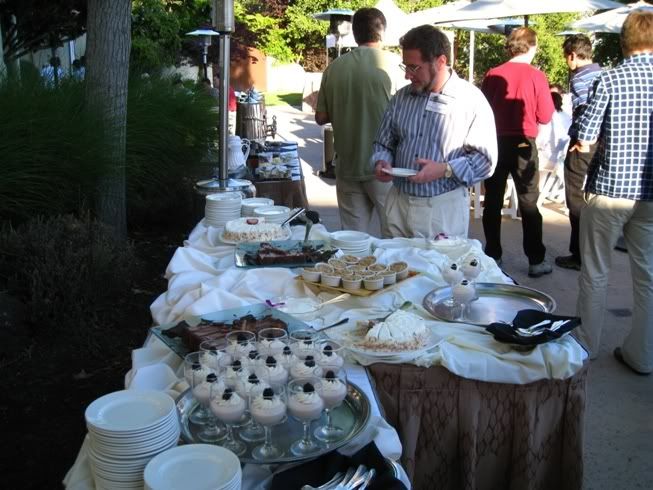
Before you know it, the end of AAC09 workshop approaches. The final evening was quite pleasant. There was a dessert reception after dinner (as if I need more food in me).


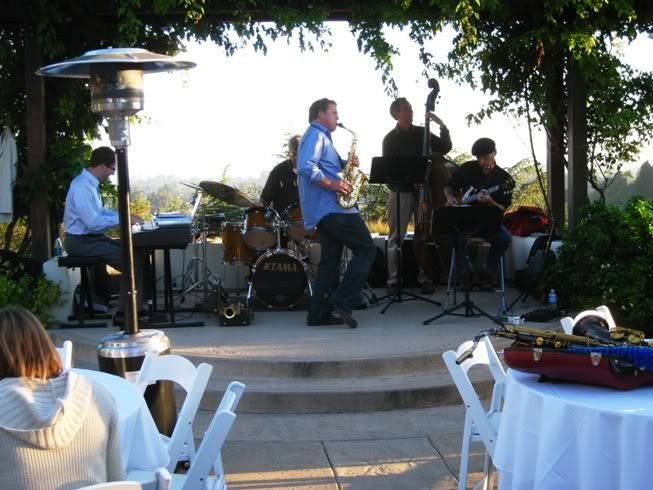
The highlight of the evening was of course the wonderful jazz band entertaining the crowd. They were certainly the crowd-pleaser.


But other than that, it was another evening in paradise as people enjoyed one last casual conversation over coffee, tea, wine, and beer.


Zz.

Friday, August 01, 2008

AAC08 Day 5

It's the second to last day of the AAC08 workshop and DISASTER STRUCK!

For the first time ever this week, there were wisps of clouds in the sky!


I guess you just can't have 5 straight days of perfect weather with clear, blue sky with not a cloud anywhere. I'm so disappointed!

:)

Anyway, the morning's plenary session was the presentations by the winners of the students poster competition in each of the Working Group. The winners are:

WG1: Jens Osterhoff (Max-Planck Inst. Quantum Optics group). "Stable electron acceleration in a steady-state-flow gas cell".

WG2: Marwan Rihaoui (Northern Illinois U.). "Beam dynamics simulation of transverse-to-longitudinal emittance exchange proof-of-principle experiment at the Argonne Wakefield Accelerator".

WG3: Feng Gao (Argonne/Illinois Inst. of Tech.). "7.8 GHz dielectric-loaded high power generation and extraction".

WG4: Andrey Knyazik (UCLA). "Status of UCLA helical inverse free-electron laser".

WG5: Ian Blumenfeld (SLAC). "Scalings in a PWFA".

WG6: Eric Montgomery (U. of Maryland). Towards a robust, efficient dispenser photocathode - the effect of recesiation on quantum efficiency".

They all won $300 cash price generously donated by Julian Bergoz of Bergoz Instrumentation.

Zz.

AAC08 Banquet Follow-Up - AAC10

I forgot to mention one other important piece of news during the banquet. It was officially announced that the next AAC workshop, which will be AAC10, will be hosted by the University of Maryland. So the workshop is going back to the east coast in 2 years.

Earlier in the day, I heard Pat O'Shea said that they might have it at a Motel 6, or was it Motel 7? I hear that Motel 7 serves a mean Shirley Temple, so I'm all set to go already! :)

I haven't spent much time in Maryland. So this is another excellent reason to go to AAC10. I expect plenty of Maryland crabcakes and people recommending me the best places for them. Bring it on!


Zz.

AAC08 Banquet

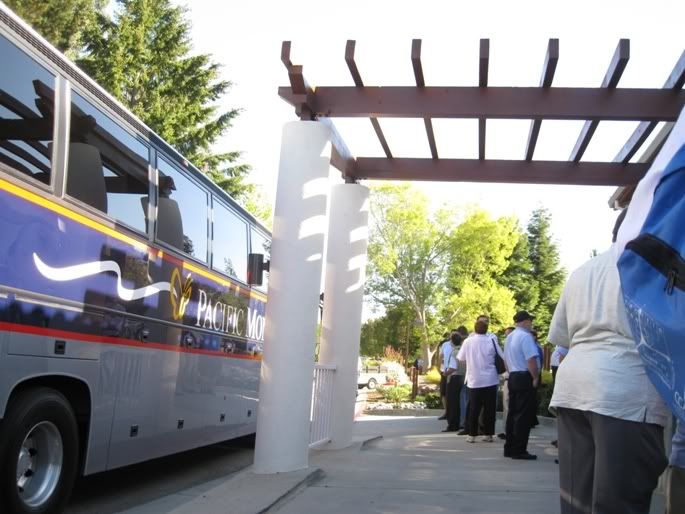
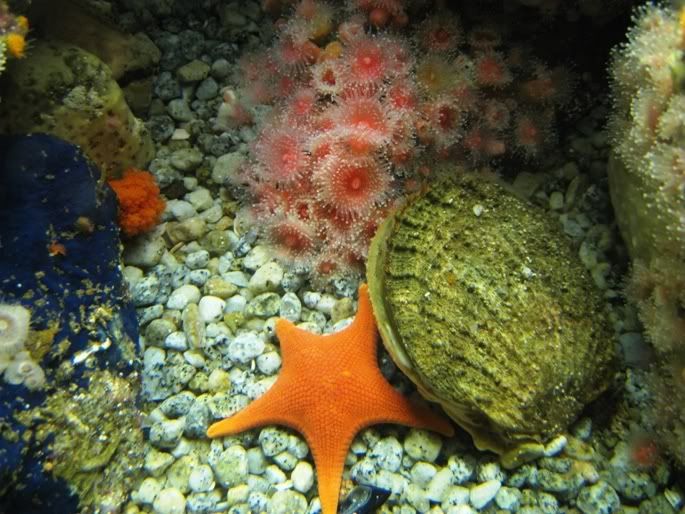
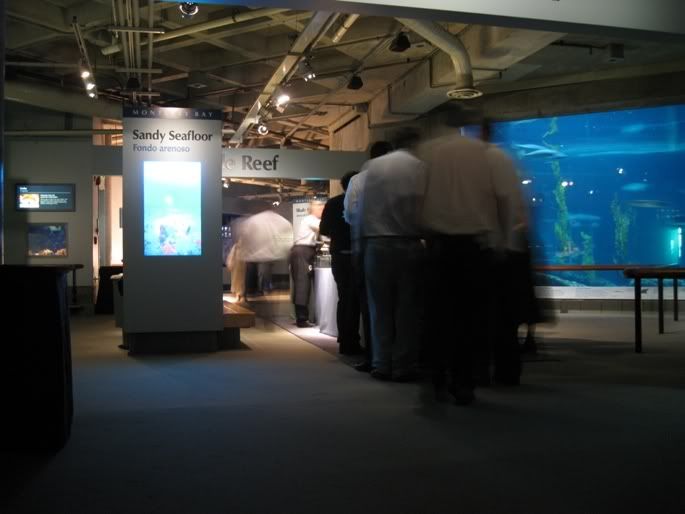
The AAC08 Banquet this year was held at the Monterey Bay Aquarium. Having been here before quite a long time ago, I was definitely looking forward to visiting it again. And so were a lot of other AAC attendees. Here we are waiting for the buses to take us there.


.. and here we are on the bus, well on our way. We made it in very good time, considering it was rush hour and traffic was kinda slow in parts of Hwy. 1.


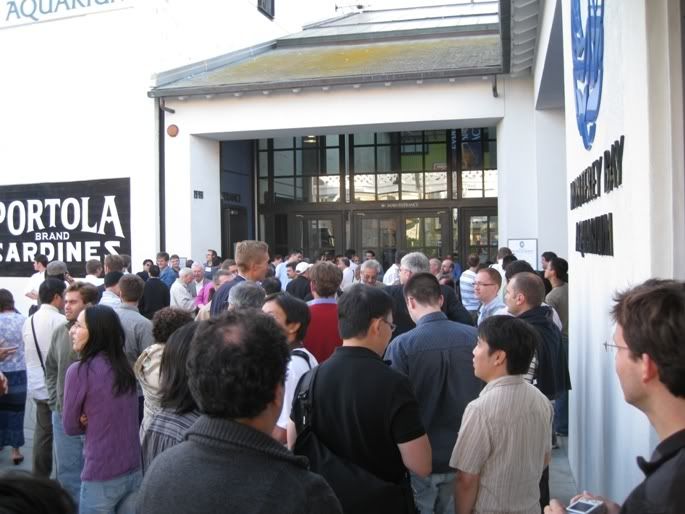
We are at the aquarium! Let us in!


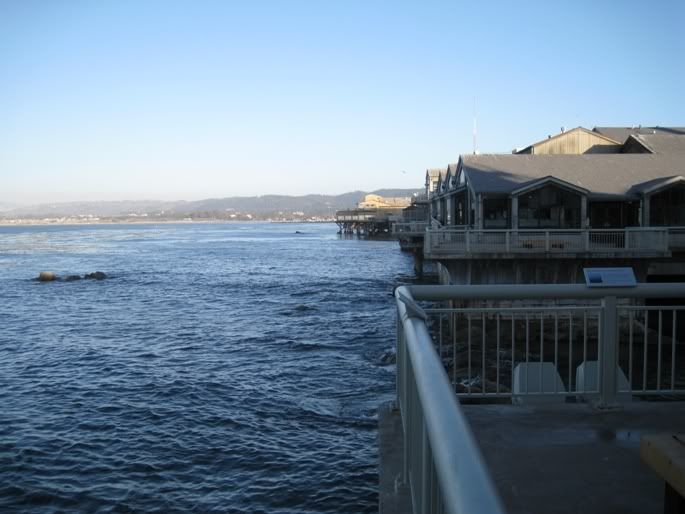
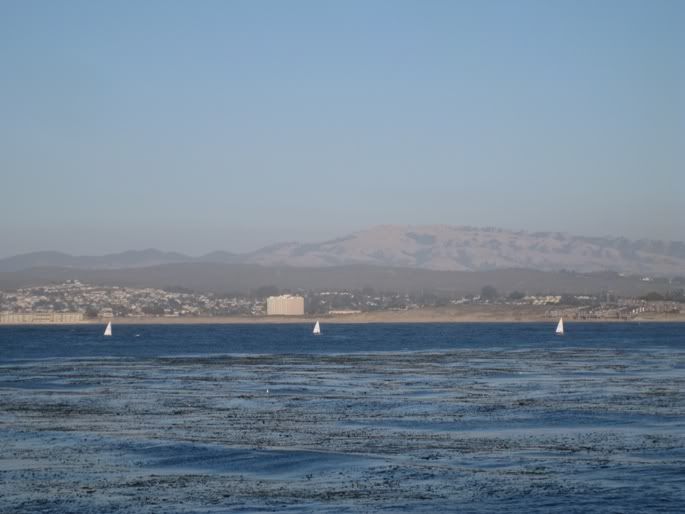
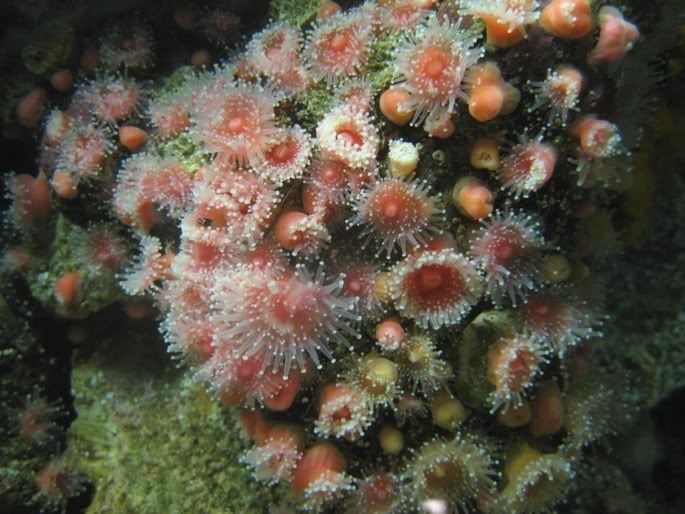
But once we are in, we certainly were amazed at the spectacular view, both inside and outside. So here are the views outside and some of the residents of the aquarium.


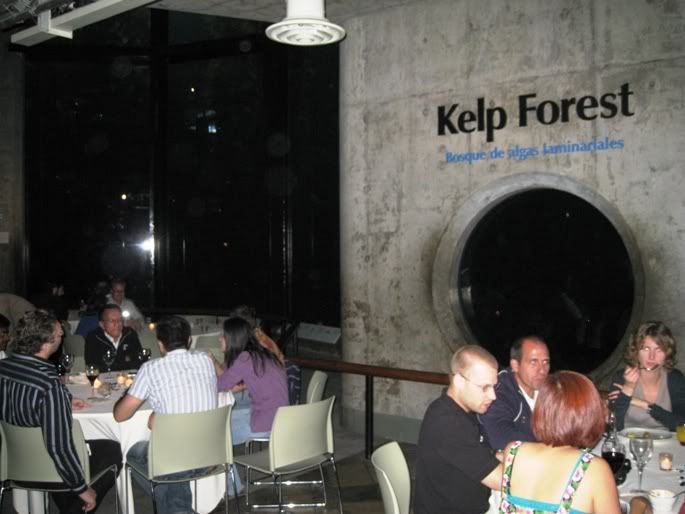
Dinner was served rather promptly. And I was starving too. The food was excellent. Great leg-of-lamb, and tasty cioppino. And just so people know (and since I'm a foodie), while cioppino has an "Italian" name, it isn't an authentic Italian dish since it was "invented" in San Francisco, but by Italian immigrants. So don't ask for such a dish when in Italy. Still, I would think that some form of a seafood stew would be available there, very much like a bouillabaisse.


The highlight of the evening was the awarding of the first ever AAC Prize to a giant in the accelerator physics field. The award committee, headed by Ilan Ben-Zvi, has unanimously picked Chan Joshi of UCLA to receive this prize. This really is a no-brainer, considering the contribution, length of time, and the number of students Joshi has made to the accelerator physics field (see an article written by him that I highlighted earlier). So congratulations to Chan Joshi for the award. No one is more deserving!

Many participants left on the early buses. Even though I'd like to stay longer, I was just pooped! Ate too much, and sleep-deprived, I thought I should head back to the Chaminade and crash. All in all, it was a terrific banquet.

Zz.

Thursday, July 31, 2008

AAC08 Day 4

OK, I'm starting to feel a bit sleep-deprived, but that's OK. We will soldier on...

The plenary session this morning started off with Phillippe Piot of Fermilab/Northern Illinois University, talking about Control and manipulation of electron beams. He covered three different aspects of this:

- maximizing beam brightness
- repartitioning of phase space between different degrees of freedom to tailor the 2D brightness for specific application, eg. FEL, mu-colliers;
- tailoring the beam's distribution along one direction.mainly along the longitudinal coordinate.

He talked about the planned emittance exchange experiment that was being planned.

This was then followed by a talk on Optical Accelerator Structures by B. Cowan (Tech-X). This is where, instead of RF structures with larger wavelengths, we are now exciting these accelerating structures using optical EM wave. This implies that with the shorter wavelength, these optical structures are tiny! He talked about various types of structures, the physics involved, and of course, the major challenges in engineering and fabricating such structures. I'm very impressed at how these things are constructed, even if they are using various advances from the electronics industries.

The last talk in the session was on Computation on new architectures by B. Albright of Los Alamos. He had a longer title than this, but I didn't write it down. This is basically a talk on advanced computing hardware. In particular, he was describing the porting of VPIC codes onto the RoadRunner supercomputer built by IBM that is now being delivered to Los Alamos.

As I listened to this presentation, the one thing that came across my mind repeatedly was "big toys for big boys". :) This thing is going to be impressive! But then again, the "big toys for big boys" can be said to almost everything being presented in this workshop.

Our banquet is tonight at the Monterey Aquarium. This should be utterly fun!

Zz.

More Bad Usage of "Centripetal" Force

I mentioned earlier of the erroneous usage of centripetal force when the author actually was thinking of "centrifugal" force, fictitious or not. This is another similar situation.

I like the application and the conscious link to physics concepts in describing everyday world. This article is discussing on various ways to get the last drop of ketchup out of a bottle.

Some of the ideas are entertaining methods to demonstrate inertia and other physics principles to your dining companion. For example, you can hold the bottle by its end and swing it around in a circle as fast as you can, letting the centripetal force push the contents toward the cap.


Of course, any first year undergraduate physics students can already tell you that a "centripetal force" is a central force that acts INWARDS, towards the center of the revolution (in a circular motion). It is the force that causes the ketchup bottle and its content to move in the circular path. A ketchup in the bottle will have a friction (and viscosity) with the wall of the bottle that will transfer this centripetal force from the source of the force to the wall of the bottle to keep that volume of ketchup in motion. However, at some point, the centripetal force will be greater than the friction between the ketchup and the wall of the bottle so that the ketchup will slid outwards.

Of course, one could also use the "centrifugal force" to explain this from the reference frame of the ketchup. This is the outward force that will "push the contents towards the cap". So again, as in the previous bad usage of "centripetal force", the author had "centrifugal" force in mind but didn't use it.

Zz.

Large Hadron Rap

Oy! I was going to say that now I've seen everything, but I probably haven't! :)

Someone at CERN certainly has a bit of time on his/her hands to do video editing and quite a bit of creativity to do this "Large Hadron Rap" music video. It is very funny, though. :)


Edit: I found the source of this video. :)


Zz.

Wednesday, July 30, 2008

AAC08 Day 3

Another packed day here at AAC08. I missed the first few minutes of the plenary session due to a teleconferencing, but still managed to get most of the going-on early in the morning.

The plenary session started with Gregory Nusinovich covering issues surrounding structure breakdowns. It's a great presentation which basically summed up all the relevant issues that we know and still don't know about vacuum breakdown. One interesting issue that he brought up is the issue of cyclic fatigue in an RF structure due to pulse heating of the structure walls in an RF magnetic field. Basically, while a lot of attention has been focused on the oscillating E-field that can produce field-emission current, the oscillating magnetic field in the RF pulse may in fact cause significant heating and possibly induce the formation of cracks in the material. These cracks could be the source of breakdown in these structures.

The next talk was by Stuart Mangles of Imperial College on Laser Wakefield Acceleration, focusing on the diagnostics and petawatt class experiment. He presented results from a recent experiment on ASTRA at Gemini.

Warren Mori of UCLA next presented a model of particle beam dynamics in plasma accelerator, focusing especially on beam loading. This was quite an informative talk because he presented a very clear background physics on the plasma dynamics due to an electron beam, especially in the non-linear regime.

We had an unscheduled presentation by Jay Hirshfield of Yale, but it was a fascinating on. He presented the first ever experimental results for LACARA - Laser Cyclotron Resonance Accelerator - at the Accelerator Test Facility (ATF) at Brookhaven. This is where they try to accelerate electrons only using lasers, no plasma or any other medium. The experiment was done last July 14-22, so it is really new. He showed both energy loss and gain, with an energy gain by the electrons of about 2 MeV. So this is essentially a successful (and encouraging) proof-of-principle experiment.

Needless to say, it was a rather exciting ending to the plenary session.

Zz.

Tuesday, July 29, 2008

AAC08 Day 2

I was asked this earlier, and I'll mention it again if someone missed the comment. The plan is for all the presentation given at this workshop to be available on the AAC08 webpage... eventually. Some sooner than later. So if you look at the workshop page often, I'm sure it'll appear somewhere. I'm guessing there will be an active link in the Program page, linking each talk to the presentation, but that's just my guess. You can already see the abstracts of the Plenary talks there.

And now, on to Day 2.

The morning Plenary session started off with Ralph Fiorito of Maryland, talking about Particle Beam Radiation Diagnostics. The problem with generating electron beam is that, how do you know what you have generated as far as its property is concerned? That's where we have various diagnostics techniques to measure things ranging from the beam emittance, bunch length, size, etc.. etc. Some of these properties are not very easy to obtain, since the electrons themselves can interact in unpredictable ways with the device measuring it. So the diagnostics isn't trivial. Fiorito described 2 different channels for charged particle radiation concepts: (i) transition radiation and (ii) diffraction radiation. He then presented direct application of incoherent and coherent radiation: near field imaging (spatial distribution) and far field imaging (angular distribution).

The next speaker was Matt Zepf of Queen's University. He presented a slightly different topic than the majority of what the attendees are used to - Laser Acceleration of protons and ions. Most of us here are more familiar with electron acceleration. He presented the physics and technology of proton/ion acceleration, and how this differ from electron accelerators.

The last speaker for today Plenary session was David Bruhwiler of Tech-X. He talked about New Development in the Simulation of Advanced Accelerator Concept. Basically it is modeling various acceleration scheme, such as laser wakefield acceleration, electron beam-driven plasma wakefield, etc.

This gives me a terrific segway into one important aspect of the accelerator physics field. Many of the structures that have to be built are often either big, complicated, expensive, time-consuming, or a combination of all of these. We can't simply build one and test it, and if it doesn't work, build another one. We have to try and build one that will do close, if not exactly, what we want, or else we have spent a lot of money and effort in building something useless. That's why a huge section of accelerator physics is computer simulation and modeling. The computational aspect of accelerator physics is extremely crucial in our ability to design and simulate the various structures that we want to build first before we build it. It is only when the various numerical codes and packages can give us the confidence that we have designed something that can possibly work do we build it and test it to confirm that our simulation was accurate.

The point here is that there's a tremendous opportunity for someone who is interested in computational physics to be extremely valuable in this field. I don't think many people, especially students, realize that.

Back to AAC08.

The late morning and afternoon sessions signal the start of the "backbone" of the AAC workshop - the Working Group sessions. This is where participants break off in various working groups centered on specific areas within accelerator physics (see the webpage for the list of all the working groups).

I went into the High Gradient Structures working group where the morning and afternoon sessions were dedicated to breakdown issues in high-gradients, including various modeling and possible triggers that starts a RF vacuum breakdown. SLAC group presented an enormous amount of observational data on various conditions where breakdown occurs. The afternoon session also included presentation on computational model (there it is again!) that tries to track or describe multipactor in an RF field.

By the end of the session, I was pooped!

Zz.

Monday, July 28, 2008

AAC08 Day 1

It was a long but interesting first day. The agenda was filled with plenary sessions, and the afternoon student poster session/competition.

The workshop was opened by high-energy physicist Hitoshi Murayama of IPMU-Tokyo and UC Berkeley. His talk was on the physics beyond the LHC. Basically he was giving a brief tutorial of high energy physics (both accelerator based and in particle astrophysics) and what to expect beyond the LHC. The motivation here was to give an idea to particle accelerator community what kind of technology that one can start to expect as soon as the first set of results from the LHC comes in.

The one thing that he kept emphasizing, possibly because of the crowd that he was addressing, was that particle accelerators have been THE enabling technology for particle physics. He emphasized that many non-accelerator physics discoveries had to be confirmed, studied, and improved using accelerators.

Murayama then established why the TeV energy scale is so crucial. This is the scale that corresponds to a length scale of 10^-17 cm, which is the scale of the short-ranged weak force. He actually described why the ILC is needed even if the LHC sees signature of the the Higgs (or many different types of Higgs). The ILC would produce a "cleaner" signal to allow high energy physicists to narrow down the Higgs properties that the LHC would find.

All in all, it was an effective "fan mail" from high energy physics community to the accelerator physicists. :)

The second talk in the morning plenary session was by Tor Raubenheimer on the Future R&D for Very High Energy Colliders. He basically listed the relevant parameters of the accelerator technology that is needed beyond the LHC. This essentially mirrors the ILC technical report, and the recent P5 report from last June. It boils down to these 2 numbers for the ILC:

1 TeV and luminosity of 1 x 10^34 cm^-2 s^-1

The estimated cost in 2020 dollars (assume an inflation of 3.5%) is $20-25 billion. The majority of the cost (60%) is estimated to be in the main linac section. So the acceleration scheme costs the most. Finding something that can substantially lower the cost of the accelerating section would substantially lower the total cost.

Next to talk was Pisin Chen of Kavli Institute/SLAC on Laboratory Astrophysics. He talked about particle astrophysics, dark matter, and high energy-density physics. He also argued that intense laser field in an electron accelerator can, in fact, probe the Hawking-Unruh effect.

Chris Barty of LLNL described the current status of the Livermore's laser technology (he jokingly described LLNL to not mean Lawrence Berkeley National Laboratory, but rather Laser, Laser, and Nothing but Laser). He spent quite a bit of time describing the laser system at the National Ignition Facility. That facility is obscenely impressive. I mean, anyone who is familiar with high-powered laser can't help but be impressed by what they have done there. It's just a jaw-dropper of the technical difficulties that they faced and have overcome. He also showed a video on how they actually used a laser with a spot 4 inch x 4 inch and simply melted a thickness of aluminum in seconds! Holy Cow!

Cameron Geddes of LBNL then proceeded next to describe all the progress made in laser-driven plasma wakefield acceleration scheme. This is the scheme that has made significant progress (and publicity) in achieving huge gradients. It is simply amazing the amount of progress that has been accomplished in this field, and they continue to refine the technology. This is a serious contender for the next acceleration scheme in future generation of particle accelerators.

After the lunch break, Wei Gai from Argonne described the Advanced Accelerating Structure and their interactions with electron beam. Basically it reviewed the effect of electrons passing through dielectric-loaded accelerating structure, photonic band-gap structure, and meta-material/left-handed structures.

Tom Katsouleas (who used to be at USC but is now at Duke University) described another type of plasma wakefield scheme. This time, instead of laser driven which was described by Geddes, it is electron-beam driven. This is where a bunch of electron passing through a plasma can create an accelerating wakefield for a witness beam that follows it. The current demonstration has shown the acceleration of an electron bunch from 42 GeV to 85 GeV in 1 m. That's pretty impressive. He also spent time showing a realistic concept of plasma wakefield accelerator for a linear collider, a facility that is being set up at SLAC.

I spent some time going around the student's poster session, which occupied 3 different rooms. The judges were already going around to different posters. Good luck to all the students!

Zz.

More On The Naming Spat At SLAC

Here's more news report regarding the use of the name "Stanford" in SLAC and the DOE's requirement of trademarking the name of its National Labs. It is resulting in the possible renaming of SLAC.

Stanford officials who insist the government can't copyright the venerable university's name have countered with an offer that would give federal officials a royalty-free "perpetual" license to use the Stanford and SLAC names.

"SLAC's record is pretty distinguished, and with the university's offer of a license to use the Stanford name, what more do they need?" said Burton Richter, SLAC's former director and one of the Nobelists who won his prize there. "I'm really bewildered."


I wonder if DOE already got a trademark for the Princeton Plasma Physics Lab? I would imagine it doesn't have the same issue here since "Princeton" is a city, unlike "Stanford".

Zz.

Sunday, July 27, 2008

AAC08 Day 0

Greetings from Santa Cruz, CA!

I arrived early this afternoon for the registration. Just got back from the evening reception dinner. People were slowly streaming in from all over the world.

The resort is rather gorgeous, high up in the hills overlooking Santa Cruz. All the sessions will be held at the resort's conference center, so those of us who are staying at the resort will find that to be rather convenient.

The first day of the workshop will start bright and early tomorrow. There should be several plenary talks tomorrow. So there should be plenty to report on.

Zz.

Saturday, July 26, 2008

Defending Your Ph.D Thesis With Flair

In my "So You Want To Be A Physicist" essay, I described a bit on the preparation leading up to one's thesis defense. It never hurts to have another point of view (and similar ones) on this. Science has an article that covers the very same topic this week in the career development section. It covers a little bit more the general preparations for one's defense, and also what one should do during the defense. It certainly is a recommended reading for anyone about to go through the process.

Zz.

Preparing for AAC08

I will be flying off to California tomorrow to attend the 2008 Advanced Accelerator Concepts Workshop (the webpage seems to be down this morning). The host for this year's workshop is the Lawrence Berkeley National Lab, and it will be held at the Chaminade resort in Santa Cruz, CA.

From the agenda, this should be quite a workshop, and certainly at a rather critical point in terms of planning for future directions. With the ILC having a delayed and uncertain future, and future particle colliders not really something anyone is willing to pay for, there's even a greater need for advancing the accelerator technology to produce more efficient, compact, and less costly alternatives, or in some case, improving the current technology to work beyond the present-day limitations.

I will try to report on some of the presentations there as the workshop progresses. Hopefully, it will be exciting enough for people to want to read. :)

Zz.

Friday, July 25, 2008

Phase Transitions of Dirac Electrons in Bismuth

And amazing and elegant experiment out of Princeton published in the latest edition of Science.

Abstract: The Dirac Hamiltonian, which successfully describes relativistic fermions, applies equally well to electrons in solids with linear energy dispersion, for example, in bismuth and graphene. A characteristic of these materials is that a magnetic field less than 10 tesla suffices to force the Dirac electrons into the lowest Landau level, with resultant strong enhancement of the Coulomb interaction energy. Moreover, the Dirac electrons usually come with multiple flavors or valley degeneracy. These ingredients favor transitions to a collective state with novel quantum properties in large field. By using torque magnetometry, we have investigated the magnetization of bismuth to fields of 31 tesla. We report the observation of sharp field-induced phase transitions into a state with striking magnetic anisotropy, consistent with the breaking of the threefold valley degeneracy.

L. Li et al. Science v.321, p.547 (2008).

There is a Perspective article on this work in the same issue of Science, and a Science Daily review. This is another example of how relativistic equations are applicable to materials that could be sitting on one's desk or being used in modern electronics, and not just to some esoteric experiments.

Zz.

Thursday, July 24, 2008

Is Faith The Enemy Of Science?

As I've mentioned a few times on here, I seldom want to highlight a non-published paper on arXiv because, well, it is not published and that some time we get rather dubious stuff being uploaded there.

Still, now and then, there are rather interesting preprints and articles that either have been submitted for publication and in the review process, or articles that are just plain fun to read. And once in a while, you get something that is quite provocative and no-less entertaining to read. This is one such article.

Richard MacKenzie of the University of Montreal has written a rather thought-provoking and lengthy article as a rebuttal to a talk given by Lawrence Krauss. In it, he is disputing Krauss's assertion that:

Faith is not the enemy.
Ignorance is the enemy.

MacKenzie argued that the reverse is more valid, that Ignorance is an opportunity to educate by starting from a clean slate, while Faith requires more effort to correct what has already been accepted. He made further discussion on the idea of scientists who also accept the validity of religious faith.

You just have to read it and see if this doesn't perk up your interest. :)

Zz.

Cow Power Could Generate electricity for Millions, Study Shows

Before you proclaim that this report stinks, you should read it carefully. :)

Scientists at the University of Texas (of course) has published a report that claim that by burning the manure from cows and other livestock, the US could get could get as much as 3% of electricity demand.

Broken down and then burnt, the scientists estimate that the manure from hundreds of millions of livestock in America could produce approximately 100 billion kilowatt hours of electricity a year.

If left to decompose naturally manure releases noxious gases into the environment, some of which warm the atmosphere at a higher rate than carbon dioxide.

Converting it to power could reduce those emissions by 99 million metric tonnes, the equivalent of approximately four per cent of America's emissions from electricity production.

Although the process would emit some carbon dioxide into the atmosphere, it would do so at a lower rate than if coal was used.


While such a claim isn't new, the numbers being presented here is unHERD of previously. I certainly don't think this is UDDER nonsense, but it might be worth looking into.

Moo!

Edit: Here is the exact reference to this work:

Amanda D Cuéllar and Michael E Webber, Environ. Res. Lett. v.3 p.034002 (2008)

Abstract: This report consists of a top-level aggregate analysis of the total potential for converting livestock manure into a domestic renewable fuel source (biogas) that could be used to help states meet renewable portfolio standard requirements and reduce greenhouse gas (GHG) emissions. In the US, livestock agriculture produces over one billion tons of manure annually on a renewable basis. Most of this manure is disposed of in lagoons or stored outdoors to decompose. Such disposal methods emit methane and nitrous oxide, two important GHGs with 21 and 310 times the global warming potential of carbon dioxide, respectively. In total, GHG emissions from the agricultural sector in the US amounted to 536 million metric tons (MMT) of carbon dioxide equivalent, or 7% of the total US emissions in 2005. Of this agricultural contribution, 51 to 118 MMT of carbon dioxide equivalent resulted from livestock manure emissions alone, with trends showing this contribution increasing from 1990 to 2005. Thus, limiting GHG emissions from manure represents a valuable starting point for mitigating agricultural contributions to global climate change.

Anaerobic digestion, a process that converts manure to methane-rich biogas, can lower GHG emissions from manure significantly. Using biogas as a substitute for other fossil fuels, such as coal for electricity generation, replaces two GHG sources—manure and coal combustion—with a less carbon-intensive source, namely biogas combustion.

The biogas energy potential was calculated using values for the amount of biogas energy that can be produced per animal unit (defined as 1000 pounds of animal) per day and the number of animal units in the US. The 95 million animal units in the country could produce nearly 1 quad of renewable energy per year, amounting to approximately 1% of the US total energy consumption. Converting the biogas into electricity using standard microturbines could produce 88 ± 20 billion kWh, or 2.4 ± 0.6% of annual electricity consumption in the US. Replacing coal and manure GHG emissions with the emissions from biogas would produce a net potential GHG emissions reduction of 99 ± 59 million metric tons or 3.9 ± 2.3% of the annual GHG emissions from electricity generation in the US.


Zz.

There's a Lot More to Going Fast Than the Horsepower Number

I think every physics student would know that. Still, this article on this particular vehicle called the "Atom" tries to illustrate why the vehicle's mass, and not just the "horsepower", certainly dictates how fast a vehicle can go and how quickly it can reach very high speeds.

The details of the physics lesson is that 200 horsepower doesn't sound like much, but when the car weighs less than 500 kilograms? Step up to the supercharged model like the one you see here and you get 300 horsepower, enough to launch the Atom to 100 km-h in three seconds.


But still, did anyone else caught the unintended pun early in the article? I'm guessing that even the writer didn't notice it.

That seems odd as you sit so low in the Atom, and you're so exposed to the elements with wind rushing up your legs through the sides of the car that it feels as though you're travelling twice as fast as you actually are.


Do you see it? Atom.... exposed to the elements.... Oh, never mind!

:)

Zz.

Wednesday, July 23, 2008

Taleyarkhan Plans To Appeal

As I've said when I reported the latest Purdue findings of scientific misconduct against Taleyarkhan, this will not be the end of it. And so it isn't. Taleyarkhan plans to appeal against the scientific misconduct finding by Purdue.

Purdue gave Taleyarkhan 30 days to appeal the committee’s verdict. According to his lawyer, he plans to do so. "There are a number of facts and issues that were not allowed in the inquiry, and the other nuclear engineers involved are all in complete support for Taleyarkhan," John Lewis of the Indianapolis law firm Lewis and Wilkins told Physics World. "Xu maintains to this day that Butt’s involvement was his choice. But that part of Xu's testimnony was completely ignored."


... and so it goes.

Zz.

Newtonian Gravity Still Holds At 10 Microns

So where are all these extra dimensions?

A new report out of Stanford has now made an even more stringent test for Newtonian gravity all the way down to 10 microns[1]!

It has been proposed that if there are extra dimensions for gravity to propagate, then at some very small distances, gravitational strength will start to deviate from the known Newtonian description. Originally, there were proposal that this deviation might be at the millimeter scale. That has been blown out of the water. There has been progressively smaller and smaller length scales over which gravity has been checked, and this latest report is the smallest as of now.

So really, where are these extra dimensions already!

Zz.

[1] A.A. Geraci et al. Phys. Rev. D v.78, p.022002 (2008).

Quantum Physics Makes Water Different

It is interesting that one of the substance that we are most familiar with, actually can only be explained using quantum mechanics. This is certainly true with water and its properties.

Quantum objects, such as atomic nuclei, have properties of both waves and particles. Quantum effects aren’t usually manifest to the naked eye, but in this case they may be responsible for some of water’s unusual features. “The quantum effect in water is abundantly obvious,” says Alan Soper of the Rutherford Appleton Laboratory in Didcot, England.


So if anyone wants to know where QM can be applied to, point to them the stuff flowing out of their taps.

I'll find the actual paper that this was published and put the reference here.

Zz.

Tuesday, July 22, 2008

The Physics of Sandcastle

Even at the beach, you can still learn about science/physics. Now you can understand the science behind sandcastles.

So why don't you go read that while I get my daily dose of sun and sand... {yawn.....}

Zz.

Monday, July 21, 2008

Argonne Scientist to Become ATLAS Physics Coordinator for CERN - Part 2

Please read this entry for Part 1 of this Q&A session with Tom LeCompte

3. Would ATLAS be able to detect signatures of any micro blackholes if such a thing is created?

Tom: If you asked me six months ago, I would have had a more definite answer. A lot of people have been asking the question, "If there are mini black holes, would their signature be sufficiently above the background that they can be detected?" The answer to that question is, for a large range of parameters, "yes". Now people are asking the question, "If there are mini black holes, would we be able to tell that's what they were, as opposed to something else?" That turns out to be a harder problem - especially right after any sort of discovery, because almost by definition you have very few events. (If you have a lot of events, you would have discovered it sooner - back when you had fewer). We have a lot of people working on this now, but I think the conclusion that it takes more data to figure out whether the new physics is a black hole or something else than it does for the initial discovery is probably always going to be the case.


4. Having been at CERN many times, how do you find living situation there when compared to where you are presently?

Tom: Geneva is a wonderful city, but very, very expensive. The weather takes some getting used to: when I was learning French, the first complex thought I was able to express in French was about the weather in Geneva: "Il neige en hiver et il pleut le reste du temps" - which means "It snows in winter and rains the rest of the time."


5. Other than the Chicago deep dish pizza, what will you miss most after your move to CERN?

Tom: Well, this year I am going to miss the cross-town world series!


Ah, ever the eternal optimist, that Tom. That's why we like him!

:)

Zz.

Sunday, July 20, 2008

Argonne Scientist to Become ATLAS Physics Coordinator for CERN - Part 1

ATLAS is one of the detector already ready to go at the LHC. Tom LeCompte will be starting as deputy physics coordinator for ATLAS before moving up to the coordinator position the following year.


The ATLAS Collaboration Board recently approved the appointment of LeCompte as deputy physics coordinator of the ATLAS experiment. He will be deputy starting Oct. 1 for one year and then become physics coordinator on Oct 1, 2009.


I was privileged to be able to ask Tom a few questions not only about his new job and move to CERN, but also on the physics issue. So here is Part 1 of my Q&A with him.

1. What will be your primary function as the science coordinator of ATLAS?

Tom: I start as Deputy Physics Coordinator, under the Physics Coordinator who is presently Professor Dave Charlton of the University of Birmingham. So for a year, it's easy - I do whatever he tells me to do. The following year, I become the Physics Coordinator. Ultimately, we're responsible for the physics results in the experiment - they obviously have to be correct, but they also have to be timely.

There's a certain amount of coordination out there. Suppose you have one group that is measuring events of a particular type - call it A. They pick a reasonable way to select their events. Now suppose there is another group measuring B, and they pick a different reasonable way. Now C comes along, and this group realizes that A and B are backgrounds to the events they are interested in. But they can't simply combine them, because they were selected differently. So they have to repeat the work of at least one of the two groups. Commonality across different analyses can save time, and reduces the chance of making a mistake, so we want to encourage this. On the other hand, we don't want to squelch individual creativity, so there's a balance we have to strike.

There are also cases where we have to prioritize. After we will have run for a while and gained some experience, our reconstruction algorithms will naturally improve. We will want to rerun them on the data we have already taken, a process that takes a couple of months. The experiment will have to decide which events to process first (not everybody can be first) and physics coordination will have to forge this consensus.

As you might imagine, getting 2000 people to work together on a scientific experiment without accidentally getting in each other's way is not something that happens automatically.


2. Besides the search for the Higgs (or many Higgs) boson, what other physics can be studied with ATLAS?


Tom: I don't really like calling it "the Higgs search", because it presupposes the answer. The problem is understanding what we call "electroweak symmetry breaking", which is a fancy name for "why are the W and Z bosons so heavy when the photon is so light", or alternatively, "why is the weak force so weak and so short range, while the electromagnetic force is long range and powerful." One possible answer is that there are one or more Higgs bosons. Another is that the W's and Z's interact very strongly at short distances and form resonances and these resonances break the symmetry. A third possibility is that the top quark, much heavier than the other five quarks, places a special role in this. There are many variations on these basic ideas, and as experimenters our job will be to gather the evidence that lets us distinguish between the various possibilities.

So, here's an incomplete list of some of the things we will have to do - besides figuring out what's up with electroweak symmetry breaking: We will need to understand the structure of the proton, because we collide beams of protons and we need to understand our initial state. We will need to make precision measurements of quantities well predicted by today's theories, to look for inconsistencies: these inconsistencies will point us in the direction of the new physics. We will need to search for new particles and new phenomena, and because the LHC has more energy than any previous accelerator, it's a likely place to look. We will need to better study the properties of the top quark, because we will have thousands of times more of them than the existing experiments. Finally, for about one month out of the year, instead of beams of protons we will collide beams of atomic nuclei, and that will let us study the properties of hot, dense nuclear matter, which behaves very differently than ordinary nuclei.

You can see that 2000 people sounds like a lot, but there are many things we will have to measure - by the time you are done dividing things up, it's not as many as you would think.


Stay tune for Part 2.

Zz.

LHC First Beam Might Be Delayed Due To......

.... the olympics!

At least that's what being reported here as a possibility (i.e. this is still a rumor and should not be blown out of proportion for what it is).

"During the month of August the first beam will be injected into the LHC," Evans said confidently, and later added that it will probably mid August.

Meanwhile, one CERN official quietly suggested a different window: the last week of August or the first of September. The reason for this discrepancy? In mid August CERN will not be able to get hold of a satellite uplink to televise the switch-on because of the Olympics, which is hording them all. So CERN's media office is pushing for a slight delay so the world can better see LHC's successful start....


Ah, the joy of doing science....

Zz.

Saturday, July 19, 2008

PPPL Gets A New Director

The Princeton Plasma Physics Lab will get a new Director. Princeton has announced that Stewart Prager from U. of Wisconsin-Madison (my alma mater) will be the new director of the DOE lab.

Prager, who also is the Dexter Professor of Physics at Wisconsin, will become the sixth director of the laboratory, which is funded by the DOE and managed by the University. His appointment as a professor of astrophysical sciences at Princeton is expected to be acted on in the fall.


Zz.

Friday, July 18, 2008

Global Warming Opponents Have Gone Bonkers! - Follow-Up

As a follow-up to my entry on Global Warming detractors who are in joyful mood when the APS's Forum on Physics and Society had a newsletter that included a "debate" on global warming, the July 18, 2008 edition of Bob Park's What's New has an even more eloquent comment on this:

1. GOOD LORD! GLOBAL WARMING DENIERS VANDALIZE APS.
Science is open. If better information becomes available scientists rewrite the textbooks with scarcely a backward glance. The Forum on Physics and Society of the APS exists to help us examine all the information on issues such as global climate change. There are physicists who think we don't have warming right, I know one myself. It is therefore entirely appropriate for the Forum to conduct a debate on the pages of its newsletter. A couple of highly-respected physicists ably argued the warming side. Good start. However, on the denier's side was Christopher Monckton, 3rd Viscount Monckton of Brenchley, who inherited his father's peerage in 2006. Lord Monckton is not a scientist, his degree is in journalism and he's a reporter for the Evening Standard, an English tabloid. Whatever it is that Viscounts do, he may do very well, but he doesn't know squat about physics and his journalism suffers from it. Worse, somebody fed the media the line that Monckton's rubbish meant the APS had changed its position on warming; of course it has not. Few media outlets took the story seriously.


and I was thinking (yes, I do that some time, especially when the moon is full). I recall that when Al Gore was criticized by global warming opponents as not being a scientist when he presented his global warming "disaster movie" in Inconvenient Truth. How come they don't go after Monckton, who isn't a scientist either? And if these people are so impressed that the APS "appears" to change their stand on global warming, how come they are not as impressed when the APS actually made its initial stand (and continues to hold the same opinion) on global warming?

All I see here is that some people are picking and choosing what they want to believe. If they put that much credibility in the APS that by simply having a "dialog" on global warming gave global warming opponents some form of "credible" ally, then how come they also don't put the same amount of credibility on all the other previous issues that the APS and AIP have strong and very clear opinions on? Evolution, anyone? And last time I checked, the AIP still has a webpage with very clear opinion (and a series of peer-reviewed references) on their stand regarding global warming. How come they IGNORE such thing, while grabbing what I've said as the flimsiest of threads?

It makes no sense.

Zz.

Purdue Declares That Taleyarkhan Guilty of Scientific Misconduct

In a complete about-face, Purdue has released its latest finding on the Taleyarkhan debacle. After an earlier investigation that found no misconduct, the most recent (and presumably, more encompassing investigation) has found him guilty of scientific misconduct.

Purdue University announced today that one of its nuclear engineers was guilty of scientific misconduct in work related to his potentially revolutionary findings about creating fusion from bubbles.

The announcement represented an about-face for the university, which more than a year ago declared that the scientist, Rusi P. Taleyarkhan, was not guilty of misconduct. The university had come under fire from members of the U.S. House of Representatives for that earlier assertion, and subsequently started a new investigation.


Do I think this is the end of this thing? Nope. I'm sure Taleyarkhan will appeal and/or both sue the university.

Edit: more coverage of this by the Science Daily News update.

Zz.

No More SLAC

I read this in this week's issue of Science (18 July, 2008). It seems that the name "Stanford Linear Accelerator Center" may be gone soon, and it has nothing to do with the fact that it is no longer a particle collider facility.

The Stanford Linear Accelerator Center (SLAC) in Menlo Park, California, will change its name. That’s because the Department of Energy (DOE) wants to trademark the names of its 17 national labs, and Stanford University won’t let DOE claim its name. The impasse is “an example of DOE idiocy,” says Nobelist and former SLAC Director Burton Richter, because the university would protect the name anyway. But DOE has been pushing to trademark lab names for more than a decade, spurred in part by a new law allowing trademark suits against the government, a risk DOE says it is trying to minimize.


Oy vey!

Zz.

Global Warming Opponents Have Gone Bonkers!

It is amazing how, just by having a discussion about it, some people have gone way over the edge and proclaim something a nanometer short of victory. Holy cow!

Now, I mentioned earlier the APS Forum on Physics and Society's July newsletter, that included a discussion on Global Warming issues. I highlighted the WHOLE newsletter, so that you can see the content, especially the two papers that have rather opposite views on Global Warming. I didn't want you to just read one without the other.

However, various rabid anti-global warming sites and blogs have somehow taken such open discussion and ran away with it. This website even proclaimed that "The Myth of Consensus Explodes". The same goes with this blog entry. They are just going ga-ga with the flimsiest piece of thread that somehow, a branch of the APS (of which I am a member of - both the APS and the division of Forum on Physics and Society) would open a discussion on such an issue.

But here's the thing - did they actually READ the papers? There are two problems with the kind of "reporting" that was done here:

(i) They never mentioned about the OTHER article by David Hafemeister & Peter Schwartz in the SAME issue of the newsletter that draws up very clear conclusion:

Earth is getting warmer. Basic atmospheric models clearly predict that additional greenhouse gasses will raise the temperature of Earth. To argue otherwise, one must prove a physical mechanism that gives a reasonable alternative cause of warming. This has not been done. Sunspot and temperature correlations do not prove causality.


This omission is misleading at best, and dishonest at worst. They highlighted ONLY the article by Christopher Monckton.

(ii) and speaking of the Monckton article, here's the conclusion that he came up with:

Even if temperature had risen above natural variability, the recent solar Grand Maximum may have been chiefly responsible. Even if the sun were not chiefly to blame for the past half-century’s warming, the IPCC has not demonstrated that, since CO2 occupies only one-ten-thousandth part more of the atmosphere that it did in 1750, it has contributed more than a small fraction of the warming. Even if carbon dioxide were chiefly responsible for the warming that ceased in 1998 and may not resume until 2015, the distinctive, projected fingerprint of anthropogenic “greenhouse-gas” warming is entirely absent from the observed record. Even if the fingerprint were present, computer models are long proven to be inherently incapable of providing projections of the future state of the climate that are sound enough for policymaking. Even if per impossibilethe models could ever become reliable, the present paper demonstrates that it is not at all likely that the world will warm as much as the IPCC imagines. Even if the world were to warm that much, the overwhelming majority of the scientific, peer-reviewed literature does not predict that catastrophe would ensue. Even if catastrophe might ensue, even the most drastic proposals to mitigate future climate change by reducing emissions of carbon dioxide would make very little difference to the climate. Even if mitigation were likely to be effective, it would do more harm than good: already millions face starvation as the dash for biofuels takes agricultural land out of essential food production: a warning that taking precautions, “just in case”, can do untold harm unless there is a sound, scientific basis for them. Finally, even if mitigation might do more good than harm, adaptation as (and if) necessary would be far more cost-effective and less likely to be harmful.

In short, we must get the science right, or we shall get the policy wrong. If the concluding equation in this analysis (Eqn. 30) is correct, the IPCC’s estimates of climate sensitivity must have been very much exaggerated. There may, therefore, be a good reason why, contrary to the projections of the models on which the IPCC relies, temperatures have not risen for a decade and have been falling since the phase-transition in global temperature trends that occurred in late 2001. Perhaps real-world climate sensitivity is very much below the IPCC’s estimates. Perhaps, therefore, there is no “climate crisis” at all. At present, then, in policy terms there is no case for doing anything. The correct policy approach to a non-problem is to have the courage to do nothing.


After reading the article, and with this conclusion, the best that I can come up with is that he is claiming that non of the global warming evidence and scenario are air tight. Well, duh! That's like people arguing that the Big Bang theory shouldn't be taught because we have no air tight evidence that it did happen, or that evolution should be adopted in schools because there's no solid "evidence" for it. (BTW, did any of these blog sites also conveniently missed the two solid articles reviewing Evolution versus Creationsm?)

With that kind of parameters and phase space, such lack of definite certainty is a given! However, the question here isn't whether they are a certainty, but rather whether they are credible enough to be considered valid. There are a lot more evidence pointing to the validity of the conclusion by Hafemeister & Schwartz than to Monckton. That is a FACT.

But the scariest part in all of this is the suggestion that we should just continue doing nothing. In other words, why don't you continue smoking that cigarette until we have definite, conclusive proof that it really isn't good for your health. Or, why don't you continue to take this drug while we sort out all of this contradicting claims that it can either kill you, or make you the healthiest person on earth. So why don't you continue to pollute the world that we live in until, you know, we completely agree on the fact that we are really killing our planet.

Zz.

Thursday, July 17, 2008

The Physicist and the "Nerd" Image

Frankly, I am extremely tired of this image of a physicist. Y'know, white lab coat, pocket protector, thick glasses, mismatch shoes and socks, etc...etc. And let me tell you this. Where I work, the only person that I know of that actually has a set of pens and stuff in the shirt pocket is an engineer! :)

So I'm sure that this was meant to be 'funny', even in Singapore:

Sec 4 student Ian Yap, 16, dressed as a physicist and won the prize for 'Most Nerdy' costume.

He said proudly: 'In order to win a prize for being nerdy, you can't just dress as a nerd! You need to truly understand the ways of the nerd.'


I guess in the scheme of things, this really is a non-issue. But truly, it is also a reflection of the fact that many people simply do not encounter physicists, much less how they work and what they do, that often or at all. So the image of a "nerd" is certainly ingrained in people's mind, especially when it is being re-enforced by popular media, movies, and TV shows.

So are there physicists that actually fit into such nerdy stereotypes? Of course there are, and there are nerdy people in political science, sociology, psychology, music, etc.. etc.. as well! But one would be surprise to see just how "un-nerdy" physicists as a group are. I mean, George Bush looks downright nerdy when you put him next to Lisa Randall! Well, OK, so that wasn't such a fair comparison, but you get the point! :)

Zz.

Wednesday, July 16, 2008

NASA Contractor Wants You To Pee

.. but only if you are at the Johnson Space Center in Houston.

Space program contractor Hamilton Sundstrand is seeking urine from workers at the Johnson Space Center in Houston, Texas, as part of its work on the new Orion space capsule that eventually would take astronauts to the moon, according to an internal memo posted on the Web site Nasawatch.com.

The need is voluminous: 30 liters a day, which translates into nearly 8 gallons. Even on weekends.


I'd say give them plenty of stuff to drink, especially coffee. Caffeine is a wonderful diuretic for me. :)

Zz.

Hawking 'Open' to a Move to Ontario

Hum... it seems that everyone is moving to Canada! :)

Stephen Hawking is leaving open the possibility of him leaving Cambridge and moving to the Perimeter Institute in Ontario, CA. This would be the biggest coup for PI since getting Neil Turok.

It certainly appears that several institutions in Canada are aggressively recruiting some of the world's most prominent physicists. George Sawatzky, a prominent condensed matter physicist, went to UBC several years ago. And recently, UBC even managed to snag Nobel Laureate Carl Wieman.

All I can say is, good for them! Obviously, they have the resources to get these people, and they know the importance of having them there. UBC certainly has elevated their stature in condensed matter many folds in recent years to become one of the most respected programs in the world.

Zz.

Tuesday, July 15, 2008

Forum on Physics and Society July 2008 Newsletter

The July 2008 Newsletter of Forum on Physics and Society is now available online.

Several good articles this month, especially a couple of tutorial on the physics of global warming. There's also a review of a couple of books on evolution versus creationism. So plenty of things to read.

Zz.

A New Frontier for Title IX: Science

Looks like the perceived "discrimination" and imbalance of women in the sciences are getting some attention in the US Congress.

It is still highly controversial, of course, on whether there really is some form of bias, intended or not, against having women in science, and especially in physics.

They remain a minority in the physical sciences and engineering. Even though their annual share of doctorates in physics has tripled in recent decades, it’s less than 20 percent. Only 10 percent of physics faculty members are women, a ratio that helped prompt an investigation in 2005 by the American Institute of Physics into the possibility of bias.

But the institute found that women with physics degrees go on to doctorates, teaching jobs and tenure at the same rate that men do. The gender gap is a result of earlier decisions. While girls make up nearly half of high school physics students, they’re less likely than boys to take Advanced Placement courses or go on to a college degree in physics.

These numbers don’t surprise two psychologists at Vanderbilt University, David Lubinski and Camilla Persson Benbow, who have been tracking more than 5,000 mathematically gifted students for 35 years.

They found that starting at age 12, the girls tended to be better rounded than the boys: they had relatively strong verbal skills in addition to math, and they showed more interest in “organic” subjects involving people and other living things. Despite of their mathematical prowess, they were less likely than boys to go into physics or engineering.


I think that there is one important point that those who are trying to push a policy one way or the other onto this group of people, who are scientists. These scientists tend to also be experts in the nature and validity of the "evidence" being used. So don't expect them to simply sit back and accept all of these various conclusions being forced onto them. If you think that there's a valid evidence for something, it better be something stronger than just some anecdotal evidence, or else it will be challenged.

Zz.

Monday, July 14, 2008

The APS Introduces "Physics"

The American Physical Society (APS) is introducing a new publication today, simply called "Physics".

Anyone who has recently glanced at a library shelf of physics journals or browsed the literature online will instantly recognize both the increase in volume and the fragmentation of disciplines. How can a researcher stay on top of his or her own field, much less stay abreast of related areas that might harbor interdisciplinary gems? One way is to seek the counsel of experts, and so we begin a new publication, simply called Physics. Our goal is to highlight exceptional papers within the body of excellent research that the American Physical Society publishes each year in all of the Physical Review journals.
.
.
.
Why Physics? We feel that it fills an important niche in the Physical Review ecosystem. At the core we have the exceptional research published by the Physical Review journals and Physical Review Letters, some 18,000 peer-reviewed papers last year. To bring this work to wider notice, every week the American Physical Society alerts journalists to these exciting research papers, to stimulate coverage in print and electronic news media. And broadening the audience further, the online website Physical Review Focus highlights research papers each week in short articles written by professional science writers. Physics now satisfies the need for comment and context written by independent scientific experts, for physicists and those in related fields.


I guess this is like the APS Focus, but covering a wider subject range and a lot more of the papers that have appeared in their publications. This certainly isn't a bad idea, considering that Nature and Science do this routinely for many of the articles that appear in their journals.

Zz.

CERN Council Looks Forward to Imminent Start-Up of the LHC

A more up-to-date progress report on the impending start-up of the LHC. This includes the safety analysis that was completed recently on the LHC that was reported here earlier.

The latest review of the safety of the LHC’s collisions was prepared by the LHC Safety Assessment Group (LSAG), which comprises scientists at CERN, the University of California, Santa Barbara, and the Institute for Nuclear Research of the Russian Academy of Sciences. The LSAG report updates a 2003 paper by the LHC Safety Study Group and incorporates recent experimental and observational data. It confirms and strengthens the conclusion of the 2003 report that there is no cause for concern. Whatever the LHC will do, nature has already done many times over during the lifetime of the Earth and other astronomical bodies.


... which has been my contention all along.

Zz.

A Cosmic Conundrum

This is a wonderful review of the book "The Mystery of the Missing Antimatter" by Helen Quinn and Yossi Nir. I always like reading a book review where the reviewer also provide ample background information of what is covered in the content, and not just simply review the book. This is what Lincoln Wolfenstein did in reviewing this book. In the process, the reader is brought up-to-date on the issue surrounding the matter-antimatter asymmetry that we see in our universe. So this review is also a review of the subject matter for non-physicists or those not that familiar with this "conundrum".

Helen Quinn, by the way, is the author of an article that I highly recommend people to read. So she certainly is one of those rare physicist who has the ability to write succinctly and clearly. I'm very much tempted to buy this book soon.

Zz.