Final day for AAC08 and the weather is still perfect (don't people get tired of such perfect weather after a while?). :)
The morning will be filled with reports from the group leaders all the Working Groups, highlighting all the various presentations and discussions that has transpired over the whole workshop. This will give a summary of the progress and direction that each different areas in accelerator physics are working on since the last AAC workshop 2 years ago.
The workshop ends at Noon. It was a great meeting. "I call upon the youth of the world to meet again in 2 years from now at Maryland for AAC10!" (hey, the Olympics is only a week away, so why not make that connection?) :)
Have a safe trip home, everyone!
Zz.
Saturday, August 02, 2008

AAC08 Final Evening
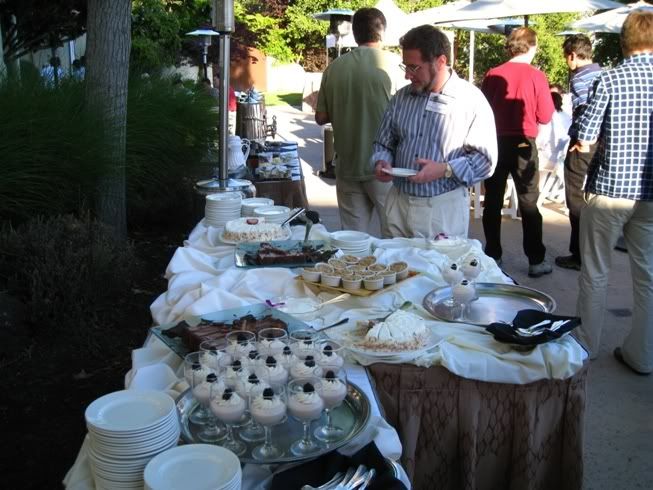
Before you know it, the end of AAC09 workshop approaches. The final evening was quite pleasant. There was a dessert reception after dinner (as if I need more food in me).

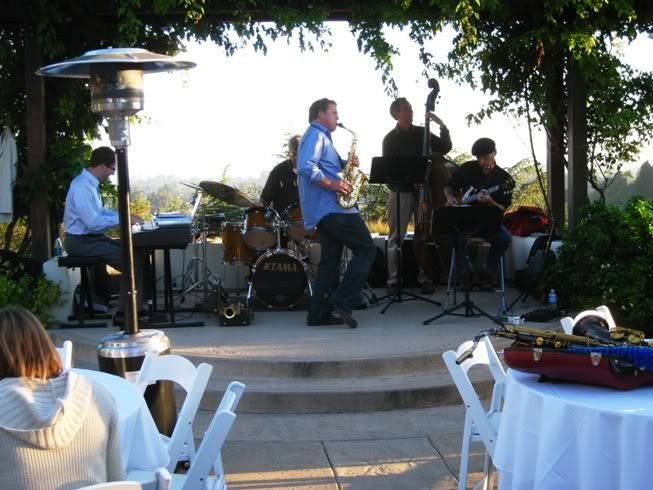
The highlight of the evening was of course the wonderful jazz band entertaining the crowd. They were certainly the crowd-pleaser.

But other than that, it was another evening in paradise as people enjoyed one last casual conversation over coffee, tea, wine, and beer.


Zz.
The highlight of the evening was of course the wonderful jazz band entertaining the crowd. They were certainly the crowd-pleaser.
But other than that, it was another evening in paradise as people enjoyed one last casual conversation over coffee, tea, wine, and beer.


Zz.
Friday, August 01, 2008
AAC08 Day 5
It's the second to last day of the AAC08 workshop and DISASTER STRUCK!
For the first time ever this week, there were wisps of clouds in the sky!

I guess you just can't have 5 straight days of perfect weather with clear, blue sky with not a cloud anywhere. I'm so disappointed!
:)
Anyway, the morning's plenary session was the presentations by the winners of the students poster competition in each of the Working Group. The winners are:
WG1: Jens Osterhoff (Max-Planck Inst. Quantum Optics group). "Stable electron acceleration in a steady-state-flow gas cell".
WG2: Marwan Rihaoui (Northern Illinois U.). "Beam dynamics simulation of transverse-to-longitudinal emittance exchange proof-of-principle experiment at the Argonne Wakefield Accelerator".
WG3: Feng Gao (Argonne/Illinois Inst. of Tech.). "7.8 GHz dielectric-loaded high power generation and extraction".
WG4: Andrey Knyazik (UCLA). "Status of UCLA helical inverse free-electron laser".
WG5: Ian Blumenfeld (SLAC). "Scalings in a PWFA".
WG6: Eric Montgomery (U. of Maryland). Towards a robust, efficient dispenser photocathode - the effect of recesiation on quantum efficiency".
They all won $300 cash price generously donated by Julian Bergoz of Bergoz Instrumentation.
Zz.
AAC08 Banquet Follow-Up - AAC10
I forgot to mention one other important piece of news during the banquet. It was officially announced that the next AAC workshop, which will be AAC10, will be hosted by the University of Maryland. So the workshop is going back to the east coast in 2 years.
Earlier in the day, I heard Pat O'Shea said that they might have it at a Motel 6, or was it Motel 7? I hear that Motel 7 serves a mean Shirley Temple, so I'm all set to go already! :)
I haven't spent much time in Maryland. So this is another excellent reason to go to AAC10. I expect plenty of Maryland crabcakes and people recommending me the best places for them. Bring it on!

Zz.
AAC08 Banquet
The AAC08 Banquet this year was held at the Monterey Bay Aquarium. Having been here before quite a long time ago, I was definitely looking forward to visiting it again. And so were a lot of other AAC attendees. Here we are waiting for the buses to take us there.


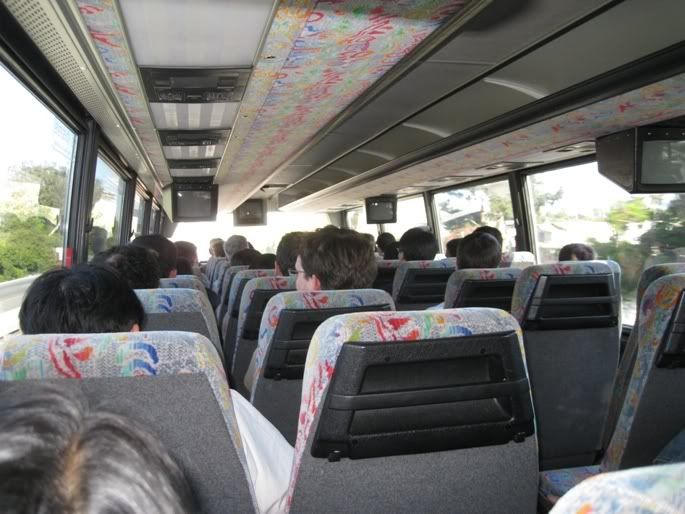
.. and here we are on the bus, well on our way. We made it in very good time, considering it was rush hour and traffic was kinda slow in parts of Hwy. 1.

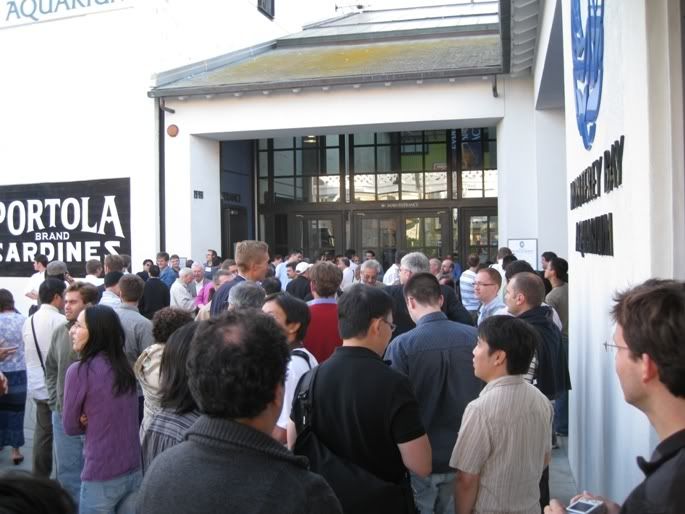
We are at the aquarium! Let us in!


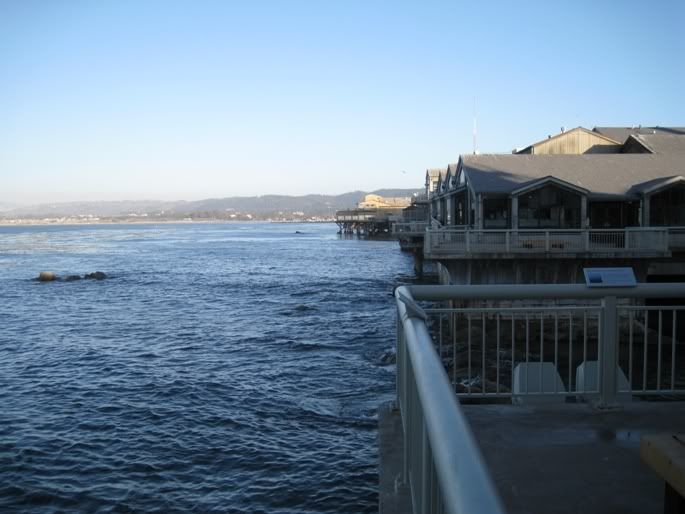
But once we are in, we certainly were amazed at the spectacular view, both inside and outside. So here are the views outside and some of the residents of the aquarium.


Dinner was served rather promptly. And I was starving too. The food was excellent. Great leg-of-lamb, and tasty cioppino. And just so people know (and since I'm a foodie), while cioppino has an "Italian" name, it isn't an authentic Italian dish since it was "invented" in San Francisco, but by Italian immigrants. So don't ask for such a dish when in Italy. Still, I would think that some form of a seafood stew would be available there, very much like a bouillabaisse.


The highlight of the evening was the awarding of the first ever AAC Prize to a giant in the accelerator physics field. The award committee, headed by Ilan Ben-Zvi, has unanimously picked Chan Joshi of UCLA to receive this prize. This really is a no-brainer, considering the contribution, length of time, and the number of students Joshi has made to the accelerator physics field (see an article written by him that I highlighted earlier). So congratulations to Chan Joshi for the award. No one is more deserving!
Many participants left on the early buses. Even though I'd like to stay longer, I was just pooped! Ate too much, and sleep-deprived, I thought I should head back to the Chaminade and crash. All in all, it was a terrific banquet.
Zz.
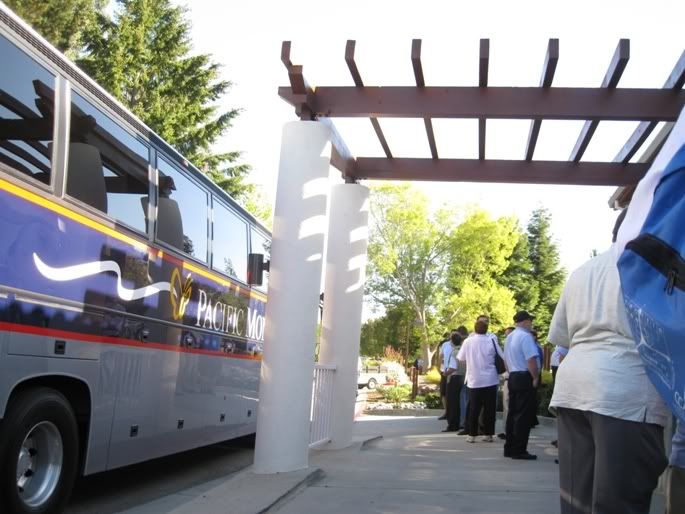
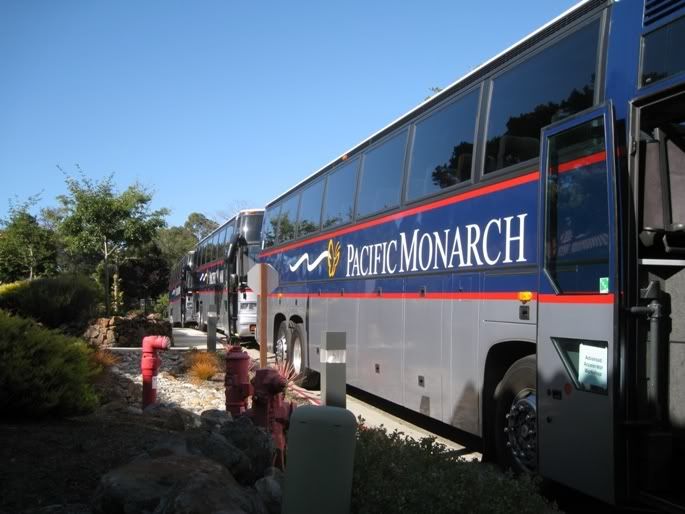
.. and here we are on the bus, well on our way. We made it in very good time, considering it was rush hour and traffic was kinda slow in parts of Hwy. 1.
We are at the aquarium! Let us in!
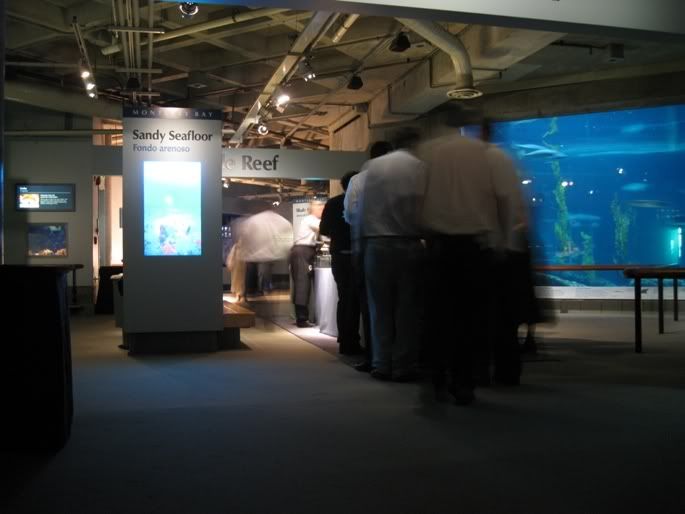
But once we are in, we certainly were amazed at the spectacular view, both inside and outside. So here are the views outside and some of the residents of the aquarium.
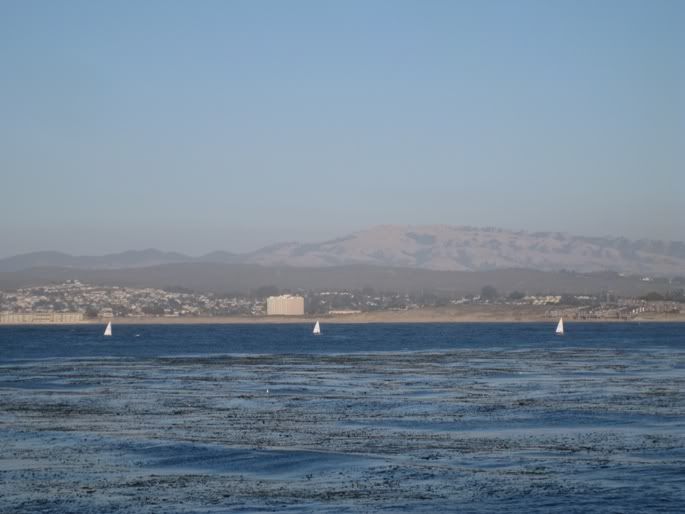
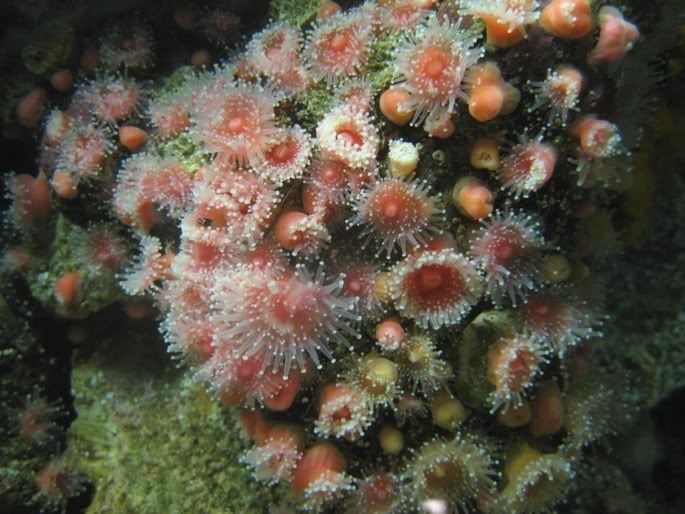
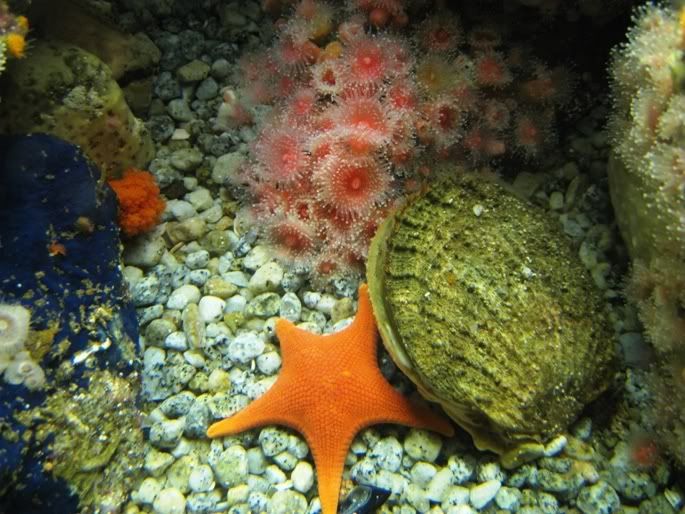
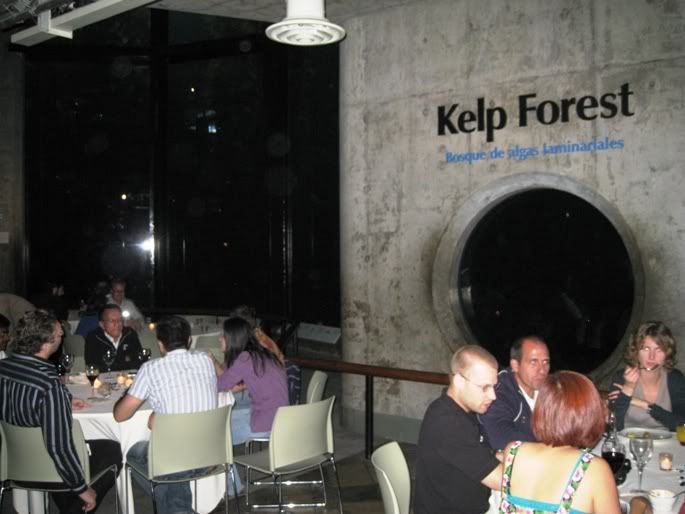
Dinner was served rather promptly. And I was starving too. The food was excellent. Great leg-of-lamb, and tasty cioppino. And just so people know (and since I'm a foodie), while cioppino has an "Italian" name, it isn't an authentic Italian dish since it was "invented" in San Francisco, but by Italian immigrants. So don't ask for such a dish when in Italy. Still, I would think that some form of a seafood stew would be available there, very much like a bouillabaisse.
The highlight of the evening was the awarding of the first ever AAC Prize to a giant in the accelerator physics field. The award committee, headed by Ilan Ben-Zvi, has unanimously picked Chan Joshi of UCLA to receive this prize. This really is a no-brainer, considering the contribution, length of time, and the number of students Joshi has made to the accelerator physics field (see an article written by him that I highlighted earlier). So congratulations to Chan Joshi for the award. No one is more deserving!
Many participants left on the early buses. Even though I'd like to stay longer, I was just pooped! Ate too much, and sleep-deprived, I thought I should head back to the Chaminade and crash. All in all, it was a terrific banquet.
Zz.
Thursday, July 31, 2008
AAC08 Day 4
OK, I'm starting to feel a bit sleep-deprived, but that's OK. We will soldier on...
The plenary session this morning started off with Phillippe Piot of Fermilab/Northern Illinois University, talking about Control and manipulation of electron beams. He covered three different aspects of this:
- maximizing beam brightness
- repartitioning of phase space between different degrees of freedom to tailor the 2D brightness for specific application, eg. FEL, mu-colliers;
- tailoring the beam's distribution along one direction.mainly along the longitudinal coordinate.
He talked about the planned emittance exchange experiment that was being planned.
This was then followed by a talk on Optical Accelerator Structures by B. Cowan (Tech-X). This is where, instead of RF structures with larger wavelengths, we are now exciting these accelerating structures using optical EM wave. This implies that with the shorter wavelength, these optical structures are tiny! He talked about various types of structures, the physics involved, and of course, the major challenges in engineering and fabricating such structures. I'm very impressed at how these things are constructed, even if they are using various advances from the electronics industries.
The last talk in the session was on Computation on new architectures by B. Albright of Los Alamos. He had a longer title than this, but I didn't write it down. This is basically a talk on advanced computing hardware. In particular, he was describing the porting of VPIC codes onto the RoadRunner supercomputer built by IBM that is now being delivered to Los Alamos.
As I listened to this presentation, the one thing that came across my mind repeatedly was "big toys for big boys". :) This thing is going to be impressive! But then again, the "big toys for big boys" can be said to almost everything being presented in this workshop.
Our banquet is tonight at the Monterey Aquarium. This should be utterly fun!
Zz.
More Bad Usage of "Centripetal" Force
I mentioned earlier of the erroneous usage of centripetal force when the author actually was thinking of "centrifugal" force, fictitious or not. This is another similar situation.
I like the application and the conscious link to physics concepts in describing everyday world. This article is discussing on various ways to get the last drop of ketchup out of a bottle.
Of course, any first year undergraduate physics students can already tell you that a "centripetal force" is a central force that acts INWARDS, towards the center of the revolution (in a circular motion). It is the force that causes the ketchup bottle and its content to move in the circular path. A ketchup in the bottle will have a friction (and viscosity) with the wall of the bottle that will transfer this centripetal force from the source of the force to the wall of the bottle to keep that volume of ketchup in motion. However, at some point, the centripetal force will be greater than the friction between the ketchup and the wall of the bottle so that the ketchup will slid outwards.
Of course, one could also use the "centrifugal force" to explain this from the reference frame of the ketchup. This is the outward force that will "push the contents towards the cap". So again, as in the previous bad usage of "centripetal force", the author had "centrifugal" force in mind but didn't use it.
Zz.
I like the application and the conscious link to physics concepts in describing everyday world. This article is discussing on various ways to get the last drop of ketchup out of a bottle.
Some of the ideas are entertaining methods to demonstrate inertia and other physics principles to your dining companion. For example, you can hold the bottle by its end and swing it around in a circle as fast as you can, letting the centripetal force push the contents toward the cap.
Of course, any first year undergraduate physics students can already tell you that a "centripetal force" is a central force that acts INWARDS, towards the center of the revolution (in a circular motion). It is the force that causes the ketchup bottle and its content to move in the circular path. A ketchup in the bottle will have a friction (and viscosity) with the wall of the bottle that will transfer this centripetal force from the source of the force to the wall of the bottle to keep that volume of ketchup in motion. However, at some point, the centripetal force will be greater than the friction between the ketchup and the wall of the bottle so that the ketchup will slid outwards.
Of course, one could also use the "centrifugal force" to explain this from the reference frame of the ketchup. This is the outward force that will "push the contents towards the cap". So again, as in the previous bad usage of "centripetal force", the author had "centrifugal" force in mind but didn't use it.
Zz.
Large Hadron Rap
Oy! I was going to say that now I've seen everything, but I probably haven't! :)
Someone at CERN certainly has a bit of time on his/her hands to do video editing and quite a bit of creativity to do this "Large Hadron Rap" music video. It is very funny, though. :)
Edit: I found the source of this video. :)
Zz.
Someone at CERN certainly has a bit of time on his/her hands to do video editing and quite a bit of creativity to do this "Large Hadron Rap" music video. It is very funny, though. :)
Edit: I found the source of this video. :)
Zz.
Wednesday, July 30, 2008
AAC08 Day 3
Another packed day here at AAC08. I missed the first few minutes of the plenary session due to a teleconferencing, but still managed to get most of the going-on early in the morning.
The plenary session started with Gregory Nusinovich covering issues surrounding structure breakdowns. It's a great presentation which basically summed up all the relevant issues that we know and still don't know about vacuum breakdown. One interesting issue that he brought up is the issue of cyclic fatigue in an RF structure due to pulse heating of the structure walls in an RF magnetic field. Basically, while a lot of attention has been focused on the oscillating E-field that can produce field-emission current, the oscillating magnetic field in the RF pulse may in fact cause significant heating and possibly induce the formation of cracks in the material. These cracks could be the source of breakdown in these structures.
The next talk was by Stuart Mangles of Imperial College on Laser Wakefield Acceleration, focusing on the diagnostics and petawatt class experiment. He presented results from a recent experiment on ASTRA at Gemini.
Warren Mori of UCLA next presented a model of particle beam dynamics in plasma accelerator, focusing especially on beam loading. This was quite an informative talk because he presented a very clear background physics on the plasma dynamics due to an electron beam, especially in the non-linear regime.
We had an unscheduled presentation by Jay Hirshfield of Yale, but it was a fascinating on. He presented the first ever experimental results for LACARA - Laser Cyclotron Resonance Accelerator - at the Accelerator Test Facility (ATF) at Brookhaven. This is where they try to accelerate electrons only using lasers, no plasma or any other medium. The experiment was done last July 14-22, so it is really new. He showed both energy loss and gain, with an energy gain by the electrons of about 2 MeV. So this is essentially a successful (and encouraging) proof-of-principle experiment.
Needless to say, it was a rather exciting ending to the plenary session.
Zz.
Tuesday, July 29, 2008
AAC08 Day 2
I was asked this earlier, and I'll mention it again if someone missed the comment. The plan is for all the presentation given at this workshop to be available on the AAC08 webpage... eventually. Some sooner than later. So if you look at the workshop page often, I'm sure it'll appear somewhere. I'm guessing there will be an active link in the Program page, linking each talk to the presentation, but that's just my guess. You can already see the abstracts of the Plenary talks there.
And now, on to Day 2.
The morning Plenary session started off with Ralph Fiorito of Maryland, talking about Particle Beam Radiation Diagnostics. The problem with generating electron beam is that, how do you know what you have generated as far as its property is concerned? That's where we have various diagnostics techniques to measure things ranging from the beam emittance, bunch length, size, etc.. etc. Some of these properties are not very easy to obtain, since the electrons themselves can interact in unpredictable ways with the device measuring it. So the diagnostics isn't trivial. Fiorito described 2 different channels for charged particle radiation concepts: (i) transition radiation and (ii) diffraction radiation. He then presented direct application of incoherent and coherent radiation: near field imaging (spatial distribution) and far field imaging (angular distribution).
The next speaker was Matt Zepf of Queen's University. He presented a slightly different topic than the majority of what the attendees are used to - Laser Acceleration of protons and ions. Most of us here are more familiar with electron acceleration. He presented the physics and technology of proton/ion acceleration, and how this differ from electron accelerators.
The last speaker for today Plenary session was David Bruhwiler of Tech-X. He talked about New Development in the Simulation of Advanced Accelerator Concept. Basically it is modeling various acceleration scheme, such as laser wakefield acceleration, electron beam-driven plasma wakefield, etc.
This gives me a terrific segway into one important aspect of the accelerator physics field. Many of the structures that have to be built are often either big, complicated, expensive, time-consuming, or a combination of all of these. We can't simply build one and test it, and if it doesn't work, build another one. We have to try and build one that will do close, if not exactly, what we want, or else we have spent a lot of money and effort in building something useless. That's why a huge section of accelerator physics is computer simulation and modeling. The computational aspect of accelerator physics is extremely crucial in our ability to design and simulate the various structures that we want to build first before we build it. It is only when the various numerical codes and packages can give us the confidence that we have designed something that can possibly work do we build it and test it to confirm that our simulation was accurate.
The point here is that there's a tremendous opportunity for someone who is interested in computational physics to be extremely valuable in this field. I don't think many people, especially students, realize that.
Back to AAC08.
The late morning and afternoon sessions signal the start of the "backbone" of the AAC workshop - the Working Group sessions. This is where participants break off in various working groups centered on specific areas within accelerator physics (see the webpage for the list of all the working groups).
I went into the High Gradient Structures working group where the morning and afternoon sessions were dedicated to breakdown issues in high-gradients, including various modeling and possible triggers that starts a RF vacuum breakdown. SLAC group presented an enormous amount of observational data on various conditions where breakdown occurs. The afternoon session also included presentation on computational model (there it is again!) that tries to track or describe multipactor in an RF field.
By the end of the session, I was pooped!
Zz.
Monday, July 28, 2008
AAC08 Day 1
It was a long but interesting first day. The agenda was filled with plenary sessions, and the afternoon student poster session/competition.
The workshop was opened by high-energy physicist Hitoshi Murayama of IPMU-Tokyo and UC Berkeley. His talk was on the physics beyond the LHC. Basically he was giving a brief tutorial of high energy physics (both accelerator based and in particle astrophysics) and what to expect beyond the LHC. The motivation here was to give an idea to particle accelerator community what kind of technology that one can start to expect as soon as the first set of results from the LHC comes in.
The one thing that he kept emphasizing, possibly because of the crowd that he was addressing, was that particle accelerators have been THE enabling technology for particle physics. He emphasized that many non-accelerator physics discoveries had to be confirmed, studied, and improved using accelerators.
Murayama then established why the TeV energy scale is so crucial. This is the scale that corresponds to a length scale of 10^-17 cm, which is the scale of the short-ranged weak force. He actually described why the ILC is needed even if the LHC sees signature of the the Higgs (or many different types of Higgs). The ILC would produce a "cleaner" signal to allow high energy physicists to narrow down the Higgs properties that the LHC would find.
All in all, it was an effective "fan mail" from high energy physics community to the accelerator physicists. :)
The second talk in the morning plenary session was by Tor Raubenheimer on the Future R&D for Very High Energy Colliders. He basically listed the relevant parameters of the accelerator technology that is needed beyond the LHC. This essentially mirrors the ILC technical report, and the recent P5 report from last June. It boils down to these 2 numbers for the ILC:
1 TeV and luminosity of 1 x 10^34 cm^-2 s^-1
The estimated cost in 2020 dollars (assume an inflation of 3.5%) is $20-25 billion. The majority of the cost (60%) is estimated to be in the main linac section. So the acceleration scheme costs the most. Finding something that can substantially lower the cost of the accelerating section would substantially lower the total cost.
Next to talk was Pisin Chen of Kavli Institute/SLAC on Laboratory Astrophysics. He talked about particle astrophysics, dark matter, and high energy-density physics. He also argued that intense laser field in an electron accelerator can, in fact, probe the Hawking-Unruh effect.
Chris Barty of LLNL described the current status of the Livermore's laser technology (he jokingly described LLNL to not mean Lawrence Berkeley National Laboratory, but rather Laser, Laser, and Nothing but Laser). He spent quite a bit of time describing the laser system at the National Ignition Facility. That facility is obscenely impressive. I mean, anyone who is familiar with high-powered laser can't help but be impressed by what they have done there. It's just a jaw-dropper of the technical difficulties that they faced and have overcome. He also showed a video on how they actually used a laser with a spot 4 inch x 4 inch and simply melted a thickness of aluminum in seconds! Holy Cow!
Cameron Geddes of LBNL then proceeded next to describe all the progress made in laser-driven plasma wakefield acceleration scheme. This is the scheme that has made significant progress (and publicity) in achieving huge gradients. It is simply amazing the amount of progress that has been accomplished in this field, and they continue to refine the technology. This is a serious contender for the next acceleration scheme in future generation of particle accelerators.
After the lunch break, Wei Gai from Argonne described the Advanced Accelerating Structure and their interactions with electron beam. Basically it reviewed the effect of electrons passing through dielectric-loaded accelerating structure, photonic band-gap structure, and meta-material/left-handed structures.
Tom Katsouleas (who used to be at USC but is now at Duke University) described another type of plasma wakefield scheme. This time, instead of laser driven which was described by Geddes, it is electron-beam driven. This is where a bunch of electron passing through a plasma can create an accelerating wakefield for a witness beam that follows it. The current demonstration has shown the acceleration of an electron bunch from 42 GeV to 85 GeV in 1 m. That's pretty impressive. He also spent time showing a realistic concept of plasma wakefield accelerator for a linear collider, a facility that is being set up at SLAC.
I spent some time going around the student's poster session, which occupied 3 different rooms. The judges were already going around to different posters. Good luck to all the students!
Zz.
More On The Naming Spat At SLAC
Here's more news report regarding the use of the name "Stanford" in SLAC and the DOE's requirement of trademarking the name of its National Labs. It is resulting in the possible renaming of SLAC.
I wonder if DOE already got a trademark for the Princeton Plasma Physics Lab? I would imagine it doesn't have the same issue here since "Princeton" is a city, unlike "Stanford".
Zz.
Stanford officials who insist the government can't copyright the venerable university's name have countered with an offer that would give federal officials a royalty-free "perpetual" license to use the Stanford and SLAC names.
"SLAC's record is pretty distinguished, and with the university's offer of a license to use the Stanford name, what more do they need?" said Burton Richter, SLAC's former director and one of the Nobelists who won his prize there. "I'm really bewildered."
I wonder if DOE already got a trademark for the Princeton Plasma Physics Lab? I would imagine it doesn't have the same issue here since "Princeton" is a city, unlike "Stanford".
Zz.
Sunday, July 27, 2008
AAC08 Day 0
Greetings from Santa Cruz, CA!
I arrived early this afternoon for the registration. Just got back from the evening reception dinner. People were slowly streaming in from all over the world.
The resort is rather gorgeous, high up in the hills overlooking Santa Cruz. All the sessions will be held at the resort's conference center, so those of us who are staying at the resort will find that to be rather convenient.
The first day of the workshop will start bright and early tomorrow. There should be several plenary talks tomorrow. So there should be plenty to report on.
Zz.
Saturday, July 26, 2008
Defending Your Ph.D Thesis With Flair
In my "So You Want To Be A Physicist" essay, I described a bit on the preparation leading up to one's thesis defense. It never hurts to have another point of view (and similar ones) on this. Science has an article that covers the very same topic this week in the career development section. It covers a little bit more the general preparations for one's defense, and also what one should do during the defense. It certainly is a recommended reading for anyone about to go through the process.
Zz.
Zz.
Preparing for AAC08
I will be flying off to California tomorrow to attend the 2008 Advanced Accelerator Concepts Workshop (the webpage seems to be down this morning). The host for this year's workshop is the Lawrence Berkeley National Lab, and it will be held at the Chaminade resort in Santa Cruz, CA.
From the agenda, this should be quite a workshop, and certainly at a rather critical point in terms of planning for future directions. With the ILC having a delayed and uncertain future, and future particle colliders not really something anyone is willing to pay for, there's even a greater need for advancing the accelerator technology to produce more efficient, compact, and less costly alternatives, or in some case, improving the current technology to work beyond the present-day limitations.
I will try to report on some of the presentations there as the workshop progresses. Hopefully, it will be exciting enough for people to want to read. :)
Zz.
Friday, July 25, 2008
Phase Transitions of Dirac Electrons in Bismuth
And amazing and elegant experiment out of Princeton published in the latest edition of Science.
Abstract: The Dirac Hamiltonian, which successfully describes relativistic fermions, applies equally well to electrons in solids with linear energy dispersion, for example, in bismuth and graphene. A characteristic of these materials is that a magnetic field less than 10 tesla suffices to force the Dirac electrons into the lowest Landau level, with resultant strong enhancement of the Coulomb interaction energy. Moreover, the Dirac electrons usually come with multiple flavors or valley degeneracy. These ingredients favor transitions to a collective state with novel quantum properties in large field. By using torque magnetometry, we have investigated the magnetization of bismuth to fields of 31 tesla. We report the observation of sharp field-induced phase transitions into a state with striking magnetic anisotropy, consistent with the breaking of the threefold valley degeneracy.
L. Li et al. Science v.321, p.547 (2008).
There is a Perspective article on this work in the same issue of Science, and a Science Daily review. This is another example of how relativistic equations are applicable to materials that could be sitting on one's desk or being used in modern electronics, and not just to some esoteric experiments.
Zz.
Thursday, July 24, 2008
Is Faith The Enemy Of Science?
As I've mentioned a few times on here, I seldom want to highlight a non-published paper on arXiv because, well, it is not published and that some time we get rather dubious stuff being uploaded there.
Still, now and then, there are rather interesting preprints and articles that either have been submitted for publication and in the review process, or articles that are just plain fun to read. And once in a while, you get something that is quite provocative and no-less entertaining to read. This is one such article.
Richard MacKenzie of the University of Montreal has written a rather thought-provoking and lengthy article as a rebuttal to a talk given by Lawrence Krauss. In it, he is disputing Krauss's assertion that:
Faith is not the enemy.
Ignorance is the enemy.
MacKenzie argued that the reverse is more valid, that Ignorance is an opportunity to educate by starting from a clean slate, while Faith requires more effort to correct what has already been accepted. He made further discussion on the idea of scientists who also accept the validity of religious faith.
You just have to read it and see if this doesn't perk up your interest. :)
Zz.
Cow Power Could Generate electricity for Millions, Study Shows
Before you proclaim that this report stinks, you should read it carefully. :)
Scientists at the University of Texas (of course) has published a report that claim that by burning the manure from cows and other livestock, the US could get could get as much as 3% of electricity demand.
While such a claim isn't new, the numbers being presented here is unHERD of previously. I certainly don't think this is UDDER nonsense, but it might be worth looking into.
Moo!
Edit: Here is the exact reference to this work:
Amanda D Cuéllar and Michael E Webber, Environ. Res. Lett. v.3 p.034002 (2008)
Abstract: This report consists of a top-level aggregate analysis of the total potential for converting livestock manure into a domestic renewable fuel source (biogas) that could be used to help states meet renewable portfolio standard requirements and reduce greenhouse gas (GHG) emissions. In the US, livestock agriculture produces over one billion tons of manure annually on a renewable basis. Most of this manure is disposed of in lagoons or stored outdoors to decompose. Such disposal methods emit methane and nitrous oxide, two important GHGs with 21 and 310 times the global warming potential of carbon dioxide, respectively. In total, GHG emissions from the agricultural sector in the US amounted to 536 million metric tons (MMT) of carbon dioxide equivalent, or 7% of the total US emissions in 2005. Of this agricultural contribution, 51 to 118 MMT of carbon dioxide equivalent resulted from livestock manure emissions alone, with trends showing this contribution increasing from 1990 to 2005. Thus, limiting GHG emissions from manure represents a valuable starting point for mitigating agricultural contributions to global climate change.
Anaerobic digestion, a process that converts manure to methane-rich biogas, can lower GHG emissions from manure significantly. Using biogas as a substitute for other fossil fuels, such as coal for electricity generation, replaces two GHG sources—manure and coal combustion—with a less carbon-intensive source, namely biogas combustion.
The biogas energy potential was calculated using values for the amount of biogas energy that can be produced per animal unit (defined as 1000 pounds of animal) per day and the number of animal units in the US. The 95 million animal units in the country could produce nearly 1 quad of renewable energy per year, amounting to approximately 1% of the US total energy consumption. Converting the biogas into electricity using standard microturbines could produce 88 ± 20 billion kWh, or 2.4 ± 0.6% of annual electricity consumption in the US. Replacing coal and manure GHG emissions with the emissions from biogas would produce a net potential GHG emissions reduction of 99 ± 59 million metric tons or 3.9 ± 2.3% of the annual GHG emissions from electricity generation in the US.
Zz.
Scientists at the University of Texas (of course) has published a report that claim that by burning the manure from cows and other livestock, the US could get could get as much as 3% of electricity demand.
Broken down and then burnt, the scientists estimate that the manure from hundreds of millions of livestock in America could produce approximately 100 billion kilowatt hours of electricity a year.
If left to decompose naturally manure releases noxious gases into the environment, some of which warm the atmosphere at a higher rate than carbon dioxide.
Converting it to power could reduce those emissions by 99 million metric tonnes, the equivalent of approximately four per cent of America's emissions from electricity production.
Although the process would emit some carbon dioxide into the atmosphere, it would do so at a lower rate than if coal was used.
While such a claim isn't new, the numbers being presented here is unHERD of previously. I certainly don't think this is UDDER nonsense, but it might be worth looking into.
Moo!
Edit: Here is the exact reference to this work:
Amanda D Cuéllar and Michael E Webber, Environ. Res. Lett. v.3 p.034002 (2008)
Abstract: This report consists of a top-level aggregate analysis of the total potential for converting livestock manure into a domestic renewable fuel source (biogas) that could be used to help states meet renewable portfolio standard requirements and reduce greenhouse gas (GHG) emissions. In the US, livestock agriculture produces over one billion tons of manure annually on a renewable basis. Most of this manure is disposed of in lagoons or stored outdoors to decompose. Such disposal methods emit methane and nitrous oxide, two important GHGs with 21 and 310 times the global warming potential of carbon dioxide, respectively. In total, GHG emissions from the agricultural sector in the US amounted to 536 million metric tons (MMT) of carbon dioxide equivalent, or 7% of the total US emissions in 2005. Of this agricultural contribution, 51 to 118 MMT of carbon dioxide equivalent resulted from livestock manure emissions alone, with trends showing this contribution increasing from 1990 to 2005. Thus, limiting GHG emissions from manure represents a valuable starting point for mitigating agricultural contributions to global climate change.
Anaerobic digestion, a process that converts manure to methane-rich biogas, can lower GHG emissions from manure significantly. Using biogas as a substitute for other fossil fuels, such as coal for electricity generation, replaces two GHG sources—manure and coal combustion—with a less carbon-intensive source, namely biogas combustion.
The biogas energy potential was calculated using values for the amount of biogas energy that can be produced per animal unit (defined as 1000 pounds of animal) per day and the number of animal units in the US. The 95 million animal units in the country could produce nearly 1 quad of renewable energy per year, amounting to approximately 1% of the US total energy consumption. Converting the biogas into electricity using standard microturbines could produce 88 ± 20 billion kWh, or 2.4 ± 0.6% of annual electricity consumption in the US. Replacing coal and manure GHG emissions with the emissions from biogas would produce a net potential GHG emissions reduction of 99 ± 59 million metric tons or 3.9 ± 2.3% of the annual GHG emissions from electricity generation in the US.
Zz.
There's a Lot More to Going Fast Than the Horsepower Number
I think every physics student would know that. Still, this article on this particular vehicle called the "Atom" tries to illustrate why the vehicle's mass, and not just the "horsepower", certainly dictates how fast a vehicle can go and how quickly it can reach very high speeds.
But still, did anyone else caught the unintended pun early in the article? I'm guessing that even the writer didn't notice it.
Do you see it? Atom.... exposed to the elements.... Oh, never mind!
:)
Zz.
The details of the physics lesson is that 200 horsepower doesn't sound like much, but when the car weighs less than 500 kilograms? Step up to the supercharged model like the one you see here and you get 300 horsepower, enough to launch the Atom to 100 km-h in three seconds.
But still, did anyone else caught the unintended pun early in the article? I'm guessing that even the writer didn't notice it.
That seems odd as you sit so low in the Atom, and you're so exposed to the elements with wind rushing up your legs through the sides of the car that it feels as though you're travelling twice as fast as you actually are.
Do you see it? Atom.... exposed to the elements.... Oh, never mind!
:)
Zz.
Wednesday, July 23, 2008
Taleyarkhan Plans To Appeal
As I've said when I reported the latest Purdue findings of scientific misconduct against Taleyarkhan, this will not be the end of it. And so it isn't. Taleyarkhan plans to appeal against the scientific misconduct finding by Purdue.
... and so it goes.
Zz.
Purdue gave Taleyarkhan 30 days to appeal the committee’s verdict. According to his lawyer, he plans to do so. "There are a number of facts and issues that were not allowed in the inquiry, and the other nuclear engineers involved are all in complete support for Taleyarkhan," John Lewis of the Indianapolis law firm Lewis and Wilkins told Physics World. "Xu maintains to this day that Butt’s involvement was his choice. But that part of Xu's testimnony was completely ignored."
... and so it goes.
Zz.
Subscribe to:
Posts (Atom)