Sunday, December 15, 2013

"I Don't Know Where/How To Start!"

I get that type of plea often on physics forums and when students used to come and see me for help with homework-type problems. Often, the person asking the question simply typed in the problem, and showed nothing else other than the claim that he/she just simply didn't know how to tackle the problem. This was despite my explicit requirement that required students to show their attempts.


Not only that, this policy of forcing the person asking the question to actually show attempts, or at least, what they know, has also been criticized. Somehow, this requirement was deemed to be unusually harsh by some people


There are three separate issues here that will require a bit of explanation on why this policy is in place. And this policy is especially applicable homework problem in physics/engineering/chemistry/biology, etc.


1. In order to assist, help, and teach you how to solve a problem, we must know (i) what you know and (ii) what you don't know. We need to know what you have already understood, and then build from that. It is useless to simply tell you something that has no connection to what you've already understood, because if we do that, you will end up MEMORIZING it without understanding it, which is a recipe for disaster and failure in physics. When we can connect it to something you already know, then you can see a connection and a logical progression of your knowledge. The information isn't just hanging there in mid air. It has some logical connection with what you've learned and already know.


This is why we always need to know what you have attempted. It is not because we want to force you to do it, but a good teacher will be able to figure out what you already know and where you got stuck! We can point it out to you where you made the wrong turn. You, in turn, should also find this highly useful, because you learn more from your errors than from what you did right. You can do your own self-diagnosis on why you did something wrong, and why such-and-such is correct. This is the essence of learning!


If you simply say "I don't know where to start!", it tells us absolutely nothing. You simply must know SOMETHING in order to be given homework problems. Did you sleep through the class? Did you not even read the chapter in the book? You must know something! Can you even make a sketch of the problem? If it is a simple kinematic problem, can't you even show us a free-body diagram? At the very least, we can tell if you know what the relevant forces are! You must know something!


2. There is a misunderstanding of what a "starting" point is. When we ask you to show what you have attempted, we don't just mean "equations" or "calculations". In fact, in my personal approach, when you tell me that you don't know where to start, I will quiz you if you even know the relevant physics concepts that are applicable in the problem. Let me give you an example.


Say that I give you this problem: After a completely inelastic collision between two objects of equal mass, each having initial speed v, the two move off together with speed v/3.  What was the angle between their initial directions?


If you come to me and tell me you don't know where or how to start, I will ask you what is the relevant concept here.


If you tell me that it is the conservation of momentum, then I will at least know that you are aware of the physics being tested here. That is a big plus! And that, by itself, IS THE STARTING POINT! If I'm grading this problem, if the student simply did nothing else but indicated that this a conservation of momentum problem, he/she would have already received partial credit from me.


So now that I've already determined that the student is aware of the relevant concept, I want to see if the student can actually APPLY the concept. I will then ask "So if this is the conservation of momentum problem, what can you tell me about the momentum before and after the collision?"


If the student says that the momentum before the collision from both objects must be the same as the momentum of the two objects sticking together after the collision, then there is another indication that the student simply just didn't memorize the concept, but has some understanding of how that concept works.


Next, I will ask the student to sketch out the problem. Often, for this question, this is where the student gets stuck. The question doesn't say how they collided. Did they hit each other head on? At an angle? Via simple physics, we can rule out the former, because head on collision of identical objects with equal and opposite velocity will not result in a net velocity of a final object AFTER the collision. Furthermore, making them collide at an angle is a more "general" problem that we can solve. So if this is where the student got stuck, then we have found the source of the problem. As an instructor, I can make a mental note to make sure I emphasize on this aspect of problem solving. As a student, you learn where you got stuck, and how to get unstuck.


Note that the ability to make this sketch is crucial! By making use of the symmetry of the problem, the student will simplify this problem because the final velocity will only occur along the x-direction. This means that the momentum before and after along the y-direction will be zero! This ability requires insight, understanding, and repeated practice.


Next, I will ask the student to proceed to actually write down the mathematical form of the conservation of momentum. This will tell me if the student has the ability to translate "word concepts" into "mathematical equation", which is necessary to solve this problem. If the student gets stuck here, then I know where the problem is. This is also another common issue with many students, trying to translate conceptual ideas into mathematics. If the student realizes that this is where he/she often gets stuck, he/she can make a conscious effort to pay closer attention to when the instructor makes such a connection. I, on the other hand, as the instructor, will try to make a clearer emphasis during lecture, or when helping a student, that this is where we formulate our understanding into mathematics.


For this problem, we can write the momentum before and the momentum after, based on the sketch that we had drawn:


p1_x + p2_x = pf_x = pf
p1_y + p2_y = 0.


Notice the simple form for the y-component of the momentum as mentioned before.


From now on, it is just a matter of solving the math by substituting what we know and given from the problem. There is no more physics involved here.


2mv*cosθ = 2mv/3
cosθ = 1/3
θ = 70.5 deg.


So the angle between their initial directions is


2θ = 141 deg.


This demonstration and example is an illustration where there is a step-by-step progression in solving the problem. Every step is distinct, and as someone who wants to help the student trying to solve this problem, it must be clear if the student either understands, or is able to make each of the step. When he/she can't, then we have diagnosed the problem, and that is extremely important. One has to figure out where the source of the problem is, where the student got stuck. This is because it is a symptom of a bigger problem where there is a lack of understanding or knowledge in that particular area. Knowing where the problem is is beneficial not just to the instructor, but also to the student! He/she at least will know where to pay closer attention to and try to overcome that hurdle.


I've lost count how many times I hear students complaining that they find physics very difficult, and they can't solve physics problems. Upon undergoing a similar diagnosis such as this, more often than not, the most common problem that the students have was their lack of mathematical skills! In other words, I could have set up the problem for them and ask them to write down the vector components of the momenta, and they can't because of their lack of ability to do algebra and trigonometry. So here, we have also diagnosed the problem, and hopefully, the students realize that they have issues, not with physics, but rather with mathematics. Again, knowing this, the student has the ability to take the necessary actions to correct this.


The important thing here is that when a student is stuck, one has to figure out WHERE the sticking point is. Simply saying that "I can't do a problem" or "I don't know how to start" provides ZERO information to diagnose this.


3. If you look at the above example that I've given, you'll notice that the physics part actually comes in at the beginning. Being aware that (i) this is a conservation of momentum issue and (ii) being able to write down the mathematical form of the conservation of momentum that is relevant to this problem ARE THE PHYSICS PART! Once those are known and written down, the rest is mathematics. To put it bluntly, any monkey that knows math can, from that point on, solve this problem without knowing any physics!


This is important to realize for those who complain that we must help the student who don't know where to start. By telling them how to start, we are doing the physics for them! This is the most important part of the problem and it is why they are in the class studying it! As an instructor, I am keenly more interested in seeing how the student start and approach the problem. I have very little interest in seeing if they can deal with grinding out the math and spitting out the final answer. The physics here occurs at the very beginning!


So giving a student the starting point is not helping. It is depriving him/her of using the physics to set up the problem. The start IS the physics. You might as well tell the readers who did it at the beginning of a mystery novel. If I tell you how to start, I've practically done the physics part of the problem for you. I then have no clue if you didn't know what physics concepts were applicable, or if you've never heard of the concept, or if you didn't understand how to use it, etc. This deprive both of us in diagnosing the source of your problems, and because of that, there's a good chance that your lack of understanding will continue to perpetuate beyond this problem.


It is why I have such a policy.

Zz.


Note: The example I took here came from a terrific set of example problems from Prof. Marianne Breinig at U. of Tennessee.


http://electron9.phys.utk.edu/phys513/Modules/module2/problems2.htm


Her examples of worked problems in that link are exactly how I would teach and approach problem solving in physics, where there is a systematic identification of each step. It clearly shows where the "starting point" or how to start tackling a problem is the identification of the relevant physics concepts involved in that problem. This is what I want to see from a student.

Friday, December 13, 2013

Stephen Hawking's Snapshots of the Universe

Just saw this app on Apple's App Store. It's produced by Random House Digital. The description is rather long. The general description is that it teaches "... both adults and students the basic theories that govern our lives on earth as well as the movement of the stars and planets"

It costs $4.99. So far the review has either been good, or it has been complaints that it crashed or can't access certain levels.

Not sure if it is also available on Android.

If anyone has this, or has intention to get this, I'd like to hear what you think.

Zz.

Would You Hire Peter Higgs Today?

This is a rather thought-provoking piece on how competitive it is now in the physics job market, especially for academic position. Peter Higgs was asked if he thinks that he could get a job in today's environment. His answer was "No".

Low productivity, Higgs believes, would sink his chances for an academic post in today's job market. In the 49 years since he wrote the papers laying out what physicists now call the Higgs model, he has "published fewer than 10 papers," The Guardian notes.

Fortunately for his career, at the time Higgs did his groundbreaking work he had a faculty post at the University of Edinburgh, where he is now a professor emeritus. His scanty publication record made him "an embarrassment to the department when they did research assessment exercises," he says, as quoted in The Guardian. Only a 1980 nomination for the Nobel Prize kept him from being let go, he told the paper.

We need to keep in mind that times have changed. Things that used to work, or things that one can get away with a couple of decades ago, may no longer work now. I cringe every time I hear advices being given to people by using the examples of Einstein and Galileo and Dyson, etc. as indicating that something can be done that way. This totally ignored the reality of today and how things no longer work the way they did back then.

Zz.

Thursday, December 12, 2013

NOvA: Building a Next Generation Neutrino Experiment

A closer look at the NOvA experiment.


Zz.

Dark Matter

In case you are still clueless on what we call 'dark matter', this might help.


Zz.

Monday, December 02, 2013

Genius Materials on the ISS

Advances in material science on the International Space Station.


Pay attention, kids. These are physics applications that have direct impacts on your lives. You are using, at this very moment, things that were first studied as part of physics/material science.

Zz.

Tuesday, November 26, 2013

Explosive Beer Trick Explained

If you were ever half-drunk at a bar and started to wonder the physics of that explosive beer trick, now your curiosity can be set to rest.

But of course, no funding agency will pay for someone to study the neat tricks one can do with beer. So there is a more "useful" consequence to this.

Explaining this phenomenon may make you the life of your next party, but Rodriguez-Rodriguez and his colleagues studied beer in order to understand bigger-picture gaseous eruptions. One example is the Lake Nyos disaster in Cameroon. Volcanic activity under this lake dissolves carbon dioxide in the water. In 1986, the lake rapidly degassed a large amount of carbon dioxide all at once, suffocating 1,700 people and thousands more livestock. This rapid degassing event, possibly caused by a landslide, could share similar physics with an erupting beer bottle.

Like I've already said many time, a lot of things are inter-related.

Zz.

Sunday, November 24, 2013

Update on Feynman Lectures On Physics

I posted earlier on the availability of Feynman Lectures on Physics on the web. Mike Gottlieb just posted an update on Vol 2 and 3 of the text on Physics Forums.

Since the release of the free online edition of FLP Vol. I in September many people have written to ask whether we will publish the other two volumes of FLP online. Many have also asked whether we intend to publish PDF editions of FLP that can be read offline. In fact we originally planned to publish all three volumes online when our PDF editions became available, so we could use the release of the online edition to promote sales of the PDFs, which help support our activities. However, that plan didn't materialize for two reasons: (1) the people hired to do the LaTeX->HTML conversion only completed Vol. I, and (2) our publisher had some technical problems that delayed the publication of our PDF editions.

Today I am writing to inform you that I have been working on the conversion of FLP Vols. II and III into HTML, and I finished Volume III yesterday, so I have just published it. Please check it out at The Feynman Lectures Website or at the Feynman Lectures Mirror at Caltech. You may notice some new behavior in the floating menu's navigational controls, which now function as follows when the floating menu appears over a Volume's Table of Contents: the next/last buttons cycle through the tables of contents of the three volumes, and the "up" button takes you to the home page of the edition. (When the floating menu appears over a chapter, the navigational controls function as before: "next/last" cycle through the chapters of the volume and "up" takes you to the table of contents.)

I also wish to inform you that our PDF editions have (finally!) appeared for sale online; you can now find them listed by our other publications, with links to retailers, on The Feynman Lectures Website Buy page. Please note that while sales of the printed books benefit Caltech and Basic Books, only sales of electronic editions benefit 'The eFLP Group' (myself and Rudolf Pfeiffer), creators of the New Millennium Edition's LaTeX manuscript, who bring you the free online edition of FLP. So, if you want to help support our efforts, please buy the PDFs!

Finally, I want to give you a "heads up" to check out the Books & Arts section in the upcoming December 5th edition of Nature (International weekly journal of science), where there will be a very nice two-page spread about The Feynman Lectures on Physics written by Rob Phillips (Fred and Nancy Morris Professor of Biophysics and Biology at Caltech).

I hope you enjoy FLP Vol. III. It is my personal favorite of the three volumes! [Regarding Volume II: 10 (out of 52) chapters remain to be converted to HTML. I'm working on it as time permits, and am not sure how long it will take to finish -- hopefully not too long.]

Best regards,
Mike Gottlieb
---
Editor, The Feynman Lectures on Physics New Millennium Edition
www.feynmanlectures.info

P.S. Caveat Reader: In converting a book as long and complex as FLP from one format to another, inadvertent errors are inevitably introduced. Moreover, you are most likely reading the online edition on a platform I don't have (since I only have three: an iPad, a PC and a Mac) so you may see things I don't. If you see anything that looks wrong in the online edition -- suspicious-looking text or equations, broken links, or other errata -- we would greatly appreciate it if you would push the "contact us" button on the floating menu, and inform us of the problem. (For this free online edition, we could not afford to hire proofreaders. So, you get to be the proofreaders ;->! Thanks.
There you go!

Zz.

Friday, November 22, 2013

IceCube Is Operational

The huge neutrino detector located at the South Pole has produced its first result of possible detection of extraterrestrial neutrinos.

The $275m US-led IceCube telescope, located at the Amundsen–Scott research centre at the South Pole, comprises 86 cables, each up to 2.5 km long, suspended inside vertical holes in the ice. Attached to each cable are dozens of photomultiplier tubes. The photomultipliers record the Cerenkov radiation given off by the secondary particles created when incoming neutrinos collide with hydrogen or oxygen nuclei inside the ice.

The result was published in this week's issue of Science (Vol. 342, p. 920(2013)).

Zz.

Thursday, November 21, 2013

Fermilab Physics Slam 2013

For pure entertainment purposes, I suppose this works. But for educational purposes, I don't know how effective it is. Does one actually learn physics with something like this? What exactly did one learn? I guess if you're tired of really learning, this is a good diversion.


Zz.

Tuesday, November 19, 2013

More "Anti-Gravity Hill"

This is the year 2013, am I right? I'm right. Yes, of course I am. For a while there, I thought I was in 2008. I'll explain why in a few moments.

This is another example why something that has been debunked many years ago, keep coming back. It is as if these people who kept making these stupid commentaries never seem to actually learned why what they say is bogus. The reason being that there is always new, knowledgeable people who will continue to buy such garbage.

This article, out of Forbes website, highlight the incredulous claim made by TV program called "European Journal" about a spot somewhere in Poland where things seem to be rolling uphill on their own.

There are places where people have observed seemingly supernatural phenomena for centuries: wandering rocks in deserts, for example, or permanent lightning storms. Scientists are often at a loss for an explanation, and that’s also true for a place in Poland, where our reporter has also discovered a fascinating phenomenon.
That Forbes article also has a link to the video on the "European Journal" site.

Now, does this sound familiar? If you've been reading this blog since 2008 (and I sincerely thank you if you have!), then you would have remembered a similar blog entry that I made on a similar topic.

So, to what extent did the reporters from European Journal actually did an actual survey of the terrain of the place beyond just looking at it with human eyes? Are they not aware of how much our eyes can succumb to optical illusions? Is this news to them?

Zz.

Monday, November 18, 2013

Quantum Cheshire Cat

.. and you thought the quantum Schrodinger Cat was already giving you nightmares!

Yakir Aharonov and colleagues have proposed a rather provocative experiment which has been dubbed the quantum Cheshire cat. The Physics World review of this paper has a rather interesting description of this proposal.

In the latest work, Aharonov has teamed up with Sandu Popescu of the University of Bristol, Daniel Rohrlich of Ben Gurion University and Paul Skrzypczyk, then at Cambridge University. The group has devised an experiment, which it says can be implemented with current technology, in which individual horizontally polarized photons pass through a beamsplitter and then traverse a series of optical devices before being registered in one of three detectors. When leaving the beamsplitter, each photon is in some kind of superposition of two different paths that it can take to reach the other devices, the two paths representing the two arms of an interferometer.

The devices are chosen and arranged so that the first of the detectors only clicks when the photon is in a specific superposition state, and it is this state that is post-selected. The researchers then consider what happens to the photon – the Cheshire cat – and its polarization – the grin – in that post-selected state. They find that while any photon detector would reveal the photon to always travel along the left-hand arm, a polarization detector would occasionally measure angular momentum in the right-hand one. "We seem to see what Alice saw," the researchers write, "a grin without a cat!"

 The researchers point out that this analysis falls down because it relies on the two kinds of detector being used at different times, and that if they were to be used simultaneously, the detectors would always show the photon and its polarization together in the same arm. But Aharonov and colleagues argue that they can "regain the paradox" by carrying out what are known as "weak measurements", which do not provide definitive values of particle parameters but do have the virtue of not completely destroying a particle's quantum state, as usually happens during the measurement process.

You can read the entire review, or the actual paper, from the links given above. Note that there are experts who still have questions about what is being measured in this scheme.

Zz.

Friday, November 15, 2013

Physics Applications and Physicists Producing Useful Products

Physics and Physicists do not produce anything of worthwhile application, you say?

Measuring the level of liquid inside a metal vessel or pipe is a huge process challenge for the petrochemical industry. Tracerco's LevelFinderPlus uses a gamma radiation source and segmented detector to accurately determine the liquid level in a vessel and the amount of other material that may have built up within the container. Andrew Hurst explains how the company's physicists addressed the challenge.


The accurate measurement of wind speeds is critical for effective siting of wind farms. The ZephIR lidar calculates wind speed and direction by projecting a laser into the air and detecting the Doppler-shifted backscatter from tiny particles and dust in the atmosphere. The process is explained here by their team of scientists.


Zz.

5 Reasons Physics Is Still Interesting

I suppose this article was in response to the widely-published news article about Hawking's disappointment at the discovery of the Higgs. He argued that physics would have been a lot more interesting had we NOT found the Higgs.

Well laa dee daa!

This article tries to debunk that by pointing out five current interesting topic in physics. They may not be of much interest to Hawking, but they certainly are a lot of interest to a lot of people.

I don't know whether this is a backhanded compliment or not, but for someone who is a "bioinformatician", this is well-covered, especially the insight to include magnetism/superconductivity in the list, something that many people often overlook.

Zz.

Wednesday, November 13, 2013

Still No Electric Dipole Moment For Electron

I would prefer to comment on something like this once it has been properly published, but this has been in the news media for the past couple of days. And since I've already highlighted an earlier result on this, I might as well mention it here.

A while back, a study to find the electric dipole moment of the electron didn't find any. This result is consistent with the Standard Model picture of the electron being a symmetric, point particle with no internal structure. Now along comes a study that tries to measure this property again with even greater accuracy, and they still found nothing.

The Standard Model of particle physics, which describes all the known particles in the universe, predicts a practically zero electric dipole moment for the electron. Yet theories that include additional, yet-to-be-detected particles predict a much larger dipole moment. Physicists have been searching for this dipole moment for 50 years. Now a group called the ACME collaboration, led by David DeMille of Yale University and John Doyle and Gerald Gabrielse of Harvard University, has performed a test 10 times more sensitive than previous experiments, and still found no signs of an electric dipole moment in the electron. The electron appears to be spherical to within 0.00000000000000000000000000001 centimeter, according to ACME’s results, which were posted on the preprint site arXiv. “It’s a surprise,” says Ed Hinds, also of Imperial College London, who worked with Hudson on the previous best limit, set in 2011. “Why on Earth is it still zero?”
Of course, this new result is another blow to some classes of Supersymmetry, as if that theory isn't in trouble already from what we have (or didn't have) out of the LHC.

The new result deals a significant blow to many new physics theories, most notably supersymmetry, a favored idea that suggests each known particle in the universe has a supersymmetric twin particle that has yet to be discovered. “Supersymmetry is so elegant and somehow feels so natural that many people were starting to believe it was right,” Hinds says. But if they exist, all these twin particles should arise as virtual phantoms in the cloud around electrons, giving it a measurable electric dipole moment. The lack of one so far backs supersymmetry into a pretty tight corner. “It’s getting close to the point where it’s make or break for supersymmetry,” Hudson says. Although some basic models of the theory have been ruled out by the latest measurement, more complex models predict a small electric dipole moment that could be hiding in the range physicists have yet to search. “You can endlessly make models of supersymmetry,” says Eugene Commins, an emeritus professor of physics at the University of California, Berkeley, who led the last search for the dipole moment in atoms. “A good theorist can invent a model in half an hour, and it takes an experimentalist 20 years to kill it.”
I'll try to update this post with the proper citation when this gets published.

Zz.

Meet Tyronne, the T-Rex

Hey everyone! Meet the newest member of my family. His name is Tyronne, and he is a Tyrannosaurus Rex.

I adopted him during the recent Donors Night at the Chicago's Field Museum. I have all the adoption papers and everything. He's a lovable guy, despite his bouts of temper where he will try to eat everything in front of him. Still, unlike newborn babies, this one came with clear instruction of his care and feeding:

Diet: Plenty of meat. Please keep away from small pets.
Habitat: The bigger the better. T.rex can grow as large as 40.5 feet long and 13 feet tall.

Exercise: Twice da day. Needs room to run.

Hygiene: Please brush teeth once a week. It has 58 of them and some can be as large as 6 inches.

One of his papers recommend that I take a photo of him when I bring him to interesting places. Of course, being an accelerator physicist, I had to take him a particle accelerator. So here's Tyronne admiring shinny accelerator beamline. I had to keep him in his cage all the time, for obvious reasons.

I think he wished he could hop on one of the accelerated beams and propelled himself to faster than the speed of light to travel back in time and back to the Upper Cretaceous period. Oh well, he has yet to fully settle in with me, I suppose.

Zz.

Monday, November 11, 2013

Real World Applications of Quantum Physics Is NOT That Unusual!

This news article is publicizing an upcoming seminar by Nobel Laureate Serge Haroche. The topic will be quantum physics and its application. However, the way the news is presented, it sounds as if applications of quantum physics is few and far in between, and many are yet to come.

In a talk open to the general public, Prof Haroche will speak about how research in quantum physics will open the way to new technologies that can exploit the strange logic of the quantum world to build more powerful and faster computers, create better satellite-based navigation or more sensitive systems for predicting earthquakes.
The real-world applications of quantum physics can be seen today in lasers, energy harvesters which convert heat into electricity, ultra-precise clocks for calculating trajectories of spacecraft and unbreakable cryptography.

That list of "real-world applications" that are in used today are too exotic! It makes it sound as if QM's applications are not as prevalent, when they are! All of our modern electronics are based on QM. Your iPad, iPhone, medical devices and diagnostics, etc... anything that makes use of microelectronics are essentially applications of QM.

Quantum mechanics: We're Everywhere!

Zz.

Cloaking Makes Object MORE Visible?

Well, this doesn't have quite the intended result, does it?

A new report has suggested that the various cloaking schemes that have been published so far might actually scatter more EM radiation when integrated over the range of frequencies outside of the cloaking frequency, thus making the object more visible.

According to Andrea Alù and his colleague Francesco Monticone of the University of Texas at Austin, most cloaking techniques used today, including popular ones such as transformation cloaks and plasmonic cloaks, are fundamentally limited by causality and passivity to actually scatter more than the uncloaked object, if you integrate over the entire spectrum, instead of looking at just the wavelength being cloaked. "This means that if you excite the cloak with a pulse, you would actually see it more easily than the uncloaked object it is trying to hide," says Alù. The researchers go on to explain that, apart from the scientific significance of solving the scattering problem, it is equally important for a variety of situations – from warfare to commercial uses – where it is essential that a cloaked object at a given frequency does not become a beacon in a range of the other frequencies.

The authors presented a few suggestions on how to reduce the amount of scattered light. I'm not sure how effect, and more importantly, how realistic those suggestions are based on how these devices are intended to be used.

The paper is published in PRX, which should give you open access to the paper.

Zz.

Friday, November 08, 2013

The Discovery of Mendelevium

If nothing else, this is historically fascinating just because the video actually exists. Here is the blurb from the YouTube page:

A reel of black & white film shot nearly 60 years ago has surfaced at Berkeley Lab, depicting the discovery of Mendelevium — or Element 101 — as reenacted by some of the legendary scientists who did the actual work at that time. Since the 1940s, Berkeley Lab scientists were locked in a race to synthesize new elements, and more often than not, they came out winners. Sixteen elements, most of them in the actinide series at the bottom of the periodic table, were discovered and synthesized by its researchers.

Retired Berkeley Lab physicist Claude Lyneis found the reel in a box of dusty and deteriorating films slated for disposal. Using digital editing skills he acquired to make videos of his son's lacrosse team, Lyneis has produced and narrated an excerpt of this nearly-lost footage. It is an entertaining and informative look at the pioneering physics performed at UC Berkeley and Lawrence Berkeley National Laboratory's hillside campus. Get the full story here: http://today.lbl.gov/60-year-old-film...


Zz.

The Ultimate Building Blocks of Matter?

In case you are not familiar with the Standard Model of elementary particles, here's a brief crash course.


Zz.

Thursday, November 07, 2013

The Physics Of Urine Splashback

Oh, I kid you not, dear readers!

First of all, I'm sure you can guess that this isn't just something trivial with no applications elsewhere. But still, it is rather amusing that there is an active research on the problem of urine splashback.

If you don't know what it is, or maybe this is not a problem you normally have (especially if you have a different anatomy than a man), let me explain. It is the splashing that occurs when a thin stream of water hits a water surface. OK, sounds familiar? Good!

So what's the problem, you ask?

"In response to harsh and repeated criticisms from our mothers and several failed relationships with women, we present the splash dynamics of a simulated human male urine stream," reads their conference abstract.
.
.
.

One might think the physics of aiming urination had already been summarised by the formula: "get it all in the bowl". But micturation is still a messier business than it needs to be, according to the research.

Taking measurements live "in the field" did not appeal to the scientists, so the duo built a urination simulator. The "Water Angle Navigation Guide" is a five-gallon bucket with hoses connected to two types of synthetic urethra.

OK, that's just way to hysterical. And oh, there's a video in the link above to show you the dynamics.

So, is anyone here going to attend the APS meeting where this will be presented? I would appreciate someone reporting back.

Zz.

Tuesday, November 05, 2013

"Theoretical physics – like sex, but with no need to experiment"

I'm not a theorist, and I don't play one on the internet either. Still, I had a few chuckles reading this article. It certainly presents a case justify the pursuit of theoretical physics.

Certainly, theoretical physics is what makes the rest of our work in physics not simply "stamp collecting", to quote Rutherford. It is also interesting for me to observe that many young, new students who are interested in physics tend to gravitate towards theoretical physics AND particle physics, i.e. the 'sexy' aspect of physics that are getting a lot of media coverage. It is only later on in their pursuit to be a physics major that "reality" hits them and they discover not only the experimental aspect of physics, but also other topics and fields in physics. And we must also not forget the "employment" picture.

Of course, those are not within the scope of the article that I cited. I suppose that if you are already employed as a theoretician, then certainly the general public should be aware of what you do and why it should be supported (I support it). But if you're not, it is going to be a tough nut to crack, especially in this climate of budget cuts.

Zz.

How Particle Physics Can Save Your Life

This Symmetry article highlights all the "side effects" of particle/high energy physics, and how we are benefiting from it.

You'll notice that I've mentioned similar items listed in the article in here and here. So these should be too much of a big news if you've followed this blog for a while. I just think that, in this article, they are lumping accelerator physics and particle physics to be the same thing, which in this day and age, they aren't anymore. Accelerator physics is a separate branch of physics than particle/high energy physics, even though their lives are certainly closely intertwined in some cases. But still, let's be clear that the majority of particle accelerators in the world have nothing to do with particle physics.

The one clear area where particle physics greatly impact our lives is in the detector business, as I've mentioned in my blog entry above. This is where the need of high energy physics experiments directly results in the advancement in detector physics. This then trickle down to other sector of our economy, including medical devices.

Still, this article is a good read if you are not aware of it already.

Zz.

Friday, November 01, 2013

"The Higgs and all that. How the universe works and why we should care"

A rather elementary-level lecture that I would imagine many people can comprehend. And yes, I know that there has been a lot of videos and resources on this topic, but I keep getting the same question over and over again. So I'm going to post over and over again the same stuff that have been newly-produced on this topic.


Zz.

Thursday, October 31, 2013

Yes, We Have No WIMPS, So Far

I guess the big news of the week is the result out of LUX that they found no signature of dark matter candidate called WIMPS that was reported elsewhere earlier. The news was important enough that there was even a news piece on the CNN website.

After analysing three months of data taken by LUX, physicists found no evidence for dark-matter collisions. However, because the experiment is the most sensitive yet to a range of WIMP masses, LUX has provided important new information about what dark matter is not. In particular, LUX is more than 20 times more sensitive than previous experiments when it comes to detecting low-mass WIMPs – those with masses of about 5–10 GeV/c2. 

Dark matter remains elusive, at least on earth and for this type. However, up in space, the Alpha Magnetic Spectrometer has a different story, obviously. We still need a better understanding of those excess positron.

Zz.

Monday, October 28, 2013

Interview With John Pendry

You heard all about those metamaterials, recent news on cloaking, and left-handed materials? Well John Pendry has a major influence on the advancement of this area.

This video is an interview about his life and his science.


Zz.

Sunday, October 27, 2013

What's In A Name?

I've dealt with many non-scientists who put too much emphasis on the names or labels given in  science, and especially physics. Because they do not understand the physics attached to these names, they put all their understanding based on what the name seems to imply. Examples are the over-emphasis on the name "theory" and "law" and "model", etc.

With the Higgs, a lot of people, especially crackpots, pseudoscientists, and downright misguided people seem to have jumped on the moniker given to the Higgs by Leon Lederman, which was the "god particle". People seem to think that this particle has a more important significance or that it carries religious meanings. All this with many of these people not even having the capability to understand the physics associated with the Higgs.

This is a rather amusing article on how some of the names given in physics have a rather mundane, and utterly boring origin, devoid of any deeper significance. For example, on how the Higgs particle got its name:

There are two-and-a-half theories to explain why Higgs' name won the title, Carroll said. One is that the works of Higgs, et al., were cited in a study by Steven Weinberg in 1967, but Higgs was listed first, unintentionally leading later researchers to cite his work ahead of the others. The second is that physicist Benjamin Lee, who wrote and spoke about the theory and is credited with popularizing it, read Higgs' paper first, and began using the shorthand "Higgs" to describe it, Carroll said. And finally, he said, "Higgs boson" just sounds better than "Brout boson."

"Once it was there, there was never a strong attempt to change it," Carroll said. "And it's just a name."

This is not unusual. Often, another researcher citing another paper would tend to either give it a name, or a short abbreviation, rather than citing the full thing over and over again. In publications such as Phys. Rev. Lett., where there is a page limit, you don't want to type down the full thing. So you either give it a short name, or abbreviation (example: BCS theory). That's how many of the names and labels orginated.

Moral of the story: stop paying too much attention to the names and labels. Understand the underlying physics. That is more important.

Zz.

Friday, October 25, 2013

Leviton Says "Hello World!"

Say hello the the leviton, everyone!

A new type of quasiparticle – dubbed the "leviton" – has been seen by physicists in France and Switzerland. First predicted in 1996 by a team led by Leonid Levitov, the phenomenon involves the excitation of as few as one electron to create a wave that propagates coherently through a metal. The ability to make levitons on demand could lead to the creation of quantum-electronics circuits that involve sending single electrons through tiny circuits. 

I tell ya, the 2D electron gas universe is just so rich, we will discover a whole lot more. We already have seen fractional quantum hall effect in such a system, and it may even exhibit signs of Luttinger liquid properties. So I will not be surprised if there are more to come.

Zz.

The Physics of Whistling Tea Kettle

I kid you not.

I would think that, considering that this is quite common already, people would have known the intricate physics of the whistling kettle. Turns out, I was wrong!

Cambridge University researchers recently published a paper in the journal The Physics of Fluids, describing what’s considered the first accurate model for kettle whistling dynamics.

Think this is trivial research? It actually has more far reaching implications. According to the press release, these dynamics could be used to stop pipes in household plumbing from squealing or car exhausts from sounding, well, exhausted.
There you have it!

Zz.

Wednesday, October 23, 2013

MOOC On "The Discovery Of The Higgs Boson"

The registration is now open for the massive online open course (MOOC) on "The Discovery of the Higgs Boson".

This MOOC introduces the theoretic tools needed to appreciate the discovery, and presents the elementary particles at the tiniest scales ever explored. Beginning with basic concepts in classical mechanics, the story unfolds through relativity and quantum mechanics, describing forces, matter and the unification of theories with an understanding driven by the tools of mathematics.

Narrating the journey through experimental results which led to the discovery in 2012, the course invites you to learn from a team of world-class physicists at Edinburgh University. Learners participate in discussion of the consequences of the Higgs boson, to physics and cosmology, and towards a stronger understanding and new description of the universe.

Note the knowledge requirement to enroll for this course:

The course requires a basic level of mathematical skills, at the level of a final-year school pupil. A basic knowledge of physics is helpful, but not required.

So there ya go! If you are a non-physicist, and you are serious about learning about the Higgs and also a bit about elementary particle physics and the Standard Model, this is your chance! There are people trying to make it accessible for you to understand these things.

Zz.

Saturday, October 19, 2013

Magnetic Levitation

You learn about magnetic levitation, and a little bit about magnetism, in this video.


Zz.

Is There A Link Between Intelligence And Entropy?

It's an interesting question, and there are certainly models that point to such a link. The latest one is a very clear example the strong possibility that intelligence can be linked to entropy.

Entropy measures the number of internal arrangements of a system that result in the same outward appearance. Entropy rises because, for statistical reasons, a system evolves toward states that have many internal arrangements. A variety of previous research has provided “lots of hints that there’s some sort of association between intelligence and entropy maximization,” says Alex Wissner-Gross of Harvard University and the Massachusetts Institute of Technology (MIT). On the grandest scale, for example, theorists have argued that choosing possible universes that create the most entropy favors cosmological models that allow the emergence of intelligent observers.
This, I think, would give some degree of a quantitative description of intelligence, a characteristics that so far defy such a clear description. And yes, I'm discounting the silly IQ test as a measure of intelligence. Linking it to a concept in physics allows for a more definite foundation to define and measure intelligence.

Will be fascinating to see how far this will lead.

Zz.

Friday, October 18, 2013

You Can't Escape The Heisenberg Uncertainty Limit

A rather interesting treatment of redefining the Heisenberg uncertainty principle, in light of recent advancement in the so-called weak-measurement experiments.

The popular conception of the Heisenberg uncertainty principle is that measurement is unavoidably invasive. We disturb an object when we observe it, thus introducing error into subsequent measurements. However, recent experiments (see 6 September 2012 Synopsis) claim to have measurement errors below the Heisenberg limit. To address this apparent contradiction, a paper in Physical Review Letters reports a new formulation of the uncertainty principle in which measurement disturbance depends on the performance of the measuring device, which is quantified as the maximum possible change in the state of the object.
.
.
.
Paul Busch of the University of York in the UK and his colleagues believe there is no contradiction here, but only a misunderstanding over how to characterize the effects of measurement. Previously, measurement-induced errors have been calculated on a state-by-state basis, by comparing the state of a system “before” and “after” a measurement. But Busch et al. show that defining measurement error in a state-independent way, through a kind of calibration process of the measuring device, leads to limits in line with the uncertainty principle.
 I expect more of something like this to occur as we probe the more minute detail of QM.

Zz.

Thursday, October 17, 2013

Science In The Classroom

This is a new project by Science Magazine, with funding from the US National Science Foundation. Called Science in the Classroom (SitC), this is an educational material aimed at pre-college, university students, and the public in general to read a scientific research paper (at least one) by the time he/she completes school. Or in the case of the general public, being able to at least read one scientific paper and understand how scientists work.

The initial offering so far covers topics in Chemistry, Biology, and Physics, and it is expected the amount of papers being offered will expand.

Zz.


Wednesday, October 16, 2013

Light Ties The Knot

An amazing theoretical advancement on a very old and well-established set of equations.

Physicists have found a very interesting solution to the well-known Maxwell Equations, one in which can form light into interesting geometries and knots.

In the late 1980s, a researcher discovered exact solutions of Maxwell’s equations in free space (containing no electric charge) with the odd property that every field line formed a closed loop, and each loop was linked to another. This structure is called a Hopf fibration, which has been found in other places such as liquid-crystal physics (see 3 June 2013 Viewpoint). Kedia et al. now go a step further with their discovery of exact solutions that are both linked and knotted: the field lines are tied around each other inside a torus.

More coverage and explanation on Physics World.

Identified by Hridesh Kedia at the University of Chicago, along with colleagues at the Polish Academy of Sciences in Warsaw and the Spanish National Research Council in Madrid, the new family of solutions to Maxwell's equations have field lines describing all "torus knots" and "links". Torus knots are those knots that can lie on the surface of a torus, whereas a link is a collection of such knots.

One solution involves magnetic-field lines that trace out a familiar "trefoil" knot around a torus that is aligned in the plane perpendicular to the direction of propagation of the light (see figure). As the light propagates, the knot is distorted but retains the topological property of being a trefoil knot. The electric-field lines have the same structure as the magnetic-field lines but are rotated about the propagation axis by an angle that depends upon the knot. Other solutions include cinquefoil knots and linked rings. 

Still plenty of surprises and interesting solutions out of the old equations!

Zz.

Tuesday, October 15, 2013

Paper Isn't Dead Yet

.. and no, I'm not referring to this hilarious video either! :)

Anyone who has followed this blog would have known that I'm all for new technology if it actually has a beneficial effect on what we do. I mentioned a while back of trying to use tablets instead of papers in an undergraduate intro physics labs. I think this is possible, and certainly something we should expose the students to, considering that by the time they enter the job market, these technologies will be ubiquitous in their will place.

However, I find that, in some cases, I still prefer the old-fashion paper. This has nothing to do with being stubborn and wanting to do it in ways that I'm familiar with. Rather, it has more to do with convenience. The one area that I still prefer to have a printed copy in my hands is when I referee/review a manuscript.

What I like the most about having a paper copy is that I can more easily write comments on the paper itself. This is actually not that convenient to do on a tablet. While there are apps that allow you to write on PDF documents on a tablet, I still do not find a standard tablet large enough to accommodate a substantial amount of comments/annotations/etc. Besides, the typical stylus that one use with a tablet are not as responsive as a pen-on-paper combination.

The other aspect of paper-refereeing where paper trumps over electronic version is when I have to keep on referring to figures or tables. Let me explain. A typical manuscript that I often get to be reviewed are often typed double-spaced, and the figures, tables, and captions are grouped at the end of the manuscripts. They are not imbedded within the text. This is because the typesetting will be done by the editors after the manuscript has been accepted for publication. So what usually happens is that when I read a reference to a figure or a table in the text, I often have to go back and forth looking at the figure and reading the relevant text referring to that figure. It is tedious to do electronically. One can lessen the effort on an actual computer where one opens more than one window to display the same manuscript, so that in one window, one has the text, and the other window one can display the relevant figure. So in this case, one only need to switch between windows. But try to do this on a tablet! Oy vey!

What I often do is to print a copy of the manuscript to use to read the text, but also display the manuscript on my iPad by showing the figures. This way, I can read the text, and look at the relevant figures on the tablet. I find that to be the most convenient. Still, the hard-copy print makes it a convenience.

Do you still use paper copies? In what way?

Zz.

Monday, October 14, 2013

The First Physics MOOC From MITx

This is a rather interesting article for anyone interested in online physics courses. It is a report on MIT's first Massive Online Open Course.

Abstract: Massive Open Online Courses are an exciting new avenue for instruction and research, yet they are full of unknowns. In the Spring of 2013, MITx released its first introductory physics MOOC through the edX platform, generating a total enrollment of 43,000 students from around the world. We describe the population of participants in terms of their age, gender, level of education, and country of origin, highlighting both the diversity of 8.02x enrollees as well as gender gap and retention. Using three midterm exams and the final as waypoints, we highlight performance by different demographic subpopulations and their retention rates. Our work is generally aimed at making a bridge between available MOOC data and topics associated with the Physics Education Research community.

I am still not sure how effective such a course is when compared to the traditional method of brick-and-mortar classrooms. Certainly, modern advancement inevitably will expand the way we all attend classes beyond the common practice. Still, based on the conclusion derived from this study, such a course may still not be suitable for first-time learner.

Our analysis of retention points toward the possible outcome of 8.02x being better suited for advanced degree holders versus college undergraduates. Some MOOCs have realized the importance of designing courses for population with education beyond a bachelor degree (e.g. a MOOC targeting high school physics teachers


Zz.

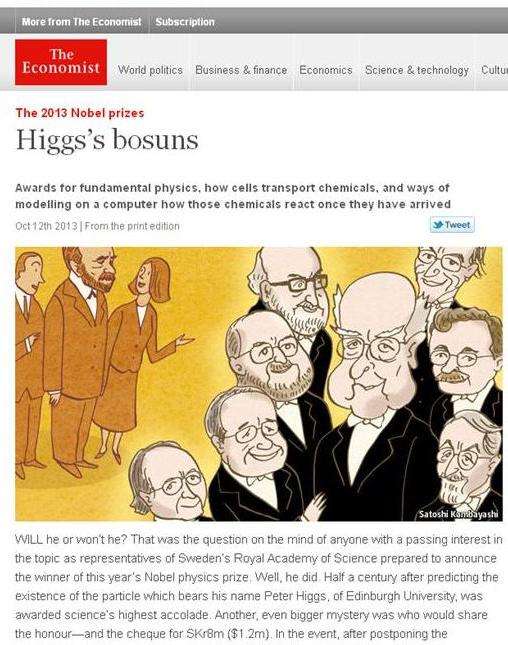
The Higgs Bosuns?

One sometimes wonder if news outlets have done away completely with copy editors, who should catch obvious mistakes and typos such as this.

This morning, while browsing through the news, I stumbled upon the Economist page reporting the Nobel Prizes, and had a chuckle with the title line read "Higgs's Bosuns". Maybe this is on purpose, I don't know, because the rest of the article had the correct spelling. Still, there's nothing in the article to imply anything about Higgs's "bosuns".


Zz.

Tuesday, October 08, 2013

2013 Physics Nobel Prize

So it is not a surprise at all that this year's Nobel Prize in Physics goes to two theorists who were the prominent figures in the development of the Higgs mechanism.

The 2013 Physics Nobel Prize has been awarded to two physicists who were instrumental in developing the theory that helps explain the origin of mass of elementary particles and predicts the existence of the Higgs Boson discovered last year. The prize, which recognizes the contributions of François Englert (Universite Libre de Bruxelles) and Peter Higgs (University of Edinburgh) for the theory of broken symmetry in electroweak physics, echoes the announcement of the 2010 American Physical Society’s J. J. Sakurai prize, which was awarded to the two Nobel Laureates as well as four additional physicists who made comparable contributions to the symmetry breaking work.

The link above also gives you access to free copies of the two relevant papers.

I think that the Nobel committee might be reserving another round to award the Nobel Prize for the experimental discovery.

Zz.

Thursday, October 03, 2013

Accelerating Charge Particles Using Visible Light

This accelerating scheme should see a large interest after this proof-of-principle demonstration. Two separate papers are showing the feasibility of accelerating electrons using the E-field from visible light, as opposed to the RF fields used in a typical accelerating structures.

Two teams now report rapid acceleration of electrons using small silica structures to shape light fields into patterns similar to those in a linear accelerator. In both of the experiments, the researchers sent electrons skating just over a silica surface that contained narrow grooves in the direction perpendicular to the electron beam. They then shined ultrashort laser pulses directly onto the surface (called a grating), which generated a pattern where the electric field was alternately enhanced and diminished in neighboring “zones” just above the surface. This pattern of fields reversed direction twice during every oscillation cycle of the laser light and could accelerate electrons (see YouTube video).

Here's the YouTube video:


Of course, with any initial advancement, there's still plenty of work to do. For many applications, getting to higher energy alone isn't the only issue. In FEL's, for example, the emittance of the beam is equally crucial. So accelerating scheme such as this must show the ability to not cause an emittance blow-up. The other issue that is often critical is the question on how much charge per bunch that can be accelerated. For many applications, the standard "high-brightness" beam requires a 1 nC per bunch charge. So the scheme must be able to handle beams of that magnitude without sacrificing the quality.

Still, this promises to be another exciting avenue for future accelerators.

Zz.

Tuesday, October 01, 2013

US Particle Physics Community Plans For The Future

As the US govt. starts its shutdown due to the US Congress's lack of ability to do the work they were elected to do (how come we don't dock their pay when they can't come up with a budget on time?), we have a report on the last "Snomass on the Mississippi" workshop by US Particle Physicists in prioritizing the different projects that US particle physicists should be involved in. It is a rather challenging task considering the severe budget cuts and constraints being put on science funding in the US as a whole, and on high energy physics in particular.

As stated at the end of the article, the US has lost its "leader" status in high energy physics. That's gone, and if the ILC is built in Japan, and funding continues to be dismal due to the political bickering by the dimwit politicians, then I don't see it coming back. I do not see the LBNE, even if it is built to its original specifications, getting the same global interest and status as the LHC and the ILC, certainly not in the public's eye.

Zz.

Monday, September 30, 2013

How To Destroy A Magnet

Besides learning how to destroy a magnet, you get to learn why certain things are magnetic, or can be magnetized.


Zz.

Saturday, September 28, 2013

Nanoscale NMR/MRI? Why, Yes We Can!

An amazing improvement in science technology and instrumentation. A new paper reports on the recent achievement of performing NMR on nanoscale size targets. You can also read the paper for free since it is published in the new APS family journal Phys. Rev. X. The one interesting aspect of this journal is that it includes a "Popular summary" of the paper that has been published. The popular summary accompanying this paper is this:

Tuesday, September 24, 2013

Any Guesses For 2013 Nobel Prize In Physics?

As the leaves turn color (at least here in the higher latitude in the Northern Hemisphere), the thoughts of many physics academics and professionals turn to Sweden and guessing at who will win this year's Nobel Prize for physics.

The obvious front runner is anything related to the Higgs. It's confirmed discovery this year means that it will not be a surprise if the award goes to people related to it. Questions remains on how they will be honored, considering that only a maximum of three individuals can be awarded the prize at any given time. Will they honor the theorists and the experimentalists in separate years? After all, there are already at least 4 deserving theorists who could easily be given the honors for formulating the Higgs mechanism, and the number is even larger for leading the experimental discovery of the Higgs.

The outcome of this will be very interesting. Or maybe the Nobel committee will forgo awarding the prize for the Higgs another year, and go with some other discovery in physics. That will be a fascinating surprise in itself!

:)

Zz.

Friday, September 20, 2013

When Belief Trumps Scholarship

The most significant argument against Creationism/Intelligent Design is that the proponents of these beliefs tends to try to find faults in existing concept of evolution, but without providing evidence of their own in support of their beliefs. The most often line of attack by these people is what we often normally refer to using the concept of "god of the gaps", where one tries to find some evidence or observations that defies current scientific explanation.

The problem with this, of course, is that these "gaps" often continue to shrink over time, and as our understanding of the world around us expand and improve. The ancient civilization used to think that the moving clouds, the eclipses, the ebb and flow of ocean tides, etc., were all due to some act of gods, because they didn't have any knowledge of what caused them. Now, we know better and these events are no longer mysterious or mystical.

And that's where we come back to the ID crowd. More often than not, they lack the necessary scientific evidence to strengthen their arguments. And when they try, the only people they could convince are people who really are not well-equipped to actually decipher the science. This appears to be the case of the latest book titled "Darwin's Doubt" written by Stephen Meyer, who runs the Discovery Institute. He's a non-biologist, who is trying to argue that the rapid explosion of animal phylia in the Cambrian period cannot be explained via the slow and tedious process of evolution, and thus, via invoking the god-of-the-gaps, points to evidence of an intelligent designer.

Whenever someone brings up a scientific point, it must be countered with equivalent scientific point. And this is exactly what has been done in this case. A review of this book written by UC Berkeley's Charles Marshall in this week's issue of Science (Science, v.341, p.1344 (2013)) did just that. In this review, Marshall pointed out several flaws in the biological/scientific points presented in Meyer's book.

However, my hope soon dissipated into disappointment. His case against current scientific explanations of the relatively rapid appearance of the animal phyla rests on the claim that the origin of new animal body plans requires vast amounts of novel genetic information coupled with the unsubstantiated assertion that this new genetic information must include many new protein folds. In fact, our present understanding of morphogenesis indicates that new phyla were not made by new genes but largely emerged through the rewiring of the gene regulatory networks (GRNs) of already existing genes (1). Now Meyer does touch on this: He notes that manipulation of such networks is typically lethal, thus dismissing their role in explaining the Cambrian explosion. But today's GRNs have been overlain with half a billion years of evolutionary innovation (which accounts for their resistance to modification), whereas GRNs at the time of the emergence of the phyla were not so encumbered. The reason for Meyer's idiosyncratic fixation with new protein folds is that one of his Discovery Institute colleagues has claimed that those are mathematically impossibly hard to evolve on the timescale of the Cambrian explosion.

In other words, this scientific argument doesn't hold water.

Unfortunately, and I can see this happening often, the counter argument to this book will not reach those who should be aware of it. The same with the perpetual argument that evolution violates the 2nd law of Thermodynamics, those who belief in ID will use this as the scientific argument against the evolution of life on Earth, without being aware of the holes in Meyer's book.

But at least now, you know that there is a scientific counter argument to what Meyer has brought up, and you can point to this Science review article.

Zz.

Tuesday, September 17, 2013

Superconductivity And The Environment - A Roadmap

A rather interesting and unusual review article. It describes how superconductivity and superconductors can actually help in improving our environment. As stated in this PhysicsWorld blog, it is an unusual assertion because "... superconductors only work at very low temperatures and lots of energy is needed to cool them.. "

Still, you might want to check out the list of things that have been argued that superconductors can do to help with the environment. The review paper is available for free.

Zz.

Monday, September 16, 2013

Graphene - The Aspirin Of Microelectronics

A while back, aspirin was touted as a miracle drug. Its use beyond just being a pain killer was being discovered constantly, ranging from an efficient blood thinner to prevent heart attack and stroke.

That is why I'm calling graphene as the aspirin of microelectronics. It seems that almost every year we hear more and more use of this miracle material. It's a good conductor, it is very strong, and now, in the latest chapter of what graphene can do, it has been touted as a very efficient converter of light into electricity.

Now the one-atom-thick lattice of carbon has added another string to its bow. Three research groups have independently shown that graphene can efficiently convert infrared light into electrical signals, as part of devices known as photodetectors. As fast and accurate translators of optical data, graphene photodetectors could speed up computers and significantly cut their power consumption. The devices, each with a slightly different architecture, are reported in Nature Photonics.

This performance already rivals that of existing photodetectors. “We’re seeing graphene getting to a point where it can compete with today’s technologies,” says Dirk Englund, a physicist at the Massachusetts Institute of Technology in Cambridge who developed one of the graphene photodetectors. “That’s an important new step.”
I expect it to be able to clean windows soon.

Zz.

Sunday, September 15, 2013

Fermilab's Neutrino Beam Source

Here's a short article on Fermilab's repurposed Main Injector into a neutrino beam source for MINOS and NOvA. The article is OK. It kinda stopped short in describing the mechanism of generating neutrinos (why did it stop at creating pions?) Luckily, it linked to a YouTube video that explains how we get neutrinos at the end of the process.


Zz.

Friday, September 13, 2013

Feynman Lectures On Physics

I just read a note by Mike Gottlieb on the availability of the famous Feynman Lectures on Physics online, for free!

Not sure how long this has been available, but in case you didn't know, now you do!

Now, let me clarify something. I think this book is a classic, and advanced physics students, and graduate students, should read parts of it (or if you have time, read as much as you want). It provide quite a bit of insight into many different physics subjects.

However, as a pedagogical tool to teach physics to new students, I think this book is unsuitable and may be beyond what such students can comprehend. So if you are a freshman, or just trying to pick up some physics, you may still read it, but don't be surprised if you find it rather difficult to learn from. It is one of the reasons why this book isn't a popular intro physics text in most schools.

Zz.

Wednesday, September 11, 2013

The Quantum Quest

Again, I don't know how long this article from Nature will be available freely on the web. So read it while you can. It describes the continuing effort to decipher the fundamental issues surrounding Quantum Mechanics, and the effort to formulate it from some set of axioms.

Over the past decade or so, a small community of these questioners have begun to argue that the only way forward is to demolish the abstract entity and start again. They are a diverse bunch, each with a different idea of how such a 'quantum reconstruction' should proceed. But they share a conviction that physicists have spent the past century looking at quantum theory from the wrong angle, making its shadow odd, spiky and hard to decode. If they could only find the right perspective, they believe, all would become clear, and long-standing mysteries such as the quantum nature of gravity might resolve themselves in some natural, obvious way — perhaps as an aspect of some generalized theory of probability.

Zz.

Monday, September 09, 2013

Cow Tipping - It's A Myth!

What better way to break up the monotony of important advances in elementary particles, of topological insulators, of neutrino physics, etc. then to talk about the myth of cow-tipping! This article in Modern Farmer collects up-to-date info on why this is a myth, including a physics calculation on what it would take to do such a thing, which would make it even more unlikely.

But say our hypothetical cow tippers got lucky enough to get close to a cow at night. There’s still the matter of the brute force needed to get the cow over. In 2005, University of British Columbia student Tracy Boechler and doctor of zoology Margo Lillie ran the numbers on cow tipping. Their findings? There’s no way one person could tip a cow. Two people? Maybe — but not in real world conditions.

“Two could do it in theory,” says Dr. Lillie. “But it’s not going to be easy, and as soon as the cow responds by bracing herself or leaning into you — which she will do — it will be even harder.” Cows, after all, stand on four legs and will quickly shift their weight to a wider, more stable stance if pushed against. And Lillie and Boechler’s calculations are based on an unmoving cow in equilibrium in which slow, steady force could be applied without pushback — an optimum (and unrealistic) state for cow tipping. Pull out your high-school text book and look up Newton’s Second Law: Force equals mass times acceleration. A cow has a lot of mass, and you’ll want to move that mass quite quickly, before the cow can react. Which means you’ll need to generate a lot more force. Per her calculations, that would require at least five, and probably more like six pushers. “It just makes the physics of it all, in my opinion, impossible,” says Dr. Lillie.

There ya go, kids! Don't try this at home, or more accurately, at a farm near you!

Zz.

Wednesday, September 04, 2013

It's About Time

One of the most common arguments that I've seen online is the question on whether time is "real" or is it an "illusion" or doesn't exist. I've addressed this before quite a while back. In fact, that blog entry actually became a "reference" in a Wikipedia entry!

Last week's issue of Science had an interesting article. It is actually a review of Smolin's book "Time Reborn", with the review written by Huw Price (Science v.341, p.960 (2013)). What is interesting about the review here is the impression that I got that, even in philosophical circles, there is really no serious argument on the question on whether time exists or not (it does!). Rather, the question is really on the nature of time.

The differences between the two camps on the nature of time is described in the article:

I’ll come back to that question, but first to the dispute itself, which is one of philosophy’s oldest feuds. One team thinks of time as we seem to experience it, a locus of flow and change, centered on the present moment-“All is flux,” as Heraclitus asserted around 500 BCE. The other, my clan, is loyal instead to Heraclitus’s near contemporary, Parmenides of Elea. We think of time as it is described in history: simply a series or block of events, lined up in a particular order, with no distinguished present moment. For us, now is like here—it marks where we ourselves happen to stand but has no significance at all from the universe’s point of view.

And it brings me to the main point in which the differences really is not about the question whether time exists, or if it is real.

To Parmenideans such as Williams and myself, this attitude is just linguistic imperialism, cheeky and rather uncharitable. Of course we believe that time is real, we insist. (It is as real as space is, the two being simply different aspects of the same fourdimensional manifold.) What we deny is just that time comes carved up into past, present, and future.

You'll notice that the argument that time is as real as space is the same argument that I used in that earlier post that I linked above.

So really, enough of this nonsense on whether time exists or not, or if it is real or not.

Zz.

Sunday, September 01, 2013

Friday, August 30, 2013

The Birth Of Photonic Crystals

If you've read this blog for any period of time, you will have seen that, as many times as I can, I try to highlight the application side of physics. This is because a lot of people who are not familiar with the field tend to think that physics is only the LHCs, the Brian Greenes, the particle physics, the String theories, etc. If I can't contribute anything to physics, I want to at least contribute to destroying such myth.

This is one such example. APS Physics has recently highlighted a landmark paper that marked the birth of the idea of photonic crystals.

Semiconductors and band insulators are material that has a gap in the electronic band structure. On the other hand, photonic crystals have gaps in the photonic band band structure, whereby the material simply does not propagate photons having energies within that gap.

You may read the article to find out what applications such materials are good for.

Zz.

Thursday, August 29, 2013

The Origins of Space Time

I guess theoretical physics is supposed to extrapolate and make these types of conjectures. Still, it would be nice if there are already experimental indications that they are on the right path, rather than just continue on blindly.

This is a rather interesting article from Nature on some very fundamental issues in physics, and the theories (yes, there are many of them, which is common when there are no experimental evidence to weed them out) that claim to describe them. Not sure how long the article is available for free online, so read it while you can.

Zz.

Carl Wieman Moves to Stanford

I mean, where else would highly-sought-after, Nobel laureate end up?

Carl Weiman has taken up a faculty position in the Physics Dept. and in the Graduate School of Education at Stanford University. He brings with him quite a program in physics education, I must say.

Carl Wieman’s crusade to improve undergraduate science education is now based at Stanford University.

The physics Nobelist and former White House science education czar has been named a faculty member in both the physics department and Stanford’s Graduate School of Education. The joint appointments, effective 1 September, give Wieman an academic perch to take his research on learning in new directions while continuing to incorporate those insights into the classroom.
Zz.

11-Year Old Starts College Majoring In Physics

Here's a piece of news to make all of us mere mortals feel highly inadequate.

A lot of people have a hard time choosing a major when they start college at 18, but that isn't the case for Carson Huey-You, who's just 11 years old.        

"I am studying physics," the youngest student to ever enroll at Texas Christian University who started college on Monday says. "That's my major."

But like all college freshman, the 11-year-old is starting out by taking some required courses. His ultimate goal? Becoming a quantum physicist.

"I'm taking calculus, physics, history and religion – those are my core classes," says Huey-You, who seems to be adapting to college life quite well.  

I certainly wish him the best! It would be nice if the news organization continues to track him through his program. I would be curious to learn where he'd end up.

Zz.

Wednesday, August 28, 2013

Friday, August 23, 2013

An Actual Test To Verify A Quantum Computer?

We may just have one, according to this Wired article.

In the April 25 issue of the journal Nature, Vazirani, together with Ben Reichardt of the University of Southern California in Los Angeles and Falk Unger of Knight Capital Group Inc. in Santa Clara, showed how to establish the precise inner state of such a computer using a favorite tactic from TV police shows: Interrogate the two components in separate rooms, so to speak, and check whether their stories are consistent. If the two halves of the computer answer a particular series of questions successfully, the interrogator can not only figure out their internal state and the measurements they are doing, but also issue instructions that will force the two halves to jointly carry out any quantum computation she wishes.

Wonder if the D-Wave people would like to subject their machines to such a test?

The article also has some coverage of quantum entanglement and the basics of quantum computation.

Zz.

Thursday, August 22, 2013

Your Proposal Received Glowing Reviews, But We Are Not Going To Fund It

It is the sign of the times, I suppose.

I've submitted quite a few funding proposals, and some got rejected, while others got funded. Nothing unusual. However, the ones that got rejected typically have mixed reviews. I remember one where 2 of the reviewers liked it, and one was not too thrilled about it. It got rejected, which was not surprising. But in all my years of doing this, I don't ever recall where a proposal got really glowing reviews, and then it was summarily rejected!

That is what just happened to me (I'm not going to name the agency and anything else, because I am not bitter, really!). We just heard the news of the rejection, and I went to look at the reviews. At the end of reading all three of them, my jaw dropped. I can't remember reading a more positive, glowing reviews of my proposals before. The reviewers did read the proposal carefully, and actually got the novel method we were proposing. The whole proposal got very good rating. But, obviously, these mean nothing because, in the end, it got rejected.

I will also say that I am not surprised. Disappointed, yes, but not surprised considering the severe budget constraints that many of the US funding agencies are under right now. It is up to the fractured US legislators, and ultimately, the people, to put a value on science research and how it has affected the US economy and our lives thus far. If this is not of any value, then the US certainly deserves to undergo its current, slow decline of its civilization and suffers from the same fate as other great civilizations of the world throughout history.

Oh, did I say that I'm not bitter? :)

Zz.

Wednesday, August 21, 2013

Quantum Zeno Effect Observed In Diamonds

Diamonds could be quantum physicists best friends!

Turns out that the quantum Zeno effect has been observed in diamond.

The researchers focused on nitrogen–vacancy (NV) centres, imperfections in diamond that arise where an atom of nitrogen and an empty space replace carbon atoms at two neighbouring spots in the crystal lattice. The team used microwaves to change the magnetic spin state of an electron located at an NV centre, and then used a laser beam to trigger red fluorescence that revealed which of two possible states the electron was in at any given moment. When they measured the NV centre in this way, the researchers found that the oscillation between the two states was disrupted — just as would be expected if the quantum Zeno effect were operating.

The paper is to be published in PRA, but the preprint is online.

Zz

Tuesday, August 20, 2013

Science, Religion, and the Big Bang

This should stir up the pot, and I think it already has, judging from the comments accompanying this YouTube video.


Zz.

Wednesday, August 14, 2013

The Dynamics of Hyperloop

I heard about this on the new yesterday because the infamous Elon Musk has thrown his support behind it. It is a new high-speed transportation method that primarily depends on an evacuated (or partially evacuated) tube to reduce air friction.

I was going to do a quick study on it, but Rhett Allain at Dot Physics has already done a preliminary analysis on it, so I'll just point to his page.

As someone who works with vacuum/ultra-high vacuum systems, all I can say is that this thing will need a lot of huge vacuum pumps, although for what it intends to do, I think all they need is to get into probably just the milliTorr pressure range, just enough to be below the viscous flow regime.

Zz.

Monday, August 12, 2013

Google Physics Doodle

Google celebrates Erwin Schrodinger's 126th birthday today with a physics-themed doodle that most physicists and physics students will get.

Zz.

Sunday, August 11, 2013

How To Find Black Holes With Lasers

It's a bit tedious to follow, but you might learn something. And one camera angle has a bit of a problem with aspect ratio.


Zz.

Saturday, August 10, 2013

Higgs Boson: The Inside Scoop


Zz.

Why Aren't More Girls Attracted To Physics?

This is not a new topic. In fact, I'm sure it has been discussed, published, and talked about many other times. I've also posted several items on this, including this one about the shortage of women physicists.

The latest study aims at understanding why girls aren't not as interested in physics as boys.

But when Riegle-Crumb controlled for those and other possibilities, she found one reason remained: "What we found is that in communities that had a higher percentage of women in the labor force who are working in science, technology, engineering and math, that in those schools, girls were as likely as boys to take physics, or even more likely."

Riegle-Crumb's finding about the importance of local role models meshes with a broad range of that shows the decision to pursue math and science is not about innate differences between boys and girls, but about and norms. Countries with greater , for example, reveal more equal math test scores among boys and girls.

This is interesting. In my participation on the various outreach program to get girls to go into science/engineering, I've asked these girls many times on whether it was important for them to have a female role model before the chose a career. Fascinatingly enough, the overwhelming majority of the girls said no! Those who said no told me that in this day and age, they are used to the idea that they can pursue whatever career that they want.

Now, I'm not saying that anecdotal accounts contradict the study. I think the girls who showed up or have been selected to participate in many of the events that I attended were already from an environment in which they no longer significantly need role models. So my observation can definitely be skewered. This study clearly shows that there is a significant influence on having a role model within the environment that the girls live in.

Zz.