Saturday, November 28, 2009

The e-Print ArXiv To Undergo Major Changes

Looks like the venerable ArXiv will be undergoing a major upgrade.

New tools will link papers by concepts, not just by the citations they contain, and this will help users without advanced expertise -- including some outside the scientific community -- understand the significance of new research, said Ginsparg.


I wonder if they'll put in new efforts to weed out some of the "strange" papers (I'll refrain from calling them crackpottery) that appear periodically.

Zz.

Why Can't Time Run Backwards?

Nobel Laureate Tony Leggett gave a rather intriguing lecture at St. Andrews this week that tried to address the topic.

Leggett said, "We can all tell when a movie of some everyday event, such as a kettle boiling or a glass shattering, is run backwards.

"Similarly, we all feel that we can remember the past and affect the future, not vice versa. So there is a very clear "arrow" ( direction ) of time built into our interpretation of our everyday experience.

"Yet the fundamental microscopic laws of physics, be they classical or quantum-mechanical, look exactly the same if the direction of time is reversed. So what is the origin of the "arrow" of time?

"This is one of the deepest questions in physics; I will review some relevant considerations, but do not pretend to give a complete answer."


It took place on Nov. 27 (yesterday). Did anyone reading this attended this lecture? If you did, I'd appreciate a brief report.

Zz.

Wednesday, November 25, 2009

Albert Einstein, the Robot

OK, this is just wrong, or in very poor tastes.

It seems that a bunch of engineers thought that putting an Albert Einstein's head on a robot would be appropriate, and then calling it "Albert Hubo".

Albert HUBO is an android robot. It is composed of a head, which takes after Dr. Albert Einstein, and HUBO’s body. The development period took about 3 months, and it had been finished at November, 2005. The head part was developed by Hanson-Robotics. Its skin is a special material, Frubber, often used at Hollywood.


Besides being rather creepy, it is in poor tastes because as most of us know, Einstein's brain was removed from his head. Now with this thing, it appears as if his head has been decapitated from his body and put on this robot.

Not sure what they hope to accomplish, other than publicity value.

Zz.

Monday, November 23, 2009

First Collisions at the LHC

Great news coming out of CERN:

Geneva, 23 November 2009. Today the LHC circulated two beams simultaneously for the first time, allowing the operators to test the synchronization of the beams and giving the experiments their first chance to look for proton-proton collisions. With just one bunch of particles circulating in each direction, the beams can be made to cross in up to two places in the ring. From early in the afternoon, the beams were made to cross at points 1 and 5, home to the ATLAS and CMS detectors, both of which were on the lookout for collisions. Later, beams crossed at points 2 and 8, ALICE and LHCb.

"It's a great achievement to have come this far in so short a time," said CERN Director General Rolf Heuer. "But we need to keep a sense of perspective - there's still much to do before we can start the LHC physics programme."

Beams were first tuned to produce collisions in the ATLAS detector, which recorded its first candidate for collisions at 14:22 this afternoon. Later, the beams were optimised for CMS. In the evening, ALICE had the first optimisation, followed by LHCb.

"This is great news, the start of a fantastic era of physics and hopefully discoveries after 20 years' work by the international community to build a machine and detectors of unprecedented complexity and performance," said ATLAS spokesperson Fabiola Gianotti.

"The events so far mark the start of the second half of this incredible voyage of discovery of the secrets of nature," said CMS spokesperson Tejinder Virdee.

"It was standing room only in the ALICE control room and cheers erupted with the first collisions," said ALICE spokesperson Jurgen Schukraft. "This is simply tremendous."

"The tracks we're seeing are beautiful," said LHCb spokesperson Andrei Golutvin, "we're all ready for serious data taking in a few days time."

These developments come just three days after the LHC restart, demonstrating the excellent performance of the beam control system. Since the start-up, the operators have been circulating beams around the ring alternately in one direction and then the other at the injection energy of 450 GeV. The beam lifetime has gradually been increased to 10 hours, and today beams have been circulating simultaneously in both directions, still at the injection energy.

Next on the schedule is an intense commissioning phase aimed at increasing the beam intensity and accelerating the beams. All being well, by Christmas, the LHC should reach 1.2 TeV per beam, and have provided good quantities of collision data for the experiments' calibrations.


So far, so good. No birds with baguette, please! :)

Zz.

Galileo Fingers Found

These are just too morbid and gruesome for me. First it was Einstein's brain, now it's Galileo's fingers. It seems that they found his "missing" fingers after more than 100 years.

Removing body parts from the corpse was an echo of a practice common with saints, whose digits, tongues and organs were revered by Catholics as relics with sacred powers.

There is an irony in Galileo's having been subjected to the same treatment, since he was persecuted by the Catholic Church for advocating the theory that the earth circles the sun, rather than the other way around. The Inquisition forced him to recant, and jailed him in 1634.

The people who cut off his fingers essentially considered him a secular saint, Galluzzi said, noting the fingers that were removed were the ones he would have used to hold a pen.


Horrors! People need to really find a hobby!

Ironically, they found the fingers during the 2009 Year of Astronomy commemorating Galileo! Can't stage this any better!

Zz.

Work on the Manhattan Project, Subsequent Events, and Little Known Facts Related to its Use

I was planning on doing quite a bit of work this morning when I showed up extra early at the lab, but instead, I spent several delightful minutes reading this amazing personal account of the Manhattan Project and the dropping of the bombs that ended World War II. This personal account was written by Lawrence Bartell, one of the last remaining participants of the venerable project.

Abstract: A personal account of work on the Manhattan Project in Chicago by one of the few remaining survivors of the war-time project is given, illustrating, among other things, how absurd things can happen at a time of great stress and concern.. As is well known, Los Alamos was the site specializing in the physics of the bomb while Chicago emphasized metallurgical and chemical research. Nevertheless, physics played a significant role in Chicago, as well. That is where Fermi constructed the worlds first uranium pile under the stands of Stagg field, a site at which this author got seriously irradiated. Some curious events occurring after the bomb was dropped are also related. In addition, at this time of public protest by sincere people who question the ethics of America for dropping the bomb on innocent civilians, certain facts, obviously unknown to the protesters, are presented which place the bombing in a rather different light.

It's amazing that all of the radiation and chemical exposure that he endured haven't caused him more significant health problems.

It's an amazing historical account and adds another perspective to the Manhattan Project, especially from the Chicago effort.

Zz.

Albert Crewe, Inventor of the STEM

Albert Crewe, the inventor of the scanning transmission electron microscope, and the first person to image single atoms, died this past week.

Dr. Crewe's breakthrough image of an atom was taken in 1970 with a scanning transmission electron microscope of his own invention at the U. of C., where he taught until 1996.

The uranium and thorium atoms that Dr. Crewe captured were magnified 1 million times. It was a significant breakthrough -- an atom is incredibly tiny, approximately 4 billionths of an inch in diameter. The event was met with quiet satisfaction by Dr. Crewe and his fellow Hyde Park physicists.


Again, this is one of those giants in the field that many in the public would not know, but whose work has such huge impact on our lives. Thank you, Dr. Crewe!

Zz.

Friday, November 20, 2009

First Beam Splashes at ATLAS

News brief from the ATLAS Detector at the LHC:

Dear Colleagues,

ATLAS has recorded successfully the first beam-splash events of 2009. You can admire them at the following sites:

http://atlas.web.cern.ch/Atlas/public/EVTDISPLAY/events.html
https://atlas-live.cern.ch

Keep an eye on these sites, as they will be refreshed regularly.

This very exciting moment and great achievement for the machine and our experiment are the results of the outstanding work of many people !

Kind regards

Fabiola Gianotti


Well done! We look forward to more progress from this re-start.

Zz.

Newton Voted Greatest Cambridge Student

Students at Cambridge voted Newton as the greatest Cambridge student of all time. He was followed closely by Charles Darwin, which isn't a slouch himself in the history of science.

The physicist and mathematician, who went to Trinity College, won 23.6 per cent of the vote in the poll by student newspaper Varsity.

Charles Darwin, who attended Christ's College, came a close second with 20.6 per cent and poet Lord Byron, who was a student at Trinity College, came third with 10.8 per cent.


Zz.

Controlling the Velocity of Light Pulses

There is a very good review article in the latest issue of Science[1] that compiles all of our experimental and theoretical understanding of light propagation in a medium.

Abstract: It is now possible to exercise a high degree of control over the velocity at which light pulses pass through material media. This velocity, known as the group velocity, can be made to be very different from the speed of light in a vacuum c. Specifically, the group velocity of light can be made much smaller than c, greater than c, or even negative. We present a survey of methods for establishing extreme values of the group velocity, concentrating especially on methods that work in room-temperature solids. We also describe some applications of slow light.

Zz.

[1] R.W. Boyd and D.J. Gauthier, Science v.326, p.1074 (2009).

Thursday, November 19, 2009

What Happens When You Wanted To Be A Physicist And It Just Didn't Work Out?

Well, you then go to your back up plan and be a CALL GIRL!! :)

This is way too hysterical to make up, or maybe it is made up, who knows?

The more complete story on this can be found at Times Online. The part I found to be quite hilarious was this:

How did she become a prostitute? She studied anthropology and mathematics in Florida: “I wanted to be a physicist, but that just didn’t work out.” After Florida, her family lived in Sheffield, where she studied some more: “By the time I got to Sheffield it was for doctoral study at the department of forensic pathology.”


I would say that was a drastic alternative indeed! :)

Zz.

Wednesday, November 18, 2009

Paul Chu Returns To University of Houston

Ah, a name from the past!

Paul Chu, after serving as president of the Hong Kong University of Science and Technology, returns to the scene of his triumph at the University of Houston. Back in the heyday of high-Tc superconductors, he discovered YBCO after the publication of Bednorz and Müller's LACO, the first high-Tc superconductor. What was significant about YBCO was that it was the first superconductor discovered that has a Tc above liquid nitrogen temperature. This is important because it allows one to have a superconductor using a relatively cheap cooling source, rather than using liquid helium.

This, of course, was the trigger for the "Physics Woodstock" at the 1987 APS March Meeting in New York. Ah, the good old days!

Zz.

Tuesday, November 17, 2009

Phenomenological Quantum Gravity

I don't normally find reading papers on quantum gravity to be "entertaining". However, this is actually is, simply because the authors have to be rather concise due to limited space. Written by Sabine Hossenfelder Lee Smolin of the Perimeter Institute, it actually provides quite an overview of the phenomenological aspect of the search for the effects of quantum gravity. It focuses entirely on what we had measured and can possibly measure in the next decade or so. Reading this, one notices a lot of "negative result" experiments, especially on the search for possible violations of Special Relativity at those extreme scales.

Like I said, a very entertaining reading. :)

Zz.

Taking the Wraps Off Cloaking

This is an excellent review article by John Pendry on left-handed material and its application to "cloaking". Pendry, as everyone should already know, revived this field of study with his work on metamaterial. So this article compliments quite well with the earlier article in Physics Today.

Zz.

Triple Hit

It appears that there's a new independent movie titled "Triple Hit" that is making use of various popularization of quantum mechanics.

The film - previously called Schrodinger's Girl - centres on Rebecca Hunter, a disgraced scientist conducting research into alternate universes. She discovers a way to travel between realities and then finds her parallel-world counterparts have their own agendas: Anastacia Hunter is the science director for a gulag in the People's Republic of Great Britain, while Sarah Hunter-Gibson is a professor in a utopian hi-tech society.

Rebecca takes a terrifying trip into the People's Republic, a dystopian alternative Britain, where her encounter with a totalitarian regime is only the beginning of her problems as the multiverse begins to unravel around her. She has to use her sharp intellect and mastery of quantum physics to save the entire universe.


Oy vey!! :)

Well, to be fair, I shouldn't make any comments on this since I haven't seen it. And it is, after all, a "sci-fi" movie, so they should have some latitude to run away with it a bit. But this parallel universe type of theme is nothing new. How come no one makes a movie about the possibility of fractionalization and spin-charge separation, for example? Now THAT would be entirely new! :)

Zz.

Monday, November 16, 2009

Trajectory Analysis of a Soccer Ball

This is another fun article, and fun physics, that could be of interest to many casual reader. It's a very in-depth analysis of the trajectory of a soccer ball, with and without spin. The paper has been published in the Dec. 2009 issue of AJP.

Zz.

Holes That Block Light

This is a rather fascinating result.

You have a thin film that's already semi-transparent. If you punch more holes into the film, do you expect more light to get through? You would, wouldn't you? That's not what happened here!

Toward this end, researchers from the University of Stuttgart in Germany laid very thin films of gold onto pieces of glass and then used ion beams to etch the film with holes arranged in a regular, square array. These holes were smaller than the wavelength of light and, despite being so tiny, are just the kind of openings that have been shown to let light through the thicker, opaque film used in the 1998 experiment. But in the new experiment, the gold film was so thin--only 20 nanometers--that light could already shine through it. And surprisingly, less light went through the holey gold than through the original semitransparent film.


You have to read the rest of the article (and maybe even the paper) to find out why. This, btw, is another example of some of the most fascinating results out of condensed matter.

Zz.

Friday, November 13, 2009

A Sit Down Talk With Michael Green

The new holder of the Lucasian Chair at Cambridge sat down for a brief interview. He, of course, tried to justify String Theory.

"I have been thinking about how I can make use of such a prominent position to benefit my colleagues. It is difficult to find funding at the moment, especially for subjects which don't obviously have an immediate application for something that will make money.

"But the people who discovered magnetism and electricity had no idea what they could be used for. The MRI scanner wouldn't exist without particle physics. There are so many spin-off industrial investments in things that are being researched, and we need more of this."


There's only so far that one can run away with this. People "...who discovered magnetism and electricity..." had, in their corner, empirical evidence to at least tell them if they are on the right path or not. This is where the analogy to pursuing String Theory breaks down and the similarity ends. I don't believe that there has been, in the history of physics, a study in a field of physics that has gone for so long, and garnered THIS much attention, that has been totally devoid of any empirical evidence which indicates one way or the other that it is on a right path. For many of us who value physics as being guided by empirical evidence, this is the most troubling aspect of String theory.

Zz.

Thursday, November 12, 2009

A String Theorist Wants LHC To Look For The "Stau"

The stau?

Oh well. This will be another hunt in the pursuit of finding any valid empirical evidence to show that String Theory is not a meaningless pursuit. Could String Theory produce a particle that has a lifetime of a minute?

Vafa traveled to CERN in late October to discuss with teams of scientists at the two main detectors on what else they might see. If the assumptions that he and Heckman make in the context of string theory are valid, Vafa said, the two lightest of the new particles are the gravitino and the stau. The gravitino, however, is so weakly interactive that it is hard to produce directly, Vafa said. A stau particle, however, is easier to produce and should be semi-stable, lasting as long as a minute. And it should leave a signature track — unexplainable by any of the already-observed particles — as it streaks across the LHC’s detectors.


We shall see....

Zz.

10 Weirdest Physics "Facts"

I suppose this is OK for a popular media and for mass consumption for the public. The Telegraph has a rather amusing description of what the writer thinks as the 10 weirdest physics "facts". Of course, all the usual suspects are there: entanglement, superposition, speed of light, etc..

Still, can you nitpick a few rather inaccurate statements in there? I'm sure you can. I'm not going to bother because, really, it won't matter for those who don't understand physics, because the subtleties won't make a difference. Nevertheless, I wish that last part on "relativistic mass" didn't appear, because it will only propagate the same misconception that we are trying to eradicate (see here and here, for example).

Zz.

Wednesday, November 11, 2009

APS Council Overwhelmingly Rejects Proposal to Replace Society’s Current Climate Change Statement

In a blow to those who still doubt the science and physics of anthropic global warming, the APS has overwhelmingly rejected a petition to soften the society's statement on this matter.

WASHINGTON, D.C. — The Council of the American Physical Society has overwhelmingly rejected a proposal to replace the Society’s 2007 Statement on Climate Change with a version that raised doubts about global warming.

The Council’s vote came after it received a report from a committee of eminent scientists who reviewed the existing statement in response to a petition submitted by a group of APS members. The petition had requested that APS remove and replace the Society’s current statement. The committee recommended that the Council reject the petition.

The committee also recommended that the current APS statement be allowed to stand, but it requested that the Society’s Panel on Public Affairs (POPA) examine the statement for possible improvements in clarity and tone. POPA regularly reviews all APS statements to ensure that they are relevant and up-to-date regarding new scientific findings.

Appointed by APS President Cherry Murray and chaired by MIT Physicist Daniel Kleppner, the committee examined the statement during the past four months. Dr. Kleppner’s committee reached its conclusion based upon a serious review of existing compilations of scientific research. APS members were also given an opportunity to advise the Council on the matter. On Nov. 8, the Council voted, accepting the committee’s recommendation to reject the proposed statement and refer the original statement to POPA for review.


What this means is that the APS, which is the preeminent society of physicists in the US, and which tends to be extremely conservative in its policy and statements, continues to support the prevailing consensus of AGW model based on the scientifically available studies and results. The APS has never been known to choose something based on a whim or political pressure (refer to its statement on Missile Defense project). That is why many anti-AGW camp were quick to latch on to any possible hint that the APS might change its stance, because they know that this would be a major coup for an organization as respected as this one to show some doubt in this issue. Just look at the brouhaha when the APS Newsletter published a contradicting viewpoint to AGW a while back!

Alas, this is not to be the case here, and the APS's statement on AGW is extremely clear.

Zz.

The Physics of Usain Bolt

I'm a sucker for these type of analysis and article. It is a lot of fun to read when it isn't really connected to "significant" physics research, mainly because for me, it is a pleasant diversion from my work, but still intellectually stimulating. Furthermore, exercise like this can be something fun for a class or a group of students to do, because it is something they have seen or heard about, and it is based on really basic physics that they can do or follow along.

This is a preprint of a paper that will appear in AJP. It analyzes the mechanics of Usain Bolt's 100m sprints, both from the last Beijing Olympics in 2008, and the recent Track and Field Championship in 2009, both resulting in new world records.

Abstract: At the 2008 Summer Olympics in Beijing, Jamaican athlete Usain Bolt broke the world record for the 100 m sprint. Just one year later, at the 2009 World Championships in Athletics in Berlin he broke it again. A few months after Beijing, Eriksen et al. studied Usain Bolt's performance and predicted that the record could be about one-tenth of second faster, which was confirmed in Berlin. In this paper we extend the analysis of Ref. [1] to model Bolt's velocity profile for the Beijing 2008 and Berlin 2009 records. From the results we obtained, we were able to deduce the maximum force, the maximum power and the total mechanical energy produced by the athlete in both races. Surprisingly, we concluded that all of these values were smaller in 2009 than in 2008.

Oooh.. now that last part is, indeed, surprising. You have to read it to find out why! :)

Edit: this has now appeared in AJP. The exact citation is:

O. Helene and M.T. Yamashita, Am. J. Phys. v.78, p.307 (2010).

Zz.

Tuesday, November 10, 2009

Placebo Power Behind Many Natural Cures

This is a terrific example on why we do not accept anecdotal evidence, because our mind can play plenty of tricks on an individual, strong enough to affect our physiology.

This article describe why many of the "benefits" of alternative medicine cannot be distinguished from the placebo effect.

Swear-by-it stories and anecdotal reports of benefit are one thing. Proving a treatment helps is quite another. Many alternative medicine studies have not included a placebo group — people who unknowingly get a dummy treatment so its effect can be compared.

Acupuncture is especially hard to research. Positive studies tend to lack comparison groups that have been given a sham treatment. Or they are often done in China, where the treatment is an established part of health care.

One U.S. study found that true acupuncture relieved knee arthritis pain better than fake acupuncture, in which guide tubes were placed but no needles were inserted. But a European study involving twice as many patients and using a more realistic sham procedure found the fake treatment to be just as good. The conclusion: Pain relief was due to the placebo effect.


The one bad thing about reports in mass media news like this is that they never give exact citation for all of these research and results that they are quoting. It's as if we are expected to just accept these things without having to know the source of what they used to draw up their conclusions.

Zz.

Creationist Refutes Darwin’s Evolutionary Theory - A Rebuttal

I mentioned about this talk about a week ago of a creationist attempting to falsify Darwin's theory of evolution. This morning, I found this response written by a physics major junior that easily threw a lot of doubt in the garbage that was spewed at that talk.

Carter used a wonderful scientific vocabulary and showed some facts that were true.

However, blinded by science jargon, he put up facts and figures with little truth to them, no way to verify them (or if he did, they were not accurate and considered fraudulent in the scientific community), nor accuracy to the science actually used.

This man performed a wonderful show, and is an outstanding example of how the public will believe almost anything that has numbers and graphs in it with no scientific proof.


The writer listed several examples where Carter simply can't produce valid sources for his numbers.

I'm left to wonder how many people in the audience who bought into what they were told. We often talk about the public needed to be scientifically literate. What we mean by that is NOT that the public knows all these "facts", but rather, having the skill to analyze how one goes from A to B to C to D. How, for example, do you draw up the conclusion that, say, "gay marriage" leads to "undermining traditional marriage". People throw out those two phrases all the time, but no one seems to explain the mechanism that show how "gay marriage" CAUSES "undermining of traditional marriage". Not only that, if such mechanism exists, one needs to publish such a thing and be scrutinized for it by others who are experts in the field of study to ensure that such a mechanism is valid, and that leads to the unique conclusion.

The same thing is occurring here. One simply can't throw out all of these numbers and conclusions (something that is commonly done in politics and economics) without any basis to show that they are valid. But the public that isn't familiar with the scientific process are ignorant of that. This is why I'm very proud of this young writer who already has the skill (hopefully something he gained from his education) to analyze and question how such conclusions are made. So well done, Jim Eakins!

Making the public be scientifically literate should mean making them able to make a rational analysis of how one draws up a conclusion. It is why when I proposed a revamping of the undergraduate intro physics labs, I try to steer away from making "textbook tests" of physics principles. Rather, I focused on how one can draw up the conclusion on how A depends on B, and what is the exact relationship between those two. Our world has always been focused on how we can relate things, how are they interconnected, etc. These types of lab exercises precisely present such tests.

Zz.

Monday, November 09, 2009

Vitaly Ginzburg: 1916–2009

The major physics news of the day is certainly the passing of one of the giants in this field - Vitaly Ginzburg. Physics World has one of the best summary of his life and times.

My first introduction to the name "Ginszburg" was certainly when I took up superconductivity and came across the "Ginzburg-Landau" model for superconductivity. This may even be the first instance of the idea of the "order parameter" for superconductivity took shape. He certainly left a lot of marks in the world of physics.

Zz.

Einstein’s Theory of Gravity and the Problem of Missing Mass

There is a very good review of the current progress in the theory of Modified Newtonian Dynamics (MOND) in the current issue of Science[1].

Abstract: The observed matter in the universe accounts for just 5% of the observed gravity. A possible explanation is that Newton’s and Einstein’s theories of gravity fail where gravity is either weak or enhanced. The modified theory of Newtonian dynamics (MOND) reproduces, without dark matter, spiral-galaxy orbital motions and the relation between luminosity and rotation in galaxies, although not in clusters. Recent extensions of Einstein’s theory are theoretically more complete. They inevitably include dark fields that seed structure growth, and they may explain recent weak lensing data. However, the presence of dark fields reduces calculability and comes at the expense of the original MOND premise, that the matter we see is the sole source of gravity. Observational tests of the relic radiation, weak lensing, and the growth of structure may distinguish modified gravity from dark matter.

Whether you buy into it or not, this will at least get you up to speed on the strengths and weaknesses of this theory.

Zz.

[1] P.G. Ferreira1 and G.D. Starkman, Science v.326, p.812 (2009).

Friday, November 06, 2009

The Physics of Ski Moguls

Here's a chance for you to learn about ski moguls, those "bump in the snow" thingies that you see on ski slopes that only make news during the Olympics, at least to me. I didn't realize there was a minor mystery to them till I read this.

Zz.

Thursday, November 05, 2009

A Chunk of Baguette Stalled the LHC?

OK, this is way too ridiculous that you just can't make it up.

Scientists at the CERN particle physics laboratory in Geneva noticed that the system’s carefully monitored temperatures were creeping up.

Further investigation into the failure of a cryogenic cooling plant revealed an unusual impediment. A piece of crusty bread had paralysed a high voltage installation that should have been powering the cooling unit.


Oy vey!!!

Luckily, this isn't anything major, just a minor setback. But really, now small things like this will make the news. It means that they are on center stage and every little thing will get reported.

Zz.

Statement on Research Experiences for Undergraduates

The American Association of Physics Teachers (AAPT) Executive Board has released a statement on research experiences for undergraduate physics majors.

The American Association of Physics Teachers urges that every physics and astronomy department provide its majors and potential physics majors with the opportunities and encouragement to engage in a meaningful and appropriate undergraduate research experience.


There!

From my perspective, the "meaningful and appropriate" part of undergraduate research experience isn't just about doing "new" work or publishing some amazing discovery. That's just a bonus. What is more important is that the student learns the technique and procedure, and even more important, learns to think things through and be systematic in doing something. Those are skills that can only be acquired, not taught, and they transcend beyond just doing physics research. To me, those are the more important aspect out of doing research work that the student can acquire.

Zz.

The Physics of Free-Throw Shooting

This discussion keeps popping up now and then. Recall that I've mentioned an article that suggests that throwing "granny style" might actually increase the chance of making a basket in basketball. Now comes another research on the mechanics of free-throw shooting that studies this a little bit more.

There is a difference though because the starting conditions are different, i.e. they're not studying the best way to do the free-throw, i.e. underhand or overhead.

The engineers used a men’s basketball for the study; it is heavier and a bit larger than basketballs used in women’s games. They also assumed that the basketball player doing the shooting was 6 feet 6 inches tall, and that he released the ball 6 inches above his head, so the “release height” was set to 7 feet. The free-throw line is 15 feet from the backboard, a cylinder-shaped opening that is 10 feet off the ground. Though it looks smaller, the diameter of a regulation basketball hoop is 18 inches; the diameter of a men’s basketball is a bit more than 9 inches.


So they are already starting with the assumption that one is launching the ball overhead.

Zz.

Wednesday, November 04, 2009

Creationist Refutes Darwin’s Evolutionary Theory

I received a lot of flak when I made my blog entry on "An Astronomer At The Vatican", simply because I would have asked more pointed questions rather than the fluff that was given. What I wanted to established is specific and CLEAR stand of Catholicism in particular of various issues where religion and science have come to a loggerhead.

It is with that in mind that we have this example of someone who is using Christianity and are still arguing for creationism AND falsely claiming that evolution is wrong.

According to a presentation held Tuesday at West Virginia University, evolutionist Charles Darwin did not know geology, biology, or Jesus.

Dr. Robert Carter, has a doctorate in marine biology and is currently the head speaker and scientist for Creation Ministries International (USA) in Atlanta, Ga., gave a presentation listing in detail what Darwin did not know at that time. Carter argued evolution theory, therefore, cannot be held as the true explanation of the history of the natural world.


So you get all of these people who complained that my view of the Catholic belief is outdated, and yet you have on the other hand, various parts of the same Christian belief that clearly show that that "outdated" belief is alive and well. My question has always been, how come someone within the church (and I'm talking about ALL of Christianity, and not just a particular denomination) talk to this guy and set him straight, if that's possible? Obviously, he would not listen to other scientists since he has ignored not only the overwhelming evidence, but also the overwhelming consensus among scientists. But maybe he'll listen to someone with the same strong background in theology within his religion! If Catholics believe that evolution does not conflict with Catholicism, and if the Pope truly has declared that evolution is true, then someone's clearly wrong here! You guys are all reading from the SAME book, aren't you?

Zz.

Tuesday, November 03, 2009

Superconducting Rings and Early Development of the Universe

I'll sound like a broken record (how many would know that expression anymore?) but I'll say it again that condensed matter physics can be as "fundamental" as any area of physics. I've said this many times previously, and now we have another clear example of that.

This article reviews a recent paper that appeared in PRL. It appears that one can look at the superconducting phase transition in metal rings and gain quite an insight into the rapid cooling of our early universe.

Watching a metal transform into a superconductor, it may not be obvious that this transition provides access to some of the same physics that governed the cooling of the universe following the Big Bang. Yet at the root of both of these phenomena—albeit at astronomically different energy scales—is the question of how defects form in a continuous phase transition. In a paper appearing in Physical Review B [1], Roberto Monaco at the Università di Salerno in Italy, Jesper Mygind at the Technical University of Denmark, Ray Rivers at Imperial College London, UK, and Valery Koshelets at the Russian Academy of Science in Moscow have taken ideas about the early development of the universe and applied them to the dynamics of the superconducting phase transition in metal rings. In doing so, they introduce an elegant way to measure the tiny flux quanta that are trapped at the centers of these rings, and develop a new understanding of how the cooling process works in mesoscopic systems.


I'm a sucker for such a paper. :)

Zz.

Monday, November 02, 2009

Reverse Cherenkov Radiation Detected In Metamaterial

A group has claimed the detection of the reversed Cherenkov radiation in left-handed metamaterial. However, they didn't pass any charge particle through the metamaterial structure.

The second innovation is to emulate a charged-particle beam by means of a waveguide with a periodic array of slots, instead of using real charged particles [Fig. 1, right]. By doing so, Xi et al. solved the problem of extremely weak ÄŒerenkov radiation in the microwave frequencies associated with moving charged particles. As an electromagnetic wave travels inside the waveguide, it emerges at each slot with a fixed phase retardation relative to the neighboring slots. This leaking radiation from the waveguide is equivalent to the radiation from a phased antenna array. The Fourier transform of the electric current carried by a moving charged particle results in a broad spectrum in the frequency domain. But as long as a single frequency is concerned, the current of the charged particle is equivalent to that of a phased dipole array, as mathematically proved by the authors. In this analog, the phase velocity of the electromagnetic wave propagating inside the waveguide corresponds to the moving speed of the charged particles in a regular ÄŒerenkov radiation configuration.

In the experiment, the authors designed a waveguide with comparatively low refractive index of n ~0.5, which is equivalent to a charged particle moving with a speed twice as great as that of light in a vacuum. With this new experimental configuration, the radiation signal can be many orders of magnitude stronger than the traditional ÄŒerenkov radiation induced by a fast charged-particle beam, and thus the ÄŒerenkov radiation was directly observed along the backward direction within the left-handed frequency range of the metamaterials. It is worth noting that Grbic and Eleftheriades carried out an experimental attempt earlier at the University of Toronto, in which they observed the backward radiation from a low-index left-handed microwave transmission line into free space [8]. However, considering the fact that it is the phase velocity rather than group velocity of the electromagnetic wave propagating in the transmission line that corresponds to the speed of an equivalent moving charge, the ÄŒerenkov radiation observed by Grbic et al. was indeed in the forward direction with respect to the direction of the equivalent moving charge.


I guess this is fine, but I'd say that one still needs to show this with actual particle beams. If this can't be done, then the claim that such phenomenon can be used as beam diagnostics doesn't quite hold.

Ironically, in the same issue of PRL, another paper gave a theoretical analysis of the detection of this reverse Cherenkov radiation of an electron beam passing into a left-handed metamaterial[1]. So it would be nice if one can actually detect this direction from electron beams, rather than simulated ones.

Zz.

[1] S.N. Galyamin et al. Phys. Rev. Lett. v.103, p.194802 (2009).

How To Make A Comet

This is sort of a "trip report" of the 2009 Open House at Indiana University's Physics and Astronomy Dept. It sounds like a fun event, including an instruction on how to make a comet!


In the hands-on astronomy exhibit, my oldest son devoted about ten minutes to making a comet. Ingredients include: water, ammonia, dirt, corn syrup, and dry ice … plus some sarcasm and melodrama. A couple hours later, the comet didn’t look as pretty, but it retained enough mass to make it to our freezer. I fear this may be a summer snow ball accident waiting to happen.


Definitely a fun Fall event for those who can make it next year.

Zz.

Friday, October 30, 2009

Pumpkin Physics

With Halloween just a day away, many pumpkins are being massacred as part of physics demonstrations.

At the Chico State University, they had a annual pumpkin drop.

The Society of Physics Students at Chico State University held its 22nd annual Pumpkin Drop in front of Butte Hall Thursday. Students portray historical characters such as Einstein, Aristotle, Galileo, Newton and Igor as they explain and illustrate the theory of gravity to a large crowd of students.


Out in Utah, the Roy Junior High School has homemade trebuchets to launch projectile pumpkins.

As pumpkins were loaded into homemade trebuchets, launched into the air, and obliterated by the earth, students shivered in their Viking helmets and Scottish kilts and worried about their grades.

Trebuchets, physics, medieval warfare and pumpkins all contributed to a memorable learning experience for a trio of ninth-grade physics classes at Roy Junior High School.


The Mundelein High School in Illinois had "Peter" the catapult to toss the pumpkins.

Joining the fun this year are students from Mundelein High School, who along with physics instructor Michael Hickey and student teacher Mark Michalski created "Peter" the catapult (named after the nursery rhyme, "Peter, Peter, Pumpkin Eater"). Painted bright red for Mundelein High, Peter spans nearly 10 feet across. Watch the pumpkins soar after being loaded onto Peter and launched into the air.


SPLAT!!!!!!!!

Zz.

Thursday, October 29, 2009

Study Suggests U.S. Could Use Fewer, Not More Science Students

In a study that not only will cause many responses, but also contradicts many other previous studies, a new report argues that the US does not need more students to pursue STEM subject areas. You can read the actual report in that link, or directly here.

The supply has actually remained steady over the past 30 years, the researchers conclude from an analysis of six longitudinal surveys conducted by the U.S. government from 1972 to 2005. However, the highest-performing students in the pipeline are opting out of science and engineering in greater numbers than in the past, suggesting that the threat to American economic competitiveness comes not from inadequate science training in school and college but from a lack incentives that would make science and technology careers attractive.

The researchers—led by Lowell and Harold Salzman, a sociologist at the Urban Institute and Rutgers University, New Brunswick—argue that boosting the STEM pipeline may end up hurting the United States in the long-term.
This happens, they say, by depressing wages in S&T fields and turning potential science and technology innovators into management professionals and hedge fund managers.


The one criticism against this study was stated in the article:

Susan Traiman of the Business Roundtable criticizes the new study, saying that it gives an illusion of a robust supply because it bundles all STEM fields together. There may be an oversupply in the life sciences and social sciences, she argues, but there is no question that there are shortages in engineering and the physical sciences. The findings "are not going to make us go back and re-examine everything we've been been calling for," she says.


There are definitely indications that this is true. The exploding funding for the NIH has caused a huge surge in jobs related to that funding and therefore, gives the illusion that there is an increase in students pursuing STEM subject areas. That's why there may be an oversupply in the life sciences. I don't have any clue about the social sciences, and why this would even be considered as part of the STEM field.

As far as I'm concerned, my interest in physics education is more towards having student be literate in physics and how it is done, rather than trying to gear them towards specializing or majoring in physics. I don't care if they end up as physicist or not, but they shouldn't be ignorant of what physics is, and how we gather our knowledge.

Zz.

Wednesday, October 28, 2009

More Verification of Lorentz Invariance

Another key test of Lorentz invariance has been reported, and this time, it is a test that indirectly measure the Lorentz invariance "close" to the Planck length scale.

Granot and colleagues studied the radiation from a gamma-ray burst – associated with a highly energetic explosion in a distant galaxy – that was spotted by NASA's Fermi Gamma-ray Space Telescope on 10 May this year. They analysed the radiation at different wavelengths to see whether there were any signs that photons with different energies arrived at Fermi's detectors at different times. Such a spreading of arrival times would indicate that Lorentz invariance had indeed been violated; in other words that the speed of light in a vacuum depends on the energy of that light and is not a universal constant. Any energy dependence would be minuscule but could still result in a measurable difference in photon arrival times due to the billions of light years that separate gamma-ray bursts from us.

The Fermi team used two relatively independent data analyses to conclude that Lorentz invariance had not been violated. One was the detection of a high-energy photon less than a second after the start of the burst, and the second was the existence of characteristic sharp peaks within the evolution of the burst rather than the smearing of its output that would be expected if there were a distribution in photon speeds. The researchers arrived at the same null result when studying the radiation from a gamma-ray burst detected in September last year, but could only reach about one-tenth of the Planck energy. Crucially, the shorter duration and much finer time structure of the more recent gamma-ray burst takes this null result to at least 1.2 times the Planck energy.


The paper appeared in Nature advance online publication today.

If this is true, several quantum gravity theories will crash and burn.

Edit: This paper has now officially appeared online. The exact reference is

A.A. Abdo et al., Nature v.462, p.331 (2009).

Zz.

America's Accelerator Future

A wonderful article in Symmetry Breaking today on not only the future of accelerator research in the US, but also its importance beyond just the obvious application to high energy physics.

But behind the scenes, smaller and more modest accelerators have been cutting big swaths through the lives of ordinary Americans.

For instance, “The argument’s been made that accelerators have saved more lives than any other biomedical device,” with an estimated 10,000 of them being used to treat cancer, Tom Katsouleas of Duke University told the audience.

More than 18,000 industrial accelerators have been built over the past half-century and most of them are still in use, according to a commentary by Robert W. Hamm in the Oct 09 issue of symmetry; they sterilize medical supplies, analyze materials, toughen the rubber in tires, play a key role in manufacturing the semiconductor chips at the hearts of electronic devices, and even create shink-wrap, among many other things.


I think that I've tried many times on here to dispel the popular misconception of accelerator physics being tied only to particle physics by pointing out that particle accelerators are used in many doctors offices' x-ray machines. Hopefully, this article reinforces that point.

Zz.

Tuesday, October 27, 2009

Einstein Versus The Physical Review

I did a search on this article because I remember reading it quite a while back. Luckily, it is available for free for everyone who does not have a Physics Today subscription.

I was searching for it because someone was criticizing the peer-reviewed process, and arguing that Einstein would not have been accepted for publication had he tried to publish his papers.

Neglecting the fact that Einstein did published his papers, and that all this person can offer is only mere speculation of whether or not Einstein's work could have been published (if he had lived today, he would have been quite familiar with the system and would have accepted how physics is practiced today), the paper above showed that the great Einstein himself could have learned a thing or two had he paid attention to the referee of the manuscript he submitted to the Physical Review.

The irony, of course, is that Einstein could have found that escape route months earlier, simply by reading the referee's report that he had dismissed so hastily. The referee had also observed that casting the Einstein–Rosen metric (as we now call this solution of the Einstein equations) in cylindrical coordinates removes the apparent difficulty.


The peer-review system isn't perfect, because it is done by humans. But it is the best we have now until a better system comes along. And there ARE valuable feedback done by referees who take their responsibility very seriously. I know that *I* try to be very fair when I referee any papers, and often when there's doubt, will err on the side of the authors. This particular incident with Einstein is one such example where Einstein would have done well to pay attention to the referee report, and where the system really worked the way it should.

Zz.

The Medical Isotope Shortage

I've mentioned before on this issue regarding the Chalk River facility and also the possible alternative of using particle accelerator to produce such isotopes. This is a good comprehensive review of the shortage of medical isotope that will become critical soon if no new solution can be found.

Zz.

The Particles Are Back At The LHC!

Well, it's about freaking time too, even though this is still way too early in the testing stages.

CERN successfully injected proton beams into the LHC over the weekend. They were at a significantly lower energy, and they didn't go all the way around. This appears to be more for beam diagnostics and to test out the magnets current supply. But at least they are on their way.

Zz.

Monday, October 26, 2009

Spintronics Made Easy

... well, as easy as can be explained in an interview.

PhyicsWorld has released another video. This time David Awschalom of UC-Santa Barbara describes what spintronics is and why it is important.


Zz.

Saturday, October 24, 2009

Quantum Physics in 60 Minutes

While it is impossible to teach quantum physics in 60 minutes, it is certainly a possible task (barely) to illustrate it to the general public in that time. That's what Damien Pope of the Perimeter Institute tried to do during their Quantum To Cosmos Festival.

You can judge for yourself how successful he was in this video, assuming that you can get past all that long list of sponsors at the beginning of the video.


Zz.

Friday, October 23, 2009

The Tevatron - The Collider That Refuses To Go Away

There might still be some life left in that big old lady. The Dept. of Energy is now requesting a budget that will allow the Tevatron to run until 2011. With the LHC being delayed due to the mishap, the race to be the first to detect the Higgs is still the major motivation for the Tevatron to continue running.

There is also a clear message by William Brinkman, head of DOE's Office of Science, on the fate of the International Linear Collider.

Brinkman, who took over the $4.9 billion science office in late June, also had some harsh words for advocates of the International Linear Collider, a 30-kilometer-long straight-shot particle smasher that would study in detail the new particles and phenomena physicists hope to glimpse at the LHC. "With all the contingencies, you're talking about $20 billion. In my opinion, that price pushes it way out into the future, and onto the backburner."


I'd say that the ILC in its current form, for all practical purposes, is DEAD, at least here in the US. It is also interesting that the muon collider is now back, considering that that too was thought to be dead several years ago. Now it is clear that, if the Higgs is found, either at the Tevatron or the LHC, an electron-positron linear collider will be needed to refine the discovery. It is just that the ILC design as it is now will probably not get a lot of support, at least not from the DOE.

Zz.

Thursday, October 22, 2009

2008 Roster of Physics Departments

The American Institute of Physics has released the 2008 roster of physics degree-granting departments in the US. The statistics also includes total number of enrollment for both undergraduate and graduate students, number of degrees awarded for that year, and other fun statistics. It appears that the number of students getting their Bachelors degree has remained constant from the previous year, and so is the number of new graduate students.

Zz.

Wednesday, October 21, 2009

Spooky Science Saturday Returns to NIU Campus

This really sounds like a fun event, and educational as well.

Last year's successful Spooky Science event at the Northern Illinois University returns this year in time for the Halloween festivities.

Since last year’s event drew such a big crowd, this year’s event has been expanded to two campus buildings. Visitors will be allowed to take a tour of the labs in the Faraday Hall West. There will also be activities located in Faraday Hall.

The two buildings, which are adjacent to one another, are connected by a tunnel, which will be used for traveling between the two buildings.

The program’s original motive was to attract young people’s interest in science, technology, engineering and math before they reach the age where they can attend college.


This is such a tremendous opportunity not only to entertain young kids, but also to educate at the same time, all in a fun environment. So kudos for those who thought of such a thing at this spooky time of the year.

Zz.

The Physics of Tom Stoppard's Movies

A rather interesting way to teach non-science majors some physics and literature at the same time. This article in Physics Central covers Prof. Brad Carroll's course at Weber State University in Utah that examines the physics in 3 of Tom Stoppard's plays/movies: "Arcadia", "Hapgood", and "Rosencrantz and Guildenstern are Dead".

I wonder if these movies are included whenever people evaluate the science (or bad physics) in Hollywood movies? :)

Zz.

Tuesday, October 20, 2009

Focus on Dark Matter and Particle Physics

... or what is now called the field of Particle Astrophysics.

Don't miss this issue of New Journal of Physics that focuses on the marriage between the search for dark matter and our understanding of particle physics. There are several review articles on the current search for dark matter, and as far as I know, all the papers published in NJP are available for free.

Zz.

Michael Green Replaces Hawking As Lucasian Professor

One of the co-founder of string theory, Michael Green has been slated to replace Stephen Hawking as Cambridge's Lucasian Professor.

Green, who works in the same department as Hawking, played a major role in developing a form of string theory that describes all of the different types of particles in the universe and how they interact with each other.


Zz.

Ask a Nobel Laureate on YouTube

Hey, you can now ask questions to Nobel Laureates on YouTube! The Nobel Prize organization now has ways for you to ask questions to various Nobel Laureates on the YouTube channel that they run. The first Nobel Laureate up is the 2006 Physics Nobel Laureate John Mather.

YouTube viewers worldwide have the unique opportunity to "Ask a Nobel Laureate" a question on the official Nobel Prize YouTube channel (http://www.youtube.com/thenobelprize). Awarded the Nobel Prize in Physics 2006, John Mather, an astrophysicist from NASA, is the first Nobel Laureate to participate and he will answer a selection of questions from the online community.

Nobelprize.org, the official web site of the Nobel Foundation, manages The Nobel Prize YouTube channel, and disseminates content from their vast archives gathered since the first Nobel Prize was awarded in 1901. Besides spreading information about all the amazing discoveries, achievements and inspirational stories that have been rewarded by the Nobel Prize, Nobelprize.org is now offering anyone the chance to pose their questions directly to a Nobel Laureate via their YouTube channel.


You can watch the promotional video and the videos that have been submitted with various questions here.

Zz.

Monday, October 19, 2009

P.A.M. Dirac: Some Strangeness in the Proportion

I thoroughly enjoyed reading Jeremy Bernstein's article in AJP this month[1]. The article discusses Dirac's life and is motivated by the recent biography of Dirac by Graham Farmelo, which I've mentioned on here.

As with many prominent figures in physics, Dirac had his own eccentricities, many of which are listed in this article. For those who have not read Farmelo's biography, this is the next best "Cliff Notes" version.

I see a movie being made of the book, probably directed by the Cohen brothers! :)

Zz.

[1] J. Bernstein, Am. J. Phys. v.77, p.979 (2009).

Saturday, October 17, 2009

Balloon Launch Scheduled for Today at Wesleyan

A group of physics students in Kansas will be launching high-altitude balloons today to study altitude effects and the atmosphere.

Over the past few years, members of Kansas Wesleyan's Physics Club have launched five high-altitude balloons in order to study various aspects of altitude and the atmosphere. Most recently, the group attempted to set an amateur balloon altitude record with its spring 2009 launch.

The balloons also have been equipped with cameras and GPS transmitters. The GPS transmitters allow team members to track the balloons during flight. Some of the team members have remained on campus and tracked the balloons via the Internet, while others have formed chase teams to follow the balloons.


Normally, this story would have not caught my eye. But after the recent brouhaha on the news of a kid floating in a weather balloon, and then the kid really wasn't in the balloon, etc., I just thought that I should offer an advice to these students to make sure that there's no one floating with the balloon!

:)

Zz.

Friday, October 16, 2009

Computers Have A Fundamental Speed Limit?

That's what two physicists have argued in a recent PRL paper[1].

Abstract: How fast a quantum state can evolve has attracted considerable attention in connection with quantum measurement and information processing. A lower bound on the orthogonalization time, based on the energy spread DeltaE, was found by Mandelstam and Tamm. Another bound, based on the average energy E, was established by Margolus and Levitin. The bounds coincide and can be attained by certain initial states if DeltaE=E. Yet, the problem remained open when DeltaE[not-equal]E. We consider the unified bound that involves both DeltaE and E. We prove that there exist no initial states that saturate the bound if DeltaE[not-equal]E. However, the bound remains tight: for any values of DeltaE and E, there exists a one-parameter family of initial states that can approach the bound arbitrarily close when the parameter approaches its limit. These results establish the fundamental limit of the operation rate of any information processing system.

In fact, if we go by with Moore's law, the prediction comes to roughly another 75 years before this speed limit is reached.

If components are to continue shrinking, physicists must eventually code bits of information onto ever smaller particles. Smaller means faster in the microelectronic world, but physicists Lev Levitin and Tommaso Toffoli at Boston University in Massachusetts, have slapped a speed limit on computing, no matter how small the components get.

"If we believe in Moore's laW ... then it would take about 75 to 80 years to achieve this quantum limit," Levitin said.

"No system can overcome that limit. It doesn't depend on the physical nature of the system or how it's implemented, what algorithm you use for computation … any choice of hardware and software," Levitin said. "This bound poses an absolute law of nature, just like the speed of light."


Still, 75 years is a very, very long time as far as technology is concerned. While a fundamental limit is a fundamental limit, I can certainly see new physics popping up in 75 years that will require a re-evaluation of this conclusion.

Zz.

[1] L.B. Levitin and T. Toffoli, Phys. Rev. Lett. v.103, p.160502 (2009).

Thursday, October 15, 2009

Standing Up For Science

And excellent article on the importance, and necessity, of fundamental, basic research in light of the Nobel Prize in physics this year.


The problem the country faces is that the conditions in which Charles Kao, Willard Boyle, and George Smith made their breakthroughs are harder to come by today. Kao, for example, made his breakthroughs in fiber optics (the thin glass threads that now carry a vast chunk of the world's phone and data traffic) while at Standard Telecommunications Laboratories in the U.K. Similarly, Boyle and Smith designed the first digital imaging technology while working at Bell Labs, the legendary research organization that was once part of AT&T.

What was so special in these corporate labs of the 1960s?

In these settings, world-class scientists were allowed to work on deep-going, "basic" research quite freely, albeit in close proximity to commercial product development. The result was uniquely productive. No wonder Energy Secretary Steve Chu — another Nobel laureate — often recalls fond memories of his time at Bell Labs, calling it a special place that promoted high-intensity collaboration and empowered scientists to conduct long-term basic research that could lead to new breakthroughs while also holding them accountable for delivering products to the parent company. Indeed, millions of jobs have resulted from such contributions to science and technology, including such Bell Labs inventions as the transistor, photovoltaic cells, and cell phone technology.

Unfortunately though, this sort of corporate research platform is in trouble today. As noted in a recent Wall Street Journal article, the tyranny of shorter-term horizons means big companies now spend much less on potentially risky long-term basic research. Meanwhile, much of the action in long-term research has shifted to universities that have a mixed record in commercializing breakthroughs for the good of the regional and national economy. The upshot: Corporations' shorter-term focus combined with universities' variable record at commercialization serves to limit society's overall innovation capacity and so its capacity for high-quality job creation.


Many of the type of research that was done at the old Bell Labs and are no longer done there are now being taken over by many US National Labs, which till recently, were themselves stretched very thin due to stagnant, or even diminishing budgets. These are basic research in which one simply can't immediately attach any kind of possible applications, much less, bring an quick, short-term profit to a company. Yet, as we have seen this year and repeated many times already, these high-risk endeavor can produce such a tremendous pay-offs that not only advance technology and produce fat profits to many companies, they also change our world and our lives directly.

If this isn't convincing enough for why an investment in such basic research must be supported, and why the economy depends on such a thing, then nothing will.

Zz.

Fractional Hall Effect Observed in Graphene

Graphene has become almost the "aspirin" of condensed matter, exhibiting everything from "speed of light" electron transport, and now, fractional quantum hall effect.

Andrei and her team have finally spotted electrons in graphene getting together in the right way. To do it, the team suspended micrometer-sized bits of graphene to avoid interference from the underlying substrate. The researchers then used a special arrangement of electrodes to keep from shorting out their own measurements, they report online this week in Nature. They observed quasiparticles with 1/3 an electron's charge. In fact, Andrei says, the researchers saw the effect at higher temperatures and lower magnetic fields than are needed to see it in semiconductors, suggesting that the electrons in graphene interact especially strongly.


This is turning out to be such an amazing material, as amazing, if not more, than the high-Tc superconductors.

Zz.

Wednesday, October 14, 2009

ThorLabs' "Lab Snacks"

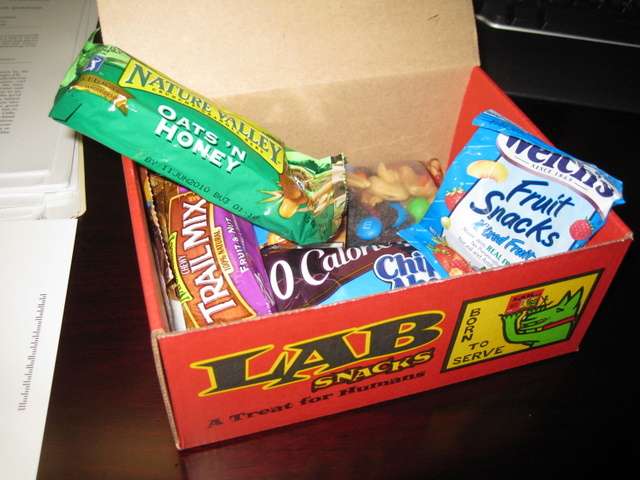
Has anyone ordered stuff from ThorLabs? I have, and quite a few times. I ordered mainly optics equipment from them, and they provide good stuff and good service. But one amusing and fun things they do is that, when they ship the stuff that I ordered, they included this "care package", or what they call "Lab Snacks". This can be a small package or even a small box containing either candy, nuts, or other snacks. This always brought a smile to my face whenever I open a shipment from them. I always forget they do that and it is always a present surprise to see this extra packet or box along with your optics equipment. As far as I know, they are the only company that does that, and I routinely order stuff from many different vendors.

In any case, here are a couple of pictures of the most recent Lab Snacks that I got from them.


Zz.

Tuesday, October 13, 2009

US Nobel Domination Points to Brain Drain

This is nothing new or surprising. The article points out the fact that many of the US Nobel winners from this year and the past were born and probably educated from elsewhere.

According to research from Britain's University of Warwick, published last January, scientific migration is common, and vastly beneficial to the United States.

"Nearly half of the world's most-cited physicists work outside their country of birth," the study said.

A survey of 158 of the most highly cited physicists showed systematic migration to nations with large research and development spending, most notably the United States.

"At birth, 29.7 percent of physicists are in the USA. This increases to 43.4 percent at first degree, to 55.1 percent at PhD, and to 67.1 percent presently," the report said.


However, the number of science Nobel winners does not reflect the downward turn in the US, since the prizes are usually awarded for work done many years ago. The 8 years of very tough science funding in the US will have an impact, especially when Europe and Asia have significantly increased their funding of the sciences.

Zz.

Monday, October 12, 2009

Follow-Up On "An Astronomer at the Vatican"

It seems that my set of questions that I would ask the Vatican astronomer Guy Consolmagno didn't go well with some people (surprise!). There seems to be a misunderstanding that I was confusing some of the "fringe" aspects of Christianity with Catholics, etc.

No, nowhere in my article was there any implication that this was directed at Catholicism only. Whether this is offensive or not I don't know, but I directed the questions to be the view of Christianity in general. After all, the Intelligent Design movement was based on the Christian faith, and so was the Young Earth movement. If these are close to be heresy, then as a Christian, isn't it his or her responsibility to rectify that? Shouldn't the Catholic church stand up at one of these school board meetings to teach creationism and tell those rabid Christians that they're really barking up the wrong tree?

It is because of such lack of internal "self-consistency" that people like Richard Dawkins are making wholesale attacks not only against Christianity in general, but also on all organized religion. When you don't stand up against someone who shares your beliefs, but makes completely different interpretation of it, then you should be ready to being lumped together with him/her. We have seen the same backlash against Islam and other religion, simply due to the stupidity of a few.

The questions I would ask were direct, without any pussyfooting around. Such clear answers articulated by someone of that stature, would be of considerable importance when I'm in a "discussion" with another person who is advocating ID, etc. based on the Christian beliefs. After all, when I'm discussing physics with another person who disagrees with me, that person often tries to make quotes from Einstein, Feynman, etc.. Unless the "denomination" matters THAT much that it can change the age of the universe, what the Vatican astronomer says should carry quite a bit of weight.

But even if you disagree, I would say that my questions would have been a lot more interesting than the ones that were asked. I mean, just look at the feedback that I'm getting now!

Zz.

Crisis of Thailand and Beyond from a Quantum Physics Perspective

I've often read things published in the mass media that simply made me scratched my head. This is one such example.

Apparently, a talk has been scheduled at the Thammasat University in Thailand on Oct. 18 that has the title: "Crisis of Thailand and Beyond from a Quantum Physics Perspective".

Here's an open invitation to a new talk show-turned-seminar series called "Head + Heart Walking Together!" The first event, on the topic of "Crisis of Thailand and Beyond from a Quantum Physics Perspective", will be held from 1 to 5.30pm, on Sunday, October 18 in the LT Room, Faculty of Law, Thammasat University, Tha Phra Chan campus. The speakers will be Sivinee Sawatdiaree, a physicist from the National Institute of Metrology; Attakrit Chatputi, founder of Vcharkarn.com and the Thai translator of Fabric Cosmos; and Pramual Pengchan, philosopher and writer of Walk to Freedom. Thammasat law academic Kittisak Prokati will deliver a closing speech under the theme of "Scientific Worldview in Social Science".


Now c'mon, any physicist worth his salt would be utterly curious on how one can make such a connection between "quantum physics" and "crisis in Thailand". Of course, my skeptical instinct would be to think that this is another example of the bastardization of quantum mechanics, something that we see very often and something that I've tackled many times on here. Still, I would love to be the fly on the wall when this forum actually takes place. Will there be anyone, on the remote chance, reading this blog that will actually make it to this event? I would love a report on what was presented. Maybe we all can use quantum physics to tackle the crisis in the Middle East next!

:)

Zz.

Sunday, October 11, 2009

An Astronomer At The Vatican

This is an interview with the Vatican astronomer Guy Consolmagno.

It sounds as if a high-school student interviewed him. I mean, is this the best that the reporter can actually ask him? The questions were amateurish and benign! I have tons of questions I would like to ask. For example:

1. How old do you estimate the universe to be based not only on your observation, but also the consensus among astronomers? Would this be contrary to the biblical interpretation on the age of the universe? What about the Young Earth's interpretation of the age of the universe?

2. What is your view of the treatment received by Galileo by the church? {Oh c'mon, you knew that one was coming, didn't you?}

3. If there are other life forms in the universe, do you think that they would have the same set of beliefs? I mean, if there is only one god, shouldn't they also had the same revelation? Does the bible predict their existence?

4. Does the Big Bang model of the origin of the universe contradict the biblical description? If it does, which one has the larger empirical observation in its corner?

5. etc etc...

Instead, all we get is this fluff of an interview.

Zz.

Saturday, October 10, 2009

Cloudy with Meatballs Shines Light on Women in Science

While "Cloudy, with a chance of meatballs" is certainly a movie that has something to say about gluttony and greed, it also has a social commentary about how we treat smart girls in schools.

Messages about the troubles smart women have in science or engineering careers—channeled through perky, TV “weather girl” intern Sam Sparks—are also part of the lesson. “Meatballs” grabbed the alpha spot 2 weekends in a row since opening in September and is still holding a strong second place. A lot of kids—many of them girls—are seeing that film.

Conflicted about her intelligence and beauty, Sam (voiced by Anna Faris) reins in her left-brain for eye-batting cuteness to gain acceptance—until she meets Flint Lockwood, a lovable but misunderstood brainiac inventor, as both contemplate their failures at the end of the local pier.


This, of course, leads to a problem of under-representation of women in the sciences, especially in physics and engineering.

According to government studies, interest in science between boys and girls is similar until about fourth grade. Soon after, though, many girls turn away from science, math and technology subjects like computing and engineering. High-school girls make up only 17 percent of students in AP computer science and 7 percent in AP physics.


It takes a lot for young girls to not only be fascinated by science, but also to withstand the tease and stereotype of being someone who wants to do science. It doesn't take a genius to realize that this is a major factor in discouraging anyone from pursuing anything, given that kind of a social obstacle.

Zz.

Friday, October 09, 2009

How To Do Bold, Audacious Science

Science Career section this week has an article on how an early-career scientist can pursue bold, risky, and audacious science research. In a nutshell, one should follow this:

Can a scientist just decide to do audacious science? It looks as though a person with a solid foundation and a good mind can, indeed, decide to become a bold scientist. Our conversations with, and the careers of, a few audacious scientists offer some rough guidelines. Scientific audacity starts with a passion for a topic. It requires the judicious selection of an institution and a mentor. And it necessitates searching for an important problem. Do these things and your chances of doing important science improve?


Note that that paragraph stated the necessity of finding an "important" problem, not just something "interesting". I've argued before that just because something is interesting does not make it important. I also think that this is why the old Bell Labs was such a fertile ground for any important discovery and innovations. It was precisely this ability to pursue such far-out problems that made it such a hotbed for creativity.

Zz.

Thursday, October 08, 2009

Physicist Wins 2009 Chemistry Nobel Prize

Physicist Venkatraman Ramakrishnan shares the 2009 Chemistry Nobel Prize for the study on the ribosome.

Brookhaven has released a video of a lecture given by him. It doesn't say where and when (edit: 2004) it was given, but he acknowledged Brookhaven as being instrumental in his research career.


In fact, both Ramakrishnan and another winner, Thomas A. Steitz of Yale, have Brookhaven connections. It also appears that all 3 of them have performed part of their work at Argonne as well! So it looks like EVERYONE is trying to prove their connection to the Nobel prize winners! :)

Zz.

Wednesday, October 07, 2009

Helen Quinn Takes a Deeper Look at Gravity and Science Education

Anyone who has read this blog for any considerable period of time would have recalled that I highly admire two of the essays written by Helen Quinn: Belief and Knowledge—A Plea About Language, and What Is Science? If you have a chance, you should read both essays if you haven't done so already.

Minnesota public radio airs an interview with Helen Quinn where she talks about gravity, and science education. It should be at the level that most people without much physics background can understand, although the topic being discussed was certainly not simple.

Zz.

Yoctosecond Photon Pulse?

We have had attosecond and zeptosecond time scale for photon pulses, but now comes yoctosecond! I'm not all that up on these various terminology, and I had to go look up what yoctosecond is. It is 10^-24 second. A new paper published in PRL this week talks about the possibility of producing photon pulses of that time scale from heavy-ion collisions such as from the one at RHIC[1].

What comes after yoctosecond?

Zz.

[1] A. Ipp et al., Phys. Rev. Lett. v.103, p.152301 (2009).

Edit : There's a coverage of this work in APS Physics. You might even get free access to the paper!

Tuesday, October 06, 2009

Tough Funding Environment in the UK

Physics funding in the UK is facing very challenging times ahead as the STFC evaluates its funding priorities. This Physics Today summary of the funding woes highlights all of the current and previous issues regarding the funding shortage.

It has been a number of years now it seems that physics funding in the UK has been in the dumps. I can't believe that this isn't doing considerable harm not only to ongoing projects, but also in attracting more people into the profession. The US physics funding is slowly recovering after the influx of funding this past year, but it will take a sustained effort to really get it going after such a long period of barely surviving. So the effect of reduced funding isn't that easy to recover from.

Zz.

Optical Communications Pioneers Win 2009 Nobel Prize

The 2009 Physics Nobel Prize has been awarded to 3 pioneers of optical communications.

Charles Kao, a Shanghai-born British-American, won half the prize for research that led to a breakthrough in fiber-optics, determining how to transmit light over long distances via optical glass fibers.

Willard Boyle, a Canadian-American, and George Smith of the United States shared the other half for inventing the first successful imaging technology using a digital sensor.


This is a terrific award, mainly because the one last year was more for "basic knowledge", i.e. the "LHC-type" physics. The award this year shows the "iPod" side of physics that is equally important. (For those of you who are not getting what I mean here, you probably didn't read an earlier blog entry).

More coverage and background at PhysicsWorld site.

Still, we continue to wait for a woman to win this prize again.

Zz.

Monday, October 05, 2009

Records of the Nobel Prizes

This is a bunch of fun Nobel Prizes trivia and records. Wonder if any of them will change or be broken after this week.... For example:

Since 1901 when the first Nobel prizes were awarded, a total of 35 women have been honoured and 754 men. Since its creation in 1968, no woman has won the economics prize. In the past 10 years, two women have won the literature prize, and two have won the peace prize. No woman has won the physics prize since 1963, or the chemistry prize since 1964.


Zz.

Saturday, October 03, 2009

Is Aurora Borealis Caused by Cherenkov Radiation?

First of all, this is not a blog entry that focuses on the answer to that question. Rather, it is more of a "puzzlement" on the PERSON who would ask such a question.

So if someone asks you that question online, or if you read a question like that online, what would be your first reaction? I'll be honest, my first reaction was : why is this person THAT lazy?

Let me explain why my reaction was like that. If this was asked, say, 15, 20 years ago or more, then I would not have that reaction. I would try to spend time and clearly explain why aurora borealis is NOT caused by Cherenkov radiation. Now, it is not obvious why, of course, to anyone who isn't familiar with physics. So that is a perfectly valid question to ask! Nothing wrong with that.

But when asked in this day and age, one wonders why the person never googled for the answer before asking. Now, I'm not talking about the question popping up over some casual cocktail party where someone just remembered the question and decided to ask it. After all, with all the conveniences and ability to look up practically everything imaginable, there is no longer any excuse for NOT having, at least, some answers in something. It would be a different matter if someone has read something that he/she didn't understand, and want a clarification. But asking questions like "What is the mass of a photon?" or "What is quantum mechanics?" etc.. etc. that are really either very general or extremely available online is rather puzzling.

Learning is a very PERSONAL journey. It is your own self-realization and understanding. So whenever one likes it or not, one has to do one's own homework. It can't be shoveled into you. My point here is that, at least from my perspective, if I don't know something, I look it up FIRST. Typically, if it is way outside of my area of expertise, I will always encounter something that I don't quite understand. Even then, I will try to look up other resources and see if I can find something that that would explain it better. Only when that fails, I will try to seek help. In other words, I don't go around posting online the very first question that goes through my head without first trying on my own to find the answer. With all the information available on the web, there's no reason for that.

Unfortunately, with such easy access to various information, are people simply getting too lazy? It is now no longer sufficient that most of what we want to find is only a few clicks away without having to leave our computer. Those of us old enough to remember going to libraries and hunting through card catalogs to find either a book or a journal certainly would not understand such laziness. I have seen way too many instances of people, especially kids in school, whose attitude borders on some notion of ENTITLEMENT to be given the answers to any question that they may have. "I have an question, so give me the answer!". That isn't learning.

So, is aurora borealis caused by cherenkov radiation? One can easily satisfies oneself that it can't be simply via logic. Our atmosphere is bombarded by a lot of high energy charged particles, all over the earth. Yet, aurora borealis occurs predominantly at the earth's poles. If this is nothing more than cherenkov radiation, it would be common all over the world. Yet, we don't see that.

BTW, we do detect cherenkov radiation from high energy cosmic rays. That's what many of the detectors such as the Auger Observatory are doing. Clearly, no aurora borealis accompanied such detection.

Zz.

Friday, October 02, 2009

What To Do When Your Spouse Wins The Nobel Prize

This is just plain hysterical.

Anita Laughlin, the wife of Nobel Laureate Robert Laughlin, has written a book titled "Reindeer with King Gustaf: What to Expect When Your Spouse Wins the Nobel Prize".

....a light-hearted, behind-the-scenes account of what this sort of thing can do to a family.

One occasionally sees a spouse's-point-of-view title on the bookshelf, but this is likely the first such endeavor regarding the Nobel Prize. Says Laughlin: "It demystifies, clarifies and humanizes the Nobel experience."


The report also pointed to Anita Laughlin's website that includes, among other things, a hilarious video where both husband and wife "re-enacts" receiving the phone 2:00 am phone call from Stockholm. Don't miss that one!

Zz.

Communicating Science to the Media

I had a good time reading this article. It is by Kathryn Grim from the Fermilab Office of Communications. It is meant as a guide to scientists, and physicists in particular, on how to deal with the media. She gives many very good advice here that all scientists should take heed, even if you don't think you'll ever talk to the media. You just never know when that might happen.

There is a little bit of an issue here though. Preparing for an interview with reporters from news media is clearly different than being interviewed by someone from the Daily Show. The latter is more of an entertainment/comedy show, rather than hard news. I'm not saying this because I'm an "expert" at being on the Daily Show just because I've appeared for 0.5 seconds on it! :) One can easily see the angle that they are going for in each of the segments of that show. It may be unfortunate that some of the laughs are directed at the science figure in that show, but that's certainly something that they would go for. So it is definitely a different beast here than your typical media outlet.

Zz.

Nobel Prize in Physics - It's Time For The Women!

Since people are making predictions left and right on who would win this year's Nobel Prize in Physics, I'm going to make my own plug. It's not a prediction, because I am making the choices based on preference, and not based on who I think has the highest probability of winning.

I have mentioned this before earlier, that I believe there are at least 2 women who should be candidates each year for the Nobel Prize. And considering that I don't remember a woman winning one in my lifetime, such a win would be a major news coverage. I truly believe both Deborah Jin of JILA and Lene Hau of Harvard are strong candidates and deserve to win. They have made more than just one important discovery for each of them.

Zz.

Thursday, October 01, 2009

"Mythbusters" Ready To Come Back For More Mythbusting

This article previews the upcoming season of Mythbusters.

While I do love the show whenever I catch it, I will admit that I'm not a regular viewer. A few of what they did have been highlighted on here, and I think they do a tremendous public service by examining many of these myths, some true but more often, not.

Still, what got me nodding my head in agreement is what was said at the very end of the article:

More to the point, he said, he and Savage attack their work with greater clarity now, and have a better sense of what the best process is for attacking a myth. Oddly, instead of doing better science, or making things stronger or taking more risks, it all begins with the very concepts for each myth.

"The most important thing to get straight is the question you're trying to ask in the first place," Hyneman said. "It seems like a simple thing, but it's hard to get to that point and, a lot of times now, we're spending much more time defining that question before we do anything else."


I think for many people, especially the general public and many students just about to learn science, and physics in particular, this is something that they don't realize. Many times, I get asked what appears to be a very simple question, but it is laced with many ambiguities and even misuse of physics. The one that stuck to my head right now because I was asked this recently is: "Is the electron real?"

Now, most people think that we can answer this with a simple "Yes" or "No", but really, if you think about it, it isn't that easy. You need to ask the question to the other person on what he/she means by "real"? Is your mother real? How do you know she's real, i.e. what criteria do you use to qualify that she's real? Now, use the same criteria on the electron, etc. The fact that you can't 'see' an electron with your eyes isn't sufficient to say that it isn't real, because the eye is a poor detector. Besides, we define everything based on a set of characteristics and properties (you define your mother based on what she looks like, how she behaves, what she smells like, etc.. ).

In other words, just trying to clarify the question and what is being asked can be an issue all to itself. So I definitely concur with that last part of the article. I certainly find that in many instances, trying to figure out what is being asked is half of the problem.

Zz.

Nobel Prize Needs to be Overhaul?

There are news reports everywhere about an open letter to the Nobel board of directors to make changes to the Nobel Prize selection and categories.

The Nobel Prizes need an overhaul, according to a panel of scientists assembled by New Scientist magazine. In an open letter to the Nobel Foundation published today, the scientists say that the prizes, scheduled to be awarded next week, don’t sufficiently reflect today’s science. Too many important areas of research are left out of the categories that Alfred Nobel specified in his 1896 will, they say. They ask the foundation to establish two new prizes, one for the Global Environment and one for Public Health advances, and for both they suggest allowing organizations to be eligible, as they are for the Peace prize.


The first obvious restriction on what the Nobel Prize administrators can do is dictated by Alfred Nobel's will that endows such prizes. While they certainly have tinkered with it before (adding the Economic prize, which in my opinion, is a rather dubious move), they certainly can't do whatever they please. One also runs the risk of diluting the prestige of such prize (re: Economics) and what Nobel originally intended it to be.

For me, I'd rather see them expand the maximum number of winners in each category. There have been way too many deserving people left out when a particular area is being cited and only 3 people at most can be awarded the prize.

Zz.