Monday, September 24, 2007

Hidden Galaxies Detected

I'm so glad they are not calling these "Dark Galaxies", because that would bring out a whole slew of problem.

It seems that astronomers are now able to detect dim galaxies (as in not very visible, not as in "stupid") that are in front of very bright quasars.

To locate the so-called "invisible" galaxies, Bouche and his team looked through huge catalogues of quasar data and picked out those with "dips" in their light signatures. Then, using the European Southern Observatory's (ESO) Very Large Telescope (VLT), located in the mountains of northern Chile, the team searched for galaxies close to the pulse of quasar light.

The astronomers capitalized on the VLT's special infrared spectrometer, called SINFONI, to pick apart 20 patches of sky around the quasars to search for galaxies from the time when the universe was about 6 billion years old, almost half its current age. Seventy percent of the time, they found a galaxy hiding in the "headlights" of a quasar.


Very neat!

Zz.

A Brief History of the Hawkings

Humm... we seem to have a lot of stories lately (well, a couple in a row so far) about off-springs or descendants of famous physicists. I wrote about the marriage of the grandson of John Bardeen earlier. Now comes an interview with Lucy Hawking, the daughter of Stephen Hawking.

Zz.

Sunday, September 23, 2007

Wedding Announcement

No, not mine! :)

I've never done any wedding announcements on here. But this is a bit different. I've always been curious to see how off-springs of famous physicists turn out. Many of course follow in their parent's footsteps and become physicists themselves.

If you've read my essay here on the late John Bardeen, you'd know that I consider him as the most influential physicist that has ever lived. So I was trolling the news and read something related to the wedding of one of his grandsons.

The bridegroom, 33, is the director of corporate development for The New York Times Company; he helps manage mergers and acquisitions and other corporate strategies. He graduated magna cum laude from Harvard and has an M.B.A. from Columbia.

He is a son of Nancy Thomas Bardeen and James M. Bardeen of Seattle. The bridegroom’s mother is a tutor at the Loft Writing Center of North Seattle Community College. His father is an emeritus professor of physics at the University of Washington in Seattle.

The bridegroom’s paternal grandfather, the late John Bardeen, was a recipient of the Nobel Prize in physics in 1956, for helping to develop the first semiconductor transistor, and in 1972, for a theory of superconductivity.


Obviously, being smart and well-educated runs very much in that family. Congratulations to the bride and groom!

Zz.

Saturday, September 22, 2007

NuSTAR Given NuLife!

OK, so that wasn't as funny of a title as I would like. Still, it's one piece of great news coming out of NASA these days, and an exception to the recent trends of either cancellation, or having to choose to fund one over the other. The Nuclear Spectroscopic Telescope Array (NuSTAR) mission that was canceled last year has been given the funding to go ahead with its project.

"We are very excited to be able to restart the NuSTAR mission," said Alan Stern, associate administrator for the Science Mission Directorate at NASA headquarters in Washington, D.C. "NuSTAR has more than 500 times the sensitivity of previous instruments that detect black holes. It's a great opportunity for us to explore an important astronomical frontier. We are getting more and more from the science budget we have, and the restart of the highly valued NuSTAR mission is an example of that."


Could the arrival of Stern at NASA be something to rejoice in terms of funding for these small mission?

With the arrival of Stern this spring, small explorer missions, called SMEX, were back on the table. NASA will invite proposals by January for three new SMEX missions. NuSTAR's resurrection is a bonus, Boggs said.

"This is a very good sign that NASA and Alan Stern are committed to continuing NASA's tradition of performing cutting edge science," he said.


"he" as in Steven E. Boggs, a collaborator for the mission and an associate professor of physics at UC Berkeley.

Let's hope more saner heads will prevail at NASA.

Zz.

Friday, September 21, 2007

Terminal Velocity

I wrote a while ago about the paper on how physics is handled in Hollywood blockbusters and the limited lessons that they can give. Strangely enough, in the current online issue of The Answer Man (September 20, 2007) at the famous film critic Roger Ebert's website, there was a rather interesting lesson on terminal velocity between a person and a bullet after both have left an airplane.

Q. It is foolish of me to wonder about the physics of a movie that contains skull-piercing carrots and bullet-propelled merry-go-rounds, but in "Shoot 'em Up" would there be any point to shooting down at Mr. Smith when he is falling from the plane? He should be traveling at terminal velocity and wouldn't the bullets also be going that fast, too? Hence, they couldn't catch him?
Alex Kincade, St. Joseph, Mich.

A. According to Hypertextbook.com, "If an object falls with a larger surface area perpendicular to the direction of motion, it will experience a greater force and a smaller terminal velocity. On the other hand, if the object fell with a smaller surface area perpendicular to the direction of motion, it will experience a smaller force and a greater terminal velocity." A skydiver has a larger surface area than a bullet; also, the skydiver is falling, but the bullet is propelled by an explosive charge.


While certainly the cross-sectional geometry would dictate a amount of drag force exerted on the object, one also cannot ignore the mass of the object here, no? For example, take 2 object of the same shape by different mass. While they would fall at the same rate in vacuum, the one with the large mass has a larger gravitational force, and requires a larger drag force (i.e. at a higher velocity) to cause it to reach a terminal velocity.

But the other aspect of it is also interesting. While it is true that the bullet was propelled out of the gun (i.e. initial velocity is some value) while the person fell out of the plane (initial velocity is approximately zero), would the bullet still reaches the same terminal velocity? I say it would, because if it is moving faster than the terminal velocity, the drag force is larger than the gravitational force on it, and will slow it down until they both are equal. So whether the bullet will catch up to the person or not depends how far that person has started his fall.

In other words, what happened as described in the movie isn't impossible physically. But it isn't necessarily what can happen all the time since a few other facts are involved.

So what do you think? Did I analyze this correctly myself?

Zz.

Existence of Fractional States Even in 3D?

It is always fun when you read about new and unexpected observations, even if it is just an initial observation that requires much more studies.

We all know about fractional quantum hall/fractional charge phenomenon observed and verified many years ago. These were seen on 2D material where the behavior observed appears to indicate that the charge carriers have fractional charges (e/3 at that time). The understanding that we have today is that the dimensionality (i.e. 2D) is the requirement for such an effect to take place.

Now we have preliminary indication that this may not be the case. A report in this week's Science on Bismuth indicates hints that such fractional effects can also be seen in 3D material (K. Behnia et al., Science v.317, p.1729 (2007)). While the signal may not be as clean as the 2D case, there are distinct indications that some form of fractionalization (they have assigned a filling level as 1/2) is taking place.

So now, if this is true, we will have to go back and revise our understanding of the behavior of strongly-correlated electrons and the role of dimensionality in such a system.

Zz.

Thursday, September 20, 2007

Batters May Achieve Dramatic Increases In Home Runs Through Steroids

This should add to the controversy.

Tufts University physicist Roger Tobin is about to publish a paper in the journal American Journal of Physics titled "On the potential of a chemical Bonds: Possible effects of steroids on home run production in baseball" (I wonder if that "chemical Bonds" was a pun?)

A change of only a few percent in the average speed of the batted ball, which can reasonably be expected from steroid use, is enough to increase home run production by at least 50 percent," he says. This disproportionate effect arises because home runs are relatively rare events that occur on the "tail of the range distribution" of batted balls.


I wonder if this should be added to our collective knowledge on the Physics of Baseball? :)

Zz.

Einstein Failed Mathematics?

For some odd reason, this myth seems to perpetuate no matter how many times it gets debunked (very much like the claim that evolution violates the 2nd law of thermodynamics).

This myth is now a new entry in a collection of physics myths. Hopefully, there's enough people who know about this to help destroy it.

Zz.

Wednesday, September 19, 2007

Nobel Laureate Disses NASA's Manned Spaceflight

The International Space Station is an orbital turkey.....


That's what Nobel Laureate Steven Weinberg said.

You go, Steven!

As many physicists/scientists have mentioned many times (including Bob Park in his weekly column What's New), manned space flight program has not produced much science, and certainly not commensurate with the cost.

"No important science has come out of it. I could almost say no science has come out of it. And I would go beyond that and say that the whole manned spaceflight program, which is so enormously expensive, has produced nothing of scientific value."


What is even sadder is that these types of projects that have no scientific merit are getting the green light, whereas really strong science projects like the Beyond Einstein missions are having to fight among themselves to be the one to take off. NASA has been forced to be more of a "cheerleader" rather than a scientific organization, where what gets funded has more to do with political whims rather than solid science. Now this is fine if this is what is being sold to the public. If the public is silly enough to prefer to pay for such a thing, then the public deserve what they get, which are more orbiting turkeys. But if this is sold as great scientific endeavor, then it is a lie, especially when most scientists, and certainly the prominent ones, are not support it.

Zz.

Tuesday, September 18, 2007

Kung Fu Science

I found this website back in 2005. It is called Kung Fu Science. It is fun enough and silly enough to warrant a small advertisement in here.

"For a lighthearted exploration of the connection between physics and martial arts, punch up the new exhibit Kung Fu Science from the Institute of Physics in London." - Science NetWatch.

You get to follow the progress of a student trying to find the ability to chop a board in half with her hand using nothing but physics knowledge. What could be more fun than that? :)

Enjoy!

Zz.

Monday, September 17, 2007

Undergraduates Ask: Should I Do a Ph.D.?

This is a very useful article from the current issue of Science. It explores the question on whether a student should pursue a Ph.D after completing his/her undergraduate program. This is a question that get asked often in various forums on the internet.

I believe this article is accessible to everyone. Still, if the link is restricted, please let me know.

Zz.

Sunday, September 16, 2007

The Plasma Revolution

The title is a bit misleading. This article in this week's Nature (v.449, p.133 2007) is on the use of plasma for particle acceleration. I have written about the advancement in this field a few times already (read here, here, and here).

It's a good review article on the use of plasma as a medium for the wakefield generated either using charge particles or laser. However, it has some misleading and incomplete parts to it. For example:


A handful of groups are working on a new way to accelerate particles - known as wakefield acceleration - that should not only help push physicists towards the next energy frontier, but also provide affordable, table-top accelerators that could revolutionize cancer treatment.

The technique involves passing either a laser beam or a beam of particles through a plasma....


Nothing wrong with this, but the author made it sounds as if the ONLY technique for wakefield acceleration is using plasma as a medium. He is ignoring another technique that is also making quite a good progress here, the use of dielectric medium instead of a plasma. The dielectric-loaded accelerating structure, such as those done at Argonne's Wakefield Accelerator group, has recently shown the ability to generate and withstand an accelerating gradient of 100 MV/m. Now it may not be of the same gradient as those achieved using the plasma technique. However, this technique has several advantages, such as the obvious ability to be staged.

The wakefield technique, both using plasma and dielectric media, has shown promising advancement for a new acceleration technology that might allow for the next generation of particle accelerators. The next few years should be very exciting.

Edit: A new press report on the AWA dielectric-loaded gradient can be found here.

Zz.

Friday, September 14, 2007

'Beyond Einstein' Research Should Begin With Mission to Study Dark Energy

The National Academy of Science's National Research Council panel has issued its report and recommendation on the next set of moderate but ambitious task to tackle cosmological issues. Due to NASA's budget constraints, the panel recommended only one project, the $1-billion-plus Joint Dark Energy Mission (JDEM), while putting the other projects on the back burner for now.

Prompted by Congress and the Office of Science and Technology Policy, NASA and DOE asked the committee to assess the five proposed mission areas and recommend one for first development and launch. NASA’s Beyond Einstein program, set to begin in 2009, is comprised of two astronomical observatories, Constellation-X and LISA, as well as a series of probes: the Inflation Probe (IP), the Black Hole Finder Probe (BHFP), and JDEM.

"All of the mission areas in the Beyond Einstein program have the potential to fundamentally alter our understanding of the universe," said committee co-chair Charles F. Kennel, distinguished professor and director of the Environment and Sustainability Initiative at the University of California, San Diego. "But JDEM will provide direct insight into a key Beyond Einstein science question, and is the most technically feasible option for immediate development."


It's too bad that sacrifices like this has to be made, while the scientifically meaningless ambition to send manned mission to the Moon and Mars are getting funding.

Zz.

Thursday, September 13, 2007

Physics, The Backbone Of The Scottish Economy

Well, maybe they're exaggerating a little bit. Still, it is undeniable that physics does play a prominent role in a large part of the Scottish economy from this report.

The research, which quantifies the scope of physics as well as its practical, economic worth, claims that while only four per cent of Scottish workers are employed in industries that are physics-based, the sector actually contributes ten per cent of its entire economic output.


Zz.

US/LHC

The US Dept. of Energy has produced a website that highlights the contribution from the US in the building of the LHC. While the mission is rather narrow, the website actually has quite a lot of information on the LHC itself, including various blogs of people directly involved in it. Besides, there's plenty of neat pictures there that give you a sense of scale on the size of these detectors, especially ATLAS.

Zz.

Wednesday, September 12, 2007

Kilo Prototype Mysteriously Loses Weight

This is rather disconcerting.

The standard kilogram kept in Paris is mysteriously losing its mass, but about 50 micrograms!

"The mystery is that they were all made of the same material, and many were made at the same time and kept under the same conditions, and yet the masses among them are slowly drifting apart," he said. "We don't really have a good hypothesis for it."


Now, 50 micrograms is actually quite big, considering that we can detect changes to a mass by single molecules. I think this strengthen the calls for a better (atomic) standard of the kilogram, much like the standard for 1 m and 1 second have been migrated to more well-defined quantities.

Zz.

Firm Evidence for Existence of Positronium

The same group that had the initial evidence for the formation of positronium (a "molecule" of 2 electrons and 2 positrons) has now presented more convincing evidence (link may only be open to non-subscribers for a limited time).

The clinching data come from looking at how the intensity of the gamma-rays changes as the temperature is altered. Electron-positron annihilation should be more rapid in Ps2 than in lone positronium atoms, because the binding increases the chance of collision. And the positronium mix should have a greater proportion of molecules at lower temperatures, since the cold makes molecules more stable. So the gamma-rays should become more intense when the mixture is cooled. That's exactly what the researchers saw, they report in Nature.


The exact citation for this paper is:

D. B. Cassidy and A. P. Mills, Jr., Nature v.449, p.195 (2007).

Nice going!

Zz.

Purdue's Bubble Fusion Panel Submits Report

This embarrassing and continuing saga of the bubble fusion fiasco has taken another step. The panel set up by Purdue University at the urging of the Office of Naval Research has issued a finding.

A Purdue University panel that reviewed misconduct allegations against a scientist who claims he produced "tabletop fusion" has concluded that "several matters merit further investigation."

The finding was announced without elaboration in the case of Purdue nuclear engineering professor Rusi Taleyarkhan.


Which means that this will go on and on and on and on....

Nature's news report can be found here (link may be available for free only for a limited time).

This is the third inquiry run by Purdue, which was criticized earlier this year by both scientists and lawmakers for its handling of concerns raised by scientists about bubble-fusion claims at the university. Purdue has not said publicly what exactly in Taleyarkhan's work it might investigate further.


Zz.

Tuesday, September 11, 2007

Thundercloud Accelerator?

This is certainly fascinating. Physicists in Japan has compelling evidence that potential gradient in thunderclouds can in fact accelerate electrons up to 35 MeV, or maybe even higher.

Still, I don't think we can use it in a controllable manner. :)

Zz.

Forum on Education Newsletter Fall06/Spring07

The Forum on Physics Education newsletter for Fall06/Spring07 is now available online. It is full of information on a number of issues on physics education.

Zz.

Is This The Clearest Picture Of Space Ever Taken?

Of all the things they have to argue about, I would think this would be the last of it.

Nature has a rather amusing (at least, it is for me, but probably not for the participants) of the minor controversy surrounding what has been claimed to be the clearest pictures taken of objects in space (link may be open for free only for a limited time). A group at CalTech and Cambridge claims to have taken the clearest picture ever using a ground-based observation and 50,000 cheaper than the Hubble telescope. Of course, the Hubble people aren't taking this lying down and have fired back!

I think that whenever something like this occurs, people tend to forget the REASON for doing these things. Rather, they are arguing the means, rather than figuring out how the get to the ends. Can any of these pictures actually give us the information we need? Getting a good resolution and better pictures are only the means to being able to give us information to better our understanding. Can any of these pictures do that, and do that better than the other? That is what should have been pointed out and discussed, not who has the "clearest" picture.

Zz.

Monday, September 10, 2007

Thomson Scientific Predicts Nobel Laureates

OK, the season for the Nobel Prizes is coming up. Everyone seems to have their own ideas. However, Thomson Scientific has a more "statistical-based" prediction using the citation index. This is what they came up with for Physics:

Sumio Iijima - Meijo University (Japan);
Martin J. Rees - University of Cambridge;
Arthur B. McDonald - Queen's University (Canada);
Yoji Totsuka - University of Tokyo (Japan).

Still, their batting average isn't that good.

Of the 54 Thomson Scientific Laureates named since 2002, four have gone on to win Nobel honors.


4 out of 54 is not a good percentage, so I'm not sure what they're croaking about. In many instances, even a moron can predict who will win (the Bednorz and Muller award was a no-brainer). And I had predicted Leggett and Abrikosov back in the mid 90's already.

We will see how accurate they are this year. So what is YOUR prediction for this year?

Zz.

Friday, September 07, 2007

Of Physics and Finance

Is this more bastardization of Quantum Mechanics? Well, not quite, but it is still perpetuating the common misconception about QM, especially on the wave-particle duality. This article tries to point out similarities, analogies, and parallel actions between QM and the world of finance.

It really is difficult for me to accept one of these things, because using the argument that they appear to share SOME characteristics doesn't mean that they formalism for both should be identical. QM is MORE than just "wave-particle duality". In fact, if you have read my earlier entry on this, there is NO DUALITY in the formalism of QM! So using such phenomenon to make similarities between these two fields is highly dubious.

Still, at the very least, the article isn't pushing for the USE of QM's principle in finances, because that would be outright crackpottery, unlike some of the recent bastardization of QM that we have seen. And there is a legitimate merging of physics and economics that is now popularly called "econophysics". I just wish that people don't try to extend a superficial understanding of physics, especially quantum mechanics, into something it isn't supposed to be used.

Zz.

Wednesday, September 05, 2007

Fermilab Employees Think Green

Good for them! Even when they funding agency that owns Fermilab is unable to provide any kind of financial support, several Fermilab employees, under their own initiatives, started their own not-for-profit organization to restore the open prairie area on Fermilab grounds.

For its first endeavor, FNA hopes to secure a $25,000 matching grant to improve a 35-acre savannah inside the lab's Tevatron ring. Savannahs are ordinarily open, forested areas, but this one is being choked by raspberry patches and dogwood trees and needs to be completely reworked.

"We would get all of that brush and stuff out of there, whether by cutting, or herbicide, or burning," he said, "and then we would extensively reseed it with plants, grass and trees."


Check at the end of the article on how you can make monetary contribution.

Zz.

ILL Celebrates 40 Years of Service

Institut Laue-Langevin in Grenoble, France, celebrates its 40th Anniversary. This is an outstanding neutron source facility that has users in many areas of physics ranging from condensed matter to elementary particle physics.

This is a good overview of the facility and its scientific activities.

Zz.

You Can’t Get Physical Without Physics

Physics is all around us, and we live and depend on it. Take it from someone who didn't study it that much and now get to realize that we are living and surrounded by it.

Yet, physics is all around us, involved in virtually everything that moves. It didn’t occur to me that I would one day need to become one with the beast.

.
.
.
.

Physics is involved in everything from walking to gymnastics to hockey, from shooting a game of pool to watching a balloon float off into the sky.


Now, if only more people realize that.

Zz.

Don't Try This at Home!: The Physics of Hollywood Movies

Hollywood movies seems to be getting quite a bashing lately with their bad physics. First was the article that recently got quite a bit of publicity describing their unlimited fun, but limited science literacy. Now comes a book, written by California high school physics teacher Adam Weiner, describing more of the unrealistic situations in major movies.

A sample: If, in the original Willie Wonka and the Chocolate Factory, poor old granddad really did float to the ceiling after drinking an extra-carbonated beverage, the bubbles should technically have swollen him to a sphere about 15 feet wide.


Zz.

Tuesday, September 04, 2007

Multiple Problems Push LHC Start to Next Spring

So one can't just blame it on the failure of the superconducting magnet made by Fermilab! :)

This is a rather good summary of the reasons for the delay in the start up of the Large Hadron Collider at CERN. Still, for something this huge, the delay is not unexpected, but it will be costly.

Zz.

What is Conceptual Understanding?

This article deals with the issue of conceptual understanding in mathematics education. Still, it is a fascinating article that may even apply to how we understand things in physics.

One interesting aspect to this essay that deals with physics and engineering is this:

One of the principal reason why mathematics majors students progress far, far more slowly in learning new mathematical techniques at university than do their colleagues in physics and engineering, is that the mathematics faculty seek to achieve full conceptual understanding in mathematics majors, whereas what future physicists and engineers need is (at most) functional understanding. (Arguably most of them don't really need that either; rather what they require is another of the five strands of mathematical proficiency, procedural fluency.) I have taught at universities where the engineering faculty insisted on teaching their own mathematics, precisely because they wanted their students to progress much faster (and more superficially) through the material than the mathematicians were prepared to do.


I actually rather agree with that. In my "So You Want To Be A Physicist" essay, I've stated that some time, physics majors need more mathematics than mathematics major. However, they don't need to know it that deeply. They only need to know how to use it correctly. That is why many physics departments teach their students their own brand of "mathematical physics", mainly to arm their students with the necessary "tools" that they would need to tackle advanced physics courses without having to take all the equivalent mathematics classes that deal with these topics with rigor.

So yes, I'd say "procedural fluency" would be an apt description of what most physics majors need as far as mathematics is concerned.

Zz.

Hawking Wants Science To Be As Exciting As Science Fiction

Remember a while back I reported that Hawking was planning on writing children's books on science? It has now been released. This is a recent interview of him on his reasons for writing such books.

"Our aim is to make real science as exciting as science fiction," Hawking said.

Lucy Hawking, a journalist and writer, told the press conference that one of her father's common refrains was, "That's too much science fiction, we do science fact."

The trio wanted to "provide a modern vision of cosmology from the Big Bang to the present day," without presenting it as magic, Galfard said.


Certainly an admirable intention. But I wonder which parents would be the ones buying these books for their kids? Would parents who do not believe in evolution and the cosmological age of the universe buy these for their kids?

Zz.

ITER Takes Step Forward Towards Fusion Energy Future

An ion source developed at the Max Planck Institute has been chosen to heat up the plasma for ITER. Looks like they are making progress in building this thing.

Zz.

Monday, September 03, 2007

Examples of the Zeroth Theorem of the History of Physics

This is just a fun paper to read, even if it is only for historical context. J.D. Jackson (he of the dreaded "Classical Electrodynamics" graduate level text author) has written a rather engaging essay on the assignment of "names" to various discovery/invention in physics. He calls it the Zeroth Theorem of the History of Physics. And I think there's often quite a bit of truth in it based on my own observation.

The zeroth theorem has some similarities to the "Matthew effect" The Matthew effect describes how a more prominent researcher will reap all the credit even if a lesser known person has done essentially the same work contemporaneously, or how the most senior researcher in a group effort will get all the recognition, even though all the real work was done by graduate students or postdocs. The zeroth theorem might be considered as the first kind of Matthew effect , but with some time delay, although some examples do not fit the prominent/lesser constrain. Neither do my examples reflect, as far as I know, the possible influence by the senior researcher or friends to discount or ignore the contributions of others. The zeroth theorem stands on its own, examples often arising because the first enunciator was before his/her time or because the community was not diligent in searching the prior literature before attaching a name to the discovery or relation or effect.


You'll get to know all the participants that may not get the recognition that they deserve in some of the well-known formulations that we currently use.

Zz.

Saturday, September 01, 2007

Argonne's Green Transportation Event

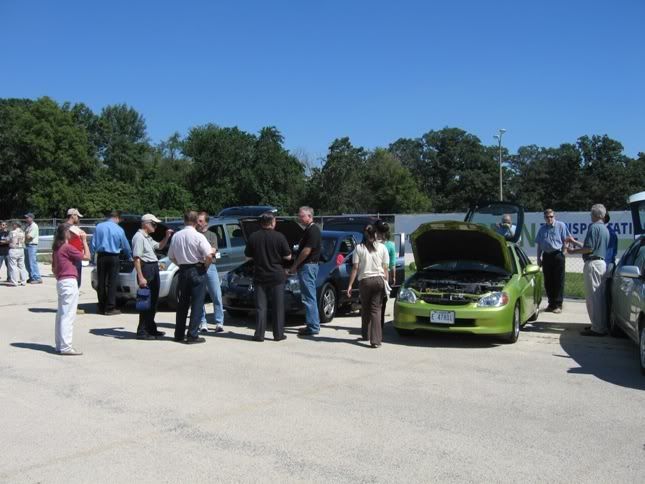
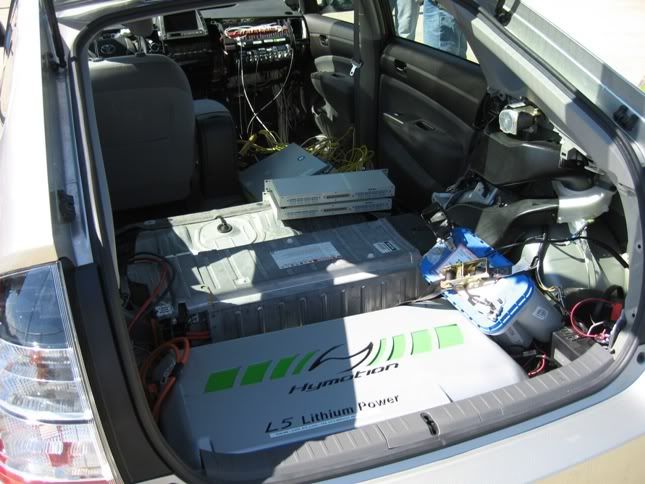
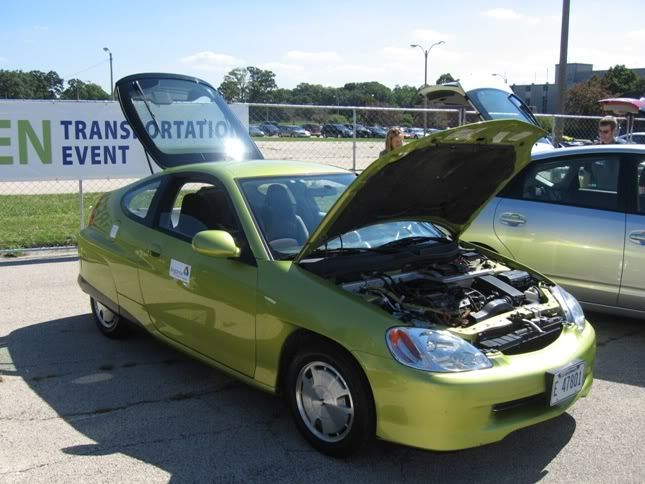
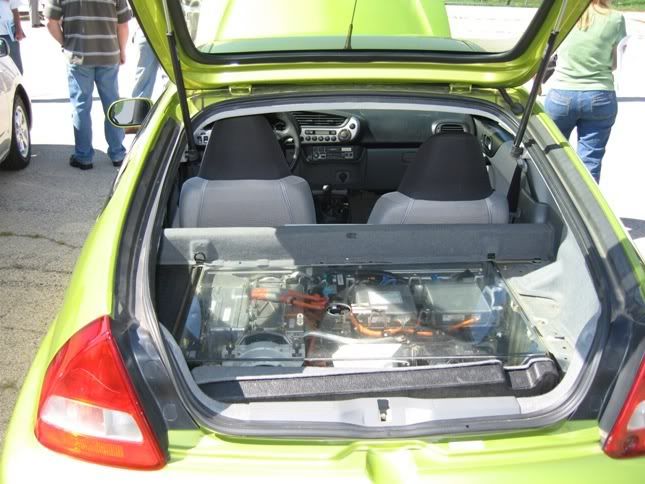
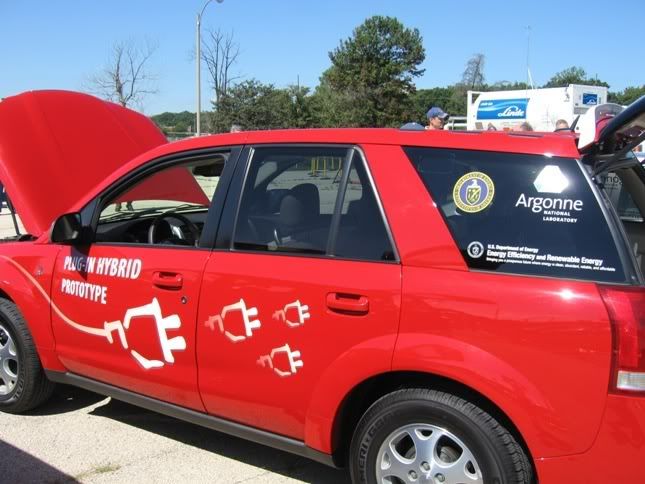
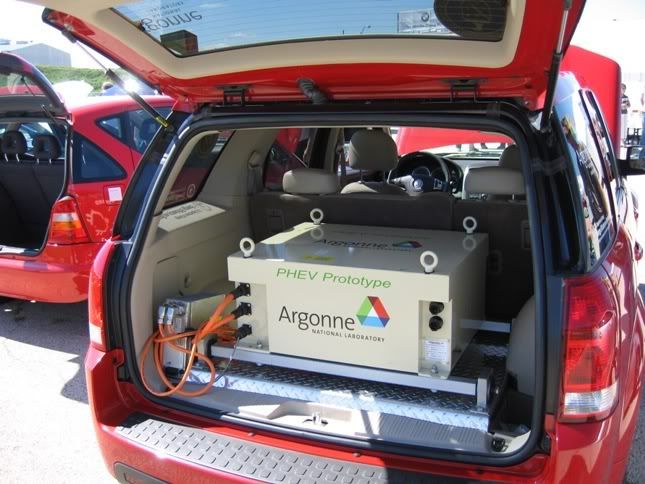
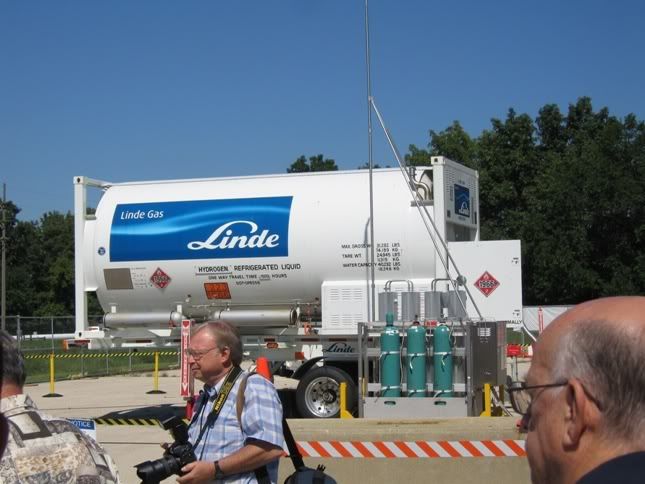
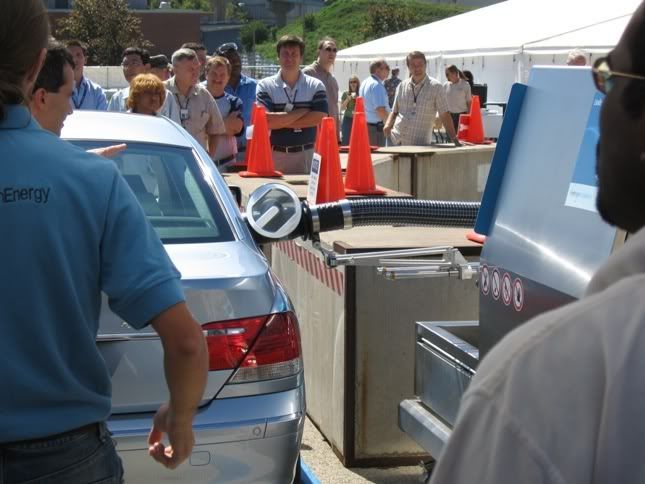
This past Friday, Aug. 31, 2007, the group involved with transportation research here at Argonne held an open day for Argonne and U. of Chicago's employees to visit their temporary display area. On exhibition are all the latest technology in fuel-efficient vehicles and alternative fuel sources for road vehicles. This includes the latest technology in hybrids, plug-in hybrids, and even hydrogen-powered vehicles.

While some of these new technology have a lot of obstacles left to over come to make them a viable alternative to current fuel sources, it was still nice to get a closer look at them, and get to talk and ask questions to the experts doing research work with these vehicles. The hydrogen source, for example, still has plenty of issues to deal with, including how to produce hydrogen without consuming even more power than it can produce, and how to transport it over long distances.

Here are a few pictures taken during this event.


There was a nice crowd at the first session in the morning.


There were several different types of hybrid and fuel-efficient vehicles on display. Many of them were loaded both on the front and on the back of the vehicles. Here are three of them.


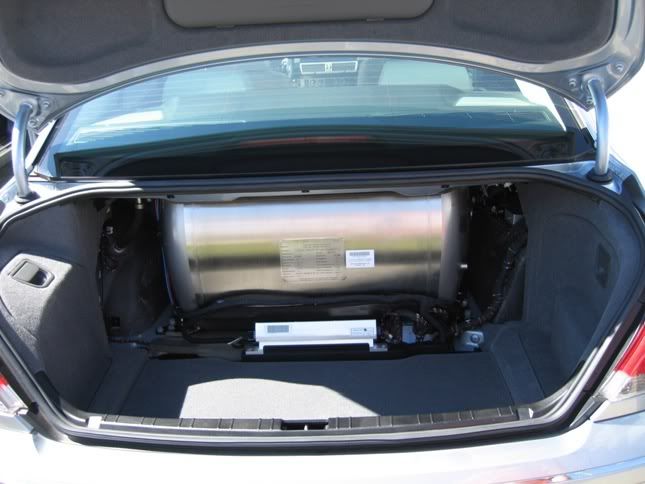
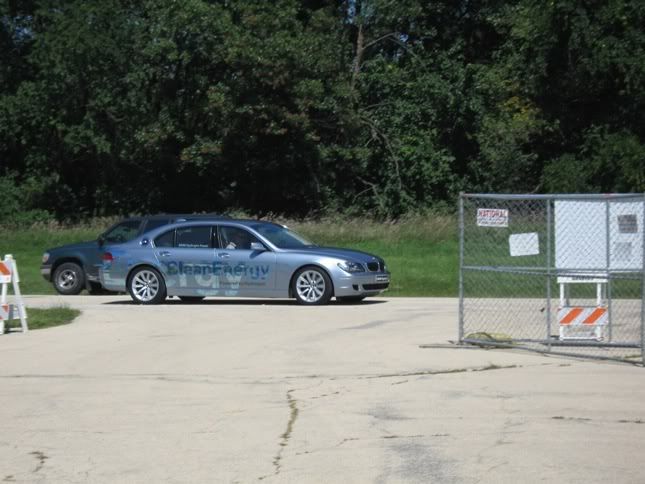
The "star" of the event was the five BMW vehicles that were hydrogen-powered. The event highlighted the research work done by BMW and other automobile companies in this area.


This is the hydrogen fueling tank that was used to refuel one of the vehicles as part of the demonstration.


We were shown how one of these vehicles is refueled. Just look at the size of that insulated transfer line and what actually coupled to the car!


The hydrogen fuel tank is in the trunk of the vehicle, right behind the rear passenger seat.


A few lucky attendees got to do a test drive around the Argonne campus in these BMW vehicles. I wasn't one of the luck ones. :(


It was a fun event. Again, it is always nice to see the actual vehicles and get to talk to the experts. That was the best part of the whole event for many of us, especially those car fanatics. :)

Zz.

Friday, August 31, 2007

Interface Between 2 Insulators Becomes Superconducting

As Alice in Wonderland says "things are becoming curioser and curioser".

First there was a report that the 2D interface between 2 insulators can become metallic[1]. Now a new report in Nature has indicated that such interface can in fact become superconducting, albeit at 200 mK[2]. Fantastic!

This interface is a 2D thin region (~10 nm) and evokes exotic transport mechanism, I would assume. There's still considerable work in coming up the theoretical explanation for this phenomenon. So there's plenty of work left to be done.

Zz.

[1] A Ohtomo, H.Y. Hwaing, Nature v.427, p.423 (2004).
[2] N. Reyren et al., Science v.317, p.1196 (2007).

SNS: America Regains Leadership with World Record

This appears to be a breaking news from Oak Ridge National Lab regarding the Spallation Neutron Source.

Lab officials have announced that the Spallation Neutron Source, the Department of Energy’s $1.4 billion research facility at the Oak Ridge National Laboratory, has established a new record as the world’s most powerful accelerator based source of neutrons for scientific research.

The SNS surpassed the previous record for beam power 160 kilowatts, held by the United Kingdom’s ISIS facility, while operating at 183 kilowatts.


I wouldn't stamp it with the "leadership" medal yet, because the usefulness of such source depends more than just this parameter. Still, it is a good start at justifying all that money spent on building it.

Zz.

Thursday, August 30, 2007

String Theory Might Provide Insight Into High-Tc Superconductors and Quark-Gluon Plasma?

Say it isn't so!!

:)

Jan Zaanen's article in this week's Nature (Nature v.448, p.1000; 30 August 2007) highlights an ArXiv preprint by Hartnoll et al. that seems to have made a connection between one aspect of String Theory called the anti-de-Sitter/conformal field theory correspondence(AdS/CFT), and the heat and charge transport in high-Tc superconductor called the Nernst effect.

Hartnoll et al. push what one might term the 'AdS-to-high-Tc correspondence' to its logical conclusion. They study its application to a particular, rather recondite transport phenomenon known as the Nernst effect — the crosswise flow of heat and charge currents in the presence of a magnetic field7 — in the nearly quantum-critical matter of a two-dimensional cuprate system. In a theoretical tour de force, they use the physics of a black hole in a three-dimensional anti-de-Sitter space that carries both electrical and magnetic charge to guide them in the very complex derivation of the relevant transport equations directly from quantum field theory. They show that these theoretical results are seemingly consistent with a number of hitherto unexplained features of the Nernst effect in a high-temperature superconductor7.


Man, that takes a lot of balls to do that! :) And what about the quark-gluon plasma that has been studied at RHIC?

Here, the AdS/CFT correspondence comes to the aid of the experimentalists in a similar way. The background is the observation that quark–gluon fireballs, as have been created in the Relativistic Heavy-Ion Collider at Brookhaven National Laboratory on Long Island, behave in a remarkably simple way, but one that current theories find difficult to explain — they are governed by normal hydrodynamics, but have extremely low viscosity. Quite simply, the AdS/CFT correspondence tells us that when the quantum physics is scale invariant, the viscosity of such a system can be as small as it is. This result is far from obvious given our current understanding of quantum chromodynamics, the standard-model quantum-field theory of the strong nuclear force that governs interactions in the quark–gluon plasma.


I'm not going to jump onto the String Theory bandwagon and proclaiming it as the next best thing since sliced bread, but this is getting to be rather interesting.

Zz.

Wednesday, August 29, 2007

Yukawa's Gold Mine

This is an excellent article on the historical significance of Yukawa's hypothesis of the pion. It is simply amazing how this theory has legs, even till today.

Zz.

Tuesday, August 28, 2007

Illusion Mimics Out-of-Body Experiences

So now we can manipulate the brain enough that we can even mimic the so-called "out of body" experience (link open for free for a limited time only).

The effect was created in two separate experiments described in Science1,2 this week, both of which used a simple method to fool volunteers into thinking that their minds had been displaced outside their bodies. In each case, participants wore virtual-reality goggles hooked up to cameras trained on their own bodies.

In one study, carried out by Henrik Ehrsson at University College London, volunteers were then prodded in the chest at precisely the same moment that an object approached the camera. In this scenario, the volunteers identified strongly with the location of the camera, thinking that this is where their true self was — the view of their body was like a view of someone else.

In the other experiment, led by Olaf Blanke of the Swiss Federal Institute of Technology in Lausanne, patients viewed a camera image of their own back being stroked, while their own back was stroked too. In this instance, volunteers identified strongly with the picture of their back, thinking that this was their location - again outside their own body.


So again, something that was "mystical" and supernatural actually is nothing more than our minds playing tricks on us, as in the case of many other examples (placebo effect). It is why valid evidence cannot be based on just anecdotal evidence. Our minds can be easily susceptible to illusions that we think are real. Scientific evidence requires a lot more rigorous testing to ensure that we do not fool ourselves.

Zz.

[1] H. Henrik Ehrsson Science v.317, p.104824 (2007).
[2] Bigna Lenggenhager et al. Science v.317, p. 1096 (2007).

Nuclear Reactions in the Lab Mimic Supernovas

This is one way to create a controlled "supernova" in the lab.

RESOLUT is not the only facility in North America using a beam of atomic particles to isolate rare nuclei in a particle accelerator, but it is unique in its flexibility. The TRIUMF Accelerator at the University of British Columbia and the ORELA facility at the Oak Ridge National Laboratory in Tennessee have, Wiedenhöver admits, "better beams, but we can select more freely which isotopes to study."


So how come we don't get people complaining about a doomsday scenario for such an experiment? They seem to be coming out of the woodwork with the LHC collider creating blackholes. You don't hear people complaining about blowing ourselves up by creating a supernova.

Or maybe they aren't quite sure yet what a "supernova" is. :)

Zz.

Monday, August 27, 2007

The Unreasonable Effectivness of Mathematics in the Natural Sciences

This is a rather old essay written by Eugene Wigner. However, it is still as relevant today. This is one of the best essays that I've ever read. He gave a rather practical definitions of Mathematics and Physics, and what mathematics means to physics.

This was already implied in the statement, made when discussing the role of applied mathematics, that the laws of nature must have been formulated in the language of mathematics to be an object for the use of applied mathematics. The statement that the laws of nature are written in the language of mathematics was properly made three hundred years ago; [ It is attributed to Galileo.] it is now more true than ever before.


And as I've indicated in my own essay on why QM is so difficult, in such a case, the mathematics of QM is the main connection we have between it and what we already understand, even when there is no conceptual connection between classical and quantum mechanics. It is the bridge and thus, if one does not understand the mathematical formulism of QM, one hasn't understand QM at all but rather has a superficial idea of what it is.

If you haven't come across this yet, I would certainly highly recommend that you read it.

Zz.

Living Is "Riskier" Than Nuclear Power

Y'know, I've seen this kind of claims forever. Newspaper column and people on the street often argue about something having a risk, or no amount of radiation is "safe", etc.. etc., without realizing quantitatively what they are saying in comparison to others that they have accepted. The case in point is the "risk" associated with nuclear power. It seems that the LA Times editorial has concluded that nuclear power is "extremely risky". That, in itself, is extremely irresponsible if one doesn't compare the risk involved with the risk others have accepted.

So it was good that R. Stephen White, emeritus professor of physics at University of California, Riverside, wrote back to blast such claims.

Really, how risky is nuclear power? The Three Mile Island meltdown was the worst accident in the history of U.S. commercial nuclear fission electricity generation. It occurred at a time when about 100 U.S. commercial reactors were generating electricity, with an average life span of about 30 years. Yet it caused no injuries or deaths. The emitted radiation was so low that it could hardly be measured. In the 20 years before and 28 years after that accident, no deaths from other U.S. commercial reactor meltdowns occurred.

But let's assume that three people had died in that emergency, and from that hypothetical make a simple estimate of the risk of death to a person in the United States by the operation of 100 reactors. We will assume a U.S. population of 300 million, and a person's lifetime of 75 years. Dividing the three deaths by the population of 300 million, we find the chance of a person's death over his/her lifetime is 1 in 100 million.

We now compare that risk to those a person may take every day, like riding in a vehicle or walking along the street. In the United States, about 40,000 people are killed each year in vehicle accidents. Five thousand of these are pedestrians. In the 28 years since the Three Mile Island accident, over 1 million people have been killed in U.S. vehicle accidents. In a person's 75-year lifetime, 3 million people will die. Thus, the chance of any one person being killed in his or her lifetime is 3 million divided by the 300 million population, or about 1 in 100. Driving is 1 million times more risky than nuclear fission generation of electricity. Riding in vehicles, even walking, with a risk of about 1 in 800, might be called "extremely risky."


Again, there is often a disconnect (hypocracy) between what people claim and do. They claim such-and-such is risky, yet they are practicing and accepting something even riskier. And note that this is the same pattern that can be applied to other things as well, such as the proclaim that "time is an illusion", without bothering with the fact the criteria being used to make such a claim can also be used to assert that "space is an illusion" as well. Yet, no one seems to be making such a claim. So why did they just pick on time?

Often, human actions are inconsistent.

Zz.

Friday, August 24, 2007

Clavius.org

We continually see discussion on various conspiracy theory on the moon landings. Very much like the claim that the 2nd Law of Thermodynamics falsies the theory of Evolution, the people who make these claims are either simply proud of their ignorance, or simply won't learn (or both). This is despite the fact that there have been many explanation for the various claims made by these conspiracy theories.

One such website that has collected many of these claims and has debunked them meticulous is Clavius.org. There is a tremendous wealth of information here, and everything one can think of or has been made against the moon landings, one can find it here and see it smashed into bits. It's a great site to have in your Bookmars/Favorites because, inevitably, these "conspiracists" will pop their ugly heads again, and you'll know where to look for your ammunitions.

Zz.

Astronomers Puzzled by Cosmic Black Hole

OK, so the title is rather misleading because this isn't a "Black Hole", but rather a void in the universe.

Astronomers have stumbled upon a tremendous hole in the universe. That's got them scratching their heads about what's just not there. The cosmic blank spot has no stray stars, no galaxies, no sucking black holes, not even mysterious dark matter. It is 1 billion light years across of nothing. That's an expanse of nearly 6 billion trillion miles of emptiness, a University of Minnesota team announced Thursday.


As an experimentalist, I love it when we discover unexpected or new observations. So this is really something right up my alley. :)

Of course, I could make some dumb jokes about this void being the possible origin of dark matter, but I won't. :)

Zz.

Thursday, August 23, 2007

Medical Linear Accelerator Celebrates 50 Years of Operatons

This is a bit late, but better than never.

I wrote an entry earlier on Accelerator Physics, and how many people do not actually understand what it is and why it is different than particle smasher. I have examples where linear accelerators can in fact already be present in your hospitals. It turns out that the medical linear accelerator celebrated its 50th Anniversary this past April.

This is one very clear example where the advancement made in one field provides a new opportunity and technique in another. And no one reading this should make the mistake anymore of confusing "particle accelerator" with "particle collider". :)

Zz.

Wednesday, August 22, 2007

Light Collapses Step-By-Step

This is such a cool experiment. They are able to make non-destructive measurement of the photon number in a superconducting cavity, and then as they successively make this measurement, they begin to see the result converging (collapsing?) to a single number. Just exactly what quantum mechanics described!

The exact citation for this paper is C. Guerlin et al. Nature 448, 889 (2007).

Zz.

Enemy of Reason Part II Video

Thanks again to Moridin at PF for pointing this out. Part 2 of Richard Dawkins's "Enemy of Reason" video has now appeared online. The first part of this series can be found here, if you missed it.

Let the fall-out begin!

:)

Zz.

Tuesday, August 21, 2007

'X' Marks Fermilab Future

With the Tevatron shutdown looming and the International Linear Collider still a dream away, Fermilab is making its own effort to survive by proposing an intermediate project called Project X. It is meant to be a project that allows for the lab to remain in operation, continues to produce fundamental science, and also allows for the engineering expertise that is eventually needed for the ILC to be tested.

Fermilab's long-range ambition is to host a mammoth project called the International Linear Collider, but that idea will take decades to bring to fruition. Project X would incorporate many of the technologies needed for the ILC, yielding new experimental opportunities and potentially strengthening Fermilab's chances of landing the bigger device.

"This would be a world-class machine at a cost that is much lower than the ILC," said Fermilab Director Pier Oddone.


Of course, as the article has stated, everyone, including Fermilab officials, are aware of the possible downside to such a proposal and especially if it gets built. Certainly there's a perception that Fermilab may not get the ILC if this gets built, and that Project X may be a "light" version of the ILC, the same way RIA got downsized by half of the cost and morphed into an "Advanced Exotic Beam Laboratory".

Zz.

Scientists Confirm Long-Held Theory About Source of Sunshine

It is always good to confirm a long-standing understanding of anything. This is such a case done at Gran Sasso National Laboratory near L'Aquila, Italy. By observing the low-energy neutrinos from the sun, they have verified the type of nuclear reaction going on inside the sun that generates all of the energy.

"Our observations essentially confirm that we understand how the sun shines," said Frank Calaprice, a professor of physics and principal investigator of the Princeton team. "Physicists have had theories regarding the nuclear reactions within the sun for years, but direct observations have remained elusive. Now we understand these reactions much better."


Bravo!

Edit: this is the news article from Nature on the same experimental work. Again, the link is open for free only for a limited time.

Zz.

Monday, August 20, 2007

Galactic Collision Challenges Dark Matter Theories

What? We may have to change our "understanding" of the property of something we barely know anything about? This is unacceptable! :)

All kidding aside, this observation by the Chandra X-ray Observatory could be BIG! (Open, free link available only for a limited time.)

The images depict hundreds of galaxies merging into a huge cluster called Abell 520, located about 2.4 billion light-years away. As astronomer Andisheh Mahdavi of the University of Victoria in Canada and colleagues will report in the 20 October issue of The Astrophysical Journal, some of the galaxies have moved as far away as 2 million light-years from their dark matter anchors, far enough that gravity will never bring them back. Perhaps just as incredible, the clouds of hot interstellar gas formerly contained by the galaxies--and superheated by the collision so they glow in x-ray light--seem to have been grabbed by the dark matter instead of being flung into space.


Dark matter remains mysterious, which also means that there's going to be a lot of jobs for a long time for people studying this.

Zz.

Science and the Islamic World

This is just an excellent article in Physics Today by Pervez Hoodbhoy, who is the is chair and professor in the department of physics at Quaid-i-Azam University in Islamabad, Pakistan. I think for people who are not aware of how muslims have contributed to the advancement in science, and why they are not so far lagging in it, this is an eye-opening essay from someone from the inside of the battle lines. For many of us, such restrictions and hand-cuffing of what we do or how we go about practicing our profession are unimaginable.

Zz.

The Mystery of Dark Matter and Dark Energy

For a Yahoo News article, this isn't a bad overview of the hunt for dark matter and dark energy.

I've attended seminar given by both Michael Turner and Scott Dodelson, who were both interviewed for the article. These are certainly two of the well-known names in this field of study. So they have certainly go to the experts to get information for this article.

Zz.

Sunday, August 19, 2007

More and More Bastardization of Quantum Mechanics

It never ends, does it?

This one is even hilarious. It is advertising a free "tele-seminar" on how QM can affect your consciousness.

Speaker, Thomas Herold will discuss how quantum physics can help individuals manifest their life dreams. Calling on the findings of Sir Issac Newton, the Wave/Particle Duality quantum paradox and the paradigm of space, time and matter, this seminar will illustrate how good old fashion science coupled with a strong belief system provides evidence that your thoughts create your reality.


Pardon me, but Isaac Newton had findings on wave/particle duality? No kidding!

So besides that fact that there are no clear link and evidence to extrapolate QM's formulation with "consciousness" and "belief system", they also can't get the history of physics correct. This is a first for me in seeing Newton being associated with this QM "paradox". Of course, they neglected to study QM and realize that there is NO paradox at all, and that the wave-particle duality is only something used to explain one part of an observation (not formulation) to the general public. There's no wave-particle duality in the formalism of QM. Honest! Look for yourself if you don't believe me!

Zz.

Saturday, August 18, 2007

Nature Collections of Energy Papers

Nature has compiled a list of their papers and articles related to our Energy issues and problems. Most of these papers are being made available FREE online. So take a look if you're interested (not sure why you won't be since this affects all of us).

Zz.

Friday, August 17, 2007

Accelerator Physics

I attended a meeting a while back where one of the topics was how to attract more talented students into the field of Accelerator Physics. There were several different ways that were proposed, including more money (of course), and getting the right faculty members in different colleges interested in the field of study and so, would channel students into it. Unfortunately, I had to leave early and didn't get the chance to say what I had in mind.

Accelerator Physics suffers from a serious "identity crisis". If I mention to you that I work in accelerator physics, what's the first thing that comes to your mind? I bet that you think about particle collider/high energy physics/particle physics/Fermilab/CERN/etc. Am I right? There's a good chance that I am. I've done many tours of our accelerator facility for students, general public (during our Open House last year), and even other scientists/physicists. The majority of them had that impression. People think that accelerator physics is synonymous with particle physics, which in retrospect, is highly understandable. High energy physics collider facilities have been given names such as "Fermi National ACCELERATOR Laboratory". Even nuclear physics collider facility has been called " Thomas Jefferson National ACCELERATOR Facility". So it is no wonder that the majority of people would associate the word "accelerator" with "particle collider/particle physics".

I have tried to correct this misconception earlier when I posted a blog entry titled "Particle Accelerator Are Not Just For Colliders". Still, I think people in this area of study do not realize the existence of this misconception, or they don't think it is prevalent enough. I certainly have never heard of this issue being addressed. So I would like to address it here. I'm hoping that my putting my thought on paper and writing it down, I can make a better case of it when I actually present this issue at our next meeting, if I have the opportunity.

The field of accelerator physics, to put it crudely, involves the study of the physics and engineering of various components that are related to particle accelerators. And rather than leave you with that esoteric definition, I will tell you what are some of these "components related to particle accelerators". They include:

(i) photocathodes that generate electrons to be accelerated in electron accelerators;

(ii) the study of RF fields in various geometry, configuration, waveguides, etc. that are the actual field responsible for the acceleration mechanism;

(iii) the study of the physics and engineering of those geometry itself, such as waveguides and accelerating structures

(iv) the study of beam dynamics, i.e. how does the electron beam propagate through the accelerator, what are its properties as it passes through various components, etc.

(v) the study on HOW to actually measure various beam parameters, i.e. the physics of the diagnostic techniques and equipment

(vi) plasma physics, since we are dealing with charged particles

(vii) computational physics of beam dynamics and RF fields. Many complex software packages are used (and often modified and adapted) to solve various uses. If one has an interest in computational physics, the field of accelerator physics has some of the most challenging and exciting opportunities to apply such skill.

(viii) high-powered lasers, especially those used to generate photoelectrons.

(ix) etc.

I've only scratched the surface. In fact, there are areas involved that you would not think to be associated with accelerator physics. I myself had to deal with issues of material science, since I'm involved in photocathode production (i.e. I make them). I also have to deal with the properties of dielectric material since we use that as a possible accelerating structure. We are also using a coating technique on some of our structures using atomic layer deposition (ALD) that is used in material science/condensed matter/chemistry. A good way to get a flavor on the type of subject s that are involved in being an accelerator physicists is by browsing the course material at a particle accelerator school that I also have mentioned earlier.

So yes, accelerator is a wide field involving many different aspects, as with any other field of study in physics. But what do we study these things for? To make better, more efficient accelerators that will provide the necessary charge particle beams to be used for whatever purposes. And what purposes can they be? The most obvious one would be for high energy physics/particle physics study, such as those at particle colliders. This is a no-brainer since we are often mistaken for that. But that's not just it. I have mentioned in that blog entry that a large portion of accelerator physicists work at various light source facilities such as synchrotron research centers. They work to maintain the accelerator that feeds electrons into the synchrotron ring, and they also study the dynamics of the electrons in the ring and see if there are any other improvements that can be made in terms of its "lifetime" , i.e. how long can a good quality electron beam can be maintained? Areas of study on free-electron lasers (FEL) are also in the realm of accelerator physics, because it involves the study of beam dynamics, accelerating structure, insertion devices, etc. We also have many accelerator physicists that work with medical accelerators in hospitals and clinics.

So where can you find accelerator physics-related papers? Almost everywhere. Both Science and Nature have published accelerator physics papers. In fact, Science even had devoted an issue that focused on the advancement in the next technique of particle acceleration. In Physical Review Letters, accelerator physics papers can be found in Plasma and Beam Physics section. The Physical Review also has a special journal devoted to accelerator physics called Physical Review Special Topics - Accelerator and Beams. Accelerator physics papers can also be found in journals such as Applied Physics Letters, Journal of Applied Physics, and Nuclear Instrumentation and Methods B. These are just some of the journals that publish accelerator physics papers. But beyond that, many more papers are published as conference or workshop proceedings. The Particle Accelerator Conference (PAC) is held every two years in North America, and there are the European and Asian version of this conference as well. There's also the Advanced Accelerator Concepts workshop, also held very 2 years. Then there are other numerous workshops and conferences such as LINAC, FEL, etc. Each one of them publish their own conference proceeding which is full of accelerator physics papers.

So while the field of accelerator physics suffers from an identity crisis, it still a very active field and has a significant impact on many aspect of physics, and even day-to-day lives. The field needs to clearly identify itself and what it does to attract more fresh blood. How to do that is a very good question.

:)

Zz.

Thursday, August 16, 2007

A-Level Figures Hint at Physics Recovery?

This week, many students in the UK had anxiously waited for their A-Level results, which finally have been released. After all the bad news regarding the state of physics education and students in the UK, the Institute of Physics is reporting that for the first time in 20 years, the number of students taking A-Level physics increased by just a sliver.

Overall, the number of candidates for A-level physics has risen a sliver: just 0.35 per cent from last year. The number of girls taking the subject rose by 2.5 per cent. AS-levels in the subject have done better, with rises of 3.2 per cent and 4.2 per cent respectively.

Dr Robert Kirby-Harris, chief executive of the IoP, said the numbers are very encouraging and suggest that the message is beginning to get through.


They are not out of the woods yet because the total number is still rather low. Let's see if the trend continues next year.

Zz.

Vitaly Ginzburg and I

Not exactly The King and I, but close enough in the Physics world. :)

This is a rather fascinating personal recollection of I.I. Mazin of the great Vitaly Ginzburg, who won the Nobel Prize a few years ago for his work in superconductivity. What is also interesting is the background information on the educational system and policy of the Soviet Union at that time.

Zz.

SLAC Faces Layoffs as Research Evolves

As SLAC evolves itself from a particle physics facility into a light source facilities, projects and experiments close down one after another. The evolution into its new life also means workers and scientists being laid off during the transformation.

“Scientific projects at a big lab like SLAC are constantly in evolution,” Calder said. “The End Station A series of experiments and installations are coming to a final point. This is particle physics research. At SLAC there is an overall change taking place, there is more emphasis on the photon science research rather than the particle physics research for which SLAC became famous.”

In September 2008, SLAC will also shut down its BaBar project, a particle physics experiment that has been running since 1999. Calder called the project “the last big particle physics experiment at SLAC.” The center hopes to move in a new direction in 2009, when it begins operating its Linac Coherent Light Source photon science project, the first x-ray free electron laser.


This is also another clear indication of the diminishing activity in experimental high energy physics in the US. As CERN's LHC is about to go online next year, SLAC's transformation, along with the scheduled Tevatron's shut down by 2010, high-energy physics experiments in the US will become dormant (dead?) for the next decade or so, especially with the decision on the ILC being postponed to possibly 2016 or even later. Can the US afford to be asleep in this field of study for that long?

Zz.

New Publicity for "Hollywood Blockbusters: Unlimited Fun but Limited Science Literacy"

The media world is slow, and will only print something when there's a press release (obviously).

It seems that the preprint that I highlighted more than a month ago on the scientific literacy of Hollywood blockbusters are now making the rounds in the popular media, probably after the University of Central Florida made a press release of it.

Again, they could be right as far as the impact of these movies on science literacy among the general public. However, we should counter that with Phillip Ball's blog in which he did not think it is that big of a deal.

Zz.

Wednesday, August 15, 2007

Enemy of Reason Video

As expected, it didn't take long for Richard Dawkins' "Enemy of Reason" to appear online. Thanks to Moridin at PF for pointing this out to me. The video of the first episode is now available on Google video.

Zz.

Comments to "Richard Dawkins Going After Faith Healers" Blog Entry

I've been reading the comments posted on this blog entry, especially those who are responding to Dawkins posted comment. I suppose I could post this commentary there, but I think it deserves a whole blog entry by itself. I think Dawkins can answer all those queries directed to him, but I still want to make a couple of observations on the nature (and maybe even fallacy) of a couple of the comments.

1. Supernatural, by definition, is beyond "nature" and therefore can't be explained by our current knowledge or even "detected".

This is strange in the sense that there is a double standard. First of all, there is a requirement that for science to falsify such phenomena, we must be able to comprehend and detect it, and detect it reliably. So since these things are, by definition, supernatural, it is beyond science. Fine. Yet, the same criteria does not seem to apply to those who claim that such a thing exists. It seems that any Joe Schmoe can make claims of supernatural phenomenon without the same requirement that is imposed upon science that claim that they don't exist.

2. These are rare and "transient" events that are not easy to study and reproduce. Again, fine. However, there is a difference between claiming that these are unpredictable events versus "I can make use of them reliably to make predictions or to cure a disease". When one claims the latter, then one IS making use of these supernatural events reliably and controllably! These are now no longer transients and rare events, especially when they can be used for various purposes. I believe this is what Dawkins is attacking. Did the psychic who found dead bodies found it all the time? Can he/she reliably do this? How come we have so many more still missing bodies and persons?

I highlighted earlier a study that concludes that mobile telephone masts do not cause the claimed illness. If you look carefully, the way that study is handled is related to what we are discussing here in the sense that any claims of something to exist MUST be convincing enough to be above the random, background "noise". For example, in that study, if you were conducting the study and you happen to be studying the person who got all of the signal correct, you'd be inclined to think that the effect is real. After all, here's the evidence - this person got it right 100% of the time!

However, this is what we call an anecdotal evidence and it doesn't rule out the possibility of chance. When we compile ALL of the statistics from other subjects, and if you bin the results (how many got it all wrong, how many got 1 right, how many got 2 right, etc... ), you'll notice that the number that got it all right is no more significant than the random fluctuation of the statistics. And the fact that even those who do not claim to be sensitive to the signal can ALSO got them all right means that one cannot rule out chance.

The criteria for something to be valid and accepted in science is utterly strict. People can argue of course that they believe in something, or such-and-such occurs, but one should not try to put it on the same category as scientific evidence. Yet, the alternative medicine community and even many of these crackpots not just claim these things to be real and valid, but also denigrate science and scientists for not accepting them via various conspiracy theory and whatnot.

It is why I applaud people like Bob Park, and certainly Dawkins for going after them. After all there has been a severe imbalance where one side of the story seems to be getting the popularity and free reign of the media, while science seems to take a back seat. It is about time someone goes after them and expose them for what they are.

Zz.

Tuesday, August 14, 2007

Reaction to the First Episode of Dawkins' "The Enemy of Reason"

The first episode of Richard Dawkins' "The Enemy of Reason" aired last night in the UK. There are already a lot of comments and reviews on it. Yet, there appears to be a theme through several of the reviews.

The first one came from spike-online.com:

In debunking astrology, Dawkins adopted a tone of ‘this will be big news for you, sunshine’, as if the average TV viewer is a complete dunce who had previously believed everything he read in his horoscope. Dawkins’ revelation that astrology is impossible to prove, and that the predictions published in newspapers don’t, you know, have any real bearing on your day-to-day life, would only be shocking to a five-year-old.

When he conducted a random survey of Londoners, asking them to outline their sun sign’s characteristics, we were meant to see how the idiot public has internalised today’s rampant mysticism. Wrong. What Dawkins failed to see is that most respondents were giggling as they said things like: ‘I’m a Leo. I’m meant to spend too much money but possess leadership skills.’ They weren’t actually taking it seriously, instead laughing as they listed their star sign’s endearingly daft character traits. Many of the respondents said that horoscopes are a load of nonsense.


This one from The Telegraph simply appears say that it is pointless to try to change these people who believe in such crackpottery:

More inconclusive were his encounters with the likes of astrologer Neil Spencer and Satish Kumar, editor of the New Age journal Resurgence, who in the face of his ultra-rational assault simply pointed out that they didn’t view or judge the world by the same rules as he did. Whereupon all Dawkins could do was repeat his mantra that without evidence there can be no proof.

“It all sounds very poetic, but it is not reality,” he declared.

Well, maybe not to you, Prof, but patently it was reality to them. And no amount of empirical evidence, blind trials or appealing to logic was ever going to make a jot of difference to them.


In other words, most of these underestimate what the public believes, and the impact it has on how decisions are made.

It may be an eye-opener for these people (especially that chap on spiked-online) to read the National Science Foundation recent report on the public's perception and understanding of science. In particular, read the section on pseudoscience that would be relevant to European as well:

Belief in pseudoscience is relatively widespread.[32] For example, at least a quarter of the U.S. population believes in astrology, i.e., that the position of the stars and planets can affect people's lives. Although the majority (56 percent) of those queried in the 2001 NSF survey said that astrology is "not at all scientific," 9 percent said it is "very scientific" and 31 percent thought it is "sort of scientific" (figure 7-8 figure and appendix table 7-5 Microsoft Excel icon).

Belief in astrology is more prevalent in Europe, where 53 percent of those surveyed thought it is "rather scientific" and only a minority (39 percent) said it is not at all scientific (European Commission 2001). Europeans were more likely to say that astrology is scientific than to say the same about economics: only 42 percent of those surveyed thought that economics was scientific. Disciplines most likely to be considered scientific by Europeans were medicine (93 percent), physics (90 percent), biology (88 percent), astronomy (78 percent), mathematics (72 percent), and psychology (65 percent). History (33 percent) was at the bottom of the list. (Comparable U.S. data on the various disciplines do not exist.)


So no, denying that ".... the average TV viewer is a complete dunce who had previously believed everything he read in his horoscope..." is contrary to the best statistics that we have, and certainly for those in Europe.

The report further highlights many misconception and further consequences for a public that actually believe in such things. So while it appears that many of these things are "entertainment" and harmless, even the few that actually believe in such things can cause a lot of damage if they happen to be in power or can seduce enough of the public to further their ignorance.

This is no laughing matter.

Zz.

Blogging Improves Students' Attitude Towards Physics?

Who knew?

This is a first for me since I've never heard of this line of physics education research and technique. It seems that having an official blog for a intro physics course, when conducted properly, can actually improve students attitude towards physics.

The blog was integrated into the course as follows: since reading the blog would be on top of the numerous assignments, reading quizzes, and exams that general physics students at CU already had to complete, we decided to assign the blog as extra credit. The course instructors (mainly GD) posted several times a week to the course blog. Students received a few points of extra credit per week for (1) reading the posts to the course blog during the week and (2) for posting comments to one or more posts. The criteria for student comments were that they be a thoughtful and articulate reflection on the blog post, about a paragraph in length, that tied in outside information relevant to the topic in question. In other words, students had to move beyond a simple “This is cool!” response and include some actual content, much of which was the result of additional research on their part.


OK, I'll say it. This is cool! :)

Well, it is! After all that we've heard and read about some high-tech gadgets that various schools are using to improve physics education, while others are trying some elaborate approaches with demonstrations and complete overhaul of the teaching techniques, here's a method that involves something relatively simple and already widely available to every school and instructors. All one needs is some extra time and effort, as well as understanding how the blog should be run. If their results are to be believed, it appears that it is a rather effective technique for very little money. Who could argue against that?

Zz.

Monday, August 13, 2007

Follow-up on "Richard Dawkins Going After Faith Healer"

In a blog post on this topic, there was mention of the placebo effect and how, if this is what is going on in all of these treatments, then simply fooling the subjects is more than sufficient rather than giving this cranky story about "homeopathy". Now we have an even clearer study on what is going on in the brain of subjects that either response, or are not affected, by the placebo effect.

Specifically, the research finds strong links between an individual’s response to a placebo "painkiller," and the activity of the neurotransmitter known as dopamine in the area of the brain known as the nucleus accumbens. That’s a small region at the center of the brain that’s involved in our ability to experience pleasure and reward, and even to become addicted to the "high" caused by illicit drugs.

The new research, published in the July 19 issue of the journal Neuron, builds on research previously published by the same U-M team in 2005. That study was the first to show that just thinking a placebo "medicine" will relieve pain is enough to prompt the brain to release its own natural painkillers, endorphins, and that this corresponds with a reduction in how much pain a person feels.


But the work also explains why others do not respond to it. Wouldn't it be interesting if these "alternative" medical treatments actually have the same type of statistics?

Zz.

The Physics of NASCAR

I am not much of race car or racing fan. But I know a lot of people are. So how many of them would care to know about Navier-Stokes equation via car racing application?

This article describes how a computer simulation can show how the air flows around fast-moving vehicles and shows it to TV audiences.

Computer scientists at the University of Washington have developed software that is incorporated in new technology allowing television audiences to instantaneously see how air flows around speeding cars. The algorithm, first presented at a computer graphics conference last August, was since used by sports network ESPN and sporting-technology company Sportvision Inc. to create a new effect for racing coverage.

The fast-paced innovation hit prime time in late July when ESPN used the Draft Track technology to visualize the air flow behind cars in the Allstate 400 at the Brickyard, a NASCAR race at the Indianapolis Motor Speedway.


My question is, how many of the viewers will actually be conscious of the science behind what they're seeing? I guess this is another one of those things where the end result is the only thing that matters, which in this case, is an "entertainment" purpose and not a "science education". After all, who wants to be forced into learning fluid dynamics when one is engrossed in a car race?

:)

Zz.

The Simpsons is Scientific?

I mentioned in an earlier blog entry on Science and The Simpsons. In that blog, I received a comment from Paul Halpern about his book "What's Science Ever Done for Us? What the Simpsons Can Teach Us About Physics, Robots, Life, and the Universe". USA Today now has a news article about this book.

Paul Halpern, a physics and mathematics professor at the University of the Sciences in Philadelphia and a fan of the show, uses episodes in his classes. Science themes that pop up in the show include a broad range in biology, chemistry, astronomy and physics.

Halpern says that while not everything in the show is scientifically correct, it can spark an interest in science. "The Simpsons offers a great starting point for learning about many scientific issues," he says. "However, some of the conclusions reached by characters on the show should be taken with a grain of salt because, after all, it is a comedy series."


There are now ample evidence that The Simpsons can educate you about science. So there you go! Watch more of The Simpsons! :)

Zz.

Sunday, August 12, 2007

The Race Is On To Detect Dark Matter

This news article describe the current competition between various projects to be the first one to detect dark matter, which is thought of to make up the majority of the mass of the universe.

Whoever discovers the nature of dark matter would solve one of modern science's greatest mysteries and be a shoo-in for the Nobel Prize. Yet it's more than just a brainy exercise. Deciphering dark matter - along with a better understanding of another mysterious force called dark energy - could help reveal the fate of the universe.

Previous hunts for the hypothetical matter have turned up nothing, but that has not deterred some two dozen research teams from plumbing the darkness of idled mines and tunnel shafts for a fleeting glimpse.


This is not going to be an easy thing to do. Along with the study of dark energy, this could take quite a while to narrow down.

Zz.

Even More Get Paid To Study Science

The UK Govt. had a plan to pay students to take A-Level science subjects. Now there are calls to pay students in universities who are majoring in the sciences. This is all in the effort to get more graduates in the sciences. It appears that the shortage of scientists in the UK is getting to be severe.

Zz.

Science Lovers Have More Fun?

This is actually a book review of "A Whirligig Tour of the Beautiful Basics of Science" by Natalie Angier. It turns out that the review has a very simple way of illustrating what is meant by the "Scientific Method".

Scientists also want us to know the scientific method is not something reserved for folks with letters after their names. When you trouble-shoot that balky toaster, you'll probably use the scientific method. Is it the fuse? Check it. No, it's fine. Then maybe the power cord ... Be it ever so humble, the scientific method usually brings home the bacon.


Usually, it is this kind of explanation that can get through to the public, not some esoteric example.

Zz.

Saturday, August 11, 2007

Responses To "Richard Dawkins Going After Faith Healers"

I mentioned earlier the BBC 2-part series by Richard Dawkins where he goes after the faith healers and other pseudosciences. The post certainly has attracted some comments when I highlighted it on PhysicsForums website. It appears that the quacks are coming out of the woodwork and already attacking not only the program, but also Dawkins in particular, such as this "astrologer" for The Observer.

I think one should pay very close attention to the nature of the objection here. This is because many people will be persuaded by such a thing. Now keep in mind that we are talking about the validity of something, and in this case, the validity of homeopathy, astrology, faith healers, etc. You cannot argue for the validity of these things simply by using flowery sentences, catchy phrase, or even quoting others. The validity of something MUST be based on valid experimental evidence. That writer offered not even a glimpse of one. At best that he could do was trying to argue about the placebo effect.

Few things arouse the indignation of science's hard hats like non-conventional approaches to healing. Homeopathy and acupuncture are particularly repellent since they work through mechanisms unknown to the laws of physics. Homeopathy's supposed cures are, according to Dawkins, merely the result of the placebo effect. 'It's our own minds that cure the pain,' he concludes. How that explains why animals respond to homeopathy isn't confronted.

The placebo effect is real enough, as any GP knows, but common sense and a wealth of personal testimony attest that there are other processes at work in treatments like homeopathy. For scientism, however, personal experience is not admissible. Everything must be subject to randomised, controlled double-blind trials, just like medical drugs - 'drugs that work' as Dawkins insists.


There are two things not quite right here. First, it is insufficient to simply spew something to the effect that such things works for "animals" without citing appropriate sources and whether such a thing has been independently verified. If it has, then it should be published in Nature or Science, because it would have been an astounding result. Or maybe this is another one of those papers in which the single-to-noise ratio is large enough that one would only believe such a result when looking at the data with "loving eyes"?

But the 2nd laughable part is that the write practically ADMITS that it could easily be the placebo effect. It means that homeopathy is then a lie with its claim of the reason for why it should work (i.e. water has memory, etc.), when in reality, it is only the placebo effect at work!

One needs to know that the placebo effect cannot be count on. More often than not, it doesn't work. If it does, we would be curing everything by giving people sugar pills! However, and this is what separate scientists from non-scientists, this write has almost no clue on what is involved when we make claims about something.

In science, when we say A causes B, we have to clearly explain the mechanism that leads us from A to B. If I say that lowering the temperature of a metal below some temperature will cause it to become a superconductor, I will have to explain the mechanism that causes this, i.e. how did "lower the temperature" results in "superconductivity". I simply cannot just say that I lower the temperature and it becomes a superconductor and leave it at that!

The same with medical drugs. There is already an intensive biochemistry study on what the medication actually does to various body chemistry. In other words, we know the mechanism at the chemistry level on how the medication react with whatever it is it is trying to battle. However, since the human body is complex, and it can vary from person to person, the medication must still undergo clinical tests to make sure (i) it works (ii) it has no or side effects that can be handled and (iii) it doesn't cause other reactions.

Now compare to homeopathy. It's starting point already is shaky, where by water has a memory of what it was, so even the multiple dilution of chemicals will still retain its effects in that water. Now, ignore the fact that how water can be assigned a human trait of having a "memory", or how a memory is defined in the first place is never clearly explained. Unlike medicine that is based on a solid foundation of biochemistry, the starting point for homeopathy is based on unverified claims. It based on something that has never been shown to be valid. So you might as well base it on invisible angels, because it has the same degree of certainty.

Thus, when you use that starting point to make further claims of actual medical/biological effects, it becomes crackpottery. There is no clear and acceptable mechanism on how one causes the others. This assume that it did cause something, because that something is still debatable. Even after years and years of such claims by those who practice homeopathy, we are still at the stage trying to establish that such effects actually exists. This is one of the criteria for voodoo science by Bob Park.

So in this misguided article, the writer not only was unable to show any experimental evidence to support his argument, he also was unable to argue for the mechanism for whatever it is he is supporting and in fact, admitted defeat by using the placebo effect as the main reason for the apparent "effectiveness" of homeopathy. The public should not be misinformed and misguided by such writing that really has zero content as far as arguing for the validity of something. Simply saying it works means nothing.

Zz.