Friday, October 18, 2013

You Can't Escape The Heisenberg Uncertainty Limit

A rather interesting treatment of redefining the Heisenberg uncertainty principle, in light of recent advancement in the so-called weak-measurement experiments.

The popular conception of the Heisenberg uncertainty principle is that measurement is unavoidably invasive. We disturb an object when we observe it, thus introducing error into subsequent measurements. However, recent experiments (see 6 September 2012 Synopsis) claim to have measurement errors below the Heisenberg limit. To address this apparent contradiction, a paper in Physical Review Letters reports a new formulation of the uncertainty principle in which measurement disturbance depends on the performance of the measuring device, which is quantified as the maximum possible change in the state of the object.
.
.
.
Paul Busch of the University of York in the UK and his colleagues believe there is no contradiction here, but only a misunderstanding over how to characterize the effects of measurement. Previously, measurement-induced errors have been calculated on a state-by-state basis, by comparing the state of a system “before” and “after” a measurement. But Busch et al. show that defining measurement error in a state-independent way, through a kind of calibration process of the measuring device, leads to limits in line with the uncertainty principle.
 I expect more of something like this to occur as we probe the more minute detail of QM.

Zz.

Thursday, October 17, 2013

Science In The Classroom

This is a new project by Science Magazine, with funding from the US National Science Foundation. Called Science in the Classroom (SitC), this is an educational material aimed at pre-college, university students, and the public in general to read a scientific research paper (at least one) by the time he/she completes school. Or in the case of the general public, being able to at least read one scientific paper and understand how scientists work.

The initial offering so far covers topics in Chemistry, Biology, and Physics, and it is expected the amount of papers being offered will expand.

Zz.


Wednesday, October 16, 2013

Light Ties The Knot

An amazing theoretical advancement on a very old and well-established set of equations.

Physicists have found a very interesting solution to the well-known Maxwell Equations, one in which can form light into interesting geometries and knots.

In the late 1980s, a researcher discovered exact solutions of Maxwell’s equations in free space (containing no electric charge) with the odd property that every field line formed a closed loop, and each loop was linked to another. This structure is called a Hopf fibration, which has been found in other places such as liquid-crystal physics (see 3 June 2013 Viewpoint). Kedia et al. now go a step further with their discovery of exact solutions that are both linked and knotted: the field lines are tied around each other inside a torus.

More coverage and explanation on Physics World.

Identified by Hridesh Kedia at the University of Chicago, along with colleagues at the Polish Academy of Sciences in Warsaw and the Spanish National Research Council in Madrid, the new family of solutions to Maxwell's equations have field lines describing all "torus knots" and "links". Torus knots are those knots that can lie on the surface of a torus, whereas a link is a collection of such knots.

One solution involves magnetic-field lines that trace out a familiar "trefoil" knot around a torus that is aligned in the plane perpendicular to the direction of propagation of the light (see figure). As the light propagates, the knot is distorted but retains the topological property of being a trefoil knot. The electric-field lines have the same structure as the magnetic-field lines but are rotated about the propagation axis by an angle that depends upon the knot. Other solutions include cinquefoil knots and linked rings. 

Still plenty of surprises and interesting solutions out of the old equations!

Zz.

Tuesday, October 15, 2013

Paper Isn't Dead Yet

.. and no, I'm not referring to this hilarious video either! :)

Anyone who has followed this blog would have known that I'm all for new technology if it actually has a beneficial effect on what we do. I mentioned a while back of trying to use tablets instead of papers in an undergraduate intro physics labs. I think this is possible, and certainly something we should expose the students to, considering that by the time they enter the job market, these technologies will be ubiquitous in their will place.

However, I find that, in some cases, I still prefer the old-fashion paper. This has nothing to do with being stubborn and wanting to do it in ways that I'm familiar with. Rather, it has more to do with convenience. The one area that I still prefer to have a printed copy in my hands is when I referee/review a manuscript.

What I like the most about having a paper copy is that I can more easily write comments on the paper itself. This is actually not that convenient to do on a tablet. While there are apps that allow you to write on PDF documents on a tablet, I still do not find a standard tablet large enough to accommodate a substantial amount of comments/annotations/etc. Besides, the typical stylus that one use with a tablet are not as responsive as a pen-on-paper combination.

The other aspect of paper-refereeing where paper trumps over electronic version is when I have to keep on referring to figures or tables. Let me explain. A typical manuscript that I often get to be reviewed are often typed double-spaced, and the figures, tables, and captions are grouped at the end of the manuscripts. They are not imbedded within the text. This is because the typesetting will be done by the editors after the manuscript has been accepted for publication. So what usually happens is that when I read a reference to a figure or a table in the text, I often have to go back and forth looking at the figure and reading the relevant text referring to that figure. It is tedious to do electronically. One can lessen the effort on an actual computer where one opens more than one window to display the same manuscript, so that in one window, one has the text, and the other window one can display the relevant figure. So in this case, one only need to switch between windows. But try to do this on a tablet! Oy vey!

What I often do is to print a copy of the manuscript to use to read the text, but also display the manuscript on my iPad by showing the figures. This way, I can read the text, and look at the relevant figures on the tablet. I find that to be the most convenient. Still, the hard-copy print makes it a convenience.

Do you still use paper copies? In what way?

Zz.

Monday, October 14, 2013

The First Physics MOOC From MITx

This is a rather interesting article for anyone interested in online physics courses. It is a report on MIT's first Massive Online Open Course.

Abstract: Massive Open Online Courses are an exciting new avenue for instruction and research, yet they are full of unknowns. In the Spring of 2013, MITx released its first introductory physics MOOC through the edX platform, generating a total enrollment of 43,000 students from around the world. We describe the population of participants in terms of their age, gender, level of education, and country of origin, highlighting both the diversity of 8.02x enrollees as well as gender gap and retention. Using three midterm exams and the final as waypoints, we highlight performance by different demographic subpopulations and their retention rates. Our work is generally aimed at making a bridge between available MOOC data and topics associated with the Physics Education Research community.

I am still not sure how effective such a course is when compared to the traditional method of brick-and-mortar classrooms. Certainly, modern advancement inevitably will expand the way we all attend classes beyond the common practice. Still, based on the conclusion derived from this study, such a course may still not be suitable for first-time learner.

Our analysis of retention points toward the possible outcome of 8.02x being better suited for advanced degree holders versus college undergraduates. Some MOOCs have realized the importance of designing courses for population with education beyond a bachelor degree (e.g. a MOOC targeting high school physics teachers


Zz.

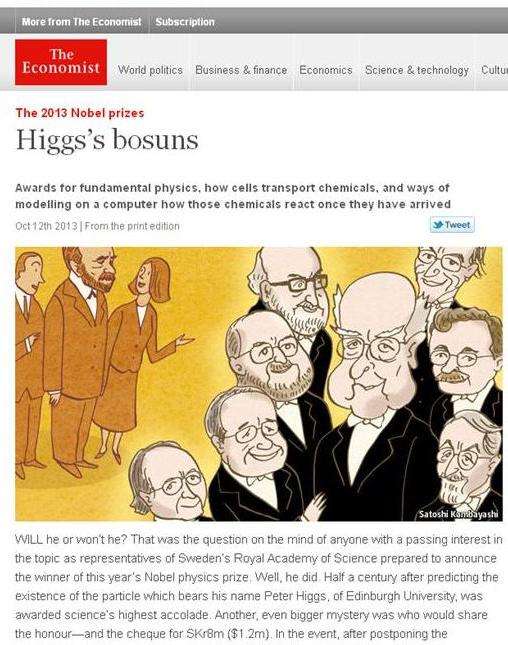
The Higgs Bosuns?

One sometimes wonder if news outlets have done away completely with copy editors, who should catch obvious mistakes and typos such as this.

This morning, while browsing through the news, I stumbled upon the Economist page reporting the Nobel Prizes, and had a chuckle with the title line read "Higgs's Bosuns". Maybe this is on purpose, I don't know, because the rest of the article had the correct spelling. Still, there's nothing in the article to imply anything about Higgs's "bosuns".


Zz.

Tuesday, October 08, 2013

2013 Physics Nobel Prize

So it is not a surprise at all that this year's Nobel Prize in Physics goes to two theorists who were the prominent figures in the development of the Higgs mechanism.

The 2013 Physics Nobel Prize has been awarded to two physicists who were instrumental in developing the theory that helps explain the origin of mass of elementary particles and predicts the existence of the Higgs Boson discovered last year. The prize, which recognizes the contributions of François Englert (Universite Libre de Bruxelles) and Peter Higgs (University of Edinburgh) for the theory of broken symmetry in electroweak physics, echoes the announcement of the 2010 American Physical Society’s J. J. Sakurai prize, which was awarded to the two Nobel Laureates as well as four additional physicists who made comparable contributions to the symmetry breaking work.

The link above also gives you access to free copies of the two relevant papers.

I think that the Nobel committee might be reserving another round to award the Nobel Prize for the experimental discovery.

Zz.

Thursday, October 03, 2013

Accelerating Charge Particles Using Visible Light

This accelerating scheme should see a large interest after this proof-of-principle demonstration. Two separate papers are showing the feasibility of accelerating electrons using the E-field from visible light, as opposed to the RF fields used in a typical accelerating structures.

Two teams now report rapid acceleration of electrons using small silica structures to shape light fields into patterns similar to those in a linear accelerator. In both of the experiments, the researchers sent electrons skating just over a silica surface that contained narrow grooves in the direction perpendicular to the electron beam. They then shined ultrashort laser pulses directly onto the surface (called a grating), which generated a pattern where the electric field was alternately enhanced and diminished in neighboring “zones” just above the surface. This pattern of fields reversed direction twice during every oscillation cycle of the laser light and could accelerate electrons (see YouTube video).

Here's the YouTube video:


Of course, with any initial advancement, there's still plenty of work to do. For many applications, getting to higher energy alone isn't the only issue. In FEL's, for example, the emittance of the beam is equally crucial. So accelerating scheme such as this must show the ability to not cause an emittance blow-up. The other issue that is often critical is the question on how much charge per bunch that can be accelerated. For many applications, the standard "high-brightness" beam requires a 1 nC per bunch charge. So the scheme must be able to handle beams of that magnitude without sacrificing the quality.

Still, this promises to be another exciting avenue for future accelerators.

Zz.

Tuesday, October 01, 2013

US Particle Physics Community Plans For The Future

As the US govt. starts its shutdown due to the US Congress's lack of ability to do the work they were elected to do (how come we don't dock their pay when they can't come up with a budget on time?), we have a report on the last "Snomass on the Mississippi" workshop by US Particle Physicists in prioritizing the different projects that US particle physicists should be involved in. It is a rather challenging task considering the severe budget cuts and constraints being put on science funding in the US as a whole, and on high energy physics in particular.

As stated at the end of the article, the US has lost its "leader" status in high energy physics. That's gone, and if the ILC is built in Japan, and funding continues to be dismal due to the political bickering by the dimwit politicians, then I don't see it coming back. I do not see the LBNE, even if it is built to its original specifications, getting the same global interest and status as the LHC and the ILC, certainly not in the public's eye.

Zz.

Monday, September 30, 2013

How To Destroy A Magnet

Besides learning how to destroy a magnet, you get to learn why certain things are magnetic, or can be magnetized.


Zz.

Saturday, September 28, 2013

Nanoscale NMR/MRI? Why, Yes We Can!

An amazing improvement in science technology and instrumentation. A new paper reports on the recent achievement of performing NMR on nanoscale size targets. You can also read the paper for free since it is published in the new APS family journal Phys. Rev. X. The one interesting aspect of this journal is that it includes a "Popular summary" of the paper that has been published. The popular summary accompanying this paper is this:

Tuesday, September 24, 2013

Any Guesses For 2013 Nobel Prize In Physics?

As the leaves turn color (at least here in the higher latitude in the Northern Hemisphere), the thoughts of many physics academics and professionals turn to Sweden and guessing at who will win this year's Nobel Prize for physics.

The obvious front runner is anything related to the Higgs. It's confirmed discovery this year means that it will not be a surprise if the award goes to people related to it. Questions remains on how they will be honored, considering that only a maximum of three individuals can be awarded the prize at any given time. Will they honor the theorists and the experimentalists in separate years? After all, there are already at least 4 deserving theorists who could easily be given the honors for formulating the Higgs mechanism, and the number is even larger for leading the experimental discovery of the Higgs.

The outcome of this will be very interesting. Or maybe the Nobel committee will forgo awarding the prize for the Higgs another year, and go with some other discovery in physics. That will be a fascinating surprise in itself!

:)

Zz.

Friday, September 20, 2013

When Belief Trumps Scholarship

The most significant argument against Creationism/Intelligent Design is that the proponents of these beliefs tends to try to find faults in existing concept of evolution, but without providing evidence of their own in support of their beliefs. The most often line of attack by these people is what we often normally refer to using the concept of "god of the gaps", where one tries to find some evidence or observations that defies current scientific explanation.

The problem with this, of course, is that these "gaps" often continue to shrink over time, and as our understanding of the world around us expand and improve. The ancient civilization used to think that the moving clouds, the eclipses, the ebb and flow of ocean tides, etc., were all due to some act of gods, because they didn't have any knowledge of what caused them. Now, we know better and these events are no longer mysterious or mystical.

And that's where we come back to the ID crowd. More often than not, they lack the necessary scientific evidence to strengthen their arguments. And when they try, the only people they could convince are people who really are not well-equipped to actually decipher the science. This appears to be the case of the latest book titled "Darwin's Doubt" written by Stephen Meyer, who runs the Discovery Institute. He's a non-biologist, who is trying to argue that the rapid explosion of animal phylia in the Cambrian period cannot be explained via the slow and tedious process of evolution, and thus, via invoking the god-of-the-gaps, points to evidence of an intelligent designer.

Whenever someone brings up a scientific point, it must be countered with equivalent scientific point. And this is exactly what has been done in this case. A review of this book written by UC Berkeley's Charles Marshall in this week's issue of Science (Science, v.341, p.1344 (2013)) did just that. In this review, Marshall pointed out several flaws in the biological/scientific points presented in Meyer's book.

However, my hope soon dissipated into disappointment. His case against current scientific explanations of the relatively rapid appearance of the animal phyla rests on the claim that the origin of new animal body plans requires vast amounts of novel genetic information coupled with the unsubstantiated assertion that this new genetic information must include many new protein folds. In fact, our present understanding of morphogenesis indicates that new phyla were not made by new genes but largely emerged through the rewiring of the gene regulatory networks (GRNs) of already existing genes (1). Now Meyer does touch on this: He notes that manipulation of such networks is typically lethal, thus dismissing their role in explaining the Cambrian explosion. But today's GRNs have been overlain with half a billion years of evolutionary innovation (which accounts for their resistance to modification), whereas GRNs at the time of the emergence of the phyla were not so encumbered. The reason for Meyer's idiosyncratic fixation with new protein folds is that one of his Discovery Institute colleagues has claimed that those are mathematically impossibly hard to evolve on the timescale of the Cambrian explosion.

In other words, this scientific argument doesn't hold water.

Unfortunately, and I can see this happening often, the counter argument to this book will not reach those who should be aware of it. The same with the perpetual argument that evolution violates the 2nd law of Thermodynamics, those who belief in ID will use this as the scientific argument against the evolution of life on Earth, without being aware of the holes in Meyer's book.

But at least now, you know that there is a scientific counter argument to what Meyer has brought up, and you can point to this Science review article.

Zz.

Tuesday, September 17, 2013

Superconductivity And The Environment - A Roadmap

A rather interesting and unusual review article. It describes how superconductivity and superconductors can actually help in improving our environment. As stated in this PhysicsWorld blog, it is an unusual assertion because "... superconductors only work at very low temperatures and lots of energy is needed to cool them.. "

Still, you might want to check out the list of things that have been argued that superconductors can do to help with the environment. The review paper is available for free.

Zz.

Monday, September 16, 2013

Graphene - The Aspirin Of Microelectronics

A while back, aspirin was touted as a miracle drug. Its use beyond just being a pain killer was being discovered constantly, ranging from an efficient blood thinner to prevent heart attack and stroke.

That is why I'm calling graphene as the aspirin of microelectronics. It seems that almost every year we hear more and more use of this miracle material. It's a good conductor, it is very strong, and now, in the latest chapter of what graphene can do, it has been touted as a very efficient converter of light into electricity.

Now the one-atom-thick lattice of carbon has added another string to its bow. Three research groups have independently shown that graphene can efficiently convert infrared light into electrical signals, as part of devices known as photodetectors. As fast and accurate translators of optical data, graphene photodetectors could speed up computers and significantly cut their power consumption. The devices, each with a slightly different architecture, are reported in Nature Photonics.

This performance already rivals that of existing photodetectors. “We’re seeing graphene getting to a point where it can compete with today’s technologies,” says Dirk Englund, a physicist at the Massachusetts Institute of Technology in Cambridge who developed one of the graphene photodetectors. “That’s an important new step.”
I expect it to be able to clean windows soon.

Zz.

Sunday, September 15, 2013

Fermilab's Neutrino Beam Source

Here's a short article on Fermilab's repurposed Main Injector into a neutrino beam source for MINOS and NOvA. The article is OK. It kinda stopped short in describing the mechanism of generating neutrinos (why did it stop at creating pions?) Luckily, it linked to a YouTube video that explains how we get neutrinos at the end of the process.


Zz.

Friday, September 13, 2013

Feynman Lectures On Physics

I just read a note by Mike Gottlieb on the availability of the famous Feynman Lectures on Physics online, for free!

Not sure how long this has been available, but in case you didn't know, now you do!

Now, let me clarify something. I think this book is a classic, and advanced physics students, and graduate students, should read parts of it (or if you have time, read as much as you want). It provide quite a bit of insight into many different physics subjects.

However, as a pedagogical tool to teach physics to new students, I think this book is unsuitable and may be beyond what such students can comprehend. So if you are a freshman, or just trying to pick up some physics, you may still read it, but don't be surprised if you find it rather difficult to learn from. It is one of the reasons why this book isn't a popular intro physics text in most schools.

Zz.

Wednesday, September 11, 2013

The Quantum Quest

Again, I don't know how long this article from Nature will be available freely on the web. So read it while you can. It describes the continuing effort to decipher the fundamental issues surrounding Quantum Mechanics, and the effort to formulate it from some set of axioms.

Over the past decade or so, a small community of these questioners have begun to argue that the only way forward is to demolish the abstract entity and start again. They are a diverse bunch, each with a different idea of how such a 'quantum reconstruction' should proceed. But they share a conviction that physicists have spent the past century looking at quantum theory from the wrong angle, making its shadow odd, spiky and hard to decode. If they could only find the right perspective, they believe, all would become clear, and long-standing mysteries such as the quantum nature of gravity might resolve themselves in some natural, obvious way — perhaps as an aspect of some generalized theory of probability.

Zz.

Monday, September 09, 2013

Cow Tipping - It's A Myth!

What better way to break up the monotony of important advances in elementary particles, of topological insulators, of neutrino physics, etc. then to talk about the myth of cow-tipping! This article in Modern Farmer collects up-to-date info on why this is a myth, including a physics calculation on what it would take to do such a thing, which would make it even more unlikely.

But say our hypothetical cow tippers got lucky enough to get close to a cow at night. There’s still the matter of the brute force needed to get the cow over. In 2005, University of British Columbia student Tracy Boechler and doctor of zoology Margo Lillie ran the numbers on cow tipping. Their findings? There’s no way one person could tip a cow. Two people? Maybe — but not in real world conditions.

“Two could do it in theory,” says Dr. Lillie. “But it’s not going to be easy, and as soon as the cow responds by bracing herself or leaning into you — which she will do — it will be even harder.” Cows, after all, stand on four legs and will quickly shift their weight to a wider, more stable stance if pushed against. And Lillie and Boechler’s calculations are based on an unmoving cow in equilibrium in which slow, steady force could be applied without pushback — an optimum (and unrealistic) state for cow tipping. Pull out your high-school text book and look up Newton’s Second Law: Force equals mass times acceleration. A cow has a lot of mass, and you’ll want to move that mass quite quickly, before the cow can react. Which means you’ll need to generate a lot more force. Per her calculations, that would require at least five, and probably more like six pushers. “It just makes the physics of it all, in my opinion, impossible,” says Dr. Lillie.

There ya go, kids! Don't try this at home, or more accurately, at a farm near you!

Zz.

Wednesday, September 04, 2013

It's About Time

One of the most common arguments that I've seen online is the question on whether time is "real" or is it an "illusion" or doesn't exist. I've addressed this before quite a while back. In fact, that blog entry actually became a "reference" in a Wikipedia entry!

Last week's issue of Science had an interesting article. It is actually a review of Smolin's book "Time Reborn", with the review written by Huw Price (Science v.341, p.960 (2013)). What is interesting about the review here is the impression that I got that, even in philosophical circles, there is really no serious argument on the question on whether time exists or not (it does!). Rather, the question is really on the nature of time.

The differences between the two camps on the nature of time is described in the article:

I’ll come back to that question, but first to the dispute itself, which is one of philosophy’s oldest feuds. One team thinks of time as we seem to experience it, a locus of flow and change, centered on the present moment-“All is flux,” as Heraclitus asserted around 500 BCE. The other, my clan, is loyal instead to Heraclitus’s near contemporary, Parmenides of Elea. We think of time as it is described in history: simply a series or block of events, lined up in a particular order, with no distinguished present moment. For us, now is like here—it marks where we ourselves happen to stand but has no significance at all from the universe’s point of view.

And it brings me to the main point in which the differences really is not about the question whether time exists, or if it is real.

To Parmenideans such as Williams and myself, this attitude is just linguistic imperialism, cheeky and rather uncharitable. Of course we believe that time is real, we insist. (It is as real as space is, the two being simply different aspects of the same fourdimensional manifold.) What we deny is just that time comes carved up into past, present, and future.

You'll notice that the argument that time is as real as space is the same argument that I used in that earlier post that I linked above.

So really, enough of this nonsense on whether time exists or not, or if it is real or not.

Zz.

Sunday, September 01, 2013

Friday, August 30, 2013

The Birth Of Photonic Crystals

If you've read this blog for any period of time, you will have seen that, as many times as I can, I try to highlight the application side of physics. This is because a lot of people who are not familiar with the field tend to think that physics is only the LHCs, the Brian Greenes, the particle physics, the String theories, etc. If I can't contribute anything to physics, I want to at least contribute to destroying such myth.

This is one such example. APS Physics has recently highlighted a landmark paper that marked the birth of the idea of photonic crystals.

Semiconductors and band insulators are material that has a gap in the electronic band structure. On the other hand, photonic crystals have gaps in the photonic band band structure, whereby the material simply does not propagate photons having energies within that gap.

You may read the article to find out what applications such materials are good for.

Zz.

Thursday, August 29, 2013

The Origins of Space Time

I guess theoretical physics is supposed to extrapolate and make these types of conjectures. Still, it would be nice if there are already experimental indications that they are on the right path, rather than just continue on blindly.

This is a rather interesting article from Nature on some very fundamental issues in physics, and the theories (yes, there are many of them, which is common when there are no experimental evidence to weed them out) that claim to describe them. Not sure how long the article is available for free online, so read it while you can.

Zz.

Carl Wieman Moves to Stanford

I mean, where else would highly-sought-after, Nobel laureate end up?

Carl Weiman has taken up a faculty position in the Physics Dept. and in the Graduate School of Education at Stanford University. He brings with him quite a program in physics education, I must say.

Carl Wieman’s crusade to improve undergraduate science education is now based at Stanford University.

The physics Nobelist and former White House science education czar has been named a faculty member in both the physics department and Stanford’s Graduate School of Education. The joint appointments, effective 1 September, give Wieman an academic perch to take his research on learning in new directions while continuing to incorporate those insights into the classroom.
Zz.

11-Year Old Starts College Majoring In Physics

Here's a piece of news to make all of us mere mortals feel highly inadequate.

A lot of people have a hard time choosing a major when they start college at 18, but that isn't the case for Carson Huey-You, who's just 11 years old.        

"I am studying physics," the youngest student to ever enroll at Texas Christian University who started college on Monday says. "That's my major."

But like all college freshman, the 11-year-old is starting out by taking some required courses. His ultimate goal? Becoming a quantum physicist.

"I'm taking calculus, physics, history and religion – those are my core classes," says Huey-You, who seems to be adapting to college life quite well.  

I certainly wish him the best! It would be nice if the news organization continues to track him through his program. I would be curious to learn where he'd end up.

Zz.

Wednesday, August 28, 2013

Friday, August 23, 2013

An Actual Test To Verify A Quantum Computer?

We may just have one, according to this Wired article.

In the April 25 issue of the journal Nature, Vazirani, together with Ben Reichardt of the University of Southern California in Los Angeles and Falk Unger of Knight Capital Group Inc. in Santa Clara, showed how to establish the precise inner state of such a computer using a favorite tactic from TV police shows: Interrogate the two components in separate rooms, so to speak, and check whether their stories are consistent. If the two halves of the computer answer a particular series of questions successfully, the interrogator can not only figure out their internal state and the measurements they are doing, but also issue instructions that will force the two halves to jointly carry out any quantum computation she wishes.

Wonder if the D-Wave people would like to subject their machines to such a test?

The article also has some coverage of quantum entanglement and the basics of quantum computation.

Zz.

Thursday, August 22, 2013

Your Proposal Received Glowing Reviews, But We Are Not Going To Fund It

It is the sign of the times, I suppose.

I've submitted quite a few funding proposals, and some got rejected, while others got funded. Nothing unusual. However, the ones that got rejected typically have mixed reviews. I remember one where 2 of the reviewers liked it, and one was not too thrilled about it. It got rejected, which was not surprising. But in all my years of doing this, I don't ever recall where a proposal got really glowing reviews, and then it was summarily rejected!

That is what just happened to me (I'm not going to name the agency and anything else, because I am not bitter, really!). We just heard the news of the rejection, and I went to look at the reviews. At the end of reading all three of them, my jaw dropped. I can't remember reading a more positive, glowing reviews of my proposals before. The reviewers did read the proposal carefully, and actually got the novel method we were proposing. The whole proposal got very good rating. But, obviously, these mean nothing because, in the end, it got rejected.

I will also say that I am not surprised. Disappointed, yes, but not surprised considering the severe budget constraints that many of the US funding agencies are under right now. It is up to the fractured US legislators, and ultimately, the people, to put a value on science research and how it has affected the US economy and our lives thus far. If this is not of any value, then the US certainly deserves to undergo its current, slow decline of its civilization and suffers from the same fate as other great civilizations of the world throughout history.

Oh, did I say that I'm not bitter? :)

Zz.

Wednesday, August 21, 2013

Quantum Zeno Effect Observed In Diamonds

Diamonds could be quantum physicists best friends!

Turns out that the quantum Zeno effect has been observed in diamond.

The researchers focused on nitrogen–vacancy (NV) centres, imperfections in diamond that arise where an atom of nitrogen and an empty space replace carbon atoms at two neighbouring spots in the crystal lattice. The team used microwaves to change the magnetic spin state of an electron located at an NV centre, and then used a laser beam to trigger red fluorescence that revealed which of two possible states the electron was in at any given moment. When they measured the NV centre in this way, the researchers found that the oscillation between the two states was disrupted — just as would be expected if the quantum Zeno effect were operating.

The paper is to be published in PRA, but the preprint is online.

Zz

Tuesday, August 20, 2013

Science, Religion, and the Big Bang

This should stir up the pot, and I think it already has, judging from the comments accompanying this YouTube video.


Zz.

Wednesday, August 14, 2013

The Dynamics of Hyperloop

I heard about this on the new yesterday because the infamous Elon Musk has thrown his support behind it. It is a new high-speed transportation method that primarily depends on an evacuated (or partially evacuated) tube to reduce air friction.

I was going to do a quick study on it, but Rhett Allain at Dot Physics has already done a preliminary analysis on it, so I'll just point to his page.

As someone who works with vacuum/ultra-high vacuum systems, all I can say is that this thing will need a lot of huge vacuum pumps, although for what it intends to do, I think all they need is to get into probably just the milliTorr pressure range, just enough to be below the viscous flow regime.

Zz.

Monday, August 12, 2013

Google Physics Doodle

Google celebrates Erwin Schrodinger's 126th birthday today with a physics-themed doodle that most physicists and physics students will get.

Zz.

Sunday, August 11, 2013

How To Find Black Holes With Lasers

It's a bit tedious to follow, but you might learn something. And one camera angle has a bit of a problem with aspect ratio.


Zz.

Saturday, August 10, 2013

Higgs Boson: The Inside Scoop


Zz.

Why Aren't More Girls Attracted To Physics?

This is not a new topic. In fact, I'm sure it has been discussed, published, and talked about many other times. I've also posted several items on this, including this one about the shortage of women physicists.

The latest study aims at understanding why girls aren't not as interested in physics as boys.

But when Riegle-Crumb controlled for those and other possibilities, she found one reason remained: "What we found is that in communities that had a higher percentage of women in the labor force who are working in science, technology, engineering and math, that in those schools, girls were as likely as boys to take physics, or even more likely."

Riegle-Crumb's finding about the importance of local role models meshes with a broad range of that shows the decision to pursue math and science is not about innate differences between boys and girls, but about and norms. Countries with greater , for example, reveal more equal math test scores among boys and girls.

This is interesting. In my participation on the various outreach program to get girls to go into science/engineering, I've asked these girls many times on whether it was important for them to have a female role model before the chose a career. Fascinatingly enough, the overwhelming majority of the girls said no! Those who said no told me that in this day and age, they are used to the idea that they can pursue whatever career that they want.

Now, I'm not saying that anecdotal accounts contradict the study. I think the girls who showed up or have been selected to participate in many of the events that I attended were already from an environment in which they no longer significantly need role models. So my observation can definitely be skewered. This study clearly shows that there is a significant influence on having a role model within the environment that the girls live in.

Zz.

Wednesday, August 07, 2013

The Utility Of Physics

In the section titled "To The Student" from Mary Boas's classic text "Mathematical Methods In The Physical Sciences", there is this passage:

There is a story about a young mathematics instructor who asked an older professor "What do you say when students ask about the practical applications of some mathematical topic?" the experienced professor said "I tell them!"

About a few weeks ago, my graduate students and I were just chatting away while we were waiting for the start of our meeting, and the topic of our conversation meandered into dealing with the "applications" of physics, and the usefulness of various topics in physics. I indicated that, as someone who have been involved in hosting open houses, tours, Q&A, etc. with the public, I've had to deal with trying not only to explain certain aspect of what I did, but also why what I did was important and deserved to be supported. That was when one of the students asked me what I tell a general public if I was asked what are the useful applications of certain topics in physics. I found myself replying "I tell them!" Thus, the connection with what I quoted out of Mary Boas's text.

In my years of being a physicist, I have tried to impress upon people that physicists don't just do esoteric, theoretical, no-applications-in-sight-type of work. In fact, as someone who was trained as a condensed matter physicist, I tried to impress upon the public that many of the things they enjoy today, especially their modern electronics, are all part of the areas that physicists work in. I've pointed out earlier that physics is not just the LHC, but it is also the iPod and the iPhone.

Unfortunately, being able to "tell them" the applications of various aspects of physics requires someone who is not only knowledgeable, but also someone who has a wider view of physics, and the ability to make connections between many of the common conveniences, devices, procedures, etc. that we enjoy that came into being due to physics. Many students aren't that well-equipped yet on being able to handle such breadth of knowledge that tends to come about from experience. I have done this, and have faced this type of question countless times that I can pull things out of my back pocket in an instant. However, what if you are just starting out, or what if you yourself want to know how to deal with the question of the usefulness of physics?

There are 3 different points that you can make:

1. Many areas of physics have a DIRECT and OBVIOUS applications. Condensed matter physics, atomic/molecular physics, medical physics, etc. can all boast a very obvious connection to modern electronics, medical advances, understanding of materials, etc. So point these out first, and in fact, point out that people in these fields are the MAJORITY of practicing physicists. You'd be surprised how many in the public area actually shocked by that revelation.

2. The utility of knowledge. Even in areas in which it is difficult to argue for the application and usefulness to the public, we can bring out the argument that it is difficult know the future applications of such knowledge. The history of physics is littered with many such examples, including quantum mechanics. The early development of quantum mechanics had almost no emphasis on the usefulness and application. If we only want to fund work that had such clear utility, then we would have missed out on the development of quantum mechanics. And yet, as we now know, our entire modern conveniences are based on this amazing theory. So while there is certainly value in the knowledge itself, demanding that it must have an immediate and obvious application is extremely shortsighted and ignorant.

3. The "side effect" of esoteric knowledge. One may doubt the usefulness of high energy physics, or astrophysics. However, there is no argument on the fact that the pursue to verify various aspects of theories from these fields via the advancement in particle accelerators, detectors, and other devices have had significant impact on our lives. Modern facilities and devices, ranging from synchrotron radiation centers, medical accelerators, light detectors, high-speed electronics, advance data/computations, etc. were all developed or came into being due to the advances that had to be made for various high energy physics and astrophysics experiments. These found applications, what I called the side effects, in other areas, and into our everyday lives. So the experiments to study these "esoteric" topics actually drive the innovation in many different areas that eventually trickled down to us the consumers!

So if you are starting out in physics, or already knee deep into it, do not run way from the question of the usefulness and applications of physics. You stand your ground and you tell them!

Zz.

Monday, August 05, 2013

The Sun's Magnetic Field is About to Flip

Our sun's magnetic field is about to flip. But don't panic, this happens pretty often, roughly once every 11 years or so.


Zz.

Rush Holt On Physics And Politics

One of the few physicists in the US Congress (I think he and Bill Fosters are the only two left, if I'm not mistaken), Rush Holt has been in the US House of Representatives for quite a few years.

This news article reveals a bit more of his position on several different hot-topic issues.

* On himself:
"I've always been an unusual member of Congress, partly because of my background, partly because of my approach to problems, partly because of my philosophy of governing. … I have a real commitment to the basic principles of equality and liberty."


* On climate change:
"This is an urgent problem. … Climate change has to be dealt with by removing our emphasis on fossil fuels. … We are ruining our planet and killing people by the millions. … How do we do it? We have to keep presenting the facts. Presenting the evidence. And confronting those who would deny the evidence until they would deny it no more. … A transition to more sustainable energy need not be costly. In fact, it could be a real boon to us economically. The sooner we do it, the sooner we can sell the technologies to the world, rather than buy them."
You can read more at the link above.

Zz.

Friday, August 02, 2013

Do We Expand With The Universe?


Zz.

Sorry, Capt. Kirk. Teleporting You Will Just Take Too Long

... in fact, longer than the age of the universe!

This fun, amusing, and back-of-the-envelope calculations done by a group of students at the University of Leicester in England shows that to sample and transport all the information about a human to another location (as in the Star Trek teleportation device) will just take too long for it to feasible right now.

Our universe has been around for 13.8 billion years. But the seriously tongue-in-cheek paper shows that at a beaming speed of 30 gigahertz, transmitting all the data within a single human would take 4,850,000,000,000,000 (4.85 quadrillion) years. The human dataset includes not only the person's genetic code but also all the memories and knowledge stored in his/her brain. While DNA would take up about 10 billion bits, the brain's information would bring the data total up to 2.6 x 1042 (26 followed by 41 zeroes) in bits.

Why not simply increase the bandwidth to speed up the process? That would require an impossible increase in power consumption beyond earth's capabilities.

I think there's something else here that should be pointed out, and something that many non-scientists should be aware of. When we think "outside of the box", we must (i) first know where the box is and where its boundary is (which means one must have the established knowledge first), and (ii) be able to make quick, back-of-the-envelope estimation to tell us if the quantitative aspect of what we wish to do or study produce a reasonable, achievable goal.

The latter is quite important, because it tells us if there's any reasonable chance that we can verify, or accomplish our goal. This means that a device, a detector, an instrument, etc. of certain parameter can either produce, detect, or accomplish that goal. When we seek support to do such work, we must show this because, as is very obvious, no one is going to fund something based on some handwaving argument, and they are especially not going to fund something if the numbers tell us that there's no REASONABLE chance for success!

So if someone wants funding to build such a teleportation device above, would you fund it knowing that it will take 4.85 quadrillion years to transport a human being? If you would, I have a bridge to sell to you.

Zz.

Wednesday, July 31, 2013

Did He Just Learned Physics?

In this video and news report, the BBC business editor is trying to learn quantum physics.

The title of this report is misleading, because one doesn't learn quantum physics (or any science for that matter) like this. Rather, one is learning ABOUT quantum physics. There is a difference here, and I've mentioned this quite a while back in context with my take on the many pop-science books out there.

While learning about science should be highly encouraged, especially among the general public, we should never mistaken it as learning science, because this practice provides information only at the superficial level.

Zz.

Tuesday, July 30, 2013

Same Paper, But Two Entirely Different Emphasis

See, this is essentially what is different between this blog, and the outlandish stuff they have elsewhere that tries to capture people's attention by drawing onto something that's improbable.

Last week, I highlighted a paper in PRL on the estimate made on the lifetime of photons based on current measurements. This upper limit also is related directly to the upper limit on the mass of photons, if any. In that blog post, I tried to highlight what is well-known and well-established, rather than try to make extrapolations on things that are still up in the air.

But that is not what is done here. This news report, also reviewing the same publication, decides to go with a different route, which is highlighting the speculative, attention-grabbing possibility, no matter how remote, how unlikely, and how improbable it might be. It focuses a lot on the minute possibility of photon decay, and decaying into "lighter" produced that could travel faster than the photons themselves.

If photons do break down, the results of such decay must be even lighter particles, ones that would travel even faster than photons. Assuming photons have mass, "there is only one particle we know from the Standard Model of particle physics that might be even lighter — the lightest of the three neutrinos," Heeck said.

It is sad that, rather than emphasizing the result that was published, news account on something like this would venture into citing remote possibilities and highly speculative conjectures. The result itself got buried. Rather, an improbable consequence of a possible outcome is the one that was brought to the forefront! This is a shameful attempt at sensationalizing a result! It is no different than the sensational front page news from supermarket tabloids.

Zz.

Monday, July 29, 2013

Still No Sign Of Violation Of Lorentz Symmetry

The more they test it, the more precise they measure the validity of the foundations of Relativity. This time, the measurement comes from a new technique of measuring the the transition energy between two electron energy states of dysprosium.

The team chose dysprosium because it has a pair of closely-spaced energy states that involve orbitals where electrons travel at very different speeds. Because of this speed difference, a change in the electron’s kinetic energy due to a change in the atom’s orientation would affect the two states very differently. The researchers illuminated a beam of dysprosium atoms with two laser beams to excite them to state B (via another state) and then drove the transition to A with a precisely calibrated microwave beam. To measure the transition energy, they found the microwave frequency most effective at driving the transition. The team repeated the experiment many times over a period from 2010 to 2012.

The orbitals of the atoms were oriented to some extent by the polarization of the exciting laser beams. So if the electrons’ kinetic energy depended on their direction of motion, the team would have seen a daily oscillation in the transition energy from the earth’s rotation. Similarly, if there were any effect from the earth’s position in the sun’s gravitational field (violating local position invariance), there would have been an annual oscillation.

There are many different ways to violate Lorentz invariance, so researchers in the field have developed a standard set of parameters to characterize different types of violations. Hohensee and his colleagues measured eight of the nine parameters that describe any dependence of the electron’s maximum attainable speed on the speed and direction of the lab’s reference frame. They significantly improved limits from previous experiments for four of them, one by a factor of 10. Their new limits on local position invariance for electrons are 160 times more precise than previous ones.
Zz.

Friday, July 26, 2013

The Physics Of High-Speed Trains

While the accident in Spain is certainly a tragedy, it is also an opportunity to examine the physics involved for us to understand a bit more of a possible cause of the accident. This article in The New Yorker has a simple enough description of it that anyone without any mathematics or science degree can understand. It tries to explain why there is speed requirement or limit of curved tracks.

One of those forces is centrifugal (“to flee from the center”) force, the inertia that makes a body on a curved path want to continue outward in a straight line. It’s what keeps passengers in their seats on a looping roller coaster and throws unsecured kids off carousels. Centrifugal force is a function of the square of the train’s velocity divided by the radius of the curve; the smaller and tighter the curve, or the faster the train, the greater the centrifugal force. As it increases, more and more of the weight of the train is transferred to the wheels on the outermost edge of the track, something even the best-built trains have trouble coping with. That’s where the concepts of minimum curve radius and super-elevation, or banking, come in.

Banked curves, in which the outer edge of the track is higher than the inner edge, balance the load on the train’s suspension. Since gravity pulls a train downward and centrifugal force pulls it outward, a track banked at just the right angle can spread the forces more evenly between a train’s inner and outer wheels, and help to keep it on the track.

But banking the tracks isn’t a cure-all—a passenger train can tilt only so far before people fall out of their seats. So the minimum curve radius comes into play. Imagine that a curved portion of track is actually running along the outer edge of a large circle. How big must that circle be to insure that a train’s centrifugal force can be managed with only a reasonable amount of banking? 

It is interesting to note that this is the type of question that we deal with in first year intro physics.

Zz.

Wednesday, July 24, 2013

The Lifetime Of Photons

I see questions on the mass of photon a lot on online forums. The idea that a photon has a mass has numerous implications, including a non-zero longitudinal polarization. Another consequence is that a photon having a mass is not stable and will eventually decay. Thus, it should have a lifetime.

This latest paper examines and calculates the lower limit of a photon's lifetime based on our best upper limit of the photon's mass (additional review of this work can be found at PhysicsWorld).

For a photon to decay, it must have a mass—otherwise there’d be nothing lighter for it to decay into. A photon with nonzero mass is not ruled out by theory, but experiments with electric and magnetic fields constrain the mass to less than 10−54 kilograms. Heeck assumed this upper limit and worked through a generic model in which photons decay into even lighter particles, which could potentially be neutrinos or some more exotic particles.

As a constraint, Heeck considered the CMB, the relic emission from the hot, opaque plasma that persisted for several hundred thousand years after the big bang. The CMB spectrum matches very closely a perfect blackbody, which implies very few, if any, of the CMB photons decayed on their 13 billion year journey. Heeck calculated that the minimum lifetime is 3 years in the photon’s rest frame. This might seem ridiculously small, but the photons are extremely relativistic. When time dilation is taken into account, a visible wavelength photon in our reference frame would be stable for 1018 years or more.
In other words, it is horribly longer than the age of our universe by many orders of magnitude! I'd say the odds of observing such a decay is zero.

Zz.

Tuesday, July 23, 2013

Physics Departments Without A Single Female Faculty Member

Before we start, let me emphasize that I'm a man, but I've been involved in promoting women participation in science, and especially physics, for years. Anyone who has followed this blog would have read several items on this issue, and also my activities in this area to promote women in science. I definitely think that there is an under-representation of women in physics, and one of the ways to improve that is to make the field more enticing and more familiar to them, both in terms of the subject matter, and the working condition.

Now, having said that, you know what's coming next is not going to be pretty. This is a news article that reports on a recent statistical analysis/modeling done by the American Institute of Physics. It aimed to address that fact that fully 1/3 of the physics departments here in the US do not have a single female faculty member. But one shouldn't stop there, because the statistics included schools with small number of faculty members (often less than 10), and these tend to be the schools that do not have any female faculty members.

The AIP ran a simulation that takes into account the number of available female faculty members and the available positions, and came out with the conclusion that the lack of female faculty members in these departments is consistent with the statistical distribution, and not due to any inherent bias.

A new report from the American Institute of Physics -- based on simulation analysis -- concludes that the large number of departments without a single woman is to be expected and is not the result of discrimination. Some experts on women and science, however, disagree.

The institute's report says that there are two factors that explain the distribution of women among departments: the size of departments and the total number of female faculty members available. There are many departments with only two or three physics faculty members, the report notes. So "it is unlikely that these departments will have a woman among the faculty because the overall representation of women among all physics faculty members is low," the report adds.
To put it simply, say that you have 100 balls. On the table, you have many compartments of various sizes, some able to contain 20 balls, while others are big enough to have only 2 balls. If you toss those 100 balls up in the air and let them land randomly into those compartments, the argument here says that naturally, the smaller compartments will have a higher probability to end up with having NO balls.

Whether one buys into the parameters set up for the simulation is another matter. But taken at face value, I don't see anything wrong with this. It is certainly a first attempt at trying to figure out if the lack of any female faculty members in these small departments are due to some inherent bias, or simply out of statistics. It is a scientifically valid methodology to START and investigate an issue. Now the next logical step is to re-examine if the parameters used are valid, or accurate. Maybe some of the assumptions used are debatable, etc., and thus, the simulation should be tweaked.

What annoys me is the response being given to this study. I certainly expect disagreement with the conclusion, but the counter-argument that has been given is purely speculative!

Janet Bandows Koster, executive director and CEO of the Association for Women in Science, said via e-mail that the report "a disappointment."

She urged physicists to study the concept of "implicit bias," which she said might have something to do with the pool of women in the discipline. "We know that most people are reluctant to accept that they are biased, and scientists in particular pride themselves on their impartiality. Yet scientists are humans raised in societies, and thus are subject to collective messages that suggest men are suited to science because they are independent and analytical whereas women are better suited to care-giving and cooperative enterprises."

It's too easy, she said, to focus only on the relatively small number of women in the field. "Inferring there is no hiring bias because the 'n' is so small for female faculty is essentially like granting a papal indulgence to physics departments across the country," she said.
I'm sorry, but that is stupid! You are countering a statistical analysis with nothing more than a speculative fishing expedition! That's like saying you don't agree with Special Relativity because you don't like the look of the equation!

And no one here is saying that there is no hiring bias. A statistical analysis such as this can't come to such conclusion. What it does say is that the lack of female faculty members in 1/3 of the physics depts. cannot be attributed to gender bias as the main factor, because statistical analysis alone can account for that observation! As scientists, we need to know what statistics say, and what they don't!

The PROPER way to counter something like this is to look at the validity of the parameter used, to see if the model is accurate, and to show where it might have missed something, NOT to simply insinuate that there are biases. For someone who is supposed to represent an association of women in SCIENCE, she sure used a lot of hand-waving, unsupported argument to counter a scientifically-derived conclusion.

Zz.

Monday, July 22, 2013

Alan Sokal Attacks Psychology Theory

I mentioned Alan Sokal and his infamous hoax before (in case you haven't heard of it). Sokal is back in the news, but not due to any hoax that he has created. This time, he's attacking a psychology theory that made use of something out of physics.

In the paper, the trio critique an application of what psychologists call the "positivity ratio" -- the ratio of a person's positive feelings to his/her negative feelings. In 2005, two psychologists wrote that people "flourish" if the ratio meets or exceeds 2.9 -- that is, if positive emotions occur at least three times as often as negative ones. A pretty intuitive concept in the abstract sense, but one Sokal and his co-authors say cannot be described by the equations the psychologists borrowed from physics.

"We find no theoretical or empirical justification for the use of differential equations drawn from fluid dynamics, a subfield of physics, to describe changes in human emotions over time," the trio wrote in their article. "Furthermore, we demonstrate that the purported application of these equations contains numerous fundamental conceptual and mathematical errors."
.
.

The trio's article, "The Complex Dynamics of Wishful Thinking: The Critical Positivity Ratio," was published online July 15, 2013 in American Psychologist.

Somehow, this fits in perfectly with an earlier comment on psychophysics babble.

Zz.

Sunday, July 21, 2013

Why Do Physicists Gravitate Towards Jobs In Finance?

This is a take on why physicists gravitate towards a job in the finance world.

Then again, perhaps it is not surprising that so many physicists wind up working in finance. After all, they are good at using mathematics to solve real-world problems and the money is good. There is more to it than that though. There are mathematical links between physics and finance that go back at least to 1900, when Frenchman Louis Bachelier wrote his Theory of Speculation, in which he used the mathematics of a random walk to analyse fluctuations on the Paris stock exchange. Five years later, the same ideas were used by a young Albert Einstein to explain why pollen grains zigzag when they are suspended in water. His explanation invoked the idea that very large numbers of tiny molecules, much smaller than the pollen grains, are responsible for kicking the grains around. This was a crucial insight and provided one of the earliest convincing confirmations of the existence of atoms. To make the parallel with the financial markets, we might say that stock prices are kicked around by myriad unknown factors in the marketplace. Today, these ideas have been developed into a means of computing the value of sophisticated financial instruments and the management of risk.

Now, I'm skeptical with the first assumption that there are physicists who "gravitate" towards a job in finance. I am not sure to what extent these people AIMED for such a job, or rather if they took it due to other circumstances. Would they have taken it if they had other jobs in physics that pay close to what they would be making? Did they graduate with the intention of take such jobs in finance?

Furthermore, I've mentioned a few articles in which these theoretical model in finance and areas dealing with social and human interactions and activities (what is often called as psychophysics) are being called into question.

In any case, this is an article that covers what is going on in the UK, and it doesn't look to be that much different than what is happening here in the US.

Zz.

Friday, July 19, 2013

"The Story Of Energy" - Physics Reporting At Its Worst!

Again, if this was another obscure, backwoods article, I wouldn't give a hoot. But this comes in with Scientific American tags! I do not know in what capacity this is part of Scientific American, but they ought to be ashamed of themselves to be associated with this type of garbage.

This article was written by a "Clarissa Ai Ling Lee". A search turns info that this is a Ph.D candidate at Duke University, majoring in Literature, and specializing in "..... in science and technology studies and comparative media studies."

There are so many convoluted, metaphysically-injected theme, or outright mistakes, that one just doesn't know where to start. For example:

In our three-dimensional world (even it we count time, that merely allows the curvature or space to be accounted for, and not much else),

Holy cow! Is she that ignorant, and is actually proud to share it with the world? I suppose those time-reversal symmetry (or lack of it) events are of no use. After all, we didn't use time in there just merely to allow for the curvature of space! Unbelievable!

But it gets better...

Cosmic rays, as high-energy charged particles, are sets of naturally occurring particles found through the process of atmospheric nuclei decay.

Now this is utterly wrong. High energy cosmic rays especially, a non-terrestrial. It originates elsewhere in the universe. So it definitely is not a produced of "atmospheric nuclei decay". Even a quick search on Wikipedia can correct that! How lazy can one get?

And if you can stomach it, here a winner when she attempts to describe beta decay:

According to the law of conservation, the disintegration of neutron should produce equal part electrons and equal part protons, but this was found not to be the case. Therefore, Enrico Fermi named it for a particle which is supposed to exhibit zero mass and zero charge (a sort of 'virtual' particle at that time) so as to counteract the 'shortfall' that would have resulted from the proton and electron not being consistently emitted as a 'neutrino.' 
 Did you have to rub your eyes and read that twice?

A beta decay produces EQUAL amount of proton and electron. There was never a problem with charge conservation. It was a problem of spin/momentum conservation!

And oh, she has picked an area we should study:

They want to know how understanding a specific property of strong interaction at the subatomic level can help explain why so much of our universe is constituted of dark matter. 

Bet you didn't know that, did you, that the strong interaction, at the subatomic level, no less, can help explain our dark matter. Yes sir!

The rest of the article, if you have the patience to read it, is a mumbo-jumbo of words with a generous dose of meta-physical flavor (a very popular trick) and enough word salad that it makes it difficult to be falsified and comprehended.

And aren't we glad that this is just Part 1! Can't wait on what other bastardization that is in store next!

Zz.

Thursday, July 18, 2013

Energy Theater?

I've read the "press release" of this work, but only had a quick glance at the paper. But that should not stop you from having a look at it.

This activity for elementary/primary level education is meant to give a rather visual representation of the concept of energy, the ability of energy to transform from one form into another, and the conservation of energy principle.

In the current study, the researchers report their ongoing examination of an activity that they have created, called "Energy Theater." Energy Theater is specifically designed to help learners visualize energy and how it dynamically changes form and location. In Energy Theater, learners (K-12 science teachers in this study) each play the role of one "chunk" of energy, and indicate with hand gestures what form that energy has (e.g., chemical, motion, gravitational, thermal). Different objects are represented by loops of rope on the ground, and learners can move from object to object, demonstrating energy moving between those objects. While energy is not actually a material substance, this metaphor can help learners think about how a fixed amount of energy can flow between different objects.

For example, the group may be given the problem of, "Show what happens when a hand pushes a box across a table." Participants would first stand in the area representing the hand, making the gesture for "chemical energy." One by one, they would move to the area representing the box, changing their gesture to "energy of motion." Other scenarios might include how energy flows when an incandescent light bulb is turned on. The group must work together to decide how the "theater" will play out for a particular situation, making complicated decisions about just where and when the energy will flow and take different forms. 

It sounds rather convoluted to me, but that is probably because I haven't had the chance to actually see it. Maybe something like this can sink in easier with students at that age and level.

In any case, you should be able to read the actual publication that appeared in PRST-PER that gives free access.

Zz.

Wednesday, July 17, 2013

Particles, Fields and The Future of Physics

If you have about an hour and a half, you could do worse than viewing this lecture by Sean Carroll of CalTech on elementary particles and the future of physics.


Zz.

Light Stopped And Stored For More Than A Minute

Advances in this field of storing light have been astounding. It was only a few years ago that we had the amazing accomplishment of light being stopped and then "played back" out of Lene Hau's lab. And there have been more advances since then (read here). Now comes this latest paper (free access to the actual paper is available at that link).

There are two major accomplishment that are notable with this one:

1. They managed to store light and all of its coherent information for more than a minute, and

2. They are using a solid state medium, rather than atomic gasses, which will make this more viable for storing quantum information.

While solid-state devices would be preferable for applications, stopping light in solids is more challenging: stronger interactions between atoms and their environment severely limit the attainable coherence times. But the effect has been demonstrated in a special class of solids: crystals doped with rare-earth (RE) ions cooled at cryogenic temperatures. Since the atoms are naturally trapped in the crystal, the motion of RE atoms is limited and the transitions of interest take place between electronic levels (e.g., the 4f electrons of praseodymium) shielded from the crystal environment by outer full electronic shells (5s and 5p). This makes the coherence properties of these crystals exceptional.

Zz.

Tuesday, July 16, 2013

"The 1905 Relativity Paper and the "Light Quantum""

Galina Weinstein has a rather nice article uploaded on arXiv recently on the history of the "light quanta" per Einstein's 1905 paper. In particular, she explored why this issue, or rather, the "light complex" that Einstein mentioned in his photoelectric effect paper, was never included directly in his Special Relativity paper. Rather, there was an implication that SR's validity actually depends on the correctness of the photoelectric effect paper and the energy of the light quanta.

Note that in the article, Einstein clearly considered that it is the idea of the light quanta, and NOT Special Relativity, that was truly revolutionary. He thought that Special Relativity was simply an extension of classical electromagnetism.. This is the view that John Ridgen has also taken in proclaiming that it is the photoelectric effect that is a truly revolutionary idea, more so than Relativity (link requires free registration).

Zz.

Zero Gravity Coffee Cup

This video is more about fluid mechanics in microgravity, but hey, coffee is important too, even in space! :)


Zz.

Sunday, July 14, 2013

Neutrinos - Nature's Identity Thieves

Here's a video explaining a bit about the flavor-changing neutrinos.


Zz.

Thursday, July 11, 2013

Physics Discussion Gave Birth To Emoticons

We all know that high energy physics led to the invention of the World Wide Web at CERN. Now comes a history lesson from Symmetry Magazine which credited a physics discussion giving birth to the ubiquitous emoticons that we all have used.

On Sept. 16, 1982, Neil Swartz, a computer scientist at CMU, posed a physics problem to his computer science colleagues on the department’s “bboard,” a form of early online message board similar to today’s Facebook group. Bboard users often posted science puzzles for one another to solve and had been discussing the riddle of whether a canary could fly in an elevator during free fall.

Swartz presented a new scenario, which involved a lit candle mounted on an elevator wall and a drop of mercury on the floor.

“The cable snaps and the elevator falls,” Swartz wrote. “What happens to the candle and the mercury?”
That evening, fellow computer scientist Howard Gayle responded with a facetious message titled “WARNING!”

“Because of a recent physics experiment, the leftmost elevator has been contaminated with mercury,” Gayle wrote. “There is also some slight fire damage. Decontamination should be complete by 08:00 Friday.”

Despite posts noting that the warning was meant in jest, some people apparently took the notice at face value, believing a mercury spill had actually taken place. Various bboard users began joking about different symbols that could identify posts that weren’t meant to be serious.

Eventually, Scott Fahlman, then a computer science research assistant professor, proposed using :-) for joke posts—or, given the preponderance of joke posts, simply using :-( for serious ones.

There ya go! And there are still people who question the value of physics??!!

:-)

Zz.

Wednesday, July 10, 2013

Eugen Merzbacher 1921 - 2013

This is a bit late.

Many physics students, especially graduate students, would recognize that name. Merzbacher's QM text is one of the more popular texts being used at both the advanced undergraduate level and graduate level. This famous author and physicist passed away last month.

You may read the obituary here and a brief description of his life here.

Zz.

Friday, July 05, 2013

Molecular Wires With 2000% Change In Magnetoresistance!

Holy magnetic wires, Batman! This thing blows away those colossal magnetoresistance material! What's bigger than "colossal" for us to give a name to this thing?

A new paper appearing in Science today is reporting the properties of a molecular wire that has the capability of having a 2000% increase in its magnetoresistance, and all at room temperature!

Ironically, the new molecular wires aren't made with magnetic materials at all. Rather, their MR effect relies on the conductivity of nonmagnetic organic dye molecules called DXP, which the Italian automaker Ferrari once used to give their roadsters their trademark red color. Unlike conventional inorganic metals in which electrons zip through a crystalline lattice, in organics electrons must hop from one molecule to another, like pails of water being passed by a bucket brigade. To create a MR, material researchers need to switch off that bucket brigade in the presence of a magnetic field.

In organic materials researchers do this with a little help from quantum mechanics. A tenet of quantum mechanics called the Pauli Exclusion Principle states that no two fermions (particles in a family that includes electrons) can occupy the same quantum state. If two electrons with the same quantum state try to hop onto the same DXP, they can't. The bucket brigade turns off and resistance skyrockets.
Of course, we all know (don't we?) that this is the field that has been responsible for invention of computer magnetic storage disks, etc. So kids, this is another example of real-world, practical application of physics, and quantum mechanics in particular.

Zz.

Thursday, July 04, 2013

First Direct Measurement of Van der Waals Force

In an amazing feat of experimental ingenuity, the first direct measurement of Van der Waals force between two atoms has been accomplished.

This latest research was done by researchers at the Laboratoire Charles Fabry (LCF) in Palaiseau and the University of Lille. "What we have done here, for the first time to our knowledge, is to measure directly the Van der Waals interaction between two single atoms that are located at a controlled distance, chosen by the experimenter," says Thierry Lahaye, who is part of the LCF team.

Controlling the distance between normal atoms – while measuring the force between them – is extremely difficult because the relevant distances are tiny. To get round this problem the team used Rydberg atoms, which are much larger than normal atoms. Such atoms have one electron in a highly excited state. This means that they have a very large instantaneous dipole moment – and therefore should have very strong Van der Waals interactions over relatively long distances. They also have unique properties that allow them to be controlled with great precision in the lab.
You can also read more review of this work at APS Physics, and, get a free copy of the paper.

Nice piece of work.

Zz.

Monday, July 01, 2013

Where Is The True North Pole?

This video might make you even more confused than before.


Zz.