Saturday, March 05, 2022

Solid State Sensors To Detect COVID Virus?

First of all, I'm not sure why this is called "Quantum sensor". Maybe it is because it is using solid-state physics principles?

This is an interesting report, and if the simulation is valid, I'm hoping that such devices will be made real soon because it has the ability to detect other types of viruses. It really is a solid state sensor that makes use of solid state physics principles.

In the presence of viral RNA, these pairs will detach from the nanodiamond surface thanks to a process called c-DNA and virus RNA hybridization. The newly formed c-DNA-Gd3+/RNA compound will then freely diffuse in solution, thereby increasing the distance between the magnetic Gd and the nanodiamond. As a result of this increased distance, the NV centres will sense less magnetic “noise” and thus have a longer T1 time, which manifests itself in a larger fluorescence intensity.

By optically monitoring the change in relaxation time using a laser-based sensor, the researchers say they could identify the presence of viral RNA in a sample and even quantify the number of RNA molecules. Indeed, according to their simulations, Cappellaro, Kohandel and colleagues, who report their work in Nano Letters, say that their technique could detect as few as a few hundred strands of viral RNA and boast an FNR of less than 1%, which is much lower than RT-PCR even without the RNA amplification step. The device could also be scaled up so that it could measure many samples at once and could detect RNA viruses other than SARS-CoV-2, they add.

I find this interesting because as students in solid-state physics, one of the first thing that the students encounter in such a course is the study of solid-state crystal lattice. This includes the type of defects in a crystal lattice, such as vacancies and impurities. So this diamond NV center is exactly those two types of defect in the lattice. Imagine that something you learned during the first couple of weeks of a course in school actually has a humongous application to human well-being!

Chalk this one up as another invaluable application from condensed matter physics.

Zz.

Friday, March 04, 2022

Excel Vector Calculator - Be Careful How You Use It

I was asked to show this video to students on how to set up their own vector calculator using Excel. The calculator gives you the ability to find the sum of vectors just by entering each vector's magnitude and direction.

Is it useful? Sure it is, but this is where if you don't know what is going on, you may be using it incorrectly! I have a couple of examples to show that.

After you have set up the calculator using the example shown in the video, enter these:

Vector A: Mag=9.8; Ref. Angle=114

Vector B: Mag=16.5; Ref. Angle= -104

Vector C: Mag=11; Ref. Angle=180

If you have set up the calculator correctly, you will get the resultant vector having a magnitude of 20.2 and a direction of 20.4 degrees.

If you don't know any better and I ask you to sketch out the direction of this vector, you would have drawn an arrow that is pointing in the first quadrant of a Cartesian coordinate system, which would be WRONG! In fact, most of my students would do that. It is a natural and automatic tendency to do so since angles are measured counter clockwise relative to the positive x-axis.

If you do a quick sketch and do a "tip-to-tail" vector addition, you will end up with a vector that is actually pointing in the 3rd quadrant! In fact, the true angular direction for this vector is 200.4 degrees (180 + 20.4, the latter is the angle found from the calculator).

The reason for this is that in calculating the angle, one is dividing the y-component by the x-component. This vector has both components being negative and so the division produces a positive value, producing a positive angle. But this angle given by the calculator, if one were to sketch out the vector, is the angle measured from the NEGATIVE x-axis, not the standard positive x-axis. If one remembers lessons from trigonometry, it is why the value of the tangent of an angle is positive in both the 1st and 3rd quadrant.

So the angle given is "correct" if one knows where it is measured from.

Here's another example to try:

Vector A: Mag=12.7; Ref. Angle=45

Vector B: Mag=19.2; Ref. Angle= -171

Entering this into the calculator, you get the resultant vector having a magnitude of 11.7 and angular direction of -30.9 degrees.

Once again, if you simply go by what you get, the tendency here is to think that the vector is in the 4th quadrant, because a negative angle means that it is an angle measured from the positive x-axis but going clockwise.

This is wrong.

The vector is actually in the 2nd quadrant. A simple sketch to do the vector addition will confirm that. The angle "-30.9 degrees" is actually an angle measured clockwise from the NEGATIVE x-axis. For this vector, the x-component of the resultant is negative, and thus, the ratio of the y-component to the x-component is negative, resulting in a negative value of the tangent and the angle. Once again, from trigonometric lesson, the tangent of an angle is negative in the 2nd and 4th quadrant.

What this all means is that a positive angle value is not unique - the vector could be in the 1st or 3rd quadrant - while a negative angle value is also not unique - the vector could be in the 2nd of 4th quadrant. Either do a quick sketch to do vector addition, or look at the sign of the resulting components.

There are two important lessons here. First is that one must know what the numbers mean. Using them blindly without understanding how they come about is risky and may result in the wrong conclusion. Secondly, for this exercise, there is no substitute for doing a sketch and knowing how vectors add. A simple sketch will provide an important sanity check that your conclusion about the vector direction is not wrong.

While this video and the setting up of the calculator is useful, the producer did not go far enough to demonstrate the possible pitfalls in using it blindly. There should have been examples involving what I had presented to tell the viewers what they should be careful about. I just wonder how many people had used this and interpreted their results incorrectly.

Zz.

Tuesday, March 01, 2022

Whatever Happened To The LHC-Will-Destroy-The-World Nutcases?

Remember way back when the LHC was about to start up and a couple of nutcases decided to file a lawsuit in the US to stop it? If you missed the fun, read a couple of my earlier posts here and here, and the dismissal of the lawsuit here.

So now that the LHC has run for many years, had gone through an upgrade, and will probably continue to do so for the next few years, what do these wackos have to say for themselves? I know that going back and asking them will probably be fruitless because we are giving them more airtime than they deserve, but I'm always curious to see how someone like this react to the clear demonstration of how wrong he is.

But then again, if something like the Jan 6th insurrection can be called a "legitimate political discourse" despite the most obvious evidence, then there's no convincing some people of how wrong they are.

Zz.

Saturday, February 26, 2022

My Favorite Web Applications - Part 1

I've used online web applications as supplement or enhancement to the class material, but during the pandemic when we went remote, I relied on them even more. In fact, I remember a couple of days where I did a lot of surfing and searching to find suitable web applications for various activities and topics, simply to catalog on the various things that are out there that I could use for my classes.

Over the months and years, I have a bunch of web applications that I consistently go to that I find to be quite useful. These can either be simulations to illustrate a physical concept, or virtual activities or experiments that mimic what students may perform in a lab.

In a series of posts, I will show what I've used and how each one was used, especially during a remote class. Maybe someone might find one or more of them useful, or might see it being used in a different way. Better yet, maybe someone has a better web application for the same task. I definitely like to hear that!

To start of, here is my most favorite web application to demonstrate the phases of the moon and why we, on Earth, see what we see. Despite the simple-looking screen, this webpage is choke-full of information. The biggest part of the screen shows the location of an observer on Earth, the location of the Moon, and the position of the Sun. You can manually click and drag the observer and the moon to get them to move to any valid position, or run the animation.

But don't ignore the two smaller animation on the right side of the screen. The top animation shows the moon phase that the observer sees at that time of the month. The lower animation shows what the observer sees at that time of the month and the time of the day. It indicates the positions of the moon and the sun at that particular time of day.

This is a very useful application to get students to understand why we see various phases of the moon, why we see the moon in a particular position in the sky at certain time of the month, etc. I tend to let the student play with the application for a while and then ask them to use the application to answer a series of questions. For example, what is the most likely day of the month for you see a full moon directly above your head at midnight? This is what the student should set up with the application to answer this question.


Another example was opportunistic because the Muslim's fasting month started sometime during the semester, and it was a common practice (it still is in many parts of the Muslim world) for people to look for the crescent moon at sundown to signify the start of their fasting month. So I also ask for when is it most likely to see a waxing crescent at sundown?

One of the best thing about this app is the ability to make the students realize, if they haven't already, that they should and can see the Moon during the day, i.e. when the Sun is also in the same side of the sky as the Moon! This allows use to discuss the often-mistaken idea that the phases of the Moon are due to the shadow of the Earth on the Moon from the Sun. We can also carry a more advanced discussion on why we don't see eclipses of the Sun and the Moon every month, especially if they have understood what this web application seems to convey.

I've looked at other websites demonstrating and explaining phases of the Moon, but to me, this is the best one out there so far.

Zz.


Friday, February 04, 2022

What An Experiment Can and Cannot Tell You

When classes had to go remote or online due to the pandemic, the biggest issue for general physics courses was, among other things, the labs. These courses were not designed to be done remotely, and so the labs could not simply be adopted for remote learning. This is in contrast to online general physics courses that were designed to be done remotely and have lab kits designed for such courses.

I had to resort to using virtual web applications and simulations at first, making extensive use of the PhET website, until I discovered Pivot Interactives. But this is not about that. Rather, I also had to think a little bit of actual activities that a student could do using simple, household stuff, that can either be their "experiment", or a supplement to any simulation or online labs that they did.

When we started a topic on electric charges, I used this as an in-class activity to supplement the lecture as a demonstration of static charges. When we went remote, I changed it so that it became an experiment that the students could do at home because it uses only one thing: sticky cellophane (Scotch) tape. I'm sure this is familiar to many people, but I'll describe briefly what is involved.

You take 4 strips of sticky tape, each about 6 inches long. Fold under one end of each tape so that that end doesn't stick to anything and acts as a convenient handle.

Take one tape and stick it to a flat surface such as a table or desk. Mark one end of it with a "B1" for bottom tape 1. Take another tape and stick it on top of B1. Mark that tape as "T1" for top tape 1.

Do the same for the other two tapes, but mark them as "B2" and "T2" for bottom and top tape 2, respectively. You should end up with something similar to the picture above.

Now take T1 and rip it off B1. Stick the sticky, unfolded end of T1 to the edge of the table so that most of the tape hangs freely.

Pull tape B1 off the table. Hold B1 at the folded end and let it hang down freely. Slowly, move it closer to tape T1 but don't let them touch. What do you see?

Next, attach the sticky, unfolded end of B1 to the edge of the table, very much like what was done to T1.

Rip tape T2 off B2.

Hold T2 at the folded end and let it hang down freely. Once again, slowly move it closer to T1 and observe. Repeat this by moving T2 closer to B1 and observe.

Attach T2 to the edge of the table again, the same as what you did with T1 and B1.

Pull tape B2 off the table, and repeat the process with T1, B1, and T2.

So that is the entire "experiment". The students had to describe clearly what they observed. I emphasized that this part should be just observational. I was not looking for explanation yet. The aim here is to distinguish between observations, which if valid are "facts", versus explanation which can be interpretation based on our understanding.

If the experiment was done carefully, the observation should be like this:

  1. When B1 is brought closer to T1, the two tapes appear to attract each other.
  2. When T2 is brought closer to T1, the two tapes appear to repel each other.
  3. When T2 is brought closer to B1, the two tapes appear to attract each other.
  4. When B2 is brought closer to T1, the two tapes appear to attract each other.
  5. When B2 is brought closer to B1, the two tapes appear to repel each other.
  6. When B2 is brought closer to T2, the two tapes appear to attract each other.

Those are the observations. So the next part is the explanation for the observation. Here, we invoke our understanding of the nature of forces on charges. We know that like charges repel, and unlike charges attract.

Since the two T tapes repel each other, we can conclude that they have the same type of charge. Similarly, since the two B tapes repel each other, we conclude that they have the same type of charge. Next, since the T tapes seem to attract the B tapes, then they have opposite charges. Thus, what we have in terms of the type of charge is

T1 = T2

B1 = B2

T1,T2 have opposite charge to B1,B2.

Now, if given NOTHING ELSE, this is as much as you can say about what you can get out of the experiment. But somehow, every single time I've had students do this, a few of them inevitably went a step further (or maybe a step too far?) and managed to conclude that tapes T1 and T2 have a particular type of charge (say, negative), which means that B1 and B2 tapes have positive charge. I don't quite know how they arrived at this conclusion.

Rather than just telling them that they were "wrong" in the sense that they could not deduce the nature of the charge just from the experiment alone, I decided to use this as a class discussion topic. My main question was that, to what extent can you squeeze all the information out of an experiment based on the observation, and when have you gone a bit too far?

Nothing in the observation alone tells you the type of charge on each tape. What you do get is the relative type of charge when you compare one tape against another. You can't tell which one is positive and which one is negative simply from the observation. You can only tell if two tapes have the same or opposite charges. That's it. That is the limit of the valid and verifiable conclusion that you can draw out of the observation. The experiment tells you nothing about the type of charge that each tape has.

I then asked the students if they can suggest what we can do next to actually determine the type of charge on each tape. Certainly, if we have a "reference" charge, something that we know that has a particular type of charge, then this can certainly be used to determine the type of charge. For example, rubbing wool onto a glass rod has been shown to induce a net positive charge on the rod. So the rod could be used as a reference. But I asked the students whether it is necessary to use this reference charge on ALL of the tapes, i.e. check what happens if they bring this reference charge to each individual tape. The purpose here is to use the inductive deduction, where one only needs to check with just one tape, and knowing that tape's relationship with the others, automatically determines the type of charge on all of them.

But the key thing here is that the experiment by itself can only tell you information about what is going on up to a point. Making a deduction that goes beyond that means that you are either guessing or speculating. While that is fine if you realize that that is what you are doing (we often do that in science research), it should not be confused as facts given by the experiment. They are not. The ability to know the type of charge on each tape requires a reference. Consequently, the validity of our determination of the type of charge on each tape depends on the validity of our knowledge about the reference charge. If, for some reason, our understanding of the reference charge is wrong, then our conclusion about the type of charge on each tape will also be wrong, BUT, our observations are not! The observations are facts, and they remain valid even if we wrongly assigned the type of charge on each tape.

This very simple exercise, and the lessons that can be learned from it, have huge implications to our world today. This is because a lot of people have a lot of problems deciphering and distinguishing between valid facts and conclusions/speculations. Often times, those two are intermingled until one can no longer tell which is which. I've seen people arguing about the conclusions, and somehow, that undermines the validity of the facts that they were based on, very much like wagging the dog. Even worse, when the "facts" are shown to be flawed or discredited, somehow the conclusions that were based on those facts remained alive and well!!

As science educators, we need to make a conscious effort to impress upon the students that science education is not just about learning the science. It is also learning how to think and the process of making systematic and rational deduction based on the nature of the facts.

Zz.

Tuesday, February 01, 2022

Making Physics Labs More Accessible

First of all, a clarification for those who are not aware of this. The term "accessible" as used here in the US within this context tends to refer to accessible to people with disabilities.

This is a report or maybe a White paper by a committee given the charge by the American Association of Physics Teachers (AAPT) to study how we can make physics labs in schools more accessible to students with various types of disabilities. I have read through it rather quickly, and I intend to read it some more when I have the chance (I've only stumbled upon it today).

Let me just say that for most physics college instructors, especially in Ph.D-granting institutions, there is very little training and awareness of the issue of accessibility of the physics courses that are taught, much less the consideration of making physics labs accessible to people with various types of disabilities. I myself was ignorant of such things until I decided to be trained as an online instructor during the COVID shutdown. It was during such training that the idea of accessibility and designing a Learning Management System (LMS) page and course material that are accessible came into my conscious awareness. So now, almost everything I post to the course's LMS page, and almost all the online material that I distribute tend to pass an accessibility evaluation, even when none of my students needed them to be.

However, those are the only things I'm capable of doing. I still struggle in trying to figure out how to make some of the more complicated figures, graphs, etc. to have the accurate alt-text to accompany them. I still am not sure how these document readers translate mathematical equations, and whether this is done accurately. And of course, the issue of how to make lab accessible to a student who can't see, can't hear, can't lift or grab something, can't walk, etc. goes way beyond my pay grade! This is not something that is easy to solve and most likely require department-wide or even institution-wide support and involvement. It will also involve quite a sizeable funding if we have to retrofit and install devices, software, etc. to existing physics lab equipment.

I'm not going to lie, I find this goal to be an exceedingly difficult task to accomplish. As an experimentalist by training, my philosophy for lab work is not just about the data-collection, but also the act of physical assembly of the equipment, following and understanding the instruction, problem-solving and making diagnostics when things don't seem to work as they should, and being creative at figuring out what causes what. I don't know how to accomplish all of this and still make the physics lab accessible to all students regardless of the type of disabilities that they have. The gist from the document that I referred to only gave superficial ideas and recommendations.

Maybe this is the lighting of the fire to start the pot to boil. I hope it is because I see a huge amount of problem-solving work to make the general physics lab more accessible and still manage to hit all the student learning goals.

Zz.

Tuesday, January 25, 2022

Battling The Flat-Earthers

A while ago, I read this article on battling those who believe that the Earth is flat but forgot to highlight it here. I won't say much more about it other than have you read it for yourself.

But one quote stood out with me, because it sums up not just the way it describes why flat-earthers believe in what they believe in, but also a reflection on the issues of vaccines, face masks, etc. that we have been facing with during this pandemic and these fake-news stupidity. The quote is attributed to Lee McIntyre of Boston University:

Flat-Earthers seem to have a very low standard of evidence for what they want to believe but an impossibly high standard of evidence for what they don’t want to believe.

Replace "Flat-Earthers" in the quote above with any of the conspiracy theory believers and you have the gist of why they believe in the crackpottery. 

But the question that I have is, has anyone ever mention THIS to the flat-earthers themselves? Are they self-aware that this is what they are doing?

Zz.

Monday, January 24, 2022

Media Reporting Failed Basic Central Force Motion Mechanics

This news report on The Telegraph written by Joe Pinkstone about the James Webb Space Telescope reaching its final position has a basic flaw that should be easily spotted by any intro physics student who has understood basic central force/circular motion topic.

It will stay at its current position, Lagrange 2 (L2), for its entire operational lifespan, which is expected to be around 20 years. L2 is a gravitational stable point on the other side of the Earth from the Sun, where the pull of the two bodies cancels out.

No, the pull due to the Earth and the Sun does NOT "cancels out", because if it does, then there is no centripetal force to keep the telescope to orbit around the sun! 

Rather, this is the location where the sum of the gravitational forces from the Sun and the Earth provides just the right centripetal force to keep the telescope in orbit around the Sun at the same angular speed as the Earth. It will always be on the opposite side from the Sun with respect to the Earth. You can read more explanation on what is this Lagrange2 (L2) point at the NASA website here.

This is the type of mistake that we expect to see in General Physics classes, not in major news media.

Zz.

Friday, January 21, 2022

Seeing A Single Atom With The Naked Eye?

This is not a critique of the winning photo. Rather, it is an example of a "click bait", where the news report tries to entice you to read it because the title is so astounding. I guess it worked on me.

This news report, purportedly from Popular Mechanics, is highlighting a winning science/engineering photo of a single strontium atom being held in an ion trap. But what it says is a bit misleading:

Now, we have a photograph that shows a single atom floating in an electric field, and it's large enough to see without any kind of microscope.

This is wrong. It is not "large enough" to be seen.

They corrected this somehow later in the article, but it still does not dispel the error that this has nothing to do with size, and it requires a bit of elementary knowledge of atomic energy level to realize that the earlier description is a mistake.

The strontium atom in the photo is hit by a high-powered laser, which causes the electrons orbiting the strontium atom to become more energized. Occasionally, these energized electrons will give off light. With enough energized electrons giving off enough light, it's possible for an ordinary camera to image the atom.

In other words, the strontium atom was excited and this then causes it to emit light. This process is no different than the light that you see from neon signs or your fluorescent light bulb that has mercury vapor. The unique part about this setup is that you are seeing light from a single atom, whereas in your neon signs, you are seeing the light from many, many atoms. But the process is identical! Yet, we don't go ga-ga and proclaim that we can see an atom with our naked eye.

Just be clear, you are not seeing the atom in the normal sense. You are seeing the light from an atomic transition of this strontium atom. The fact that this is made by a captured single atom is remarkable. The fact that we can detect light from this atom with our "naked eye" does not mean that we are "seeing" the atom in the normal sense that most people understand it.

Zz.

Friday, December 31, 2021

End of the Year Reflection

It has been more than 20 months since we went completely remote due to the pandemic. I still remember the chaos and panic when we started all this in March 2020. I think all of us thought that this would be short and will last only a few months. Boy were we wrong.

I had never wanted to be an online instructor, and I do not see how an effective physics instruction can be done via such a means, even when I was aware that many schools have online general physics courses. I was skeptical on how well a student can learn from such a format.

But when force to teach remotely, I had to train myself into being an online instructor. I already knew back then that I cannot simply transpose all my usual face-to-face (f2f) way of teaching and bring it online. It didn't work for the rest of the Spring 2020 semester, and I was highly unsatisfied with my own performance. I knew I had to do something, and that meant forcing myself to be trained as a certified, online instructor. I want to learn what has been know to work and effective, and what doesn't.

At the institution that I am at, the requirement to be certified as an online instructor involves passing two selected online courses offered by Quality Matters. Then, to complete the certification, an in-house courses on using our learning management system (LMS). I will admit that they were all extremely useful and gave me a different mindset on online learning. I knew that online courses is a different beast than f2f classes, but there's a lot more "psychological" consideration with online learning, both synchronous and asynchronous. It is why trying to apply f2f format to remote learning will not be very effective.

I became a certified online instructor at the end of Summer 2020. Since then I've applied many of the techniques, philosophy, and methodology of remote learning to the courses that I had taught in the subsequent semesters. I went from being uncomfortable and unfamiliar with remote teaching to actually liking it! It got my creative juices flowing as I continue to think of various ways to increase students' engagement in the course.

And that word, "engagement", became the central theme that I've learned as an remote instructor. While I used to think of "class participation" as something I want the students to be active in in f2f classes, it is now a more general concept of student engagement that is more important. Class participation is only one type of student engagement, and I learned of how I could get students to be engaged in a subject matter under remote learning modality. I realized that I spent a lot of time thinking of various things and activities that students can do or participate in, either synchronously or asynchronously, to keep that focused on the material or as means to get them to understand the material. Oh sure, it took a lot of time and effort in the beginning to come up with these things, but from the evaluation feedback that I received, they seem to be quite effective.

Technology-wise, I find that it is no longer a major issue to interact with students in answering their questions or showing them how to solve problems. I will either post my hand-written work on the course's LMS page, or if it is a synchronous session, I used my iPad and an app called AirSketch to mirror my iPad onto my computer and voila! I have a "pen and paper" capability to show my students, similar to being at a whiteboard.

For me, one of the most useful suite of online resources is the Google Office apps. I make use of Jamboard, Google Slides, and Google Documents for students to work either on their own or in a group during breakout sessions. I've even assigned graded tasks for them to solve using Google Slides where I post a problem and they have to work together to show their solution. Often, these are accompanied by a task they have to complete using PhET web applications and other simulations.

One of the most difficult part of going remote is the labs. We were not prepared for this, so unlike schools that already have established online presences, we do not have kits to give out to students so that they can continue doing physics experiments at home. We end up relying on either simulations, virtual experiments, or other means. Along this path, I discovered Pivot Interactives, which in my opinion, is one of the best alternatives to doing labs online. This is because this is not a simulation. It is an actual experiment, but done by someone else. A students is left with the tools to measure various parameters. So the result is almost like what the student would get if he/she were to perform the experiment itself, meaning that the data have all the uncertainties and errors in a typical actual measurement. I have more to say about this in an upcoming post.

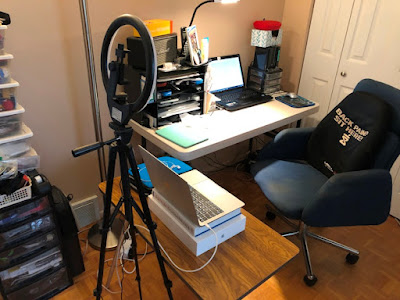
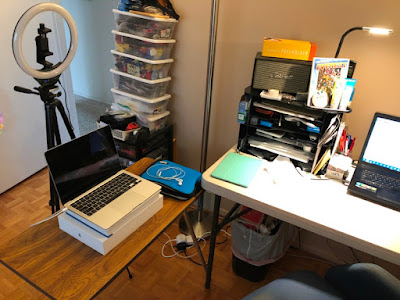
During the pandemic, I upgraded many of my equipment. I replaced my old MacBook Air with the new M1 MacBook Air (so much faster!), and added a few other accessories to enhance my synchronous session, including a ring light. Here's a look at my current setup (and yes, I do have two different notebook computers that I use frequently).


I think that as far as the quality of my video during Zoom, we are good! I had students who told me that I look like one of those TV news readers. I hope they were referring to my video quality rather than how droll and dry my presentation was. 😁

While this is all well and dandy, my skepticism of online/remote learning has not gone away. This is especially true in terms of assessment. I still believe that online cheating is too easy and too rampant. I had to work extra hard in reducing (not eliminating) the chances of cheating during my exams. Forget about using questions given by the textbook publishers because those can easily be found online, especially on Chegg. All of my exams are questions that I had to formulate on my own. And it never fail to amaze me how a student who scored 20/20 on a homework will crash badly in an exam that contained questions similar to that found on that homework. And yes, I have found questions that I had formulated in an exam given just a few weeks before now appearing online verbatim, even including the sketch that I made. It means that I can't even recycle my own questions in future exams.

I am aware that there are several proctoring method that can be done with remote learning, but many of them sound rather creepy and Big-Brother-ie to me. I do not want those things installed on my computer, so why should I force my students to have them. The way I reduced the degree of cheating in my exams is to inform the students in advance that all the exams will have limited time, will open only within a certain period of time, and all the questions will be out of my head. With this, I hoped that they will realize that even if they copied from other sources to do the homework, they will at least try to understand what was done in the solution rather than doing a blind copy. I've only had limited success so far with this.

As 2021 closes, it looks like I will have to start appearing on campus. The labs will now be done f2f while the rest of the instruction will still be done remotely. I also have the option of having exams done in class rather than remotely, so maybe that will eliminate issues of cheating with the exam. What is different now than in March 2020 is that I no longer have that apprehension of teaching remotely. While I will continue with my own personal and professional development as an instructor, I think that I am now well-equipped to handle remote instructions. During these past 20 months, I've acquired both the skills and the technology to deliver lessons online effectively, even if I'd rather things go back to the way they were (don't we all?).

Happy New Year, everyone!

Zz.


Monday, December 20, 2021

You Might Get $50 Had You Read This Professor's Syllabus

The amusing story going around right now is the report on CNN about a professor hiding an information about how a student could get $50 if he/she read his course's syllabus and found the instruction on where to find the money. At the end of the semester, when the professor went back to the money's location, the $50 was still there!

The hint read: "Thus (free to the first who claims; locker one hundred forty-seven; combination fifteen, twenty-five, thirty-five), students may be ineligible to make up classes and ..."
 
This would have led students to a locker that contained a $50 bill, free to the first student to claim it.
 
But at the end of the semester, when he went to check the locker, the bill was still there.
 
Frankly, I'm not surprised (is anyone surprised by this?). I've always assumed that students do not read the syllabus given to them at the beginning of the semester. This is why (i) I go over the syllabus on the first day of class where I point out the important parts of it, and (ii) my first quiz of the semester requires that they find the answer from the syllabus itself (i.e. "What date is Exam 2?").

I put out a very detailed syllabus. Major parts of it are dictated and required by the school. But other  parts include important requirement on what they students must do. I also include a detailed calendar of when topics or chapters of the text will be covered, what are due each week, and when the exams are scheduled. Basically the entire semester has been laid out at the beginning. I find this to be extremely useful after we went remote, because it became very clear on what tasks and assignments the students have to complete each week and when they are due. They did not have to contact me for most of the questions they had about the course.

However, it isn't unusual for me to still get, in the middle of the semester, students asking when the next exam will be held, what is the weight given to homework, etc.. etc., all information that the students can find in the syllabus. I often tell them that these are all information that they could find in the syllabus, and only then do I give them the answers.

Now, to be fair to the students, because of all the stuff we have to include in the syllabus, it has gotten rather long. With the course scheduled and the course learning outcome and student learning outcome all included, my syllabus for this Fall 2021 is 13 pages long. I can certainly understand if a student just does not have the patience to read every minute detail of the document, which is why I spend that first class of the semester going over the important highlights that they must know or be aware of. I can certainly see why this professor got his $50 back if the information is buried somewhere in the many pages of information. But then again, he could also have buried it in between some very pertinent piece of information.

If you are a student, the moral of the story here is that, no matter how tedious and unimportant it seems, just spend some time readying the syllabus. It gives you an important overview of the course, and maybe even what the instructor expects out of you. Who knows, you might be lucky enough to find some lunch money!

Zz.

Sunday, December 12, 2021

Impact of community masking on COVID-19

I find legislation that prevents mask mandates or requirements to be extremely irresponsible and abhorrent. These are made without regards to public safety and in contradiction to overwhelming scientific evidence that showed that wearing proper mask is one of the most effective means to reduce the risk of the spread of COVID-19.

I have presented several posts on this blog on the various scientific studies in support of this. Now comes another one that leave no doubt on the effectiveness of masking in reducing the virus transmission. This was very recently published in Science (a very prestigious and difficult journal to publish in, if you don't know this already), and is done across several villages and on a population of more than 300,000 adults in Bangladesh.

We designed our trial to encourage universal mask-wearing at the community level, rather than mask-wearing among only those with symptoms. We encouraged even healthy individuals to wear masks since a substantial share of COVID-19 transmission stems from asymptomatic or pre-symptomatic individuals, and masks may protect healthy wearers by reducing the inhalation of aerosols or droplets.

When you read this paper, keep this in mind. It is one thing to show scientifically of how masks reduces the spread of aerosols from our mouth and nose. This has been shown clearly and without any doubt base on the many publications and studies that I have highlighted so far. But it is another to show that it does have an impact STATISTICALLY when applied to large population. This latter part is more difficult because it involves a lot of variables. It is why this latest study is very important because it is one of the larger sampling of human population involved in masking (or lack thereof) to reduce the spread of the virus.

The sign of a valid idea is that the more you study it, the more convincing it becomes. Pseudosciences lack this kind of progression, where they continue to struggle getting to First base to prove that such-and-such even exists. In the case of the effectiveness of wearing proper mask to reduce COVID-19 transmission, the more we study it, the more the evidence we gather to point this to be valid, that wearing mask has been shown unequivocally to reduce the risk of the virus transmission.

Zz.

Tuesday, November 09, 2021

Teaching Physics Using "Anchor Equations"


I've only started reading this paper, so I haven't fully digest everything that was written, but I thought I should pass this on and maybe we can all read this together.

The author is presenting a way to teach intro physics lessons using a set of what are called anchor equations

An important step in learning to use math in science is learning to see symbolic equations not just as calculational tools, but as ways of expressing fundamental relationships among physical quantities, of coding conceptual information, and of organizing physics knowledge structures. In this paper, I propose “anchor equations” as a construct to support teaching and learning in introductory physics. I define anchor equation, provide examples, and suggest ways anchor equations can be used in instruction to support the development of students’ mathematical sense-making.

I don't know if I'm doing something similar, but I don't have what I call as "master equations", in which these are a minimal set of equations as starting points, and where other equations are derived from. Newton's 2nd law (F = ma) is certainly one of my master equations. However, I don't think my line of thought about this is as well-developed as the author's, who actually used this as a central hub in understanding the physics relevant concept.

Definitely something I need to read more carefully.

Zz.

Saturday, September 11, 2021

Getting Students To Turn On Their Video Camera During Zoom

While many schools are back to in-person classes, there are still many courses being offered online due to the pandemic. In fact, a number of schools had to revert to online classes after severe COVID outbreak on campus. So online lessons are not going away anytime soon for traditional in-person schools.

At the start of the Fall 2021 semester, during many of the meetings I attended with faculty members from my department and other departments, one of the most common "complaints" that I hear was how to get the students to turn on their camera. The school has made it abundantly clear that we cannot force the students to do that, and that turning on their cameras was something voluntary.

Still, many faculty members were having a hard time teaching to "blank boxes" on their screen. They complaint was that they find it frustratingly lonely when they look at their screen and see no faces and no one there at the other end. They also said that they couldn't see any body language to gauge the students' reaction, as if looking at a live Zoom window could tell you the accurate body language of a person.

To be clear, many of the faculty members who moaned about this were from the language/humanities/etc. department. So eventually, I had to say something about this.

What the issue here really isn't about turning on someone's camera or being able to look at a person on the screen. Rather, it is the issue of STUDENTS ENGAGEMENT on the subject matter. When we teach in class, we can judge how much the student is engage in what we are teaching, and there are many face-to-face interactions that engages the student into understanding the material.

We can't do that in an online lesson, be it synchronous or asynchronous. Treating an online lesson the same way as you would a f2f class will suck, as I've said many times. As an instructor, we have to rethink EVERYTHING when we teach things online, because the whole emotional/psychology of things are different.

I told my faculty colleagues from other departments that, if anything, *I* have a greater need to see my students in terms of being relevant to the material being taught, and not just for my psychological needs. I told them that when I teach the topic of magnetic field, such as when a charge particle moves in a magnetic field, we find the direction of the force acting on the charge particle using the cross product depicted by the so-called "right-hand rule". When I taught this in class, I can see how the students were lining up their right-hand and how they "curl" their hand to finally look at their thumbs to show the direction of the force.

So here, there is a direct and academic need to be able to see what the students are doing, and not simply just for my benefit. Thus, if anyone here has a greater claim to want to see the students during a lesson, I argue that it would be me. Yet, I make no such requirement to the students. I told them that if they want me to verify that they are doing the right-hand rule correctly, they should consider turning on their cameras, and that was it. I don't bemoan the situation that I couldn't see my students, etc. and it somehow made it feel "lonely" or as if I'm talking to nobody. It isn't about me. It is about the students!

I think that a lot of people do not realize the extra and unique challenges of teaching STEM subjects remotely/online, and this includes non-science administrators and faculty members. STEM faculty members should make their voices heard more often, and be involved in the relevant committees so that we don't get left out in course design, etc. Otherwise, a lot of things that they think will work, won't for the courses that we teach.

Zz.

Wednesday, September 08, 2021

Is 1/3 smaller than 1/4?

I'm sorry if this is old new, but I just found out about this recently.

I read a rather amusing account on why A&W 1/3 pounder lost out to McDonald's quarter pounder, even though they were both at the same price.

Confused why A&W's burgers weren't able to compete even though the burgers were priced the same as their competitors, Taubuman brought in a market research firm. 

The firm eventually conducted a focus group to discover the truth: participants were concerned about the price of the burger. "Why should we pay the same amount for a third of a pound of meat as we do for a quarter-pound of meat?" they asked. 

It turns out the majority of participants incorrectly believed one-third of a pound was actually smaller than a quarter of a pound. 

I hate to say it, but this is no longer surprising to me. I look back on my take on the public's understanding and perception of science, technology, and math, and the dismal state seems to have persisted. Nothing has changed. In fact, when I said this back in 2010 .... 

As scientists, we cannot forget this, because it explains the fickleness in the support that we get. That overwhelming support that is there one day can easily go away the next day, and not because of some scientific evidence, but possibly because someone else has better bells and whistles.

... I just never expected it to be illustrated so glaringly during the past few years. Many in the public do not have the ability evaluate the validity of a claim or evidence, and science can easily lose its support because someone else has a more attractive message, even without any valid evidence.

What are the odds that this is the root cause of our debacle today?

Zz.

Wednesday, August 18, 2021

Why You Need To Wash Your Hands For 20 Seconds

Finally, the reason why we should wash our hands for a minimum of 20 seconds has a physics explanation.

The research work was published in the Physics of Fluids journal, which so far has been quite an active journal in publishing papers related to the physics of the coronovirus transmission, making them available widely to the public.

Zz.

Wednesday, August 04, 2021

Quantum Mechanics and the Double-Slit Experiment

The double-slit experiment continues to be of interest with respect to quantum mechanics, even after so many years. I've mentioned about this many times, with this one being the most relevant here to this particular post. And note that I made that blog entry back in 2013!

This time, Don Lincoln of Fermilab has released a video on the topic of the double-slit experiment and how it is relevant to QM.


BTW, has he lost weight? If he has, I hope it is on purpose and not due to an illness.

In any case, watch the video and check out the link that I gave. This issue doesn't look like it will be resolved anytime soon unless some new experiment comes up.

Zz.

Saturday, July 24, 2021

Keeping Online Teaching Techniques For In-Person Classes

Fall semester 2021 is looming, and many schools are going back to in-person, face-to-face classes, at least here in the US. The pandemic that caused us to teach remotely has forced many of us to hone our skills as instructors and adapt them to the online environment. I mentioned earlier how I decided to enroll myself in an online program to get certified by my institution as a qualified online instructor. I had no intention of wanting to be an online instructor, but I wanted to take these courses because I needed to learn the important skills and methodology of being an online instructor because, whether I like it or not, and whether I want to or not, I was going to be delivering my lessons online. And I did, for the next 3 semesters (including summer).

The thing is, my training as an online instructor may actually have improved my overall skill as an instructor, even for an in-person setting. There are many important lessons that I learned from that training program, and I fully intend to use many of them when I go back to in-person teaching. What brought this article about was a discussion I had with a few of my colleagues on whether we will use any of what we learned from the online training courses when we go back on-site. All of us unanimously said yes.

So here, I want to outline a few of the things that I had used in my online/remote classes that I will continue to use in my in-person classes.

  1. Remote office hours. God yes! I no longer see the need to have specific office hours at a specific location. Oh, I am still going to publish one office hour on-site, but the other office hour will be via Zoom that students can drop in remotely. Not only that, I'm going to make it very flexible for students to make an appointment to see me via Zoom at almost any time of the day if I'm available. Students are no longer restricted to seeing me only when they are on campus.
  2. More extensive use of the Learning Management System (LMS). Before the shutdown, I have been using the LMS to record grades, to post announcements and the course syllabus, to upload my lecture notes, and for the students to submit their lab documents, etc. However, now, I will make even more use of the LMS after what I have learned from online courses. I will continue to use the discussion feature, although not as extensively as I did for the online classes. I find that students who are either shy or do not actively participate in person, often make more use of the discussion feature in their participation with the class. This discussion feature could be an extension of the labs, where students get to give their opinion on the experience of a particular experiment, or what they expected or didn't expect.
  3. Related to the LMS, I will keep the design and layout of the LMS page based on what I've learned from online courses. This was the biggest cosmetic and design change that I have adopted. Having weekly module that contains EVERYTHING that a student needs to do and finish that week makes so much more sense now. The surveys that I had done seem to indicate that this is highly successful and that students were able to navigate the LMS and find everything that they need easily.
  4. Before the pandemic shutdown, I was running a flipped classroom, so I was already making use of online lessons, videos, etc. I was also using clickers for the polls and a form of peer-instruction during my lesson. I adopted this for my online lessons. So this won't change when I go back to in-person classes. However, it think that I want to add a lot more video lessons that students can use as additional resources for when they are out of class. It just means that even when they are not in class, they will be able to review the lessons of that week via other means and other sources. 
  5. One of the most important aspect of online courses is student engagements. It is crucial because this is one of the most difficult thing to accomplish in online classes, and yet, it has been shown to be an effective means to convey the lesson and get a student interested in it. This is not that big of a deal for in-person classes because, well, the students are there and you can engage them with via many things in class. However, I want to formalize this engagement even when it is easier to do during in-person classes. Before the pandemic, I was already running what I would call "Studio Physics" classes, where the students have frequent discussion when other students, and even perform the demonstration of certain physics phenomenon themselves as part of the lesson. I want to increase this even more. While I had used web applications such as the ones from PhET, I want to use more of these so that they become on-going "projects" for them to investigate outside of class hours. During the past year and a half, I found a lot more websites having many different physics online simulations, "labs", and other applications that had used in my online courses. I found many of them that would be very useful to assign to students even in an in-person class. Again, a lot of this could be part of their discussion task where they discuss and report what they learned or discovered while using these web apps.
  6. Clearer, more extensive and detailed feedback. In an online course, student and teacher often do not interact either live, or often, and feedback often does not come fast and quick, unlike in-person interaction. So feedback on something, especially on an assigned and graded task, must be as clear and complete as possible that first time. This includes the tone of the feedback where we were told be mindful of how the feedback might be perceived by the student. While this may not be as crucial in an in-person environment, I still intend to make full use of the feedback feature on the LMS to give a detailed assessment on a student's work. I think that having it in writing makes it more concrete and gives the student a clear and more permanent evaluation, especially if it involves something done online such as the discussion forum.

I'm glad that I got the training that I needed to be an online instructor, even when I have very little desire to be an online instructor. The skills and technique that I learned were valuable, and in some ways, I hope it made me a better teacher both during this remote-learning phases, and when I go back to in-person instruction. We shall see if this is the reality for in-person instruction soon enough.

Zz.

Wednesday, July 21, 2021

10 Scientfic Evidence In Support Of Airborne Transmission of SAR-CoV-2 Virus

The ridiculous battle during the pandemic on wearing masks, social distancing, and other restrictions reveals the lack of understanding among many in the general public on how science works, on what is considered as valid scientific evidence, and how our knowledge progresses as more and more evidence and data accumulates. I continue to be amazed at the reasons why some people still resist wearing proper face masks. I can understand if they find it uncomfortable (who does?) and that it is inconvenient (who thinks otherwise?). However, if the reason given is that masks doesn't do anything or isn't effective in reducing the chances of the virus being spread, then I want evidence to back that up.

This is where the public lack the understanding of (i) the nature of valid, scientific evidence, versus simply something you read on Facebook, news websites, or even from talking heads on TV, (ii) where to find such evidence or what should you pay more serious attention to versus those other sources that I mentioned. Here, I want to contrast the type of information that is contained in a scientific paper versus what you find in news article or many public online websites.

(1) When you read something in the news on a typical mass media source, you are told the content, but very seldom are you given proper, exact citation. At best, the type of citation that would be mentioned would be something to the effect that this was published in such-and-such journal or book, etc. Worse still, often times the sources are not even cited, so many of these things are stated as if they are facts, and facts that many of us are unable to verify on our own, if we wish to.

In contrast, scientific publications require exact citation. If you say that this result is in agreement or support by recent discoveries, you must give bibliographical references to those sources, i.e. name of author/s, name of journal where it was published, what page/volume number, date it was published, etc. These details are crucial in someone else verifying the sources of the claim. This is what is often missing in many general public articles, and unfortunately, this is often the source of Fake News, because exact evidence and sources to back the claims are either bogus, unreported, or unrevealed, which prevented anyone from double-checking their validity.

(2) News report and online articles often ignore contradicting evidence. When someone claims that he/she got sick after receiving a vaccine shot, why doesn't he/she consider why a lot of other people didn't get sick? Of if receiving a vaccine shot makes one "magnetic", how come other people aren't? This can also be applied to a lot of "news" programs that reports on certain occurrences that was due to something, but ignore other instances where those occurrences do not happen.

In scientific papers, this is a no-no. In fact, as a referee for several physics journals, I often will check if the authors are ignoring contradicting experimental evidence, or other papers that may be in the opposite to what the authors observed or claiming. These contradictions MUST BE ADDRESSED, i.e. they are not swept under the carpet or just ignored. And they must be addressed in terms of scientific reason, not simply by claiming that the contradicting results were made by Democrats, Republicans, Muslims, Jews, liberals, conservatives, etc. Look at how many so-called discussions or reports attached labels as a means to dismiss something. Such flimsy tactics do not wash in scientific papers.

(3) General public articles and news lacks details and clarity. I read a news article last year where a family decided to go to Walt Disney World in Orlando, FL, and when they got home, they tested positive for COVID-19 and immediately blamed their presence at the theme park for being infected. The news article didn't mentioned any other details about their trip. It did not say if they took a plane, didn't not say how long they stayed, whether they only went to the Disney theme park or did they also went elsewhere, and if they drove there, did they stop anywhere along the way, etc. There was a huge amount of information here that was missing even for a casual reader to be able to clearly analyze the validity of what the family was claiming.

If this claim is to be analyzed scientifically, then an epidemiologist would need to do really detailed tracing of every activity that the family did. Casual and speculative connection between A and B are usually insufficient to draw up valid conclusions.

In a scientific publication, every detailed of a calculation, every detail of the experiment, and every detail of how the analysis was done, must be clearly revealed. Often times, the experimental setup and equipment may had already been published elsewhere, and those will be cited as a reference. Similarly with the calculation and analysis. These details allow for an independent investigator to not only double-check what was done, but also to duplicate the experiment if necessary to see if the results are reproducible, which is a pillar of all scientific experiments (and why the Fleishmann and Pons cold fusion claim failed).

(4) Scientific papers are permanently recorded. They are not like Twitter feed that can be deleted, or news article that may be difficult to find anymore, or Facebook postings that have disappeared. This allows for future citations by other papers, and allows for continuing evaluations, advancements, refinements, rebuttals, contradictions, etc. There is a clear paper trail of who said what and when, which means that it is hard to deny or lie about something, or claim that someone didn't say that or didn't do that.

The whole point in all of this is not to force you to read scientific papers. It is ridiculous to insist that because many of them are not easy to read and are written for other experts. Rather, it is to distinguish on the nature of the evidence, and that if something is backed by proper scientific sources, then the evidence has a greater degree of validity and support than something that someone just rattled off on a TV talk show or on some Facebook post. It is unfortunate that many people, especially politicians, give equal credence to someone testifying that their bodies became magnetized without bothering to invite an expert to debunk such silliness. It seems that whole topics in physics, biology, and physiology were ignored to give air to this craziness.

It is the inability to evaluate the validity of the so-called evidence is one of the fundamental reasons why we are in the state that we are in today.

"But ZapperZ, the topic is about the scientific evidence for airborne transmission of the COVID virus.  Where is it?", you asked.

Good question. I guess this is the long, circuital route to point you to this Lancet article that contains the evidence, and the references to the scientific papers, that support the claim. Compare the types of research that were done, the analysis that were performed, and how the conclusions were drawn, and compare that with the types of "evidence" presented in the popular media and TV news programs.

Have fun reading!

Zz.

Thursday, July 01, 2021

Using Science To Teach Students In The Art Of Falsifying An Idea

The climate of fake news and anti-science during the last few years have given me the impetus to be more conscious and deliberate in alerting my students on how we analyze something, on making rational judgement based on evidence, and how we come to such-and-such conclusions. To me, the issue of believing in fake news and accepting something based on flaky evidence does deeper than what it seems. It boils down to the inability to systematically and analytically evaluate the validity of something. This inability is really a serious issue and could be the root cause of what we are seeing today.

This type of skill is exactly what we use and practice all the time in science. So when I get a group of students, especially if they are non-science students who are taking the course only to fulfill their science credits, then I can't waste the opportunity to instill in them this invaluable technique and methodology that are often used in science.

Using the period where the pandemic forced us to teach remotely, I made extensive use (and still do) of the discussion forum. This is one form of student engagements that many online training courses have deemed to be essential in making sure that students feel connected and engaged with not only the subject matter, but also with other students. This medium gave me the opportunity to get the students to think things through and to present logical and rational arguments.

One of the topic that I presented was to require them to critically address a belief about the cause of the Earth's four seasons. We were going over the reason why we (at about latitude 41 degrees North) experience seasons. I presented a topic whereby someone claims that since the Earth orbits the Sun in a slight elliptical orbit, the seasons are caused by the varying distances between the Earth and the Sun, meaning that when the Sun is closest to the Earth, we have summer, and when the Sun is farthest from the Earth, we have winter.

The task was for the students to come up with typical and common everyday observations and/or knowledge to show why this idea is wrong. In other words, find a very direct and convincing way to falsify the argument.

I thought this was a straight-forward assignment and discussion topic. Unfortunately, I was quite surprised that almost 3/4 of the students didn't fulfill the briefs. What they did instead was to give the explanation for the cause of the seasons, which is the tilt of the Earth's spin as it goes around the Sun. While this is the correct explanation, it does not falsify the original argument. I tried to tell the students that what they did was to present to this person an alternative explanation on why the seasons happen, but they haven't shown evidence why the original premise was wrong! They have not falsified the first idea.

When we do that in an argument/discussion, the person who holds that idea can easily say "All you have done is showed another possible explanation. You haven't proven to me why my idea is wrong. So why should I change my mind?"

Providing an alternative explanation, even if it is the correct one, is distinctively different than falsifying an idea. In falsifying an idea, you do not need to actually have an alternative, correct explanation. In this case, you really don't need to know that the Earth's tilt is the cause of the seasons on Earth. All you need is to examine the original claim, and find evidence that contradicts that claim. In this case, what you can do is assume that it is true, that the seasons are caused by Earth's varying distances from the Sun. If that is true, then the entire Earth would have the same season at the same time of the year, because the entire Earth is at the same distance away from the Sun. Yet, it is common knowledge that Australia, New Zealand, South America and Antartica are in their deep winter freeze while we in the Northern Hemisphere are basking in our summer heat. This observation is clearly contradictory to the original claim, which means that this is a falsification of that idea. It carries no other "baggage", i.e. it doesn't promote an alternative explanation on the cause of Earth's seasons.

It found it challenging trying to convey this message to the students. They learned about the Earth's tilt and the cause of the seasons, and when they were given this topic, they immediately jumped on providing the explanation that they just learned (and understood) without thinking about how to actually address the topic of the discussion and knowing the difference between falsifying an argument versus providing an alternative explanation.

Sadly, the same situation happened again later in that semester when I brought another scenario for them to address: the claim that the phases of the moon are due to Earth's shadow of the light from the Sun. Once again, they were asked to falsify the claim, and once again, more than half of the students provided an alternative explanation on the cause of Moon phases rather than falsifying the idea.

In teaching science courses to non-science majors, I've grown more skeptical about the public's ability to analyze something. What I have observed regarding the "controversy" surrounding vaccines, the wearing of face masks, and even climate change, reinforced my skepticism about someone 's ability to either think things through, or even know what a valid evidence is. My post on the nurse who claimed that the COVID vaccine makes her becoming magnetized is one such example. Something that should have been easily checked and verified by a high-school physics student now somehow is gaining traction. That claim can be easily falsified (and have been), even by people without much scientific training and without knowing any alternative explanation on why certain objects might stick to one's body.

It requires skills to look at an idea, analyze it thoroughly, and rationally argue on its validity or its fault. It also requires skills to know what are valid evidence and what are not. Often times people confuse opinions and conclusions with facts/evidence. Talking heads on TV often spew out opinions that a lot of people mistaken for facts. In a science class, it is more important than ever that instructors make a deliberate effort to show the process of how a scientific idea becomes accepted, what kind of evidence would be considered to be scientific (why do we have to measure the forces at various extensions when just one is sufficient to find the value of the spring constant in Hooke's law experiment?), and how to challenge an idea and show that it may not be correct.

A science education is now more important than ever, not just for the scientific content, but also for the skills that come with it.

Zz.