Wednesday, October 16, 2013

Light Ties The Knot

An amazing theoretical advancement on a very old and well-established set of equations.

Physicists have found a very interesting solution to the well-known Maxwell Equations, one in which can form light into interesting geometries and knots.

In the late 1980s, a researcher discovered exact solutions of Maxwell’s equations in free space (containing no electric charge) with the odd property that every field line formed a closed loop, and each loop was linked to another. This structure is called a Hopf fibration, which has been found in other places such as liquid-crystal physics (see 3 June 2013 Viewpoint). Kedia et al. now go a step further with their discovery of exact solutions that are both linked and knotted: the field lines are tied around each other inside a torus.

More coverage and explanation on Physics World.

Identified by Hridesh Kedia at the University of Chicago, along with colleagues at the Polish Academy of Sciences in Warsaw and the Spanish National Research Council in Madrid, the new family of solutions to Maxwell's equations have field lines describing all "torus knots" and "links". Torus knots are those knots that can lie on the surface of a torus, whereas a link is a collection of such knots.

One solution involves magnetic-field lines that trace out a familiar "trefoil" knot around a torus that is aligned in the plane perpendicular to the direction of propagation of the light (see figure). As the light propagates, the knot is distorted but retains the topological property of being a trefoil knot. The electric-field lines have the same structure as the magnetic-field lines but are rotated about the propagation axis by an angle that depends upon the knot. Other solutions include cinquefoil knots and linked rings. 

Still plenty of surprises and interesting solutions out of the old equations!

Zz.

Tuesday, October 15, 2013

Paper Isn't Dead Yet

.. and no, I'm not referring to this hilarious video either! :)

Anyone who has followed this blog would have known that I'm all for new technology if it actually has a beneficial effect on what we do. I mentioned a while back of trying to use tablets instead of papers in an undergraduate intro physics labs. I think this is possible, and certainly something we should expose the students to, considering that by the time they enter the job market, these technologies will be ubiquitous in their will place.

However, I find that, in some cases, I still prefer the old-fashion paper. This has nothing to do with being stubborn and wanting to do it in ways that I'm familiar with. Rather, it has more to do with convenience. The one area that I still prefer to have a printed copy in my hands is when I referee/review a manuscript.

What I like the most about having a paper copy is that I can more easily write comments on the paper itself. This is actually not that convenient to do on a tablet. While there are apps that allow you to write on PDF documents on a tablet, I still do not find a standard tablet large enough to accommodate a substantial amount of comments/annotations/etc. Besides, the typical stylus that one use with a tablet are not as responsive as a pen-on-paper combination.

The other aspect of paper-refereeing where paper trumps over electronic version is when I have to keep on referring to figures or tables. Let me explain. A typical manuscript that I often get to be reviewed are often typed double-spaced, and the figures, tables, and captions are grouped at the end of the manuscripts. They are not imbedded within the text. This is because the typesetting will be done by the editors after the manuscript has been accepted for publication. So what usually happens is that when I read a reference to a figure or a table in the text, I often have to go back and forth looking at the figure and reading the relevant text referring to that figure. It is tedious to do electronically. One can lessen the effort on an actual computer where one opens more than one window to display the same manuscript, so that in one window, one has the text, and the other window one can display the relevant figure. So in this case, one only need to switch between windows. But try to do this on a tablet! Oy vey!

What I often do is to print a copy of the manuscript to use to read the text, but also display the manuscript on my iPad by showing the figures. This way, I can read the text, and look at the relevant figures on the tablet. I find that to be the most convenient. Still, the hard-copy print makes it a convenience.

Do you still use paper copies? In what way?

Zz.

Monday, October 14, 2013

The First Physics MOOC From MITx

This is a rather interesting article for anyone interested in online physics courses. It is a report on MIT's first Massive Online Open Course.

Abstract: Massive Open Online Courses are an exciting new avenue for instruction and research, yet they are full of unknowns. In the Spring of 2013, MITx released its first introductory physics MOOC through the edX platform, generating a total enrollment of 43,000 students from around the world. We describe the population of participants in terms of their age, gender, level of education, and country of origin, highlighting both the diversity of 8.02x enrollees as well as gender gap and retention. Using three midterm exams and the final as waypoints, we highlight performance by different demographic subpopulations and their retention rates. Our work is generally aimed at making a bridge between available MOOC data and topics associated with the Physics Education Research community.

I am still not sure how effective such a course is when compared to the traditional method of brick-and-mortar classrooms. Certainly, modern advancement inevitably will expand the way we all attend classes beyond the common practice. Still, based on the conclusion derived from this study, such a course may still not be suitable for first-time learner.

Our analysis of retention points toward the possible outcome of 8.02x being better suited for advanced degree holders versus college undergraduates. Some MOOCs have realized the importance of designing courses for population with education beyond a bachelor degree (e.g. a MOOC targeting high school physics teachers


Zz.

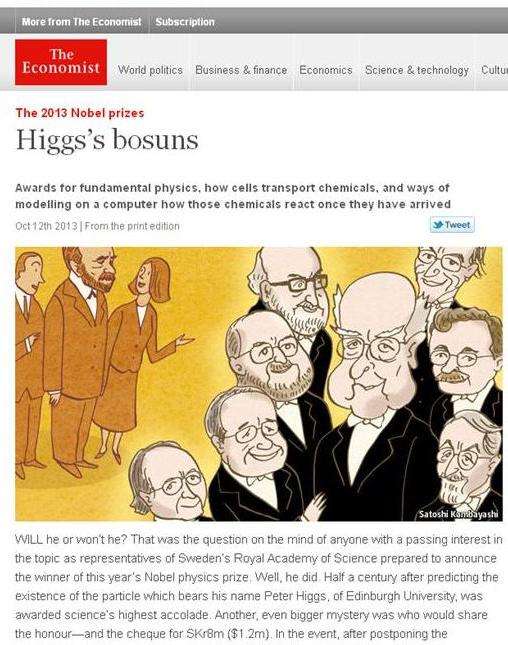
The Higgs Bosuns?

One sometimes wonder if news outlets have done away completely with copy editors, who should catch obvious mistakes and typos such as this.

This morning, while browsing through the news, I stumbled upon the Economist page reporting the Nobel Prizes, and had a chuckle with the title line read "Higgs's Bosuns". Maybe this is on purpose, I don't know, because the rest of the article had the correct spelling. Still, there's nothing in the article to imply anything about Higgs's "bosuns".


Zz.

Tuesday, October 08, 2013

2013 Physics Nobel Prize

So it is not a surprise at all that this year's Nobel Prize in Physics goes to two theorists who were the prominent figures in the development of the Higgs mechanism.

The 2013 Physics Nobel Prize has been awarded to two physicists who were instrumental in developing the theory that helps explain the origin of mass of elementary particles and predicts the existence of the Higgs Boson discovered last year. The prize, which recognizes the contributions of François Englert (Universite Libre de Bruxelles) and Peter Higgs (University of Edinburgh) for the theory of broken symmetry in electroweak physics, echoes the announcement of the 2010 American Physical Society’s J. J. Sakurai prize, which was awarded to the two Nobel Laureates as well as four additional physicists who made comparable contributions to the symmetry breaking work.

The link above also gives you access to free copies of the two relevant papers.

I think that the Nobel committee might be reserving another round to award the Nobel Prize for the experimental discovery.

Zz.

Thursday, October 03, 2013

Accelerating Charge Particles Using Visible Light

This accelerating scheme should see a large interest after this proof-of-principle demonstration. Two separate papers are showing the feasibility of accelerating electrons using the E-field from visible light, as opposed to the RF fields used in a typical accelerating structures.

Two teams now report rapid acceleration of electrons using small silica structures to shape light fields into patterns similar to those in a linear accelerator. In both of the experiments, the researchers sent electrons skating just over a silica surface that contained narrow grooves in the direction perpendicular to the electron beam. They then shined ultrashort laser pulses directly onto the surface (called a grating), which generated a pattern where the electric field was alternately enhanced and diminished in neighboring “zones” just above the surface. This pattern of fields reversed direction twice during every oscillation cycle of the laser light and could accelerate electrons (see YouTube video).

Here's the YouTube video:


Of course, with any initial advancement, there's still plenty of work to do. For many applications, getting to higher energy alone isn't the only issue. In FEL's, for example, the emittance of the beam is equally crucial. So accelerating scheme such as this must show the ability to not cause an emittance blow-up. The other issue that is often critical is the question on how much charge per bunch that can be accelerated. For many applications, the standard "high-brightness" beam requires a 1 nC per bunch charge. So the scheme must be able to handle beams of that magnitude without sacrificing the quality.

Still, this promises to be another exciting avenue for future accelerators.

Zz.

Tuesday, October 01, 2013

US Particle Physics Community Plans For The Future

As the US govt. starts its shutdown due to the US Congress's lack of ability to do the work they were elected to do (how come we don't dock their pay when they can't come up with a budget on time?), we have a report on the last "Snomass on the Mississippi" workshop by US Particle Physicists in prioritizing the different projects that US particle physicists should be involved in. It is a rather challenging task considering the severe budget cuts and constraints being put on science funding in the US as a whole, and on high energy physics in particular.

As stated at the end of the article, the US has lost its "leader" status in high energy physics. That's gone, and if the ILC is built in Japan, and funding continues to be dismal due to the political bickering by the dimwit politicians, then I don't see it coming back. I do not see the LBNE, even if it is built to its original specifications, getting the same global interest and status as the LHC and the ILC, certainly not in the public's eye.

Zz.

Monday, September 30, 2013

How To Destroy A Magnet

Besides learning how to destroy a magnet, you get to learn why certain things are magnetic, or can be magnetized.


Zz.

Saturday, September 28, 2013

Nanoscale NMR/MRI? Why, Yes We Can!

An amazing improvement in science technology and instrumentation. A new paper reports on the recent achievement of performing NMR on nanoscale size targets. You can also read the paper for free since it is published in the new APS family journal Phys. Rev. X. The one interesting aspect of this journal is that it includes a "Popular summary" of the paper that has been published. The popular summary accompanying this paper is this:

Tuesday, September 24, 2013

Any Guesses For 2013 Nobel Prize In Physics?

As the leaves turn color (at least here in the higher latitude in the Northern Hemisphere), the thoughts of many physics academics and professionals turn to Sweden and guessing at who will win this year's Nobel Prize for physics.

The obvious front runner is anything related to the Higgs. It's confirmed discovery this year means that it will not be a surprise if the award goes to people related to it. Questions remains on how they will be honored, considering that only a maximum of three individuals can be awarded the prize at any given time. Will they honor the theorists and the experimentalists in separate years? After all, there are already at least 4 deserving theorists who could easily be given the honors for formulating the Higgs mechanism, and the number is even larger for leading the experimental discovery of the Higgs.

The outcome of this will be very interesting. Or maybe the Nobel committee will forgo awarding the prize for the Higgs another year, and go with some other discovery in physics. That will be a fascinating surprise in itself!

:)

Zz.

Friday, September 20, 2013

When Belief Trumps Scholarship

The most significant argument against Creationism/Intelligent Design is that the proponents of these beliefs tends to try to find faults in existing concept of evolution, but without providing evidence of their own in support of their beliefs. The most often line of attack by these people is what we often normally refer to using the concept of "god of the gaps", where one tries to find some evidence or observations that defies current scientific explanation.

The problem with this, of course, is that these "gaps" often continue to shrink over time, and as our understanding of the world around us expand and improve. The ancient civilization used to think that the moving clouds, the eclipses, the ebb and flow of ocean tides, etc., were all due to some act of gods, because they didn't have any knowledge of what caused them. Now, we know better and these events are no longer mysterious or mystical.

And that's where we come back to the ID crowd. More often than not, they lack the necessary scientific evidence to strengthen their arguments. And when they try, the only people they could convince are people who really are not well-equipped to actually decipher the science. This appears to be the case of the latest book titled "Darwin's Doubt" written by Stephen Meyer, who runs the Discovery Institute. He's a non-biologist, who is trying to argue that the rapid explosion of animal phylia in the Cambrian period cannot be explained via the slow and tedious process of evolution, and thus, via invoking the god-of-the-gaps, points to evidence of an intelligent designer.

Whenever someone brings up a scientific point, it must be countered with equivalent scientific point. And this is exactly what has been done in this case. A review of this book written by UC Berkeley's Charles Marshall in this week's issue of Science (Science, v.341, p.1344 (2013)) did just that. In this review, Marshall pointed out several flaws in the biological/scientific points presented in Meyer's book.

However, my hope soon dissipated into disappointment. His case against current scientific explanations of the relatively rapid appearance of the animal phyla rests on the claim that the origin of new animal body plans requires vast amounts of novel genetic information coupled with the unsubstantiated assertion that this new genetic information must include many new protein folds. In fact, our present understanding of morphogenesis indicates that new phyla were not made by new genes but largely emerged through the rewiring of the gene regulatory networks (GRNs) of already existing genes (1). Now Meyer does touch on this: He notes that manipulation of such networks is typically lethal, thus dismissing their role in explaining the Cambrian explosion. But today's GRNs have been overlain with half a billion years of evolutionary innovation (which accounts for their resistance to modification), whereas GRNs at the time of the emergence of the phyla were not so encumbered. The reason for Meyer's idiosyncratic fixation with new protein folds is that one of his Discovery Institute colleagues has claimed that those are mathematically impossibly hard to evolve on the timescale of the Cambrian explosion.

In other words, this scientific argument doesn't hold water.

Unfortunately, and I can see this happening often, the counter argument to this book will not reach those who should be aware of it. The same with the perpetual argument that evolution violates the 2nd law of Thermodynamics, those who belief in ID will use this as the scientific argument against the evolution of life on Earth, without being aware of the holes in Meyer's book.

But at least now, you know that there is a scientific counter argument to what Meyer has brought up, and you can point to this Science review article.

Zz.

Tuesday, September 17, 2013

Superconductivity And The Environment - A Roadmap

A rather interesting and unusual review article. It describes how superconductivity and superconductors can actually help in improving our environment. As stated in this PhysicsWorld blog, it is an unusual assertion because "... superconductors only work at very low temperatures and lots of energy is needed to cool them.. "

Still, you might want to check out the list of things that have been argued that superconductors can do to help with the environment. The review paper is available for free.

Zz.

Monday, September 16, 2013

Graphene - The Aspirin Of Microelectronics

A while back, aspirin was touted as a miracle drug. Its use beyond just being a pain killer was being discovered constantly, ranging from an efficient blood thinner to prevent heart attack and stroke.

That is why I'm calling graphene as the aspirin of microelectronics. It seems that almost every year we hear more and more use of this miracle material. It's a good conductor, it is very strong, and now, in the latest chapter of what graphene can do, it has been touted as a very efficient converter of light into electricity.

Now the one-atom-thick lattice of carbon has added another string to its bow. Three research groups have independently shown that graphene can efficiently convert infrared light into electrical signals, as part of devices known as photodetectors. As fast and accurate translators of optical data, graphene photodetectors could speed up computers and significantly cut their power consumption. The devices, each with a slightly different architecture, are reported in Nature Photonics.

This performance already rivals that of existing photodetectors. “We’re seeing graphene getting to a point where it can compete with today’s technologies,” says Dirk Englund, a physicist at the Massachusetts Institute of Technology in Cambridge who developed one of the graphene photodetectors. “That’s an important new step.”
I expect it to be able to clean windows soon.

Zz.

Sunday, September 15, 2013

Fermilab's Neutrino Beam Source

Here's a short article on Fermilab's repurposed Main Injector into a neutrino beam source for MINOS and NOvA. The article is OK. It kinda stopped short in describing the mechanism of generating neutrinos (why did it stop at creating pions?) Luckily, it linked to a YouTube video that explains how we get neutrinos at the end of the process.


Zz.

Friday, September 13, 2013

Feynman Lectures On Physics

I just read a note by Mike Gottlieb on the availability of the famous Feynman Lectures on Physics online, for free!

Not sure how long this has been available, but in case you didn't know, now you do!

Now, let me clarify something. I think this book is a classic, and advanced physics students, and graduate students, should read parts of it (or if you have time, read as much as you want). It provide quite a bit of insight into many different physics subjects.

However, as a pedagogical tool to teach physics to new students, I think this book is unsuitable and may be beyond what such students can comprehend. So if you are a freshman, or just trying to pick up some physics, you may still read it, but don't be surprised if you find it rather difficult to learn from. It is one of the reasons why this book isn't a popular intro physics text in most schools.

Zz.

Wednesday, September 11, 2013

The Quantum Quest

Again, I don't know how long this article from Nature will be available freely on the web. So read it while you can. It describes the continuing effort to decipher the fundamental issues surrounding Quantum Mechanics, and the effort to formulate it from some set of axioms.

Over the past decade or so, a small community of these questioners have begun to argue that the only way forward is to demolish the abstract entity and start again. They are a diverse bunch, each with a different idea of how such a 'quantum reconstruction' should proceed. But they share a conviction that physicists have spent the past century looking at quantum theory from the wrong angle, making its shadow odd, spiky and hard to decode. If they could only find the right perspective, they believe, all would become clear, and long-standing mysteries such as the quantum nature of gravity might resolve themselves in some natural, obvious way — perhaps as an aspect of some generalized theory of probability.

Zz.

Monday, September 09, 2013

Cow Tipping - It's A Myth!

What better way to break up the monotony of important advances in elementary particles, of topological insulators, of neutrino physics, etc. then to talk about the myth of cow-tipping! This article in Modern Farmer collects up-to-date info on why this is a myth, including a physics calculation on what it would take to do such a thing, which would make it even more unlikely.

But say our hypothetical cow tippers got lucky enough to get close to a cow at night. There’s still the matter of the brute force needed to get the cow over. In 2005, University of British Columbia student Tracy Boechler and doctor of zoology Margo Lillie ran the numbers on cow tipping. Their findings? There’s no way one person could tip a cow. Two people? Maybe — but not in real world conditions.

“Two could do it in theory,” says Dr. Lillie. “But it’s not going to be easy, and as soon as the cow responds by bracing herself or leaning into you — which she will do — it will be even harder.” Cows, after all, stand on four legs and will quickly shift their weight to a wider, more stable stance if pushed against. And Lillie and Boechler’s calculations are based on an unmoving cow in equilibrium in which slow, steady force could be applied without pushback — an optimum (and unrealistic) state for cow tipping. Pull out your high-school text book and look up Newton’s Second Law: Force equals mass times acceleration. A cow has a lot of mass, and you’ll want to move that mass quite quickly, before the cow can react. Which means you’ll need to generate a lot more force. Per her calculations, that would require at least five, and probably more like six pushers. “It just makes the physics of it all, in my opinion, impossible,” says Dr. Lillie.

There ya go, kids! Don't try this at home, or more accurately, at a farm near you!

Zz.

Wednesday, September 04, 2013

It's About Time

One of the most common arguments that I've seen online is the question on whether time is "real" or is it an "illusion" or doesn't exist. I've addressed this before quite a while back. In fact, that blog entry actually became a "reference" in a Wikipedia entry!

Last week's issue of Science had an interesting article. It is actually a review of Smolin's book "Time Reborn", with the review written by Huw Price (Science v.341, p.960 (2013)). What is interesting about the review here is the impression that I got that, even in philosophical circles, there is really no serious argument on the question on whether time exists or not (it does!). Rather, the question is really on the nature of time.

The differences between the two camps on the nature of time is described in the article:

I’ll come back to that question, but first to the dispute itself, which is one of philosophy’s oldest feuds. One team thinks of time as we seem to experience it, a locus of flow and change, centered on the present moment-“All is flux,” as Heraclitus asserted around 500 BCE. The other, my clan, is loyal instead to Heraclitus’s near contemporary, Parmenides of Elea. We think of time as it is described in history: simply a series or block of events, lined up in a particular order, with no distinguished present moment. For us, now is like here—it marks where we ourselves happen to stand but has no significance at all from the universe’s point of view.

And it brings me to the main point in which the differences really is not about the question whether time exists, or if it is real.

To Parmenideans such as Williams and myself, this attitude is just linguistic imperialism, cheeky and rather uncharitable. Of course we believe that time is real, we insist. (It is as real as space is, the two being simply different aspects of the same fourdimensional manifold.) What we deny is just that time comes carved up into past, present, and future.

You'll notice that the argument that time is as real as space is the same argument that I used in that earlier post that I linked above.

So really, enough of this nonsense on whether time exists or not, or if it is real or not.

Zz.

Sunday, September 01, 2013

Friday, August 30, 2013

The Birth Of Photonic Crystals

If you've read this blog for any period of time, you will have seen that, as many times as I can, I try to highlight the application side of physics. This is because a lot of people who are not familiar with the field tend to think that physics is only the LHCs, the Brian Greenes, the particle physics, the String theories, etc. If I can't contribute anything to physics, I want to at least contribute to destroying such myth.

This is one such example. APS Physics has recently highlighted a landmark paper that marked the birth of the idea of photonic crystals.

Semiconductors and band insulators are material that has a gap in the electronic band structure. On the other hand, photonic crystals have gaps in the photonic band band structure, whereby the material simply does not propagate photons having energies within that gap.

You may read the article to find out what applications such materials are good for.

Zz.